

Regulating office humidity is defined as the active management of indoor relative humidity (RH) to maintain levels that protect employee health, comfort, and building assets. The EPA and ASHRAE both identify 40–60% RH as the accepted standard for occupied commercial spaces. Falling outside this band does not just affect comfort. It drives up absenteeism, accelerates building deterioration, and creates conditions where airborne pathogens survive longer. For office managers and facility administrators, understanding why regulate office humidity is the starting point for every effective indoor environment strategy.
Why regulate office humidity: the core case
The answer is straightforward. Uncontrolled humidity causes measurable harm to people and property. The ideal office RH range is 40–60%, with 40–50% representing the practical sweet spot for daily occupancy. Deviating from this range in either direction triggers a distinct set of problems.
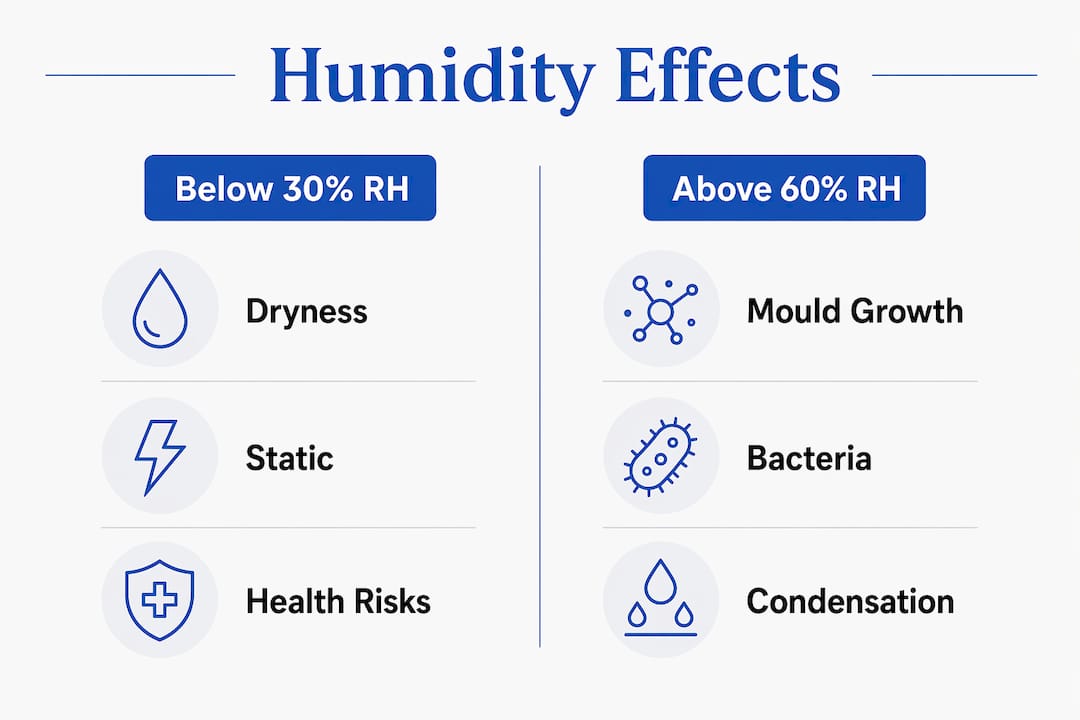
What happens below 30% RH
Low humidity dries out mucous membranes, increasing susceptibility to respiratory infections. Static electricity builds up on surfaces and equipment, which damages sensitive electronics and irritates staff. Timber furniture, paper records, and structural timber elements crack and warp under sustained dry conditions. These effects compound over time and are often misattributed to poor ventilation or seasonal illness.

What happens above 60% RH
Elevated humidity creates the moisture conditions that mould, bacteria, and dust mites require to thrive. Condensation forms inside wall cavities, on HVAC coils, and within ceiling plenums. This hidden moisture is particularly damaging because it progresses silently. By the time occupants notice musty odours or visible mould, the structural and microbial damage is already significant.
The table below summarises the key effects at each humidity band.
| RH level | Primary risk | Affected area |
|---|---|---|
| Below 30% | Dryness, static, cracking | Staff health, electronics, timber |
| 30–40% | Mild irritation, reduced comfort | Respiratory health, occupant morale |
| 40–60% | Optimal conditions | Health, comfort, building integrity |
| Above 60% | Mould, bacteria, dust mites | Air quality, structure, HVAC systems |
How does humidity affect employee health and productivity?
Humidity has a direct, documented effect on how people feel and perform at work. Proper humidity control reduces respiratory symptoms by up to 42%, with corresponding improvements in cognitive function and reduced absenteeism. That figure is not a marginal gain. It represents a meaningful shift in workforce availability and output.
The effects of humidity on productivity operate through several mechanisms:
- Respiratory health: Dry air irritates airways and increases the spread of airborne particles. Maintaining 40–60% RH reduces the persistence of respiratory viruses on surfaces and in the air, acting as a passive health defence for the entire office.
- Cognitive function: Staff working in non-optimal humidity report higher fatigue and reduced concentration. The discomfort created by dry or humid air consumes cognitive resources that would otherwise go toward work tasks.
- Absenteeism: Humidity-related illness, including dry throat, headaches, and aggravated allergies, is a leading driver of short-term sick leave in office environments.
- Occupant morale: Occupants are more sensitive to humidity fluctuations than to moderate temperature shifts. A two-degree temperature change is often unnoticed. A significant humidity swing is felt immediately.
Research also shows that mid-range humidity reduces airborne pathogen survival, which is particularly relevant in high-density office environments where airborne transmission risk is elevated. This benefit extends beyond individual comfort into genuine workplace health safety.
Pro Tip: Install wall-mounted RH sensors in high-occupancy zones such as open-plan floors and meeting rooms. These areas generate the most moisture load from occupants and are the first to drift outside the 40–60% target band.
Giving staff some degree of control over their immediate environment also matters. The GSA’s indoor environmental quality guidance confirms that occupant control improves satisfaction and reduces complaints. Even small adjustments to local airflow or humidity perception can shift morale measurably.
What risks does poor humidity control pose to buildings and assets?
Humidity damage to buildings follows a predictable pattern. It starts invisibly and becomes expensive. Hidden moisture inside walls, ducts, and ceiling plenums promotes mould growth and material degradation long before any surface signs appear. By the time a facility manager identifies the problem, remediation costs are typically far higher than prevention would have been.
The specific risks break down as follows:
- Corrosion of metal components: Elevated humidity accelerates oxidation in electrical conduits, HVAC components, and structural fixings. This shortens equipment life and increases replacement frequency.
- Mould in building cavities: Moisture trapped inside walls or above ceiling tiles creates persistent mould colonies. These affect air quality throughout the building and can trigger regulatory compliance issues.
- Cracking and warping of materials: Low humidity causes timber flooring, joinery, and paper-based materials to lose moisture and crack. This is common in UAE offices during heavily air-conditioned periods when indoor air becomes excessively dry.
- HVAC microbial contamination: Biofilm on HVAC coils and drain pans is a direct consequence of unmanaged moisture. These microbial reservoirs circulate contaminants through the air supply and are difficult to detect without scheduled maintenance inspections.
Pro Tip: Schedule HVAC coil and drain pan inspections at least twice per year. In humid climates like the UAE, where outdoor humidity is high for extended periods, quarterly checks are more appropriate for commercial buildings.
The long-term cost of ignoring humidity control is not just structural. Facilities that allow humidity to fluctuate widely face higher energy bills, more frequent equipment failures, and greater staff turnover linked to poor working conditions. Humidity regulation is a maintenance investment, not an optional upgrade.
How should humidity control integrate with HVAC strategy?
Humidity regulation does not function as a standalone fix. It must be part of the overall HVAC and ventilation design. A common misconception among facility managers is that cooling an office sufficiently will also control humidity. This is incorrect. Dehumidification requires the active removal of moisture from air, not simply reducing air temperature.
Commercial HVAC systems are typically designed to prioritise sensible heat loads, meaning temperature. Latent humidity loads require dedicated management through real-time sensor data and responsive control logic. A system running on fixed setpoints cannot respond to the humidity spikes that occur when a large meeting room fills with occupants or when outdoor humidity rises sharply.
The table below compares two approaches to humidity management within an HVAC strategy.
| Approach | Method | Outcome |
|---|---|---|
| Fixed setpoint control | Single RH target, no dynamic adjustment | Energy waste, occupant discomfort during load changes |
| Flexible band control (40–55% RH) | Sensor-driven adjustment within a range | Reduced equipment cycling, lower energy use, stable comfort |
A flexible humidity target of 40–55% RH reduces equipment cycling and energy waste compared to rigid setpoints. This approach also extends the service life of HVAC components by reducing the frequency of compressor starts and stops.
For facility managers overseeing multiple zones, airflow zoning is a practical tool. Different areas of an office building carry different moisture loads. Server rooms, kitchens, and high-occupancy meeting rooms all require different humidity management approaches. Integrating these into a unified HVAC control strategy, rather than treating each space independently, produces better outcomes and lower operating costs. Climatepro’s guidance on commercial air quality strategies covers this integration in detail for UAE property managers.
What practical steps can office managers take?
Effective humidity regulation does not require a full HVAC overhaul. Most offices can achieve meaningful improvements through targeted monitoring and maintenance.
- Deploy RH sensors across zones: Place sensors in open-plan areas, meeting rooms, server rooms, and near HVAC supply vents. Real-time data is the foundation of any responsive humidity strategy.
- Maintain HVAC drain pans and coils: Dirty coils reduce dehumidification efficiency. Blocked drain pans allow moisture to accumulate and promote microbial growth. Both require scheduled inspection.
- Use humidifiers in dry conditions: During periods of heavy air conditioning use, indoor RH can drop below 30%. Standalone or HVAC-integrated office humidifiers restore moisture levels without requiring system-wide changes.
- Use dehumidifiers in damp zones: Kitchens, bathrooms, and ground-floor offices in humid climates often exceed 60% RH. A targeted office dehumidifier addresses localised moisture without affecting the broader HVAC load.
- Review settings seasonally: Outdoor humidity in the UAE varies significantly across the year. HVAC setpoints appropriate for july are not appropriate for january. Seasonal reviews of humidity targets keep the system aligned with actual conditions.
Combining these steps with the top office air quality strategies produces a more complete indoor environment programme that addresses humidity alongside ventilation, filtration, and temperature.
Key takeaways
Regulating office humidity within the 40–60% RH band is the single most effective step facility managers can take to protect employee health, reduce absenteeism, and prevent building asset damage.
| Point | Details |
|---|---|
| Target 40–60% RH | This range protects health, comfort, and building materials simultaneously. |
| Humidity affects productivity | Proper control reduces respiratory symptoms by up to 42% and supports cognitive performance. |
| Hidden moisture is costly | Moisture inside walls and HVAC systems causes damage long before it becomes visible. |
| Cooling is not dehumidification | Active moisture removal requires dedicated HVAC management, not just temperature reduction. |
| Sensors and seasonal reviews | Real-time monitoring and regular setpoint adjustments are the practical foundation of humidity control. |
The part most facility managers get wrong
Most humidity problems I encounter in commercial buildings are not caused by broken equipment. They are caused by a management assumption: that if the temperature feels right, the air quality must be acceptable. Humidity does not announce itself the way heat does. Staff rarely say “the humidity is too high.” They say they feel tired, their throat is dry, or the office feels stuffy. By the time those complaints surface, the RH has often been outside the target band for weeks.
The other common error is treating humidity as a set-and-forget parameter. Offices are dynamic environments. Occupancy changes by the hour. Outdoor conditions shift by season. A humidity setpoint that worked in march will not work in august, particularly in the UAE where outdoor humidity can swing dramatically. Facilities that review their HVAC humidity settings only during annual maintenance cycles are always reacting, never preventing.
The most effective approach I have seen is pairing real-time RH sensors with a flexible control band rather than a fixed target. This reduces the frequency of large humidity swings, cuts energy use, and keeps occupants comfortable without constant manual intervention. It also makes it far easier to identify when something is genuinely wrong, because the data is continuous rather than periodic.
Humidity regulation is not a comfort luxury. It is a facility management discipline with direct consequences for health outcomes, maintenance budgets, and staff retention.
— Nevel
Climatepro’s humidity control solutions for UAE offices
Office managers across the UAE face a specific challenge: outdoor humidity is high for much of the year, but heavy air conditioning creates dry indoor conditions that push RH below the healthy threshold.

Climatepro stocks a range of humidifiers and dehumidifiers suited to commercial office environments, from compact units for individual zones to models that integrate with existing HVAC systems. Products such as the Blueair InvisibleMist Humidifier H35i and the Xiaomi Smart Dehumidifier Lite are designed for practical, low-maintenance deployment in office settings. Climatepro delivers across Dubai, Abu Dhabi, Sharjah, and all seven emirates, with product support to help facility managers select the right equipment for their specific building conditions.
FAQ
What is the ideal humidity level for an office?
The recommended range is 40–60% relative humidity, with 40–50% as the practical target for occupied workspaces. Levels outside this band affect health, comfort, and building materials.
Does humidity affect employee productivity?
Yes. Maintaining proper humidity reduces respiratory symptoms by up to 42% and supports better cognitive function. Humidity fluctuations also affect morale and increase short-term absenteeism.
Can air conditioning control office humidity on its own?
No. Air conditioning reduces temperature but does not adequately remove moisture from the air. Dehumidification requires dedicated equipment or HVAC systems designed to manage latent moisture loads.
How often should office humidity levels be checked?
Real-time monitoring with fixed RH sensors is the most reliable approach. At minimum, humidity setpoints should be reviewed seasonally to account for changes in outdoor conditions and occupancy patterns.
What causes hidden moisture damage in office buildings?
Moisture accumulates inside wall cavities, HVAC ducts, and ceiling plenums when humidity is not actively managed. This promotes mould growth and structural degradation that is often not detected until significant damage has occurred.