

Most UAE families assume that closing the front door keeps pollution out. It doesn’t. Outdoor air seeps in through gaps, ventilation systems, and open windows, carrying fine particles, dust, and chemical compounds directly into living spaces. The Air Quality Index (AQI) is a practical tool that translates outdoor pollution data into clear health guidance, and understanding how to use it daily can meaningfully reduce your family’s exposure to harmful air, particularly for children, people with asthma, and anyone with respiratory sensitivities.
Table of Contents
- What is AQI and why does it matter at home?
- How AQI influences your everyday decisions indoors
- The limits of AQI for indoor air and what most people miss
- Best practices for monitoring AQI and indoor air in UAE homes
- Our perspective: AQI is powerful but don’t stop there
- Improve your home’s air quality today
- Frequently asked questions
Key Takeaways
| Point | Details |
|---|---|
| AQI guides healthy choices | Monitoring AQI at home helps families decide when to ventilate, filter, or limit exposure, especially for children and allergy sufferers. |
| Indoor air can be worse | Indoor pollutant levels are often higher than outdoor air, so relying on AQI alone is not enough. |
| Daily checks matter | Regular AQI checks let you respond to changing pollution, weather, and indoor needs in the UAE. |
| Combine AQI with indoor monitoring | Use both AQI alerts and indoor sensors for the most complete air safety strategy. |
What is AQI and why does it matter at home?
AQI stands for Air Quality Index. It is a standardised, colour-coded scale that summarises how polluted the outdoor air is on any given day, and what health effects that pollution may cause. Developed as a health communication tool, it converts measured concentrations of pollutants such as fine particles (PM2.5), ground-level ozone, carbon monoxide, sulphur dioxide, and nitrogen dioxide into a single number on a 0 to 500 scale.
Each range on that scale carries a colour code and a plain-language message:
| AQI range | Category | Health guidance |
|---|---|---|
| 0 to 50 | Good | Air quality is satisfactory |
| 51 to 100 | Moderate | Acceptable; sensitive groups should limit prolonged exertion |
| 101 to 150 | Unhealthy for sensitive groups | Children, elderly, and those with asthma should reduce outdoor activity |
| 151 to 200 | Unhealthy | Everyone may begin to experience effects |
| 201 to 300 | Very unhealthy | Health alert; serious effects are possible |
| 301 and above | Hazardous | Emergency conditions |
The 100 threshold is particularly important. AQI guidance for sensitive groups confirms that readings above 100 signal the point at which children, people with asthma or allergies, and older adults should actively reduce their exposure. For UAE households with young children or allergy sufferers, this is a critical daily benchmark.
It is equally important to understand what AQI does not measure directly. AQI reports ambient outdoor pollutants regulated under established air quality standards. It is not a direct measure of what is happening inside your home. However, outdoor pollutants do infiltrate indoor spaces. Fine particles and gases travel through window seals, under doors, and through air conditioning inlets. This means a high outdoor AQI almost always signals elevated indoor risk too.
“Even indoors, air can be several times more polluted than outside.”
This is especially relevant in the UAE, where fine dust from desert storms, vehicle emissions from dense urban traffic, and construction particulates are regular features of the outdoor environment. Staying informed about AQI is one of the most practical steps any family can take. For further reading on how air quality affects home environments, the ClimatePro UAE blog provides locally relevant guidance.
Key groups that benefit most from regular AQI monitoring:
- Children under 14, whose lungs are still developing
- People living with asthma, chronic obstructive pulmonary disease (COPD), or rhinitis
- Pregnant women, whose respiratory demand is elevated
- Adults over 65, who may have reduced lung function
- Anyone recovering from a respiratory illness
How AQI influences your everyday decisions indoors
Understanding what AQI means is only useful if it actually changes what you do. This is where most families miss an opportunity. With a clear understanding of AQI, you will see how it translates to real-life actions inside your home.
Outdoor AQI directly affects ventilation decisions because indoor and outdoor air are constantly exchanging, particularly in UAE apartments and villas that rely on split-system air conditioning or natural ventilation. On high-AQI days, opening windows to “freshen the air” can actually worsen indoor air quality significantly.
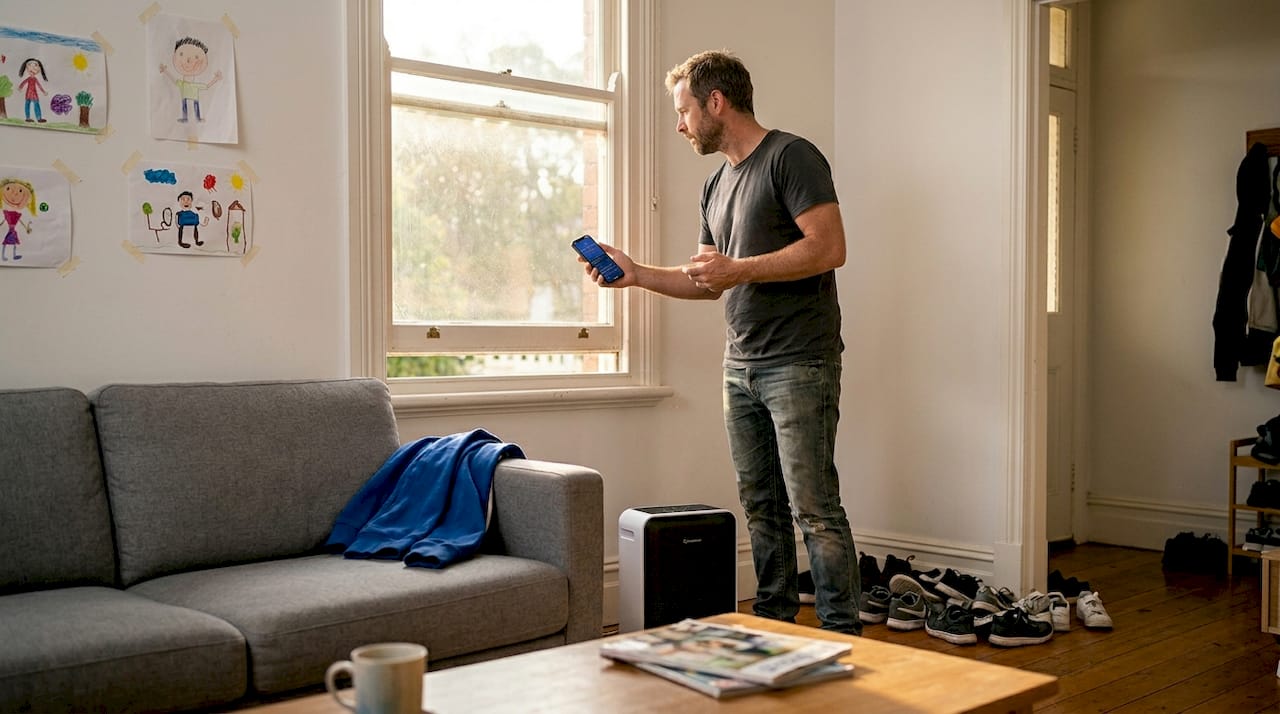
The practical approach is straightforward. Use a reliable AQI app (UAE residents can access readings through the UAE Ministry of Climate Change and Environment, or international services such as IQAir or AirVisual) and match your household’s response to the reading.
| AQI category | Window/ventilation choice | Air purifier use | Child activity guidance |
|---|---|---|---|
| Good (0 to 50) | Windows can be open | Optional; standard use | Normal indoor and outdoor play |
| Moderate (51 to 100) | Open briefly; monitor | Recommended | Limit prolonged outdoor exertion for sensitive children |
| Unhealthy for sensitive groups (101 to 150) | Keep closed | Run on high setting | Keep sensitive children indoors |
| Unhealthy and above (151+) | Keep sealed | Run continuously | All children stay indoors; minimise activity |
For families with asthmatic or allergic children, AQI monitoring supports specific behavioural adjustments that can reduce symptom flare-ups and emergency healthcare visits. This goes well beyond weather awareness. It is a practical risk management tool.
Steps to take when AQI rises above 100:
- Check the AQI reading on a trusted local app before opening any windows or doors in the morning.
- Switch your air purifier to a higher fan speed or activate its auto mode if available.
- Seal gaps around windows and doors using draught excluders or temporary seals.
- Reschedule outdoor playtime for children until AQI returns below 100.
- Avoid vacuuming with a standard vacuum cleaner, as it can re-suspend fine particles. Use a HEPA-filter vacuum or air purifier instead.
- If cooking, use the exhaust fan at full power to prevent compounding indoor pollution.
- Check the AQI again in the late afternoon, as readings often shift after midday heat disperses and wind patterns change.
Pro Tip: Check AQI first thing in the morning and again after any windy or dusty event. UAE dust storms can cause AQI to spike within minutes, and the view from your window will not tell you what particles are in the air.
Keeping a quality air purifier running during elevated AQI periods is one of the most direct ways to reduce indoor particle loads, particularly for families in dusty urban areas like Dubai, Abu Dhabi, or Sharjah.
The limits of AQI for indoor air and what most people miss
While using AQI for daily decisions is powerful, it is essential to understand what AQI cannot tell you. This prevents overconfidence and ensures that your household’s air quality strategy is actually complete.
AQI measures outdoor pollutants. It provides no information about what is happening inside your home due to indoor sources. In UAE households, indoor pollutants are common and often underestimated. Cooking on a gas hob generates nitrogen dioxide and fine particulate matter. Cleaning products release volatile organic compounds (VOCs). Damp areas in bathrooms, laundry rooms, or around air conditioning units can harbour mould. Building materials, furniture, and carpets off-gas chemicals over time. None of these appear in an outdoor AQI reading.
“Personalised action plans are crucial for people with severe asthma or allergies.”
This is why combining AQI with an indoor air quality monitor is the most complete approach. Indoor air quality best practices from leading environmental health authorities consistently recommend addressing indoor sources, improving ventilation strategically, and using filtration to manage what remains. AQI is a necessary input, but it covers only one part of the picture.
Indoor pollutants that AQI will not detect:
- Cooking fumes and combustion byproducts from gas appliances
- VOCs released from paints, adhesives, cleaning sprays, and furniture
- Mould spores from moisture accumulation around air conditioning units or wet areas
- Carbon dioxide build-up from poor ventilation in sealed, air-conditioned rooms
- Pet dander and biological allergens
For additional guidance on managing these indoor-specific risks, air quality tips tailored to UAE conditions are available through the ClimatePro UAE blog.
The gap between AQI and indoor reality is widest in tightly sealed homes. In summer, UAE residents keep windows sealed and air conditioning running continuously for months. This limits outdoor pollutant entry but allows indoor pollutants to accumulate without dilution. An indoor air monitor measuring PM2.5, CO2, VOCs, and humidity gives you the data AQI cannot.
Pro Tip: Pair every AQI check with a glance at your indoor monitor. If indoor PM2.5 is rising on a day when outdoor AQI is moderate, the source is likely inside your home, not outside.
Best practices for monitoring AQI and indoor air in UAE homes
With the right tools and habits, you can move from reacting to air quality issues to preventing them. The following routine is designed specifically for UAE families, taking into account the local climate, seasonal dust events, and the challenges of year-round air conditioning use.
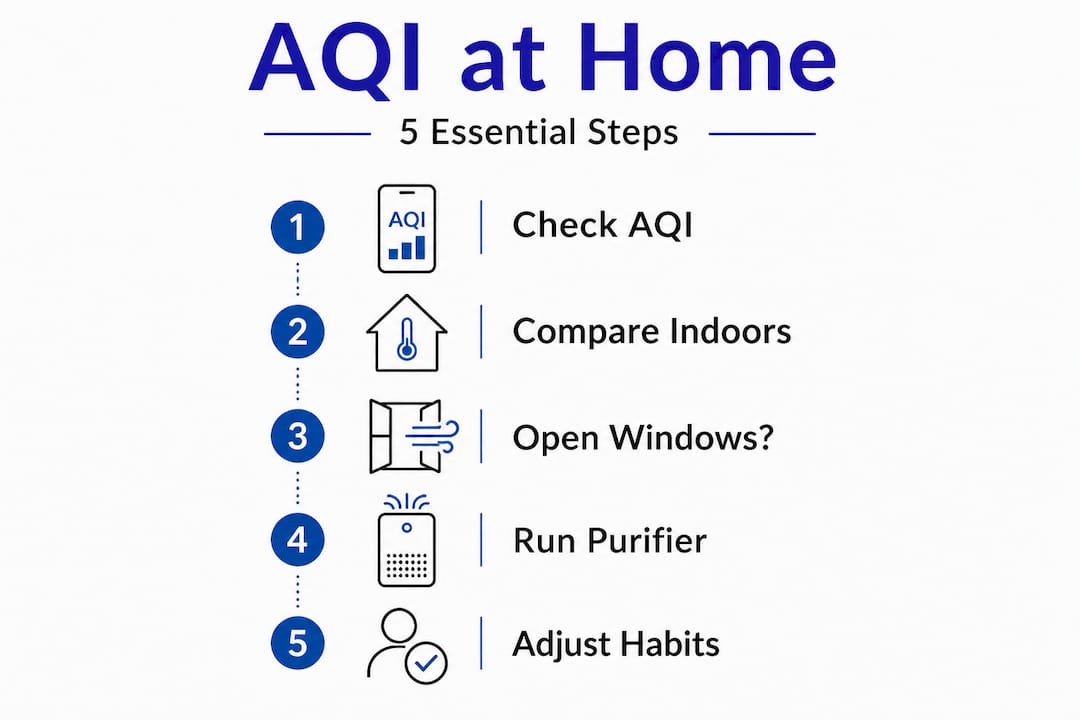
Daily AQI-integrated air quality action plan:
- Morning check: Open a reliable AQI app and note the current reading and forecast for the day. Set an alert for readings above 100.
- Ventilation decision: Based on AQI, decide whether to open windows briefly (early morning, below 75 AQI) or keep them sealed.
- Air purifier review: Confirm your air purifier is operating and the filter status is current. Replace filters on schedule.
- Indoor monitor reading: Note your indoor PM2.5, CO2, and humidity levels. Ideal humidity for UAE homes is between 40% and 60%.
- Activity planning: Adjust children’s outdoor activity based on the morning AQI reading.
- Evening review: Check AQI again at sunset. Dust particles can settle in the evening, improving conditions for brief ventilation.
- Weekly maintenance: Inspect and clean air purifier pre-filters. Check window seals and air conditioning filters monthly.
| Household type | Recommended monitoring frequency | Key actions to prioritise |
|---|---|---|
| Family with children under 10 | Twice daily; alert set above 100 | Run air purifier continuously; limit outdoor activity on high-AQI days |
| Adult with asthma or allergies | Twice daily; alert set above 75 | Add indoor VOC and humidity monitoring; use HEPA purifier |
| Standard household | Once daily in the morning | Adjust ventilation; run purifier on high during dust events |
| Office or nursery environment | Monitor continuously | Dedicated commercial-grade air purifier; CO2 monitor for occupancy |
Combining AQI alerts with an indoor sensor gives you a layered system. EPA indoor air quality guidance identifies source control, ventilation, and air filtration as the three pillars of healthy indoor air. AQI informs your ventilation decisions. Your indoor monitor informs source control and filtration adjustments. Together, they form a complete strategy.
Explore the full range of indoor air improvement products available through ClimatePro UAE to find sensors, purifiers, and filters suited to your household’s specific needs.
Pro Tip: After a UAE dust storm, do not immediately open windows once the storm passes. Particles settle gradually and outdoor AQI can remain elevated for several hours. Wait until AQI reads below 75 before ventilating.
Our perspective: AQI is powerful but don’t stop there
AQI is among the most accessible and reliable environmental health tools available to UAE families. It requires no technical knowledge, is freely available on smartphones, and is directly tied to evidence-based health thresholds. That makes it genuinely valuable.
But relying on AQI alone is like checking the outdoor temperature before deciding whether to cook dinner. The number tells you something real about conditions outside, but it says nothing about what is building up in your kitchen while the windows stay shut. The same logic applies to indoor air quality.
The families who benefit most from air quality monitoring are those who treat AQI as a starting trigger, not a complete answer. A high AQI reading prompts them to seal the home and run the purifier. An indoor monitor then confirms whether the strategy is working. Regular filter maintenance ensures the purifier is actually removing what it should. This three-part loop, monitoring, filtering, and maintaining, is what distinguishes households that experience consistent relief from those that still struggle with dust, allergens, and respiratory irritants.
The distinction between outdoor and indoor air quality measurement is something many consumer guides overlook. AQI is standardised and outdoor-facing. Indoor air quality varies from room to room, hour to hour, and depends heavily on what activities are taking place. Cooking a meal, cleaning with spray products, or even sleeping with a pet can shift indoor air quality significantly within minutes.
The practical recommendation from expert air quality insights is consistent: use AQI as your baseline, not your boundary. It is the foundation of a healthy indoor air strategy, not the entirety of it. Families who add indoor sensors, maintain their filtration equipment, and adjust ventilation habits based on real data consistently report better outcomes for children with asthma and adults with allergies.
Improve your home’s air quality today
Understanding AQI is the first step. Acting on it with the right products is what makes a difference in your family’s daily health.

ClimatePro UAE offers a curated range of air purifiers designed for UAE home conditions, including models with HEPA and activated carbon filtration suited to fine dust, VOCs, and seasonal pollution. Alongside air purifiers, a broad selection of humidifiers and filters helps you manage humidity, replace worn filtration media, and maintain consistent air quality throughout the year. Products are available for delivery across Dubai, Abu Dhabi, Sharjah, Ajman, Ras Al Khaimah, Fujairah, and Umm Al Quwain, making it straightforward to find and receive the right solution for your home.
Frequently asked questions
What is the Air Quality Index (AQI) and how is it calculated?
AQI is a colour-coded scale that converts outdoor pollutant concentrations into health risk categories, using established evidence-based thresholds for each major ambient pollutant. Each pollutant is scored separately and the highest individual score becomes the reported AQI for that location.
Is it possible for indoor air in the UAE to be more polluted than outdoors?
Yes. Indoor pollutant levels can be significantly higher than outdoors, particularly in sealed, air-conditioned homes where cooking fumes, cleaning products, and mould have no exit path. This is a common issue in UAE homes during the summer months when windows remain closed for extended periods.
How often should I check AQI for my home?
Check local AQI at least twice daily, particularly in the morning before opening windows and again in the late afternoon. CDC guidance for children with asthma specifically recommends daily AQI checks for caregivers, with heightened attention during dust storms, heavy traffic events, or periods of regional haze.
Can AQI monitoring help if my child has asthma or allergies?
Absolutely. Monitoring AQI for asthmatic children supports caregivers in making specific behavioural adjustments, including keeping children indoors, running air purifiers, and reducing strenuous activity, when outdoor pollution exceeds safe thresholds. Acting on readings above 100 is particularly important for reducing symptom episodes.
Is monitoring AQI enough to keep indoor air healthy?
No. AQI addresses outdoor pollution only, and experts treat it as an action trigger rather than a substitute for measuring indoor-specific pollutants such as mould, VOCs, or CO2. A dedicated indoor air quality monitor is essential for a complete picture of your home’s air safety.
Recommended
- Air changes per hour and better indoor air quality — Blog | ClimatePro UAE
- Air Quality Blog — Tips & Guides | ClimatePro UAE
- Buy Honeywell Air Touch V5 Air Purifier in Dubai | Best Price AED 437 | ClimatePro UAE
- Buy Blueair 2-in-1 Purify + Humidify DH3i in Dubai | Best Price AED 1,166 | ClimatePro UAE
- Why is air quality inside important? – Amazon Air Duct Cleaning
- How to test air quality: practical steps for Avondale homes