

The air exchange rate is the number of times the total volume of air inside a room or home is completely replaced with fresh outdoor air each hour. In the ventilation industry, this measurement is standardised as ACH, or air changes per hour. ASHRAE 62.2-2016 sets the minimum residential ventilation rate at 0.35 ACH, which means the entire air volume of a home should be replaced at least once every three hours. For homeowners and tenants, understanding air exchange rates is the foundation of managing indoor air quality, controlling moisture, and reducing exposure to pollutants that accumulate in sealed living spaces.
What is air exchange rate and how does it work?
The air exchange rate definition, in practical terms, is a measure of ventilation effectiveness. It tells you how quickly stale, polluted, or humid air is being pushed out and replaced with fresh air from outside. A low ACH means air sits inside your home for longer, allowing carbon dioxide, volatile organic compounds (VOCs), dust, and moisture to build up. A high ACH means air turns over frequently, which generally supports better indoor air quality but also carries trade-offs in energy use and thermal comfort.
The primary goal of air exchange is to prevent indoor pollutant and moisture buildup, which is especially critical in tightly sealed modern homes. Older homes with gaps around windows, doors, and floorboards often achieved passive air exchange through infiltration alone. Newer, energy-efficient construction eliminates most of those gaps, which is why mechanical ventilation has become a standard requirement rather than an optional upgrade.

One distinction worth understanding early: air purifiers recirculate and filter the air already inside your home. They do not introduce fresh outdoor air. Filtered air recirculation is not the same as actual air exchange, and relying solely on an air purifier will not control CO₂ levels or remove odours caused by insufficient fresh air supply.
How to calculate air exchange rate in your home
Understanding air exchange rates becomes much more useful once you can calculate them. The standard formula used across the HVAC industry is straightforward.
The ACH formula:
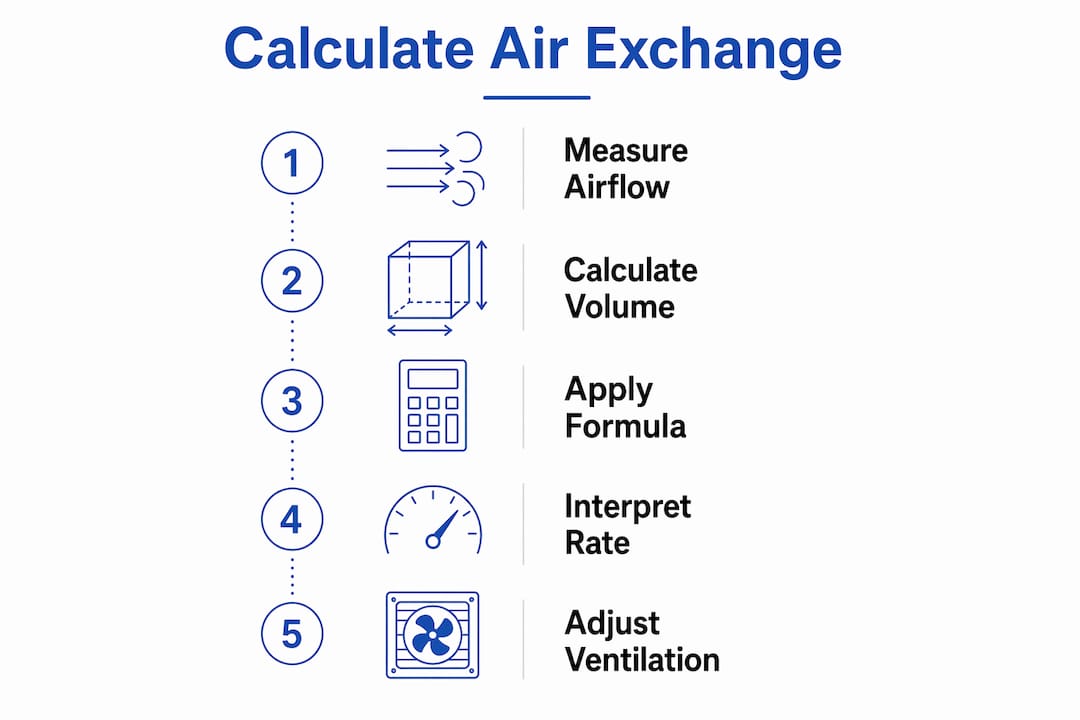
- Measure the room’s volume in cubic feet (length × width × ceiling height).
- Determine the airflow rate in CFM (cubic feet per minute) delivered by your ventilation system.
- Apply the formula: ACH = (CFM × 60) ÷ room volume in cubic feet.
Example calculation: A bedroom measuring 4 metres × 4 metres with a 2.7-metre ceiling has a volume of approximately 43.2 cubic metres, which converts to roughly 1,525 cubic feet. If your exhaust fan moves 25 CFM, the calculation is: (25 × 60) ÷ 1,525 = 0.98 ACH. That result sits just above the ASHRAE minimum of 0.35 ACH, which means the room meets the baseline standard but leaves limited margin for activities that generate additional pollutants or moisture.
For metric users, the equivalent formula uses cubic metres per hour (m³/h) divided by room volume in cubic metres. Most mechanical ventilation systems sold in Australia and the UAE display airflow ratings in both CFM and m³/h, so conversion is rarely a barrier.
Pro Tip: If you do not know your ventilation system’s CFM rating, check the product label or technical datasheet. Most exhaust fans and HRV units list airflow at standard operating conditions. This single figure is all you need to run the calculation above.
One important clarification: the ACH figure produced by this formula reflects the rate at which air is mechanically moved, not necessarily the rate at which fresh outdoor air reaches every occupant. Poor duct design or blocked vents can result in a calculated ACH that overstates real-world ventilation performance.
Why does the air exchange rate matter for your health and comfort?
The importance of air exchange rate extends well beyond a technical compliance figure. The air inside a typical home contains two to five times more pollutants than outdoor air, according to the US EPA. Without adequate air exchange, those pollutants accumulate continuously throughout the day.
Key risks associated with insufficient air exchange include:
- CO₂ buildup: Occupants exhale carbon dioxide constantly. In poorly ventilated bedrooms, CO₂ levels can reach concentrations that cause fatigue, headaches, and reduced cognitive function overnight.
- Moisture and mould: Cooking, showering, and breathing all add moisture to indoor air. Without adequate ventilation, relative humidity rises and creates conditions for mould growth on walls, ceilings, and in cavities.
- VOC accumulation: Paints, furniture, cleaning products, and building materials off-gas VOCs continuously. Higher ACH rates dilute these compounds before they reach harmful concentrations.
- Odour control: Residential spaces typically target 4 to 6 ACH for comfort, partly because this range is sufficient to prevent persistent odours from cooking, pets, and daily activity.
“Ventilation is not just about comfort. It is a direct determinant of respiratory health, sleep quality, and long-term exposure to indoor pollutants.”
The risks of excessive air exchange are also real. High ACH can create a wind tunnel effect inside a home, causing thermal discomfort and forcing heating or cooling systems to work harder. The goal is not the highest possible ACH but the right ACH for the space, its occupants, and the climate. Excess ventilation can cause thermal instability and increase energy costs without delivering proportional air quality benefits.
What factors affect air exchange rates in homes?
Several variables determine the actual air exchange rate in any given home or apartment. Understanding what affects air exchange rate helps you identify where your home may be falling short.
| Factor | Effect on ACH | Notes |
|---|---|---|
| Building airtightness | Lower ACH in tight buildings | Modern construction reduces infiltration significantly |
| Mechanical ventilation | Increases ACH predictably | HRVs and ERVs provide controlled fresh air supply |
| Natural ventilation | Variable ACH | Depends on wind, temperature difference, and window use |
| Infiltration | Passive ACH contribution | Cracks, gaps, and unsealed penetrations in older homes |
| Climate and season | Seasonal ACH variation | Hot or cold weather reduces window-based ventilation |
Air exchange occurs via three main pathways: infiltration through gaps and cracks, natural ventilation through open windows and doors, and mechanical ventilation through fans, ducted systems, and dedicated ventilation units. Most homes rely on a combination of all three, though the balance shifts significantly depending on the age and construction type of the building.
Modern energy-efficient homes present a specific challenge. Tight construction reduces infiltration to the point where natural and passive air exchange alone cannot meet the ASHRAE 0.35 ACH minimum. In these homes, heat recovery ventilators (HRVs) or energy recovery ventilators (ERVs) are the standard solution. These systems bring in fresh outdoor air while recovering thermal energy from the outgoing stale air, which limits the energy penalty associated with continuous mechanical ventilation. For UAE homeowners, energy recovery ventilation is particularly relevant given the extreme heat and the cost of cooling incoming outdoor air.
Pro Tip: In apartments, check whether your building has a centralised mechanical ventilation system. Many residents assume their unit has independent ventilation when it actually depends on shared building infrastructure. If the central system is poorly maintained, your individual ACH may be far below the recommended minimum regardless of what you do inside the unit.
How can you measure and improve your home’s air exchange rate?
Measuring and improving air exchange does not require specialist equipment in most cases. The following approaches range from simple DIY checks to professional assessments.
Methods to assess your current ACH:
- Tracer gas testing: A professional injects a known concentration of a tracer gas (such as sulphur hexafluoride) and measures how quickly it disperses. This is the most accurate method and is used in formal building assessments.
- Blower door test: A calibrated fan is fitted to an exterior door to pressurise the home and measure air leakage. Results are expressed as ACH50 (air changes per hour at 50 pascals of pressure), which can be converted to natural ACH estimates.
- Airflow measurement: Using an anemometer or a balometer, a technician measures the actual CFM delivered by each supply and exhaust vent, then applies the ACH formula directly.
- CO₂ monitoring: A CO₂ monitor placed in occupied rooms provides a practical proxy for ventilation adequacy. Levels consistently above 1,000 ppm during normal occupancy indicate insufficient fresh air supply.
Practical steps to improve your ACH:
- Install or upgrade exhaust fans in bathrooms and kitchens, targeting units rated for the room volume.
- Open windows strategically during cooler parts of the day to increase natural ventilation without thermal penalty.
- Consider an HRV or ERV if your home is newly built or recently insulated to a high standard.
- Service existing mechanical ventilation systems annually, as blocked filters and dirty ducts can reduce actual airflow by 30 to 50 per cent compared to rated performance.
For a broader look at improving indoor air quality in your home, ventilation improvements work best alongside source control and air filtration as part of a layered approach. The relationship between air changes per hour and indoor air quality is well documented, and even modest improvements in ACH produce measurable reductions in pollutant concentrations.
Pro Tip: A basic CO₂ monitor costs between AED 150 and AED 400 and provides continuous, real-time feedback on ventilation adequacy in any room. Place it at breathing height in the bedroom overnight. If readings exceed 1,000 ppm by morning, your bedroom ACH is almost certainly below the recommended minimum.
Key takeaways
Adequate air exchange rate is the single most controllable factor in maintaining healthy indoor air quality, and most homes require mechanical ventilation to meet the ASHRAE minimum of 0.35 ACH.
| Point | Details |
|---|---|
| ACH definition | Air changes per hour measures how many times a room’s total air volume is replaced each hour. |
| Minimum standard | ASHRAE 62.2 sets 0.35 ACH as the residential minimum; most comfort targets fall between 4 and 6 ACH. |
| Calculation method | Use ACH = (CFM × 60) ÷ room volume in cubic feet to estimate your home’s ventilation rate. |
| Tight homes need mechanical ventilation | Modern energy-efficient construction reduces infiltration and requires HRVs or ERVs to meet minimum ACH. |
| More is not always better | Excessive ACH increases energy costs and can cause thermal discomfort without proportional air quality gains. |
Why ventilation numbers alone do not tell the whole story
I have spent considerable time reviewing ventilation data across residential projects, and the pattern I keep seeing is this: homeowners fixate on hitting a target ACH number without considering where the air actually goes once it enters the building. Effective air distribution matters as much as the total volume exchanged. A home can technically achieve 0.5 ACH while leaving bedrooms chronically under-ventilated because all the airflow is concentrated in the living areas near the intake vents.
The other mistake I see regularly is treating air purifiers as a substitute for ventilation. An air purifier in a sealed bedroom will reduce particulate levels, but it will not address rising CO₂ or moisture. These are fundamentally different problems requiring different solutions. Understanding air cleaning technologies and their limitations is what separates homeowners who genuinely improve their indoor environment from those who spend money without measurable results.
For Australian and UAE homeowners specifically, the climate creates a strong temptation to keep windows closed year-round and rely entirely on air conditioning. That approach almost always produces ACH values well below the recommended minimum. The practical answer is not to choose between comfort and ventilation but to invest in systems that deliver both. An ERV in a UAE home, for example, brings in fresh air while pre-cooling it using the outgoing conditioned air, which makes adequate ventilation economically viable even during peak summer months.
The bottom line is this: chase effective ventilation, not just a high ACH figure. Measure what is actually happening in your occupied rooms, address the weakest points first, and layer air purification on top of adequate fresh air supply rather than instead of it.
— Nevel
Improve your indoor air quality with Climatepro

Climatepro stocks a curated range of indoor air quality solutions suited to homes and apartments across the UAE, including Dubai, Abu Dhabi, and Sharjah. Whether you are addressing dust, humidity, odours, or airborne allergens, the right combination of products makes a measurable difference. The Honeywell Air Touch P2 is a popular choice for bedrooms and living areas, delivering HEPA filtration alongside activated carbon for odour control. For a broader selection of units suited to different room sizes and pollutant types, browse the full range of air purifiers available at Climatepro. Pairing a quality air purifier with adequate mechanical ventilation gives you both clean air and sufficient fresh air supply.
FAQ
What is the air exchange rate definition in simple terms?
The air exchange rate, measured as ACH (air changes per hour), is the number of times the total volume of air in a room is replaced with fresh air within one hour. A higher ACH means more frequent air replacement.
What is the recommended ACH for a home?
ASHRAE 62.2 sets the minimum residential ventilation rate at 0.35 ACH, while most comfort-focused targets fall between 4 and 6 ACH depending on room type and occupancy.
How do I calculate the air exchange rate for my room?
Use the formula ACH = (CFM × 60) ÷ room volume in cubic feet, where CFM is the airflow rate of your ventilation system and room volume is length × width × ceiling height in cubic feet.
Does an air purifier improve the air exchange rate?
No. Air purifiers filter and recirculate existing indoor air but do not introduce fresh outdoor air. They improve air quality by reducing particulates and odours but do not increase ACH or reduce CO₂ levels.
What happens if the air exchange rate is too low?
Insufficient ACH allows CO₂, moisture, VOCs, and other pollutants to accumulate indoors, which can cause headaches, fatigue, mould growth, and long-term respiratory health effects.