Clinic air purification is defined as the systematic removal of airborne contaminants using HEPA-based filtration systems, sized and integrated to meet clinical indoor air standards. Poor air quality in clinics directly increases infection risk for patients and staff. True HEPA filters, HVAC integration, and real-time monitoring tools like CO2 and particulate sensors form the foundation of any effective clinical air quality programme. This guide gives clinic administrators and healthcare professionals a practical framework for selecting, installing, and maintaining air purification systems that meet regulatory requirements and protect everyone inside the facility.
What key features make an air purifier suitable for clinic environments?
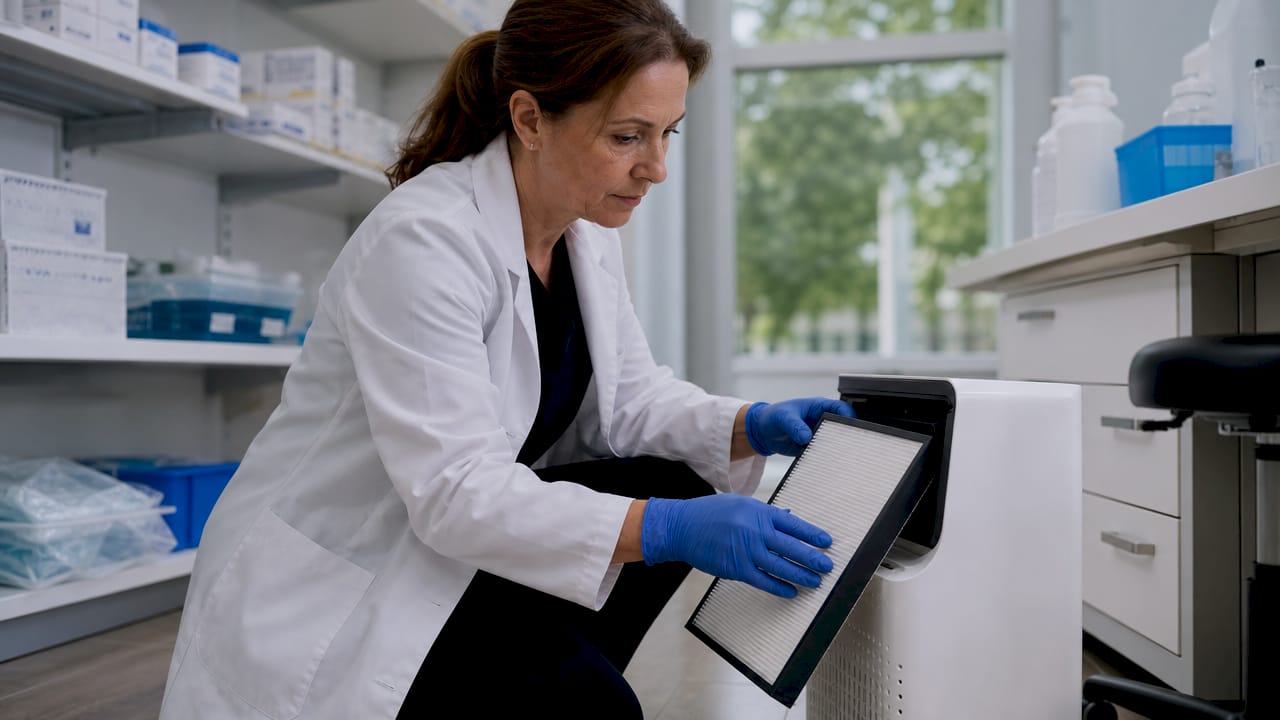
Clinical air purification demands more than a standard residential unit. The performance gap between consumer-grade and clinical-grade purifiers is significant, and choosing the wrong product creates a false sense of security.
The non-negotiable features for clinic settings include:
- True HEPA filtration: True HEPA filters capture 99.97% of airborne particles at 0.3 microns and reduce indoor PM2.5 by up to 56% in real-world clinical settings. That level of particle capture is the accepted clinical standard.
- Multi-stage filtration: HEPA filtration paired with activated carbon or UV-C addresses chemical vapours and pathogens that HEPA alone cannot neutralise. Clinics using disinfectants and anaesthetic agents need this additional layer.
- Certified Clean Air Delivery Rate (CADR): CADR measures how quickly a purifier cleans a given volume of air. The unit’s CADR must match or exceed the room’s volume requirements. Undersized units greatly underperform regardless of filter quality.
- HVAC compatibility: The purifier must work alongside existing ventilation systems and comply with standards such as ASHRAE and HTM 03-01. Standalone units that conflict with HVAC airflow create pressure imbalances.
- Humidity management: Maintaining humidity between 40% and 60% limits microbial growth and prevents airborne contaminant stagnation. Clinics in the UAE face particular challenges with humidity fluctuations driven by air conditioning.
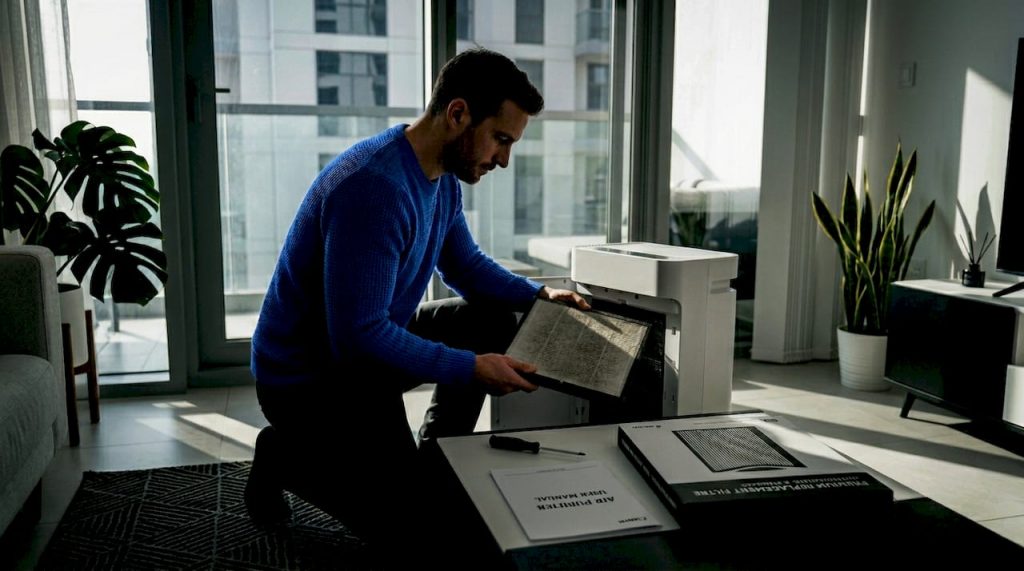
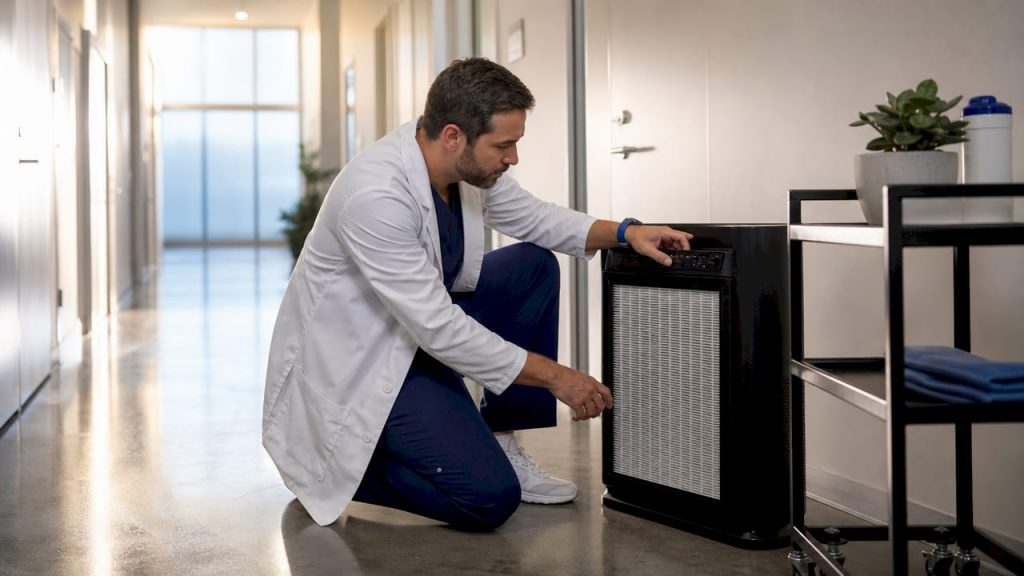
Pro Tip: Look for units with front-access filter panels. In busy clinical environments, easy filter access directly increases the likelihood that staff will replace filters on schedule.
How to assess your clinic’s ventilation and air quality needs
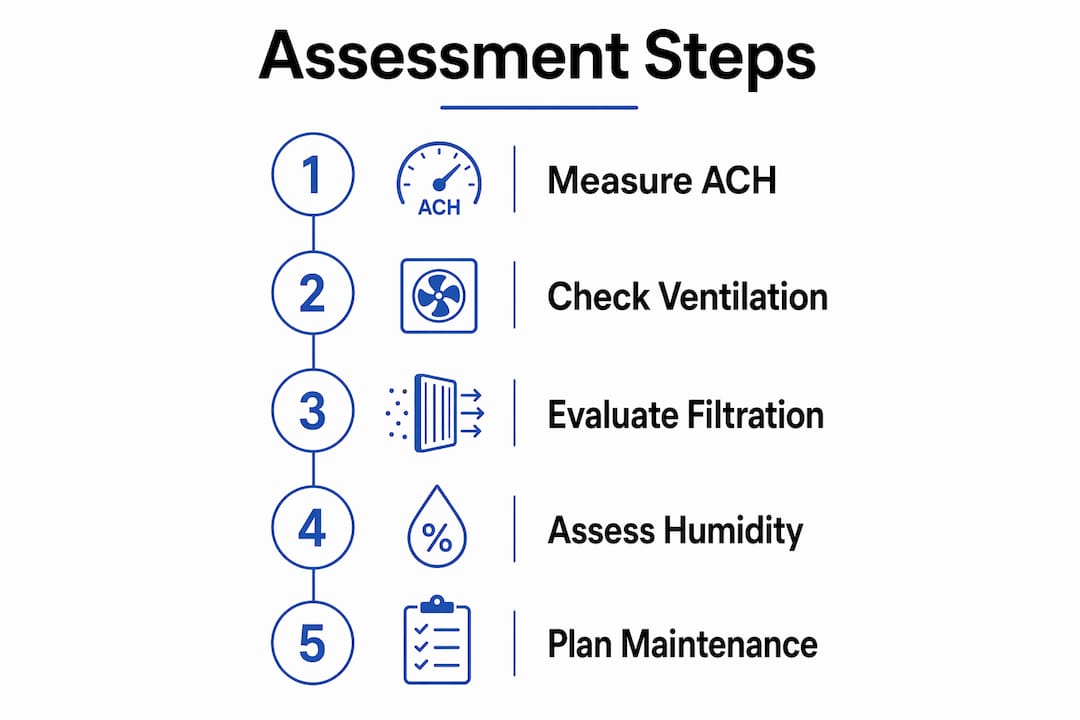
Before purchasing any purifier, a structured assessment of your clinic’s existing conditions is required. Buying equipment without this step leads to mismatched systems and wasted expenditure.
- Commission a professional HVAC audit. Determine your current air change rates (ACH) and filtration efficiency for each room type. Treatment rooms typically require higher ACH than waiting areas.
- Map critical zones. Identify areas with the highest contamination risk: procedure rooms, consultation rooms, and waiting areas with high patient turnover. Each zone may require a different purifier specification.
- Measure pressure relationships. Negative pressure rooms prevent airborne pathogens from escaping into corridors. Positive pressure rooms protect immunocompromised patients from external contaminants. Adding purifiers without verifying pressure control can disrupt these relationships.
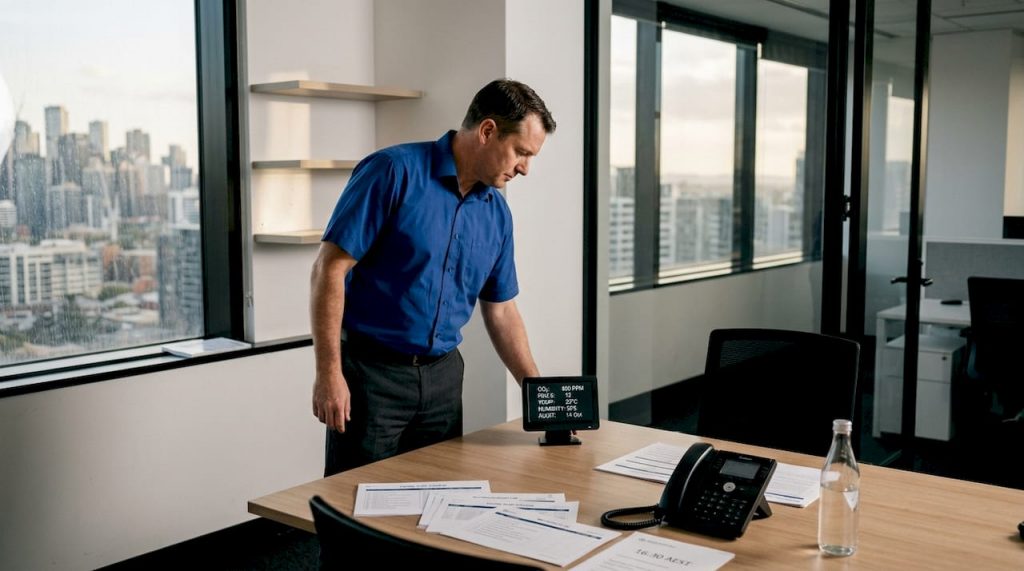
- Record baseline particulate matter and CO2 levels. These readings establish the starting point for measuring improvement after installation. CO2 levels above 1,000 ppm typically indicate inadequate ventilation.
- Measure humidity across all rooms. Identify areas where humidity falls outside the 40%–60% range. You may need supplementary humidifiers or dehumidifiers alongside purifiers.
The table below summarises the key assessment parameters and their clinical significance.
| Assessment parameter | Clinical significance | Recommended action |
|---|---|---|
| Air change rate (ACH) | Determines baseline ventilation adequacy | Verify against ASHRAE or HTM 03-01 targets |
| Particulate matter (PM2.5) | Indicates airborne contamination load | Establish baseline before purifier installation |
| CO2 concentration | Proxy for ventilation effectiveness | Target below 1,000 ppm in occupied rooms |
| Relative humidity | Affects microbial growth and comfort | Maintain 40%–60% at all times |
| Pressure relationships | Critical for infection control zoning | Verify with HVAC engineer before adding units |
Step-by-step process for selecting and installing clinic air purifiers
Selecting the right purifier is a technical decision, not a purchasing one. The process below reduces the risk of mismatched equipment and non-compliant installations.
- Calculate room volume and required CADR. Multiply room length by width by height to get cubic metres. Select a purifier with a CADR that exceeds this volume. Oversizing by 20–30% accounts for real-world airflow inefficiencies and peak occupancy loads.
- Match filtration technology to room function. A procedure room handling chemical disinfectants needs activated carbon in addition to True HEPA. A waiting room may require UV-C to address pathogen load from high patient throughput.
- Verify HVAC integration requirements. Standalone purifiers without HVAC integration can create dead zones where pollutants stagnate. Confirm with your HVAC engineer that the purifier’s airflow direction complements existing duct patterns.
- Position units to eliminate dead zones. Place purifiers away from walls where possible, with intake and exhaust vents unobstructed. Avoid corners and areas behind furniture where air circulation is poor.
- Integrate supplementary technologies where needed. UV-C disinfection modules add pathogen neutralisation for high-risk areas. Pair these with HEPA filtration technology for layered protection.
- Train staff on operation and maintenance. Clinic-grade purifiers require strict preventative maintenance schedules and easy filter access to sustain compliance. Document filter replacement intervals and assign responsibility to specific staff members.
The table below compares key purifier types for common clinic room categories.
| Room type | Recommended filtration | Minimum CADR guidance |
|---|---|---|
| Waiting area | True HEPA + activated carbon | Match room volume, oversize by 20% |
| Procedure room | True HEPA + UV-C + activated carbon | Oversize by 30%, verify ACH compliance |
| Consultation room | True HEPA + activated carbon | Match room volume, oversize by 20% |
| Reception/admin | True HEPA | Match room volume |
Pro Tip: Choose purifiers with digital filter-life indicators. Visual alerts remove the guesswork from maintenance scheduling and reduce the risk of staff operating a unit with a saturated filter.
Common mistakes when implementing clinic air purifiers
Most failures in clinical air purification stem from incorrect sizing and poor maintenance, not from technology limitations. Understanding these pitfalls before installation saves significant cost and risk.
- Undersizing the unit. A purifier rated for a 20-square-metre room placed in a 40-square-metre treatment room will not achieve adequate pollutant removal. CADR matched to room size is the single most critical selection criterion.
- Skipping filter replacements. Saturated filters reduce airflow and filtration efficiency. Units with easy filter access increase the likelihood of on-schedule servicing in busy clinical environments. Hard-to-maintain units get neglected.
- Ignoring humidity and pressure. A purifier operating in a room with 70% relative humidity will not prevent microbial growth on surfaces. Humidity and pressure control are prerequisites, not optional extras.
- Overreliance on purifiers alone. Air purifiers augment HVAC systems but do not replace required ventilation. Clinics that decommission ventilation upgrades in favour of standalone purifiers risk non-compliance with ASHRAE and HTM 03-01.
- Using ionisers or ozone generators. These technologies produce ozone as a byproduct, which irritates respiratory systems and can harm patients with existing conditions. True HEPA and UV-C are the accepted clinical alternatives.
“Air quality is a safety requirement, not a luxury. Purifiers complement but do not replace compliance ventilation.” — HVACDatabase
Clinic administrators who treat air purification as a standalone solution, rather than one component of a broader indoor air quality programme, consistently see the poorest outcomes. The technology works. The system around it must work too.
Key takeaways
Effective clinic air purification requires properly sized True HEPA systems integrated with HVAC, humidity control, and scheduled maintenance to meet clinical indoor air standards.
| Point | Details |
|---|---|
| True HEPA is the clinical standard | Select units capturing 99.97% of 0.3-micron particles with verified CADR for each room. |
| Assess before you purchase | Conduct an HVAC audit and measure baseline PM2.5, CO2, and humidity before selecting any unit. |
| Oversize CADR by 20–30% | Accounting for real-world inefficiencies prevents undersizing, the most common cause of poor performance. |
| Multi-stage filtration is required | Pair HEPA with activated carbon or UV-C to address chemical vapours and pathogens in clinical spaces. |
| Maintenance determines long-term efficacy | Assign filter replacement responsibility to named staff and use units with accessible filter panels. |
Air purification in clinics: what the evidence is telling us
I have reviewed a significant number of clinical air quality installations across healthcare settings, and the pattern is consistent. Administrators invest in quality purifiers, install them, and then treat the job as done. Six months later, filters are saturated, humidity is uncontrolled, and the units are running at a fraction of their rated capacity. The technology is not the problem. The system around it is.
The evidence supports a shift in how clinics think about air quality. Research shows that HEPA filtration improves cognitive task speed by 12% and reduces systolic blood pressure by 3–5 mmHg in older adults. That is not a marginal benefit. It means the air quality in your waiting room and consultation spaces directly affects patient outcomes, not just infection rates.
The future of clinical air quality sits in real-time monitoring. Long-term indoor air quality management benefits from real-time CO2 and particulate monitoring with automated purification controls. Clinics that adopt this approach will move from reactive filter changes to data-driven air quality management. That is where the field is heading, and administrators who build monitoring into their systems now will be ahead of compliance requirements when they tighten.
My practical recommendation: treat air purification as infrastructure, not equipment. Budget for it, maintain it, and measure it the same way you would your sterilisation systems. The office air quality strategies that work in commercial settings apply directly to clinic environments, with the added layer of infection control requirements. Start with the audit, size correctly, and build a maintenance schedule before the units arrive.
— Nevel
Climatepro’s air purification solutions for clinics
Climatepro supplies a range of certified air purifiers suited to clinical environments across the UAE, with delivery to Dubai, Abu Dhabi, Sharjah, and all emirates.

The Honeywell Air Touch P2 is a medical-grade unit with True HEPA filtration and a verified CADR, making it a practical choice for treatment rooms and consultation spaces. Climatepro also carries the Honeywell Air Touch U1 for larger clinic areas requiring higher air throughput. For clinics managing humidity alongside air quality, the full air purifier catalogue includes combination units and replacement filters to support ongoing maintenance schedules. Climatepro’s team can assist clinic administrators in matching products to room specifications and compliance requirements.
FAQ
What is the difference between True HEPA and standard HEPA?
True HEPA filters are independently tested and certified to capture 99.97% of particles at 0.3 microns. Standard or “HEPA-type” filters are not held to this verified standard and perform inconsistently in clinical settings.
How often should clinic air purifier filters be replaced?
Filter replacement intervals depend on room occupancy, pollutant load, and the manufacturer’s specification. Most clinical environments require filter checks every three months, with replacement every six to twelve months.
Can an air purifier replace a clinic’s ventilation system?
No. Air purifiers augment HVAC systems but do not replace required ventilation or pressure control. Clinics must maintain compliance with ASHRAE and HTM 03-01 ventilation standards independently of any purifier installation.
What CADR rating does a clinic room need?
CADR should match or exceed the room’s volume in cubic metres per hour, oversized by 20–30% to account for peak occupancy and real-world airflow inefficiencies. An HVAC engineer or air quality specialist can calculate the precise requirement for each room.
Are ionisers or ozone generators safe for clinic use?
Ionisers and ozone generators produce ozone as a byproduct, which can irritate respiratory systems and harm vulnerable patients. True HEPA combined with UV-C disinfection is the accepted clinical alternative.
Recommended
- Office air quality improvement: top 10 strategies — Blog | ClimatePro UAE
- Nursery air quality checklist for healthier UAE spaces — Blog | ClimatePro UAE
- Understand air cleaning technologies for healthier UAE homes — Blog | ClimatePro UAE
- Hotel indoor air quality guide for managers — Blog | ClimatePro UAE