An energy efficient air cleaning workflow is the systematic process of selecting, maintaining, and controlling air purification technologies to maximise indoor air quality while minimising energy consumption. For homeowners and apartment residents, this matters because fouled HVAC coils alone can increase energy consumption by up to 30%. The workflow combines three core components: HEPA filtration, UV-C irradiation, and structured maintenance routines. Getting all three right means cleaner air at a lower running cost, month after month.
What technologies power an energy efficient air cleaning workflow?
HEPA filters capture at least 99.97% of particles down to 0.3 micrometres, making them the foundation of any efficient air purification method. UV-C light then inactivates 99.2% to 99.9% of airborne pathogens at the correct dose. Together, these two technologies form a three-stage approach that adds catalytic mineralisation as a third layer, breaking down volatile organic compounds that neither filters nor UV-C can address alone.
The sequence in which you deploy these technologies matters as much as the technologies themselves. Placing HEPA filtration upstream of UV-C irradiation prevents biological growth on filter media, which maintains airflow efficiency and reduces energy drag over time. Reversing this order allows pathogens to colonise filter surfaces, increasing pressure drop and forcing fans to work harder.

Retrofit technologies have expanded what is possible without replacing an entire HVAC system. Systems like HiboScreen are airflow enhancers that enable standard filters to reach clinical-grade air quality without adding pressure drop. For homeowners who cannot upgrade their central unit, this type of retrofit is a practical path to better filtration at no extra fan energy cost.
Key technologies to consider for your home workflow:
- HEPA filters (MERV 13 to 17 range): high particle capture with manageable pressure drop when matched correctly to your blower
- UV-C LED lamps: positioned post-filtration for pathogen inactivation without filter contamination
- Catalytic mineralisation panels: target chemical pollutants and odours that physical filtration misses
- Airflow visualisation tools: smoke pencils or fog machines identify dead zones and over-ventilated areas before you invest in hardware changes
Pro Tip: Before purchasing any new filtration technology, use a simple smoke pencil to trace airflow patterns in each room. This reveals where air stagnates and where your existing system already performs well, so you spend money only where it counts.
How to set up a filter and UV-C maintenance schedule
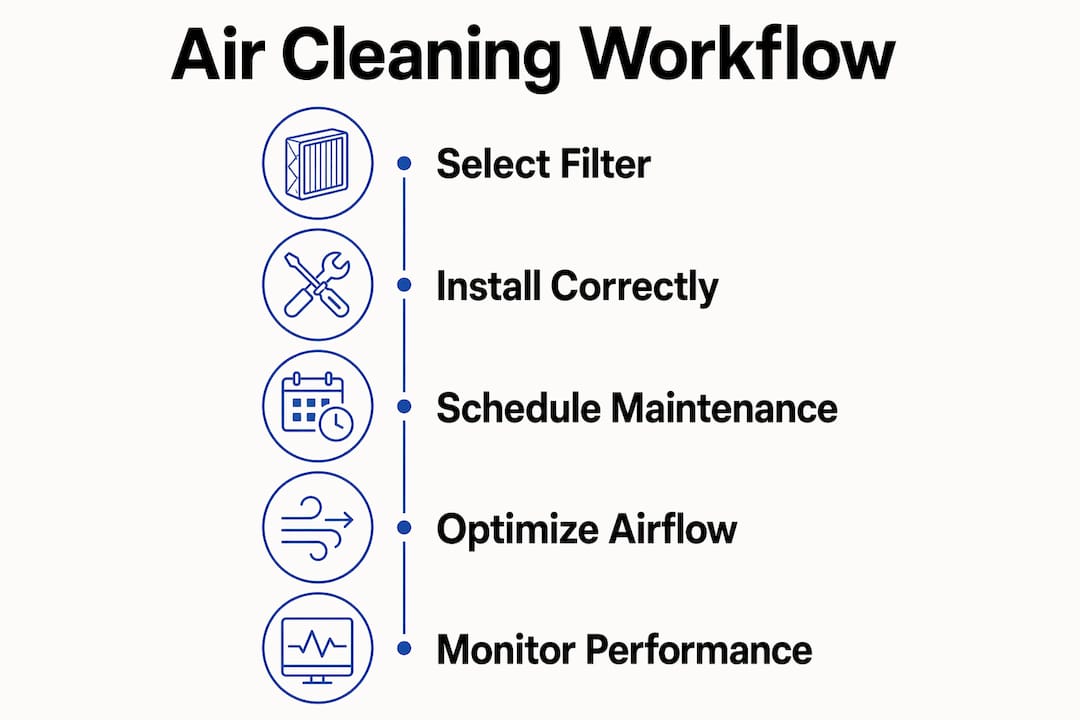
Structured preventive maintenance is the single most neglected element of sustainable air quality control in residential settings. Degraded filters cause false protection and increase energy use simultaneously, which is the worst possible outcome. Differential pressure monitoring and lamp hour tracking are the two metrics that tell you when to act.
Follow this maintenance sequence to keep your system performing at peak efficiency:
- Establish a baseline differential pressure reading across your filter on day one of installation. Record this figure. A reading that has doubled from baseline indicates the filter is loaded and must be replaced, regardless of the calendar date.
- Log UV-C lamp operating hours from the moment of installation. Most residential UV-C lamps maintain germicidal output for 9,000 to 12,000 hours. Output degrades before the lamp physically fails, so hour-based replacement is more reliable than visual inspection.
- Run post-shutdown fan cycles after your air conditioner turns off. Post-shutdown fan cycles of 150 minutes effectively remove retained moisture from evaporator coils and suppress microbial growth. This step directly protects coil cleanliness and prevents the energy penalty that biofilm accumulation causes.
- Use a maintenance tracking app such as Home Maintenance Checklist or a simple spreadsheet to log filter changes, lamp hours, and coil inspections. Scheduled reminders prevent the most common mistake: forgetting until performance drops noticeably.
- Inspect evaporator coils every six months in UAE conditions, where humidity and dust loads are higher than in temperate climates. Clean coils transfer heat efficiently; coated coils force the compressor to run longer, consuming more electricity.
Pro Tip: A step-by-step filter replacement workflow removes the guesswork from maintenance timing. Pair it with a differential pressure gauge and you will never replace a filter too early or too late again.
Low-speed post-shutdown fan operation uses approximately 79.2 watts and reduces microbial contamination effectively. This is a negligible power draw compared to the energy cost of running a compressor against biofilm-coated coils for months on end.
What airflow and control strategies reduce energy use at home?
Airflow optimisation is where most homeowners leave the largest energy savings on the table. Smoke studies identify over-ventilated zones, enabling targeted fan speed reductions that lower electricity consumption without reducing air quality in occupied areas. The principle is straightforward: do not filter air that does not need filtering.
Demand-controlled filtration adjusts fan speeds based on real-time particle counts, avoiding the energy waste of running a system at full capacity when indoor air is already clean. Particle sensors placed in living areas and bedrooms feed data to a smart controller or variable frequency drive, which modulates fan speed accordingly. This approach reacts to actual conditions rather than running on a fixed timer.
The table below summarises the main control strategies and their practical impact for residential use:
| Strategy | How it works | Energy impact |
|---|---|---|
| Variable frequency drive (VFD) | Adjusts fan motor speed in real time | Significant reduction in fan electricity use at partial load |
| Demand-controlled filtration | Particle sensors trigger fan speed changes | Avoids continuous full-speed operation |
| Airflow zone mapping | Identifies dead zones and over-ventilated areas | Allows fan speed reduction in low-occupancy zones |
| Humidity and temperature setpoint widening | Broadens acceptable indoor ranges slightly | Reduces compressor cycling frequency |
| Sequenced filtration staging | HEPA upstream, UV-C downstream | Lowers cumulative pressure drop across the system |
Integrating particle sensors and airflow mapping enables homeowners to safely reduce airflow in zones that are already clean, achieving both energy savings and effective filtration where it matters. For apartment residents with a single split system, even a basic smart thermostat with occupancy sensing delivers a measurable reduction in runtime hours.
Pairing these controls with broader home energy strategies, such as those outlined in solar power optimisation guides, compounds the savings further. Air cleaning and general home energy management are not separate problems.
How does filter selection affect long-term energy costs?
Filter selection determines a larger share of your total running cost than most homeowners realise. Energy consumption is the largest controllable operating expense in any air filtration strategy, and filter pressure drop is the primary driver of that cost. A filter with a high initial efficiency rating but a steep pressure drop forces your fan motor to work harder for its entire service life.
The total cost of ownership (TCO) framework shifts the focus from purchase price to lifecycle performance. A filter that costs twice as much upfront but maintains a lower, more stable pressure drop over its service life will reduce HVAC fan electrical consumption enough to offset that price difference. High-performance filters engineered for airflow efficiency and longer service life are the correct choice under a TCO analysis.
MERV rating selection requires matching the filter to your blower’s capacity. Mismatched high-MERV filters increase static pressure and cause excessive fan energy use, which directly offsets any air quality gain. For most residential split systems in the UAE, MERV 11 to 13 represents the practical upper limit before pressure drop becomes a problem.
The comparison below illustrates how filter choice plays out over a 12-month period:
| Filter type | Upfront cost | Pressure drop profile | 12-month energy impact |
|---|---|---|---|
| Standard fibreglass (MERV 4-6) | Low | Low but rises quickly when loaded | Moderate, but frequent replacement adds cost |
| Mid-range pleated (MERV 8-11) | Moderate | Stable across service life | Lower fan energy, good balance for most homes |
| High-efficiency pleated (MERV 13) | Higher | Higher initial drop, must match blower | Optimal air quality, higher energy if blower is undersized |
| Premium low-resistance (MERV 13+) | Highest | Engineered for stable, low drop | Best TCO outcome when blower capacity is confirmed |
Clean coils are the other side of this equation. Optimal filtration keeps coil surfaces free of particulate accumulation, which improves heat exchange and reduces compressor runtime. The HEPA filtration guide from Climatepro covers how to match filter grades to UAE-specific dust and humidity conditions.
Pro Tip: Ask your HVAC technician for the static pressure rating of your blower before purchasing a MERV 13 or higher filter. Installing a filter your blower cannot handle costs more in electricity than it saves in air quality.
Key takeaways
An energy efficient air cleaning workflow delivers the best results when filter selection, maintenance scheduling, and system controls are treated as one integrated process rather than three separate tasks.
| Point | Details |
|---|---|
| Sequence technologies correctly | Place HEPA upstream of UV-C to prevent biofilm on filters and maintain airflow efficiency. |
| Match filter MERV to blower capacity | Mismatched high-MERV filters increase fan energy use and offset air quality gains. |
| Use differential pressure, not calendar dates | Replace filters when pressure drop doubles from baseline, not on a fixed monthly schedule. |
| Run post-shutdown fan cycles | 150-minute low-speed cycles remove coil moisture and suppress microbial growth at minimal power draw. |
| Apply demand-controlled operation | Particle sensors and variable speed fans reduce runtime by responding to actual air quality, not assumptions. |
What I have learned from watching homeowners get this wrong
The most common mistake I see is treating air purification as a set-and-forget purchase. A homeowner buys a quality HEPA unit, places it in the living room, and assumes the job is done. Six months later the filter is loaded, the fan is straining, and the unit is consuming more electricity than it did on day one while delivering worse air quality. The technology was right. The maintenance habit was absent.
The second mistake is chasing the highest MERV rating available without checking blower capacity first. I have seen apartments where a well-intentioned MERV 16 filter was installed in a split system designed for MERV 8. The result was a fan running at maximum load continuously, higher electricity bills, and a compressor that failed early. Overestimating filter efficiency without matching HVAC capacity leads to increased static pressure and excessive fan energy use, which directly offsets the air quality gains you were trying to achieve.
What actually works is combining a correctly rated filter with a simple maintenance log and at least one smart control, whether that is a particle sensor, a programmable thermostat, or a basic timer for post-shutdown fan cycles. These three elements together produce results that no single premium product can match on its own. The UV-C technology guide is worth reading alongside your filter selection process, because the two technologies interact in ways that affect both performance and running cost.
Invest in the workflow, not just the hardware.
— Nevel
How Climatepro supports your air cleaning setup
Climatepro stocks a curated range of air purifiers and replacement filters designed for residential use across the UAE, where dust loads, humidity, and year-round air conditioning create specific demands on any filtration system.

The Honeywell Air Touch P2 is a strong starting point for most apartments and mid-sized living rooms. It combines a HEPA filter with an activated carbon layer, operates at low noise levels, and is designed for energy-conscious continuous use. For larger spaces or households with allergy concerns, the broader air purifier catalogue includes models with smart sensor integration that support demand-controlled operation. Climatepro delivers across Dubai, Abu Dhabi, Sharjah, and all other UAE emirates, with replacement filters available to keep your system running at peak efficiency year-round.
FAQ
What is an energy efficient air cleaning workflow?
An energy efficient air cleaning workflow is a structured approach to selecting, operating, and maintaining air purification technologies so that indoor air quality is maximised while energy consumption is kept as low as possible. It combines filter selection, maintenance scheduling, and system controls into one coordinated process.
How often should I replace HEPA filters for best efficiency?
Replace HEPA filters when the differential pressure across the filter doubles from its baseline reading at installation, rather than on a fixed calendar schedule. This approach avoids both premature replacement and the energy penalty of running a loaded filter past its effective service life.
Does UV-C technology increase energy consumption?
UV-C lamps add a small electrical load, but when positioned correctly downstream of HEPA filtration they prevent biofilm growth on filter media, which keeps pressure drop stable and reduces overall fan energy use. The net effect on energy consumption is neutral to positive when the system is maintained correctly.
What MERV rating is best for a residential split system?
MERV 11 to 13 is the practical range for most residential split systems, provided the blower capacity supports it. Installing a higher-rated filter in an undersized blower increases static pressure and fan energy use, which offsets the air quality benefit.
Can demand-controlled filtration work in a standard apartment?
Yes. A basic particle sensor connected to a smart thermostat or programmable fan controller delivers demand-controlled operation without a full HVAC upgrade. The sensor triggers fan speed increases only when pollutant levels rise, reducing continuous runtime and lowering electricity consumption.