Multi-room purification is the coordinated use of air purification devices to deliver clean air across multiple rooms or zones in a home, overcoming the barriers that walls, closed doors, and furniture create for air circulation. Standard portable air purifiers with HEPA filtration capture 99.9% to 99.97% of airborne pollutants within their rated coverage area, but that performance is strictly localised. The moment a door closes, the clean air stays in one room. Multi-room purification, known in the industry as multi-zone air purification, solves this by treating each occupied space as its own air quality zone. Metrics like CADR (clean air delivery rate) and ACH (air changes per hour) guide how units are sized and placed across a home to maintain consistent, healthy air throughout.
What is multi-room purification and why one unit falls short?
A single portable air purifier cannot clean multiple closed rooms in most homes. Portable units create localised zones, meaning clean air stays concentrated in the room where the device sits. Walls, closed doors, hallways, and even large furniture all restrict airflow and prevent purified air from reaching adjacent spaces.
The physics here are straightforward. Air purifiers draw in room air, filter it, and push it back out. That cycle works well within a defined space, but it does not generate enough pressure or volume to push clean air through a doorway and down a corridor. A bedroom with the door shut is effectively a sealed environment from the purifier’s perspective.
Room layout compounds the problem further. Open-plan living areas present different challenges than a home with many separate rooms. In an open plan, one large unit may handle the lounge and dining area reasonably well. In a home with four bedrooms, a study, and a kitchen, each closed room needs its own dedicated unit.
- Closed doors block clean air flow, making dedicated purifiers for bedrooms and nurseries necessary.
- Furniture like sectional sofas and partial walls reduce air circulation within a single room.
- Hallways act as dead zones where air stagnates rather than circulates.
- High-traffic rooms like kitchens generate pollutants continuously, requiring consistent local filtration.
Pro Tip: If you are unsure whether your current purifier covers your space, check its CADR rating against your room’s volume. A unit rated for 30 square metres will not meaningfully clean a 50-square-metre open-plan area.
How does multi-room purification work? Methods and technologies explained
Multi-room air cleaning relies on several distinct approaches, and the right method depends on your home’s layout, budget, and air quality priorities.
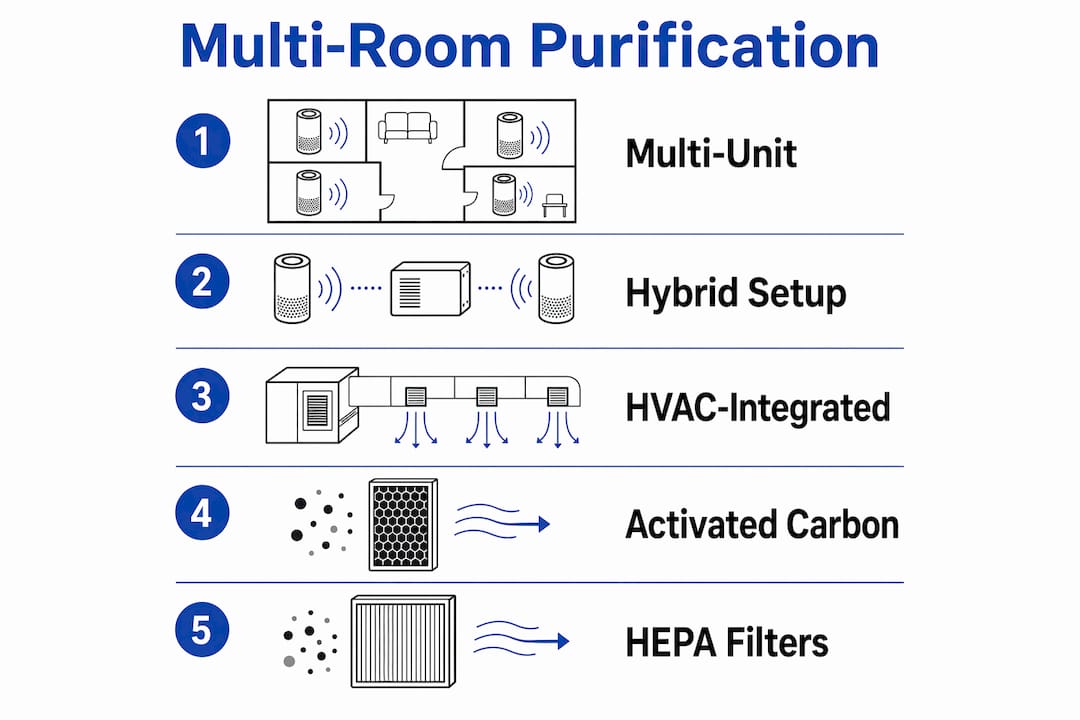
Multi-unit room-by-room strategy
The most common approach places a dedicated purifier in each high-priority room. Multi-unit setups covering 3,000–3,800+ square feet provide effective filtration across bedrooms, kitchens, and living areas simultaneously. Each unit is sized to its room using CADR and ACH calculations, and each can be set independently to match that room’s specific needs. A nursery might run on a quiet, low-speed setting overnight, while a kitchen unit runs at higher speed during cooking.
Hybrid strategies for mixed home layouts
A hybrid approach combines one larger unit in an open-plan area with smaller units in closed rooms. This suits most Australian homes, which often feature open lounge and kitchen areas alongside separate bedrooms. The large unit handles the shared living space, while compact units manage bedrooms and offices. This hybrid strategy is the most practical for most homes because it balances coverage, cost, and noise.
HVAC-integrated whole-home systems
For whole-home purification without multiple standalone devices, HVAC-integrated systems treat air as it circulates through the home’s ductwork. Advanced HVAC-integrated systems use technologies including UVC light, carbon matrix filtration, and photocatalytic oxidation to neutralise pollutants at the source. These systems suit larger homes or households with severe allergy or asthma needs. The trade-off is higher installation cost and dependence on the HVAC system running regularly.
| Approach | Best suited for | Key advantage | Main limitation |
|---|---|---|---|
| Multi-unit room-by-room | Homes with many closed rooms | Tailored filtration per room | Higher upfront cost |
| Hybrid (large + small units) | Mixed open-plan and closed rooms | Practical and cost-effective | Requires careful sizing |
| HVAC-integrated system | Larger homes with existing ductwork | Whole-home coverage | High installation cost |
Activated carbon filters play a supporting role across all three approaches. HEPA filtration captures particles like dust, pollen, and pet dander, but activated carbon targets gases, volatile organic compounds (VOCs), and odours. Kitchens and bathrooms benefit most from units that combine both filter types.
Pro Tip: For a list of purification methods suited to different home types, check Climatepro’s guide before committing to a single approach.
How to plan an effective multi-room purification system
Planning a multi-zone air purification system requires a structured approach. Guessing at placement or buying units without checking specifications leads to gaps in coverage and wasted money.
-
Identify your high-priority rooms. Start with the rooms where people spend the most time: bedrooms, the main living area, and any room occupied by children, elderly residents, or allergy sufferers. These rooms need the most consistent air quality.
-
Calculate CADR and ACH for each room. ACH of 4 to 5 is recommended for occupied rooms. To calculate the required CADR, multiply the room’s volume (length x width x ceiling height) by the target ACH, then divide by 60. This gives you the minimum CADR in cubic metres per minute your unit needs to deliver.
-
Account for room-specific pollutant sources. A kitchen needs strong odour and particle filtration. A bedroom prioritises quiet operation and allergen removal. A home office with a printer benefits from VOC filtration via activated carbon. Multi-unit systems allow tailored filtration matched to each room’s pollutant profile.
-
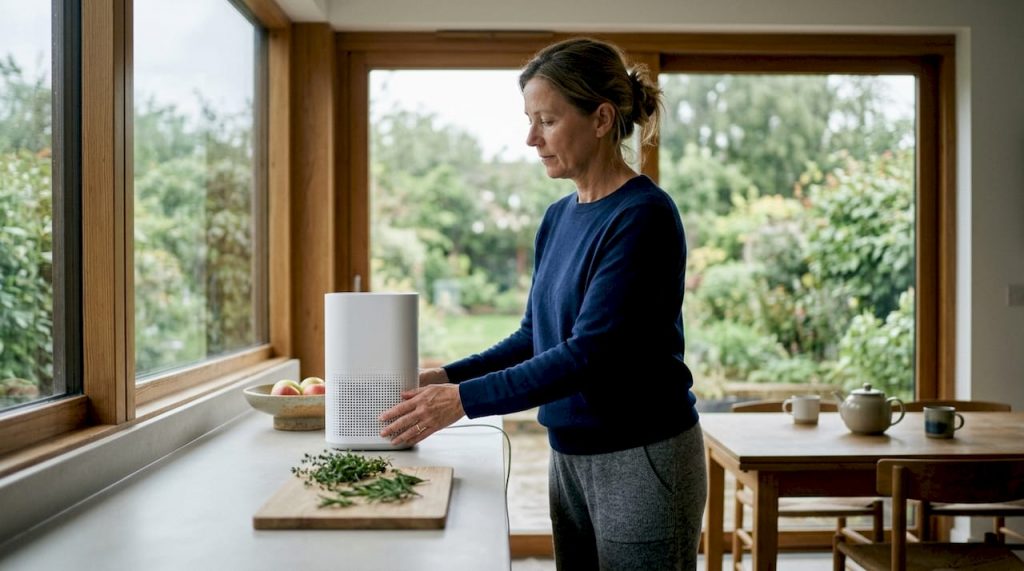
Place units to avoid airflow obstructions. Position purifiers away from walls and large furniture. In a large open-plan area, placing purifiers at opposite ends improves air mixing and reduces noise concentration. In bedrooms, place the unit near the door or in a corner with clear airflow on at least two sides.
-
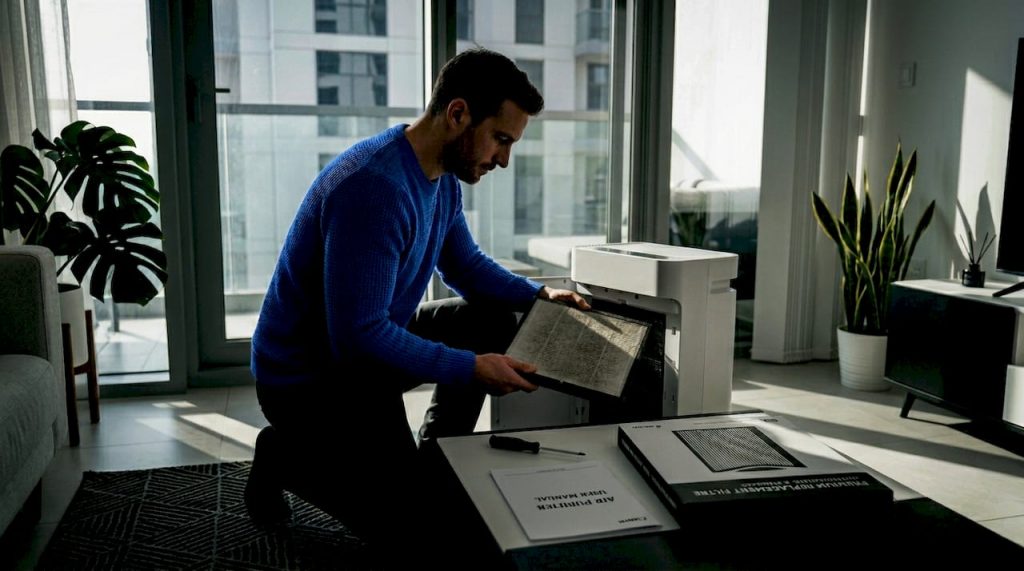
Set a filter replacement schedule. HEPA filters typically require replacement every 6–12 months depending on usage and local air quality. In the UAE, where dust levels are elevated, more frequent checks are advisable. Mark replacement dates on a calendar or use a unit with a filter-life indicator.
-
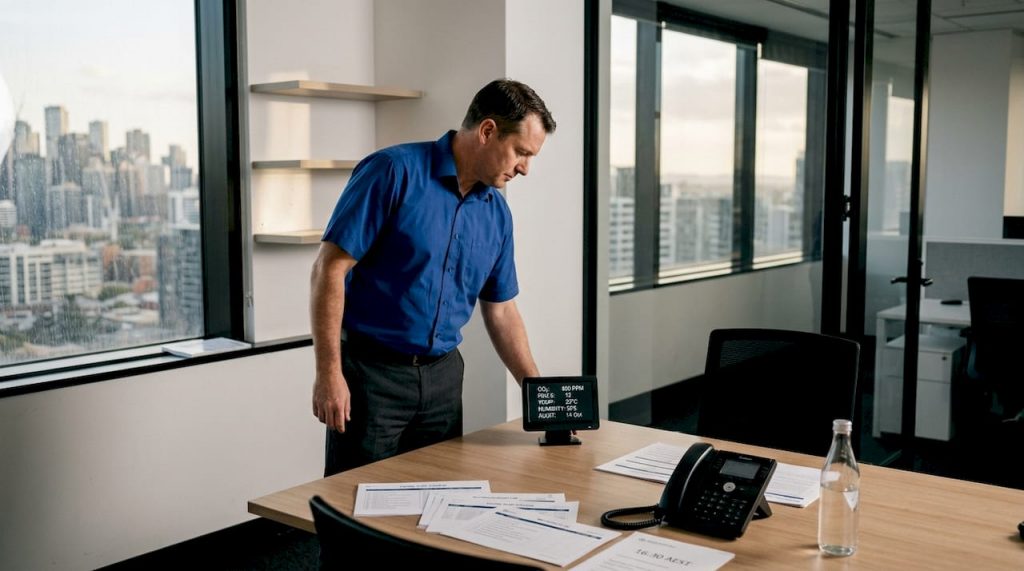
Use smart sensors to manage energy use. Modern purifiers with air quality sensors adjust fan speed automatically based on detected pollutant levels. This reduces energy consumption without sacrificing air quality. For more detail on balancing performance with running costs, Climatepro’s guide on energy-efficient air cleaning covers practical steps for multi-unit homes.
Pro Tip: Run purifiers continuously on low or auto mode rather than switching them on only when air quality seems poor. Pollutants accumulate gradually, and consistent operation maintains a stable baseline far more effectively than reactive use.
Benefits and challenges of multi-room purification
Multi-zone air purification delivers measurable improvements in home comfort and health, but it also comes with practical trade-offs worth understanding before you commit.
Key benefits:
- Multiple purifiers provide superior customisation for different household members, allowing allergy sufferers to have higher-grade filtration in their bedroom while a kitchen unit focuses on odour and smoke.
- Dedicated units in each room maintain consistent air quality regardless of what is happening in other parts of the home.
- Room-specific settings mean a nursery can run quietly overnight while a kitchen unit operates at full speed during meal preparation.
- Smart purifiers with auto-sensing reduce energy costs by scaling fan speed to actual air quality rather than running at maximum continuously.
Practical challenges:
- Multiple units carry higher upfront purchase costs compared to a single large device.
- Filter replacement across several units increases ongoing maintenance time and expense.
- Noise from multiple units running simultaneously can be noticeable if units are not selected with quiet operation in mind.
- Open-plan homes with partial walls or island benches may need careful placement to avoid dead zones where air circulation is poor.
The energy concern is often overstated. Modern purifiers with automatic sensors dynamically adjust fan speeds, which keeps running costs lower than homeowners typically expect when operating several units at once.
Common misconceptions about multi-room air purification
The most persistent myth is that one powerful purifier, placed centrally, can clean an entire multi-room home. Closed rooms with doors disrupt airflow, making single-unit whole-home cleaning impractical without HVAC integration. A unit rated for 150 square metres placed in a hallway will not meaningfully filter a closed bedroom 10 metres away.
A second common mistake is moving a single purifier from room to room throughout the day. This approach leaves each room unprotected for most of the day. Air purification is a spatial planning issue, not simply a device selection problem. Consistent placement in each key room outperforms any rotation strategy.
Furniture placement surprises many homeowners. A large sectional sofa, a bookshelf, or even a kitchen island can create airflow shadows where pollutants accumulate. Placing a purifier behind a sofa or in a corner blocked by furniture significantly reduces its effectiveness, even if the unit’s rated coverage matches the room size.
“The most effective approach to indoor air quality combines source control, adequate ventilation, and targeted purification. No purifier, regardless of its specifications, compensates fully for poor ventilation or a high-pollutant source left unaddressed. Purification works best as one layer of a broader strategy.”
Pro Tip: For room-by-room placement advice specific to common home layouts, Climatepro’s guide covers positioning for bedrooms, kitchens, and living areas in practical detail.
Key takeaways
Multi-room purification requires a spatial strategy, not just more devices: sizing each unit to its room using CADR and ACH metrics, placing units to avoid airflow obstructions, and running them consistently delivers the best results across a home.
| Point | Details |
|---|---|
| One unit cannot clean multiple closed rooms | Walls and closed doors block airflow, requiring dedicated units in each key space. |
| Use CADR and ACH to size units correctly | Target an ACH of 4 to 5 for occupied rooms and calculate CADR from room volume. |
| Hybrid strategies suit most homes | Combine a large unit in open areas with smaller units in closed bedrooms and offices. |
| Smart sensors reduce energy costs | Auto-sensing purifiers adjust fan speed to actual air quality, keeping running costs manageable. |
| Maintenance determines long-term performance | Replace HEPA filters every 6–12 months and check more frequently in dusty environments. |
My take on multi-room purification for real homes
Most homeowners I speak with approach air purification the same way: they buy one unit, place it in the lounge, and assume the job is done. The bedroom where they sleep eight hours a night gets nothing. That is the wrong priority order entirely.
Bedrooms and nurseries should be the first rooms you address. You spend more time in your bedroom than anywhere else in your home, and the air quality there directly affects sleep, recovery, and long-term respiratory health. A compact, quiet unit in each bedroom delivers more practical benefit than one large device in a shared space.
I have also found that homeowners consistently underestimate how much furniture disrupts airflow. A well-specified purifier placed behind a sofa performs like a unit two grades below its rating. Placement matters as much as specifications.
The hybrid approach, one larger unit for open living areas and smaller dedicated units for closed rooms, works well for the majority of homes. It balances cost, coverage, and usability without requiring a whole-home HVAC upgrade. Start with your highest-priority rooms, get the sizing right using CADR and ACH, and add units progressively as budget allows. That approach beats buying several underpowered units all at once.
— Nevel
Climatepro’s range for multi-room air quality
Climatepro stocks a wide range of air purifiers suited to every room size and purification need across the UAE.

Whether you need a compact unit for a bedroom, a higher-capacity model for an open-plan living area, or a full multi-room setup, Climatepro’s air purifier catalogue covers options across all price points with delivery to Dubai, Abu Dhabi, Sharjah, and all emirates. The Honeywell Air Touch P1 suits bedrooms and home offices, while the Honeywell Air Touch U1 handles larger living spaces. Each product listing includes coverage area, CADR ratings, and filter specifications so you can match the unit to your room before purchasing.
FAQ
What is multi-room purification?
Multi-room purification is the use of multiple air purification devices, or an HVAC-integrated system, to deliver clean air across several rooms or zones in a home. It addresses the limitation of single portable units, which only clean the room they occupy.
How many air purifiers do I need for my home?
The number depends on your home’s layout and how many rooms are regularly occupied. Each closed room with regular occupancy, such as bedrooms, a study, or a nursery, benefits from its own dedicated unit sized to that room’s CADR and ACH requirements.
Can I move one purifier between rooms instead of buying multiple units?
Moving a single unit between rooms leaves each space unprotected for most of the day. Consistent placement in each key room maintains a stable air quality baseline far more effectively than rotating one device.
What does CADR mean and why does it matter for multi-room setups?
CADR (clean air delivery rate) measures how quickly a purifier cleans a specific volume of air. For multi-room setups, you calculate the required CADR for each room individually based on room volume and a target ACH of 4 to 5, then select a unit that meets or exceeds that figure.
Are HVAC-integrated systems better than multiple portable purifiers?
HVAC-integrated systems provide whole-home coverage without multiple standalone devices, but they require existing ductwork and carry higher installation costs. For most homes, a hybrid approach using portable units is more practical and cost-effective.