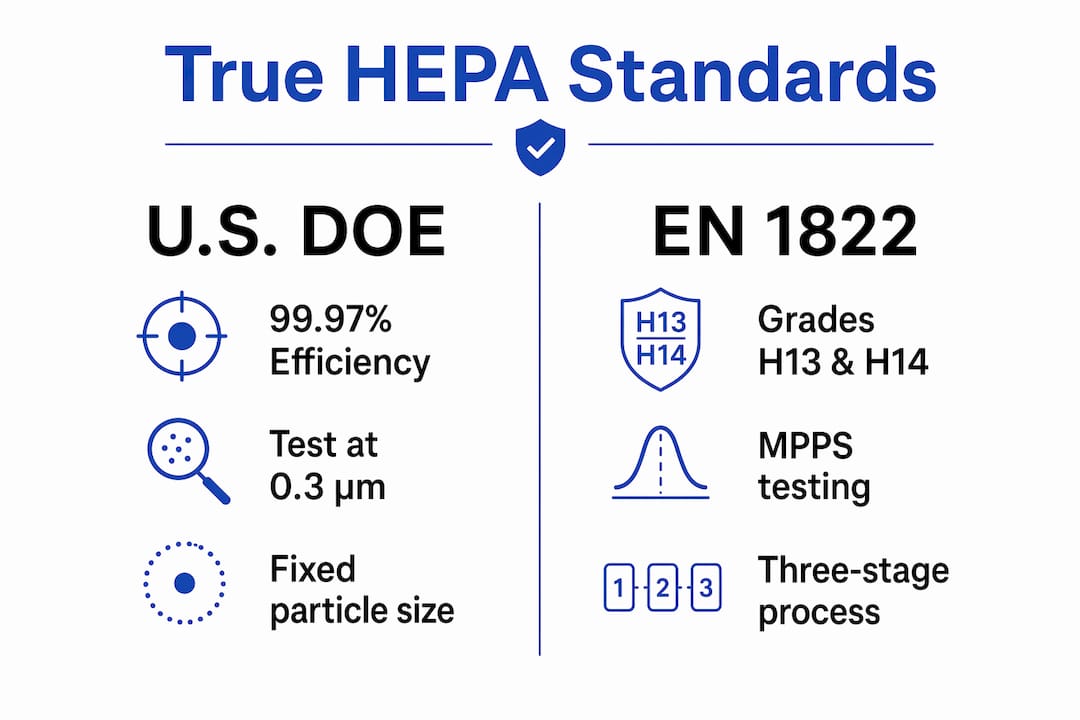
True HEPA filtration is defined by a single, non-negotiable benchmark: a filter must capture at least 99.97% of airborne particles measuring 0.3 micrometres. That threshold comes from the U.S. Department of Energy (DOE), and it is the same figure referenced by international bodies including the European EN 1822 standard and ISO 29463. Understanding what are true HEPA standards matters because the air purifier market is crowded with filters labelled “HEPA-type,” “HEPA-style,” and “HEPA-like,” none of which meet this threshold. Knowing the difference protects your health and your money.
What are true HEPA standards and how are they tested?
True HEPA filters are verified through controlled laboratory testing, not manufacturer claims. The U.S. DOE method exposes a filter to an aerosol of dioctyl phthalate (DOP) or polyalphaolefin (PAO) particles under a controlled airflow rate. Instruments measure particle concentration upstream and downstream of the filter. A filter passes only if it blocks at least 99.97% of particles at the 0.3 micrometre size, which is considered the hardest size to capture.
The European EN 1822 and ISO 29463 standards take a different approach. Rather than testing at a fixed 0.3 micrometre particle size, they test at the Most Penetrating Particle Size (MPPS). The MPPS typically falls between 0.12 and 0.25 micrometres, which is actually harder for filters to capture than 0.3 micrometre particles. This means EN 1822 testing can be more demanding than the U.S. DOE method.
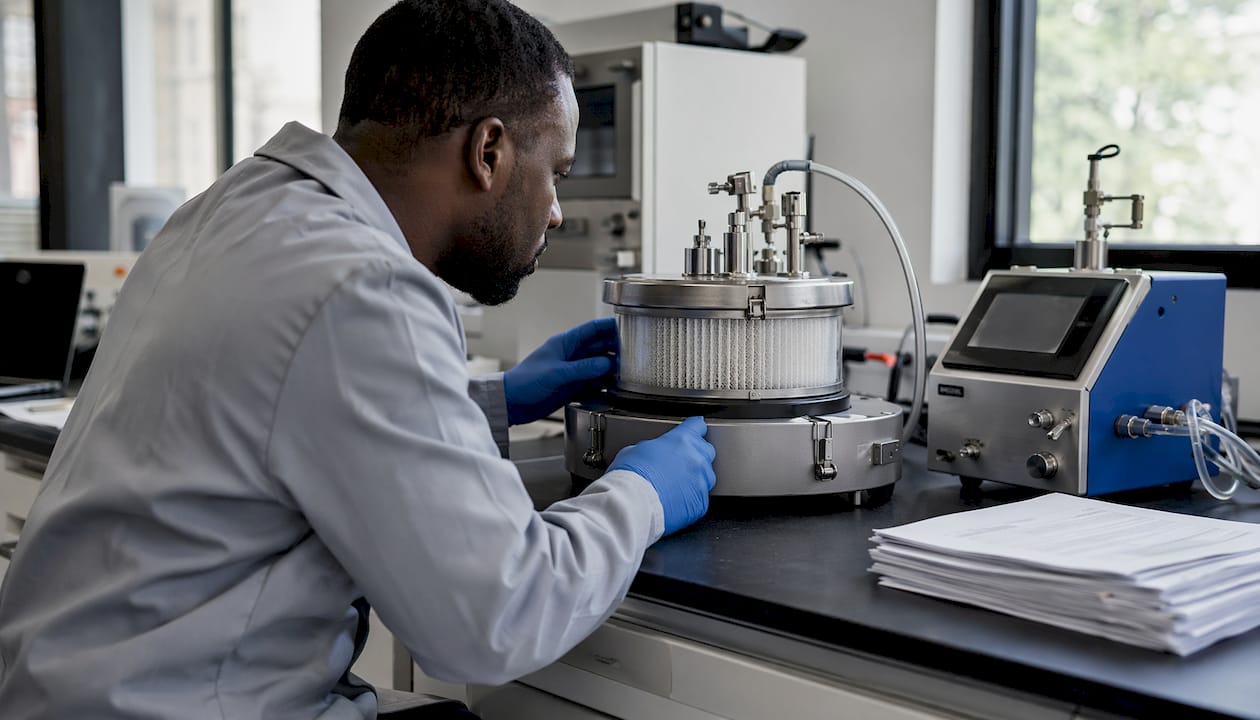
The three stages of EN 1822 testing
EN 1822 certification for H14 grade filters requires three distinct test stages:
- Media efficiency test: The raw filter media is tested at MPPS to confirm the material itself meets the required efficiency before assembly.
- Overall filter scan: The fully assembled filter is scanned across its entire face to detect any weak zones in the media.
- Local leak test: Seals, frames, and joints are checked individually to confirm no air bypasses the filtration media.
This three-stage process means an EN 1822 certified filter has been verified at both the material and the assembled product level. A filter that passes only a media test could still leak at its frame, making the full scan and leak test critical for real-world performance.
EN 1822 grading: H13 and H14
The EN 1822 standard classifies high-efficiency filters into grades. For home and commercial air purification, H13 and H14 are the most relevant.
| Grade | Minimum overall efficiency | Minimum local efficiency | Testing basis |
|---|---|---|---|
| H13 | 99.95% | 99.75% | MPPS |
| H14 | 99.995% | 99.975% | MPPS |
H14 allows ten times less particle penetration than H13. For most residential settings, H13 meets the performance criteria of True HEPA certification. H14 is more common in medical facilities, pharmaceutical cleanrooms, and operating theatres.
Pro Tip: When reviewing a product’s specifications, look for the explicit grade designation, such as H13 or H14, rather than a generic “True HEPA” label. The grade tells you exactly what efficiency level has been independently verified.
How does True HEPA compare to HEPA-type and HEPA-like filters?
The terms “HEPA-type,” “HEPA-style,” and “HEPA-like” are marketing labels with no regulatory definition. No government body certifies these terms, and manufacturers apply them freely to filters that fall well short of the 99.97% efficiency threshold.
Filters carrying these labels typically capture between 85% and 99% of particles. That gap sounds small, but the real-world difference is significant. A True HEPA filter allows only 3 particles out of every 10,000 to pass through. A filter operating at 95% efficiency allows up to 500 particles out of every 10,000 to pass. That is more than 160 times the particle leakage.
Why the gap matters for indoor air quality
The particles most harmful to respiratory health, including fine dust, pollen, mould spores, pet dander, and some bacteria, fall within the size range that True HEPA filters are specifically designed to capture. A filter operating at 95% efficiency misses a meaningful proportion of these particles on every pass. Over hours of continuous operation in a bedroom or living area, that leakage accumulates.
The core problem with unregulated labels is that no federal certification mandates exist for consumer air purifiers in the U.S. or Australia. Manufacturers can print “HEPA” on packaging without independent verification. The only reliable protection for buyers is documented test data referencing DOE or EN 1822 standards.
How to verify HEPA filter effectiveness before you buy
Checking HEPA filter effectiveness requires looking beyond the product label. The following steps give buyers a reliable framework for evaluating any air purifier.
-
Confirm the efficiency figure. Look for an explicit statement of 99.97% at 0.3 micrometres (DOE standard) or an EN 1822 H13 or H14 grade designation. A vague claim like “True HEPA” without a supporting figure is not sufficient.
-
Request or locate the test report. Reputable manufacturers publish independent laboratory test reports. These documents name the testing standard used, the particle sizes tested, and the measured efficiency results. If a manufacturer cannot provide this, treat the product with caution.
-
Check the Clean Air Delivery Rate (CADR). Filter efficiency and CADR are separate metrics. CADR measures how much clean air the unit delivers per minute, combining filter efficiency with fan airflow. A high-grade filter in an underpowered unit still produces poor results.
-
Inspect housing and seal integrity. Air bypasses the filter if the housing is poorly sealed. Even a certified H14 filter performs poorly if air leaks around the filter frame rather than through it. Check product reviews and specifications for mention of sealed housing or bypass prevention.
-
Consider regional standard equivalence. Australian consumers can rely on products certified to either the U.S. DOE standard or EN 1822 H13/H14. Both are internationally recognised and provide comparable protection for residential use.
Pro Tip: Search for the product’s model number alongside “test report” or “EN 1822 certificate” before purchasing. Legitimate manufacturers make this documentation available, often on their website or through the retailer.
For further context on HEPA filtration benefits in residential settings, Climatepro’s resource library covers practical applications across different home environments.
How do international HEPA standards compare for home use?
The U.S. DOE and European EN 1822 standards approach HEPA testing differently, but their practical outcomes for home use are functionally equivalent. The key distinction lies in the particle size used for testing.
The DOE tests at a fixed 0.3 micrometre particle size because this was historically identified as the hardest size for fibrous filters to capture. EN 1822 tests at the MPPS, which varies by filter media but generally falls below 0.3 micrometres. Because the MPPS is harder to capture than 0.3 micrometre particles, a filter that passes EN 1822 testing has cleared a slightly more demanding hurdle.
| Standard | Efficiency threshold | Test particle size | Typical application |
|---|---|---|---|
| U.S. DOE True HEPA | 99.97% | 0.3 µm (fixed) | Consumer, industrial |
| EN 1822 H13 | 99.95% overall | MPPS (0.12–0.25 µm) | Residential, commercial |
| EN 1822 H14 | 99.995% overall | MPPS (0.12–0.25 µm) | Medical, cleanroom |
| ISO 29463 | Mirrors EN 1822 | MPPS | International alignment |
For home use, H13 and U.S. True HEPA deliver comparable particle capture performance. The slight testing differences between the two standards do not produce a meaningful gap in real-world air quality outcomes for residential spaces. H14 represents a step above what most homes require, though it is the appropriate choice for households with immunocompromised members or severe respiratory conditions.
Choosing an energy-efficient air purifier with a verified H13 or True HEPA filter covers the needs of the vast majority of Australian homes.
Key takeaways
True HEPA filters must meet a verified efficiency of at least 99.97% at 0.3 micrometres under the U.S. DOE standard, or 99.95% at MPPS under EN 1822 H13, with both standards delivering comparable protection for residential use.
| Point | Details |
|---|---|
| Core efficiency threshold | True HEPA requires 99.97% capture at 0.3 µm; EN 1822 H13 requires 99.95% at MPPS. |
| Marketing labels are unregulated | Terms like HEPA-type or HEPA-like carry no standard and may only capture 85–99% of particles. |
| CADR matters as much as filter grade | A certified filter in a poorly sealed or underpowered unit still delivers poor air quality results. |
| Verify with documentation | Always request independent lab test reports citing DOE or EN 1822 standards before purchasing. |
| H13 suits most homes | EN 1822 H14 is reserved for medical and cleanroom settings; H13 covers standard residential needs. |
Why the label is only half the story
I have reviewed a lot of air purifier specifications over the years, and the pattern is consistent: buyers focus almost entirely on whether a filter carries the “True HEPA” label and stop there. That is understandable. The label sounds authoritative. The problem is that the term has no federal regulatory status in either the U.S. or Australia. A manufacturer can print it on packaging without submitting to independent testing.
What I have found actually separates a reliable air purifier from a mediocre one is the combination of a verified filter grade and a well-engineered housing. I have seen products with genuinely certified H13 filters that still underperform because air leaks around the filter frame. The filter does its job perfectly. The unit does not. CADR is the metric that catches this. It accounts for both filtration efficiency and actual airflow, so a low CADR on a “True HEPA” product is a red flag worth taking seriously.
My practical advice for Australian buyers is straightforward. Ask for the test report. If the manufacturer or retailer cannot produce documentation referencing EN 1822 or the U.S. DOE standard, move on. The products that meet genuine HEPA performance criteria have nothing to hide and typically publish this data openly. The ones that rely on marketing language alone rarely do.
— Nevel
Verified True HEPA air purifiers from Climatepro
Climatepro stocks a range of air purifiers with verified True HEPA filtration, selected for documented performance rather than label claims alone.
The Climatepro catalogue includes models suited to bedrooms, living areas, offices, and clinics across the UAE. Each listed product comes with accessible specifications so buyers can confirm filter grade and CADR before purchasing. The Honeywell Air Touch P2 is one example of a unit with validated True HEPA filtration available for delivery across Dubai, Abu Dhabi, Sharjah, and all seven emirates. For a broader selection, the full air purifier catalogue lists options across multiple room sizes and performance tiers, with pricing in AED and same-country delivery.
FAQ
What efficiency does a True HEPA filter need to achieve?
A True HEPA filter must capture at least 99.97% of airborne particles at 0.3 micrometres, as defined by the U.S. Department of Energy. Under EN 1822, the equivalent H13 grade requires 99.95% efficiency at the Most Penetrating Particle Size.
Is “HEPA-type” the same as True HEPA?
No. “HEPA-type” is an unregulated marketing term. Filters using this label typically capture between 85% and 99% of particles, which is significantly below the True HEPA threshold of 99.97%.
How do I verify a filter meets True HEPA standards?
Request the manufacturer’s independent laboratory test report. The document should reference either the U.S. DOE standard with 99.97% at 0.3 µm, or EN 1822 with an H13 or H14 grade designation.
What is the difference between H13 and H14 filters?
H13 filters achieve a minimum overall efficiency of 99.95% at MPPS, while H14 filters reach 99.995%. H14 allows ten times less particle penetration than H13 and is typically used in medical and cleanroom environments rather than standard homes.
Does a True HEPA filter guarantee clean air on its own?
No. Filter grade is one factor. Clean Air Delivery Rate (CADR) and housing seal integrity determine how much clean air the unit actually delivers. A certified filter in a poorly sealed unit will underperform regardless of its grade.
Recommended
- HEPA filtration: Improve your UAE home’s air quality — Blog | ClimatePro UAE
- List of air purification methods for healthier homes — Blog | ClimatePro UAE
- Air purifier buying tips: how to choose the right one — Blog | ClimatePro UAE
- Levoit Vital 100 true HEPA air purifier review — Blog | ClimatePro UAE