
Many UAE residents accept dusty skies as a seasonal inconvenience, but the air quality challenge here extends well beyond visible haze. Microscopic pollutants that cannot be seen or smelled circulate year-round, entering buildings through windows, air-conditioning systems, and gaps in doors. These particles carry measurable health consequences, and the good news is that residents can monitor, manage, and reduce their exposure using practical, evidence-based strategies. This guide explains exactly what you are dealing with, how the numbers are measured, and what actions produce real results.
Table of Contents
- What is air pollution and why does it matter in the UAE?
- How is air pollution measured: AQI, PM2.5, and understanding the numbers
- How air pollution affects your health: What UAE studies reveal
- Practical steps to protect your health and improve indoor air quality
- Why residents should take a common-sense, consistent approach
- How ClimatePro UAE can help you breathe easier
- Frequently asked questions
Key Takeaways
| Point | Details |
|---|---|
| PM2.5 is the key pollutant | Fine particles from dust and emissions are the main health risk in UAE air pollution. |
| Monitoring matters daily | Residents should check AQI and PM2.5 readings to plan activities and manage exposure. |
| Health effects are complex | Research shows unexpected results, so focus on consistent exposure reduction strategies. |
| Indoor air needs protection | Indoor spaces can accumulate outdoor pollutants, making purifiers and habits crucial. |
| Consistent habits are best | Ongoing, simple precautions do more to protect health than obsessing over variable readings. |
What is air pollution and why does it matter in the UAE?
Air pollution refers to the presence of harmful substances in the atmosphere at concentrations that affect human health, ecosystems, or built environments. In the UAE, the dominant sources are desert dust, vehicle exhaust, construction activity, and industrial emissions from refineries and power generation. Each source contributes different types of pollutants, but fine particulate matter known as PM2.5 is the one that carries the greatest health risk.
PM2.5 describes particles with a diameter of 2.5 micrometres or smaller. To put that in perspective, a human hair is roughly 70 micrometres wide, making PM2.5 almost invisible to the naked eye. Because these particles are so small, they bypass the nose and throat’s natural filtering mechanisms and travel deep into the lungs. From there, the smallest fractions can enter the bloodstream. Coarser dust particles, sometimes called PM10, are easier for the respiratory system to filter out and present comparatively lower long-term risk.
The primary outdoor pollutants tracked in the UAE include:
- PM2.5 (fine particulate matter from dust, combustion, and vehicle exhaust)
- PM10 (coarser particles from construction, unpaved roads, and desert dust)
- Nitrogen dioxide (NO2) (mainly from vehicle and industrial emissions)
- Ozone (O3) (formed by sunlight reacting with vehicle and industrial emissions)
- Carbon monoxide (CO) (produced by incomplete combustion)
Studies examining daily PM2.5 and asthma symptoms in Dubai highlight that air pollution is directly relevant to respiratory health in this region, not just a theoretical concern. The WHO’s PM2.5 annual guideline of 5 µg/m³ provides a health-based benchmark, yet urban centres across the Gulf regularly record annual averages that substantially exceed this figure.
The WHO guideline of 5 µg/m³ for annual average PM2.5 is not an aspirational target — it is the concentration below which long-term health risks become significantly reduced. For reference, concentrations in many UAE urban areas frequently exceed this level on a daily basis.
For residents seeking practical strategies, improving air quality in UAE apartments is a logical starting point given how much time is spent indoors. The transition from outdoor awareness to indoor action is a theme that runs through the remainder of this guide.
How is air pollution measured: AQI, PM2.5, and understanding the numbers
Two metrics appear most frequently in public reporting and air quality apps: the Air Quality Index (AQI) and the PM2.5 concentration expressed in micrograms per cubic metre (µg/m³).
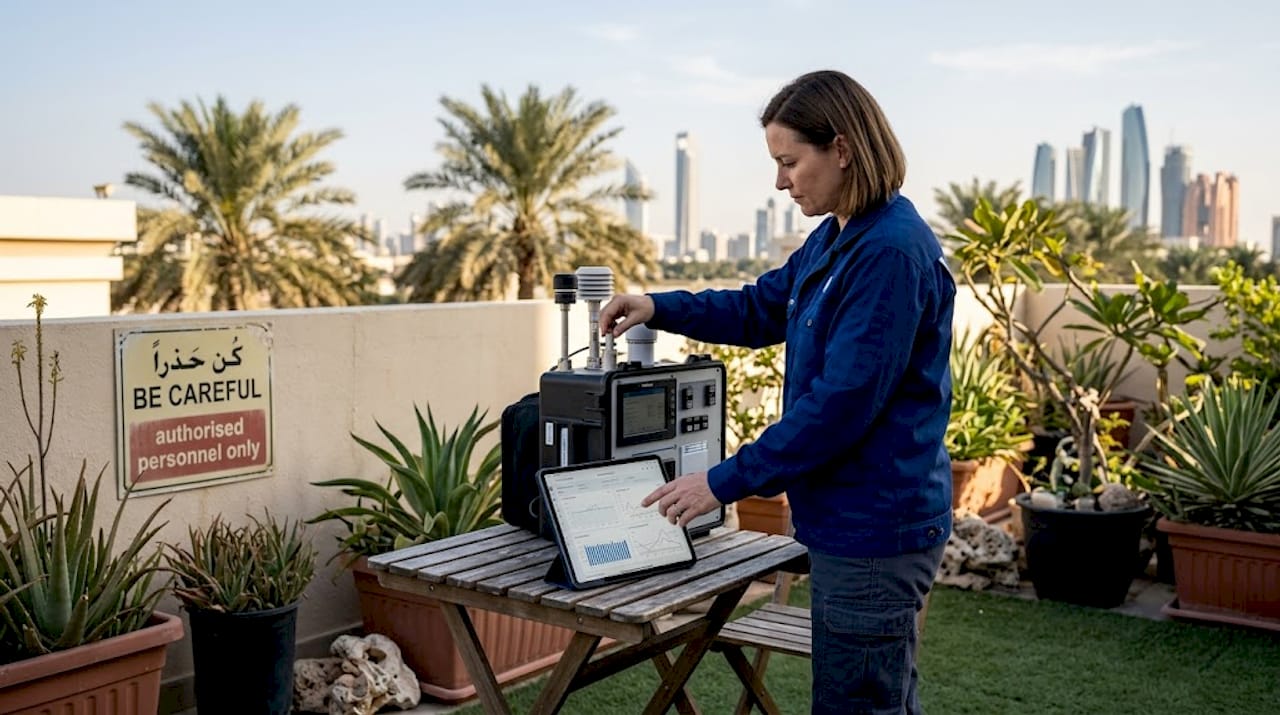
PM2.5 concentration is the direct physical measurement. It tells you how many micrograms of fine particles are present in one cubic metre of air. This is the figure that scientists and health authorities rely on most when setting health standards.
AQI is a standardised, colour-coded scale that translates raw pollution measurements into a single number ranging from 0 to 500. It was designed to make air quality data accessible to the general public without requiring technical knowledge. A reading below 50 is considered “Good,” while readings above 150 are considered unhealthy for all population groups.
| AQI range | Category | What it means for residents |
|---|---|---|
| 0 to 50 | Good | Normal outdoor activity is fine |
| 51 to 100 | Moderate | Sensitive groups should consider limiting prolonged outdoor exertion |
| 101 to 150 | Unhealthy for sensitive groups | Children, elderly, and those with asthma should reduce outdoor time |
| 151 to 200 | Unhealthy | Everyone should limit prolonged outdoor activity |
| 201 to 300 | Very unhealthy | Avoid outdoor activity where possible |
| 301 and above | Hazardous | Remain indoors; air purification recommended |
AQI and PM2.5 readings are compiled through networks of outdoor monitoring stations, aggregating data across different zones within cities such as Dubai. These networks feed into public dashboards and smartphone applications that residents can consult in real time. The WHO PM2.5 benchmarks serve as the underlying reference point for interpreting whether recorded concentrations represent an acceptable or concerning level of exposure.
Dust storms are a particular challenge in the UAE. During a major haboob (the Arabic term for an intense dust storm), PM10 and PM2.5 levels can spike within minutes, reaching AQI values above 300 in affected areas. Checking readings before morning exercise or allowing children to play outdoors is especially important during transitional seasons when dust events are more frequent.
Pro Tip: Download a reputable air quality app that displays PM2.5 specifically, not just AQI, since AQI can sometimes mask short-term PM2.5 spikes. Set alerts for when PM2.5 exceeds 35 µg/m³, which is the WHO 24-hour mean guideline.
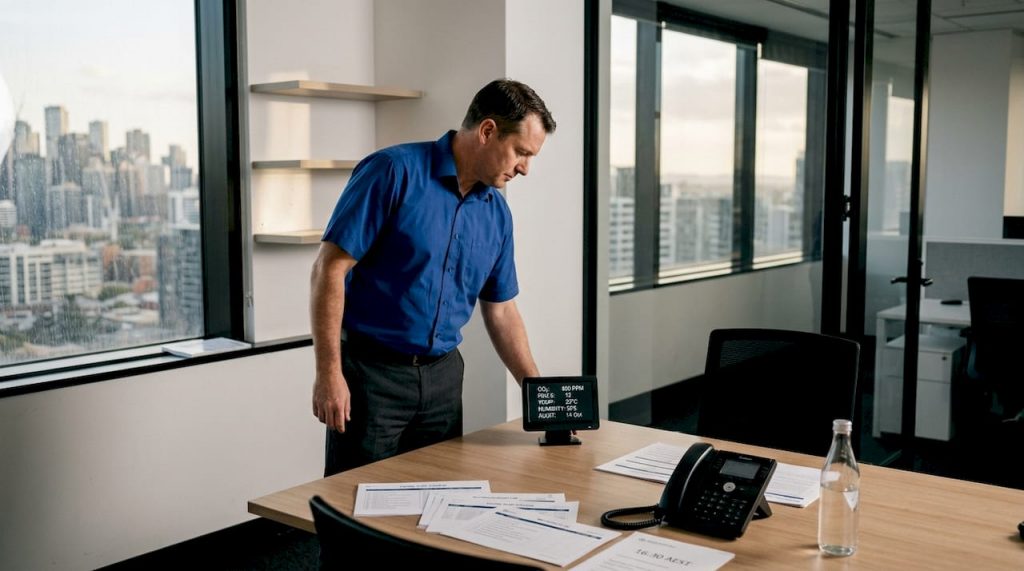
Residents interested in monitoring AQI at home with dedicated indoor monitors will find this particularly useful during dust events when outdoor readings climb rapidly. Understanding air changes per hour is equally relevant because it determines how quickly outdoor pollutants can infiltrate an indoor space through ventilation.
How air pollution affects your health: What UAE studies reveal
Short-term health effects of elevated PM2.5 exposure include irritation of the eyes, nose, and throat, aggravated asthma symptoms, increased frequency of respiratory infections, and reduced lung function during peak pollution episodes. For most healthy adults, these effects are temporary and resolve when pollution levels drop.
Long-term exposure is a different matter. Sustained exposure to PM2.5 concentrations above WHO guidelines is associated with chronic obstructive pulmonary disease (COPD), cardiovascular disease, and increased mortality risk. Children are particularly vulnerable because their lungs are still developing, and elderly residents face compounded risk due to existing health conditions.
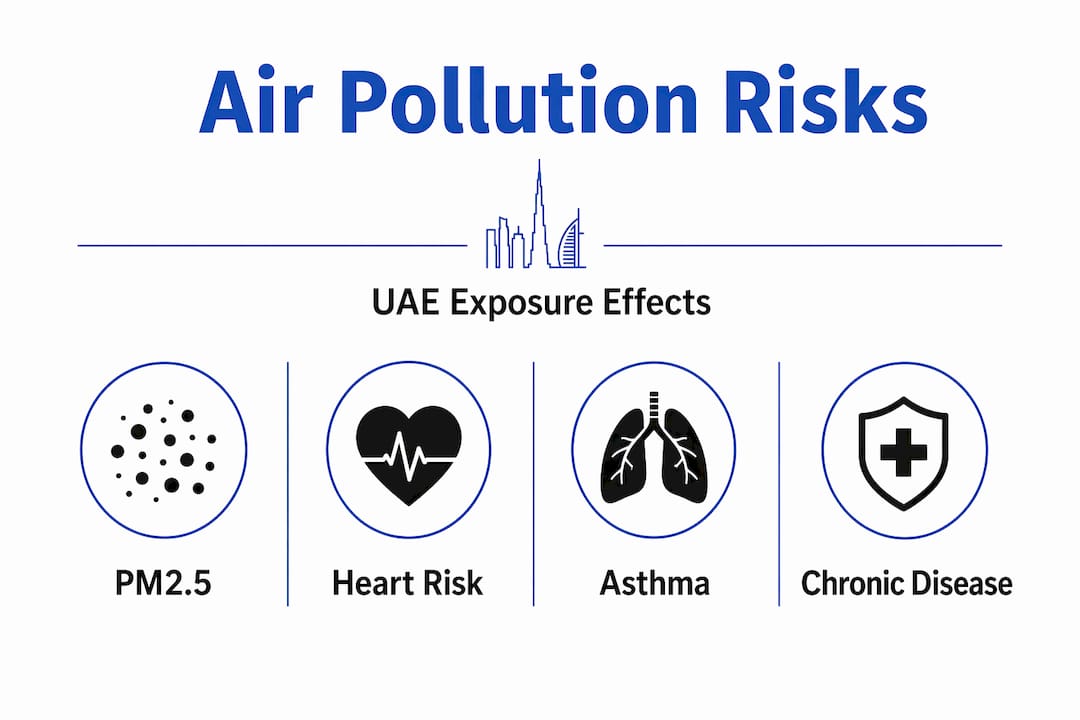
Research specifically conducted in Dubai provides an important local perspective. Dubai asthma studies examining PM2.5 have produced findings that do not always align with the straightforward assumption that higher PM2.5 automatically produces worse symptoms. One study found an unexpected inverse association between certain PM2.5 categories and shortness of breath in asthma patients. This is a nuanced finding that reflects the complexity of how different particle compositions, indoor-outdoor exposure ratios, and patient behaviour interact in real-world conditions.
The key takeaway from this nuance is not that PM2.5 is safe. Rather, it demonstrates that a single study should never be the basis for dismissing pollution as harmless. Residents who form consistent protection habits fare better than those who only react when they feel immediately unwell.
Symptoms that should prompt action include:
- Persistent or worsening cough after periods of outdoor activity during high-AQI days
- Increased frequency of asthma attacks or inhaler use with no change in medication
- Eye irritation or a burning sensation in the throat after extended time outdoors
- Unusual fatigue or difficulty breathing following dust storm events
- Children returning from school with coughs or nasal congestion during high-pollution periods
A comparison of short-term versus long-term health effects helps clarify what residents should monitor:
| Effect type | Typical symptoms | Population most affected |
|---|---|---|
| Short-term | Coughing, eye irritation, asthma flare-ups | Asthma patients, children, elderly |
| Long-term | COPD, cardiovascular disease, reduced lung capacity | All residents with chronic high exposure |
| Dust storm specific | Rapid PM2.5 spikes, severe respiratory distress | Everyone, but especially vulnerable groups |
Pro Tip: Keep a simple log of symptom frequency alongside AQI readings for a few weeks. This personal data is far more useful when speaking with a doctor about suspected air pollution-related health issues than general statistics.
Understanding air cleaning technologies for healthier UAE homes is a practical next step once you recognise the health risks associated with sustained PM2.5 exposure indoors.
Practical steps to protect your health and improve indoor air quality
Acting on air quality knowledge requires a set of consistent daily habits rather than reactive, crisis-driven responses. The evidence suggests that reducing chronic PM2.5 exposure matters more than responding to individual pollution spikes.
Key steps residents can take include:
- Check AQI before outdoor activities. This is especially important for children, elderly family members, and anyone with a respiratory condition. Make it part of the morning routine, similar to checking the weather forecast.
- Ventilate strategically. Opening windows during early morning hours, when traffic emissions are lower and before temperatures cause air-conditioning units to recirculate indoor air, can help introduce cleaner outdoor air. Avoid ventilating during peak traffic hours or active dust events.
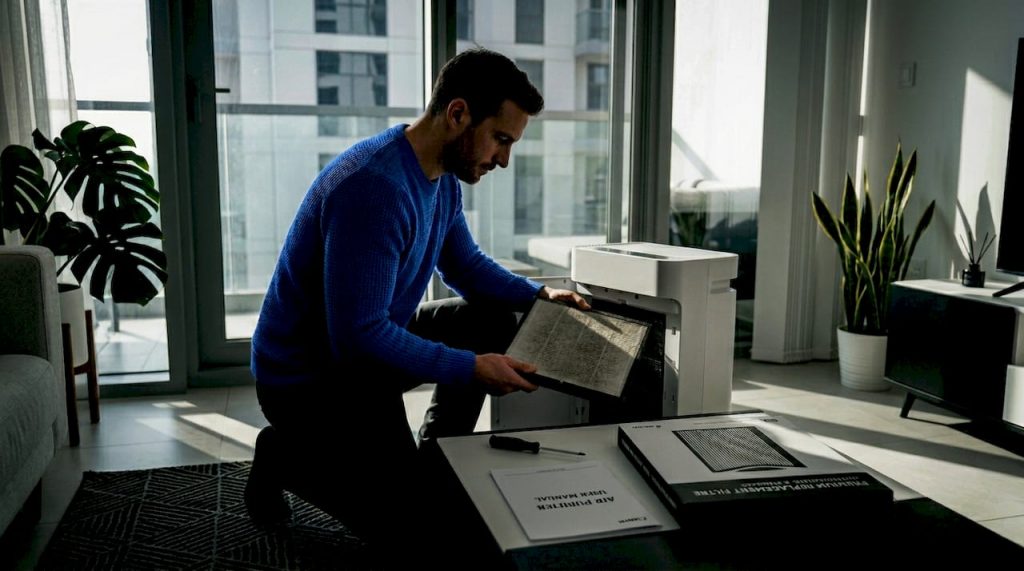
- Use a HEPA-filtered air purifier indoors. A purifier equipped with a True HEPA filter (rated to capture particles down to 0.3 micrometres) will remove the vast majority of PM2.5 from indoor air. This is the single most effective technical intervention for improving indoor air quality during high-pollution periods.
- Maintain your air-conditioning filters. Central AC and split systems trap some particulate matter, but dirty filters recirculate trapped pollutants. Clean or replace filters every one to three months depending on dust levels in your area.
- Minimise indoor pollution sources. Cooking without adequate range-hood ventilation, burning incense, and using aerosol sprays all contribute to indoor PM2.5. Addressing these sources reduces the total pollution load your air purifier needs to handle.
- Reduce outdoor exercise during high-AQI periods. This applies most strongly when AQI exceeds 100. Moving workouts indoors or to gym facilities during these periods reduces respiratory exposure significantly.
Pro Tip: Position your air purifier in the room where you spend the most time, typically the bedroom for sleeping hours. Running it overnight ensures you spend a minimum of six to eight hours breathing cleaner air, which substantially reduces your cumulative daily exposure.
Guidance on how to improve air quality in UAE apartments provides additional detail on apartment-specific strategies, including dealing with shared ventilation systems in high-rise buildings. For broader household management during UAE summers, smart climate control tips offers complementary advice on balancing ventilation, cooling, and air quality.
Why residents should take a common-sense, consistent approach
There is a tendency in health-conscious communities to monitor air quality data intensively, then feel anxious on high-pollution days or dismissive when a study produces a result that doesn’t match expectations. Neither response is particularly productive.
The Dubai asthma research is a good example. When an inverse association between PM2.5 and specific symptoms appeared in one study, it would be easy to misread that as evidence that fine particles are not harmful. This would be incorrect. What it actually reflects is the complexity of real-world exposure, including the fact that patients may modify their behaviour during known high-pollution days, that indoor versus outdoor time ratios vary, and that particle composition changes depending on the pollution source.
The practical implication is straightforward: focus on building habits that consistently reduce exposure rather than trying to manage daily fluctuations perfectly. For families in the UAE, this means having an air purifier that runs regularly, not just during obvious dust storms. It means checking AQI before outdoor activities as a habit, not an emergency measure. It means understanding that children and elderly residents benefit disproportionately from cleaner indoor air because their physiological resilience to pollutant exposure is lower.
The UAE’s air quality has distinct seasonal patterns. Summer months bring intense heat and reduced outdoor activity anyway, limiting outdoor exposure. Spring and autumn transitional months bring the highest frequency of dust events, which is when indoor air quality management becomes most critical. Winter months may see elevated NO2 from traffic as cooler, denser air traps vehicle emissions closer to ground level.
Investing in cleaning technologies for healthier homes is not about reacting to a bad AQI day. It is about recognising that sustained, lower-level exposure over months and years is where the real health risk accumulates. Consistent protective habits, applied year-round, are more effective than intense short-term responses.
How ClimatePro UAE can help you breathe easier
The steps outlined in this guide require reliable indoor air quality equipment to be fully effective, and ClimatePro UAE provides a curated range of solutions suited to UAE homes, apartments, and offices.

For residents ready to take action, browsing the full range of UAE air purifiers is a practical starting point. The range includes models suited to different room sizes and pollution challenges, from compact units for bedrooms to high-capacity models for living areas and open-plan spaces. A strong option worth considering is the Honeywell Air Touch U1 Air Purifier, which is designed to handle PM2.5 and allergens effectively in UAE conditions. ClimatePro UAE delivers across Dubai, Abu Dhabi, Sharjah, and all emirates, making it straightforward to upgrade your indoor air quality without delay.
Frequently asked questions
What does PM2.5 mean and why is it important in the UAE?
PM2.5 refers to fine particles smaller than 2.5 micrometres in diameter that penetrate deep into the lungs and pose serious health risks. The WHO’s PM2.5 guidelines identify this pollutant as one of the highest-priority air quality concerns globally, and the UAE’s dust-rich environment makes monitoring it especially relevant for residents.
How do I check daily air quality in my UAE neighbourhood?
You can view real-time AQI and PM2.5 readings through UAE government air quality dashboards or third-party apps that pull data from outdoor monitoring networks covering Dubai and other emirates. Setting daily alerts for PM2.5 thresholds is the most practical approach for busy residents.
Is indoor air also polluted in the UAE?
Yes. Outdoor pollutants infiltrate indoor spaces through ventilation systems, open windows, and building gaps, meaning indoor PM2.5 levels can closely track outdoor readings during dust events. Managing indoor air quality independently through filtration is essential, not optional.
How does air pollution impact children or asthma sufferers in the UAE?
Children and asthma sufferers face heightened sensitivity to PM2.5 exposure. Dubai studies on PM2.5 and asthma highlight complex health associations and reinforce the importance of building consistent exposure-reduction habits for these groups, particularly during dust storm season.
What is the WHO’s recommended safe level for PM2.5?
The WHO annual PM2.5 guideline is 5 micrograms per cubic metre, a level that many highly urbanised and dust-prone areas, including parts of the UAE, regularly exceed. This standard is the primary health-based benchmark used by air quality researchers and policymakers worldwide.
Recommended
- How to improve air quality in UAE apartments — Blog | ClimatePro UAE
- Understand air cleaning technologies for healthier UAE homes — Blog | ClimatePro UAE
- Why monitoring AQI at home protects your family’s health — Blog | ClimatePro UAE
- Air changes per hour and better indoor air quality — Blog | ClimatePro UAE