Young children in UAE nurseries spend up to eight hours daily in enclosed spaces where pollutant concentrations can reach levels significantly higher than outdoors. Dubai’s desert climate, dusty air, and energy-efficient sealed buildings create conditions that elevate particulate matter, carbon dioxide, formaldehyde, and humidity simultaneously. Managing these risks requires more than good intentions. This checklist gives parents and caregivers a structured, evidence-based approach to evaluating and improving nursery air quality, covering monitoring, response protocols, and practical corrective measures aligned with local regulatory expectations.
Table of Contents
- Understand essential air quality parameters and standards
- Checklist step 1: Assessing ventilation and the CO2 proxy
- Checklist step 2: Monitoring particulate matter and pollution
- Checklist step 3: Controlling humidity, VOCs and post-renovation risks
- Checklist step 4: Recommended response protocols and ongoing monitoring
- Our take: What most checklists miss about nursery air safety
- How to optimise nursery air quality with ClimatePro UAE solutions
- Frequently asked questions
Key Takeaways
| Point | Details |
|---|---|
| Monitor CO2 for ventilation | CO2 levels help you assess if fresh air is adequate and when action is needed in nurseries. |
| Control particulates and pollution | Dust, PM10, and bacteria must be monitored and addressed for child health, especially in Dubai’s climate. |
| Manage humidity and VOCs | Balancing humidity and enforcing post-renovation unoccupied periods helps prevent mould and chemical exposure. |
| Continuous monitoring and fast response | Ongoing checks and prompt interventions are critical for maintaining optimal nursery air quality. |
| Babies at higher risk | Children are especially vulnerable to poor air quality, so stricter controls and diligent checklist routines are essential. |
Understand essential air quality parameters and standards
Before any corrective action is possible, parents and caregivers need to understand which pollutants matter in nursery environments and why Dubai’s regulatory framework focuses on specific categories.
Indoor air quality monitoring in Dubai child daycare settings requires attention to five core pollutants: PM10, carbon dioxide (CO2), formaldehyde (HCHO), carbon monoxide (CO), and total suspended bacteria. Each presents a distinct risk profile for young children, whose respiratory systems are still developing and who are less able to compensate for pollutant exposure.
The following table summarises the five key pollutants, their common sources in nursery environments, their health impacts, and the regulatory thresholds relevant in Dubai:
| Pollutant | Common sources in nurseries | Key health impact | Dubai benchmark threshold |
|---|---|---|---|
| PM10 | Outdoor dust, tracked-in soil, HVAC | Respiratory irritation, lung stress | 150 µg/m³ (24hr average) |
| CO2 | Occupant breath, inadequate ventilation | Cognitive impairment, fatigue | 1,000 ppm (general guideline) |
| HCHO (formaldehyde) | New furniture, carpets, paints | Irritation, potential carcinogen | 0.1 mg/m³ |
| CO | Combustion appliances, traffic ingress | Oxygen displacement, toxicity | 10 mg/m³ |
| Total suspended bacteria | Condensation, damp surfaces, HVAC | Infections, allergic responses | 500 CFU/m³ |
With this foundation established, the checklist begins with the single most accessible monitoring parameter available to any nursery operator or parent.
Key categories to include in any nursery air quality checklist:
- CO2 (ventilation adequacy proxy)
- PM10 and PM2.5 (particulate exposure)
- Formaldehyde and other volatile organic compounds (VOCs)
- Relative humidity (mould and bacteria risk indicator)
- Carbon monoxide (combustion-source hazard)
Pairing monitoring with ventilation and air changes data gives a more complete picture of whether the nursery’s air management system is actually working. Monitoring one parameter in isolation rarely tells the full story.
Investing in low-cost multi-sensor monitors, now widely available in the UAE market, allows continuous tracking of several parameters simultaneously. This removes reliance on periodic manual inspections and ensures issues are caught early, before children are exposed for extended periods.
Checklist step 1: Assessing ventilation and the CO2 proxy
With air quality components defined, the first actionable step is to evaluate whether nursery ventilation is effective, using CO2 readings as a reliable, real-time indicator.
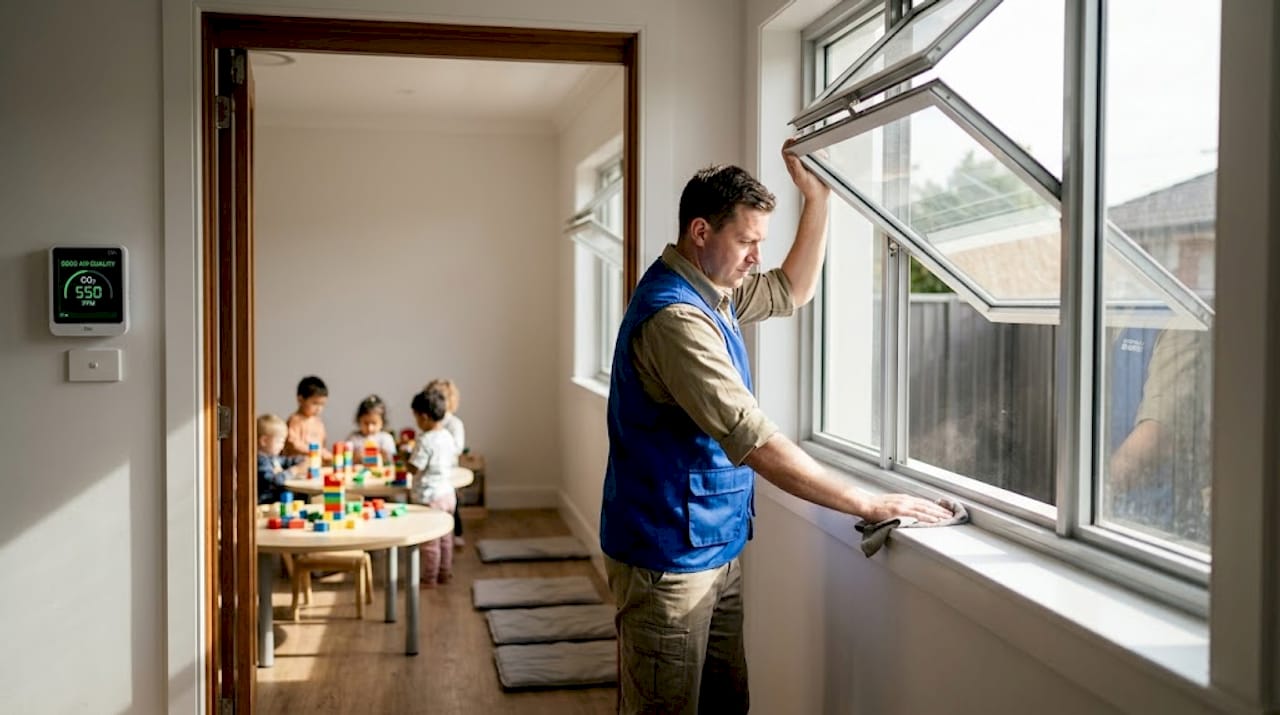
CO2 does not pose a direct health risk at levels common in buildings, but it serves as a well-established proxy for ventilation adequacy. CO2 as a ventilation proxy in occupied childcare spaces is a recognised and practical approach for caregivers without access to specialist air testing equipment. When CO2 climbs, it means occupants are exhaling more carbon dioxide than the ventilation system is clearing, which also means other pollutants (particles, VOCs, bacteria) are likely accumulating too.
Ventilation assessment checklist:
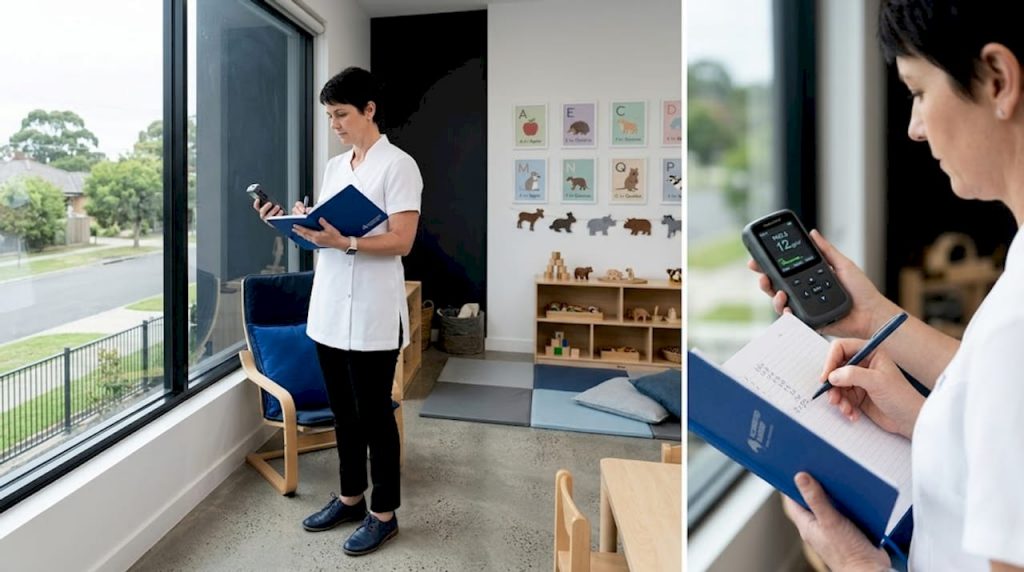
- Place a CO2 sensor at child breathing height (approximately 0.6 to 1.0 metres above floor level), not at ceiling height where concentrations differ.
- Record readings during arrival time, mid-morning peak occupancy, and rest periods to capture the full daily range.
- Check that readings stay below 1,000 ppm during occupied hours. Levels between 1,000 and 1,500 ppm indicate marginal ventilation. Levels above 1,500 ppm warrant immediate action.
- Compare peak readings against early morning baseline readings taken before children arrive, when the room has had time to flush out overnight.
- Review HVAC filter condition and outdoor air intake settings monthly, particularly during sandstorm seasons when filters can block rapidly.
- If mechanical ventilation is unavailable, create cross-ventilation by opening windows on opposing walls for at least 15 minutes per hour during cooler parts of the day.
When readings spike, the first response is to increase outdoor air flow by opening windows or adjusting the HVAC fresh air damper. If readings remain elevated after this, the ventilation system may need professional inspection.
Pro Tip: Record baseline CO2 readings during early mornings before any children arrive. This gives you a clean reference point that separates normal building background levels from occupancy-driven accumulation, making elevated readings far easier to interpret accurately.
A useful external resource for operators is the ventilation effectiveness guide published by the US Department of Energy, which provides practical assessment tools applicable to nursery settings. Tracking CO2 alongside monitoring AQI at home provides a fuller picture of overall air quality trends.
Checklist step 2: Monitoring particulate matter and pollution
Once ventilation is assessed, addressing particulate matter is critical in Dubai’s unique climate, particularly for infants spending time at floor level where dust concentrations are higher.
Dubai Municipality IAQ regulations prioritise PM10 and CO for health implications in enclosed spaces, and with good reason. Dubai’s geography means outdoor PM10 levels regularly exceed international benchmarks during shamal winds and dust events. This outdoor dust infiltrates nurseries through gaps in doors, windows, and HVAC intake systems, depositing on floors and furniture where crawling infants encounter it directly.
Additionally, babies and toddlers are more vulnerable to indoor pollutants due to their exposure patterns at floor level and their developmental susceptibility. Their breathing rate per body weight is higher than adults, meaning they inhale proportionally more of whatever is in the air around them.
Comparison table: PM sources, health effects, and remedial actions
| Particle type | Primary source in UAE nurseries | Health effect on children | Recommended action |
|---|---|---|---|
| PM10 (coarse) | Desert dust, tracked-in soil, HVAC | Upper respiratory irritation | HEPA filtration, door mats, regular wet mopping |
| PM2.5 (fine) | Traffic fumes, combustion, HVAC bypass | Deep lung penetration | HEPA air purifier, sealed windows during peak traffic |
| Total suspended bacteria | Condensation, damp soft furnishings | Infections, respiratory illness | Humidity control, UV-C supplementation |
| Fibres and allergens | Carpets, stuffed toys, bedding | Allergic sensitisation | Hard flooring where possible, frequent washing |
Particulate matter checklist for UAE nurseries:
- Change HVAC filters every 30 to 60 days during dusty seasons (typically March to June and again in September). Standard 90-day intervals are insufficient for Dubai conditions.
- Position a HEPA-equipped air purifier in the main play area, sized for the room volume. For a 40m² room with 2.7m ceilings, look for a purifier rated for at least 120m³/h clean air delivery.
- Wet mop hard floors daily rather than dry sweeping, which resuspends settled particles.
- Place entry mats inside and outside every external door to reduce tracked-in desert soil.
- Inspect soft furnishings and floor cushions weekly for dust accumulation, washing at 60°C where possible.
Pro Tip: During shamal season, consider running your category air purifiers on a higher setting during the early morning hours when outdoor dust infiltration peaks, then reducing to a maintenance setting once the space has been cleaned.
Combining air cleaning technologies with physical source reduction (matting, wet cleaning, sealed entry points) produces better results than filtration alone.
Checklist step 3: Controlling humidity, VOCs and post-renovation risks
Particulates managed, the next step is to control moisture and chemical risks from new installations, everyday use, and climate challenges.
Relative humidity in a nursery should sit between 40% and 60%. Below 40%, respiratory mucous membranes dry out and children become more susceptible to airborne pathogens. Above 60%, mould growth and bacterial proliferation on surfaces accelerates sharply. UAE’s climate creates both extremes: humidity can be very low during winter desert conditions and very high during summer coastal periods, both requiring active management.
VOCs present a separate but equally serious concern. After any renovation or new furniture installation, VOC off-gassing rates rise dramatically:
“VOC emission rates can be 100 to 1,000 times baseline post-installation, with the highest concentrations occurring in the first 48 to 72 hours.”
Local licensing requirements and national childcare authority standards specify mandatory unoccupied periods after renovation works to allow off-gassing before children re-enter. This is not a recommendation; it is a compliance requirement that operators must document.
Post-renovation holding times by material type:
| Material installed | Minimum unoccupied period | Additional recommendation |
|---|---|---|
| Fresh interior paint | 48 hours | Extended ventilation for 72 hours total |
| New carpet or vinyl flooring | 72 hours | Open windows, run HVAC on full fresh air mode |
| New furniture (MDF, particleboard) | 72 hours | Source low-HCHO certified products where possible |
| Adhesives and sealants | 48 to 72 hours depending on product | Ensure product MSDS reviewed before use |
For detailed multi-parameter monitoring support and local guidance, the multi-parameter monitoring resource from Indoor Sciences UAE provides context specific to Dubai environments.
Humidity and VOC management checklist:
- Install a calibrated digital hygrometer in the main nursery space and check it each morning.
- Use a humidifier during dry winter months to maintain humidity above 40%. Use a dehumidifier during humid summer months to keep levels below 60%.
- Select humidifiers with antimicrobial tanks and clean them weekly to prevent bacterial growth within the unit itself.
- Use dehumidifiers in areas prone to condensation, particularly bathrooms and kitchen zones adjacent to play areas.
- After any renovation, ventilate continuously for the minimum holding period before admitting children. Log the start and end times for compliance documentation.
Checklist step 4: Recommended response protocols and ongoing monitoring
Having covered the major checklist items, here is how to act swiftly when problems arise and how to ensure ongoing, consistent protection for children in the nursery.
Effective nursery air quality management is not a one-off audit. Continuous multi-parameter monitoring of PM2.5, CO2, humidity, and VOCs, paired with a clear response protocol, is the standard recommended for Dubai educational settings. Monitoring without a defined response process leaves caregivers with data but no clear direction when readings deteriorate.
Establishing monitoring baselines during periods of known good air quality significantly improves the interpretation of future readings, allowing operators to distinguish between routine variation and a genuine air quality event requiring action.
Recommended response protocol when readings spike:
- Confirm the sensor reading is accurate (check sensor placement and calibration date before assuming a genuine event).
- Increase ventilation immediately by opening windows or adjusting the HVAC fresh air intake to maximum.
- Identify and remove or isolate the pollution source (for example, a cleaning product recently used, a new item of furniture, or a malfunctioning appliance).
- Move children to an alternative room with better air quality while the primary space is investigated and ventilated.
- Log the event with time, readings, suspected cause, and corrective actions taken. This documentation supports regulatory compliance and identifies recurring issues.
- If readings do not return to acceptable levels within two hours, contact a qualified IAQ assessor and notify the relevant Dubai regulatory authority if the nursery is a licensed facility.
- Review the response within 24 hours to determine whether a systemic fix is required, such as HVAC servicing, filter replacement, or source removal.
For additional structure, external response protocol guidelines provide internationally referenced frameworks that complement local Dubai requirements.
Ongoing monitoring tools worth considering for nurseries include the Levoit Core 300S purifier, which combines effective filtration with a compact form factor suited to childcare room sizes. Pairing a quality air purifier with a dedicated multi-sensor monitor creates a closed-loop system where filtration responds to detected pollutant levels.
Ongoing monitoring checklist:
- Review logged data weekly for trends, not just individual spikes.
- Schedule monthly HVAC maintenance inspections, not quarterly.
- Recalibrate CO2 and humidity sensors every six months.
- Conduct a full IAQ baseline assessment at the start of each school year.
Our take: What most checklists miss about nursery air safety
Most nursery air quality checklists focus on visible comfort measures: clean surfaces, fresh-smelling rooms, and good ventilation during summer. These are worthwhile. They are not, however, sufficient.
The more important and often overlooked issue is that many nurseries treat air purifiers as a comfort product rather than a primary health intervention. The research is clear: ventilation improvements in educational settings are directly linked to reductions in CO2 accumulation, VOC buildup, and particulate concentrations, with associated improvements in respiratory health outcomes and cognitive performance measures in children. This is not marginal. It is measurable.
The practical implication is that ventilation strategy should come first in any nursery air quality plan, ahead of air purifiers and humidity management. An air purifier in a poorly ventilated room recirculates the same air repeatedly without addressing the fundamental problem: fresh air replacement. Understanding air changes per hour and designing ventilation to meet a minimum threshold for the nursery’s occupancy is the single most impactful step any operator can take.
A second overlooked issue is documentation. Most nurseries that have monitoring equipment do not keep structured logs. Without baseline data and event records, it is nearly impossible to demonstrate compliance during inspections or to identify recurring problems that require systemic fixes rather than spot interventions.
Treating air quality as an ongoing operational discipline, rather than a periodic compliance exercise, is where the real health gains lie for children in UAE nurseries.
How to optimise nursery air quality with ClimatePro UAE solutions
Once equipped with this checklist, the next step is putting the right tools in place.

ClimatePro UAE supplies air purifiers, humidifiers, and dehumidifiers selected for performance in UAE conditions, including the dust loads and humidity swings that make nursery air management more demanding than in most other climates. Each checklist step maps directly to a product category available through the store, with delivery across Dubai, Abu Dhabi, Sharjah, Ajman, Ras Al Khaimah, Fujairah, and Umm Al Quwain. Whether you need a HEPA air purifier for a play room, a compact humidifier for a sleeping area, or a dehumidifier for a moisture-prone space, ClimatePro UAE can support you with reliable options suited to childcare environments and professional guidance to match the right product to the space.
Frequently asked questions
What pollutants should I monitor in a UAE nursery?
Dubai Municipality IAQ regulations identify five key pollutants for nursery compliance: PM10, CO2, formaldehyde (HCHO), carbon monoxide (CO), and total suspended bacteria. Monitoring all five provides a complete picture of indoor air health and supports regulatory compliance.
How often should air quality be checked in nurseries?
Continuous multi-parameter monitoring is the recommended standard for Dubai educational settings, with regular data log reviews and comparisons against established baselines to identify trends and anomalies promptly.
How long should a nursery remain unoccupied after renovation?
A minimum of 48 to 72 hours is required after renovations or new furniture installation, as VOC emission rates can reach 100 to 1,000 times the normal baseline during this initial off-gassing period. Continuous ventilation during this holding period reduces concentrations more quickly.
Are babies more vulnerable to poor air quality?
Yes. Babies and toddlers face greater exposure to indoor pollutants due to time spent at floor level where dust concentrations are highest, and their developmental susceptibility means the health consequences of pollutant exposure are more significant than for older children or adults.
Recommended
- Understand air cleaning technologies for healthier UAE homes — Blog | ClimatePro UAE
- Air changes per hour and better indoor air quality — Blog | ClimatePro UAE
- Why monitoring AQI at home protects your family’s health — Blog | ClimatePro UAE
- Levoit Core 300S air purifier: Guide to cleaner indoor air — Blog | ClimatePro UAE