
Bringing fresh air into a UAE apartment or villa sounds straightforward, but open a window during summer and you invite 40°C heat and humidity levels that push your air conditioning to its limits. Simply running exhaust fans swaps stale air for outdoor air at a significant energy cost. Energy recovery ventilation (ERV) systems solve this by exchanging heat and moisture between outgoing and incoming air streams, delivering fresh air without the usual penalty on cooling loads or indoor comfort. This article explains what ERVs are, how they work, and why they suit UAE homes better than standard ventilation approaches.
Table of Contents
- What is energy recovery ventilation and why does it matter?
- How does an ERV system work?
- ERV versus HRV: Which is better for UAE homes?
- Real-life performance: What impacts ERV efficiency and air quality?
- Why picking the right ERV approach in the UAE is about more than just comfort
- Next steps for healthier air: Find a solution for your UAE home
- Frequently asked questions
Key Takeaways
| Point | Details |
|---|---|
| ERVs optimise fresh air | Energy recovery ventilation systems let you increase fresh air without heavy energy or comfort penalties in UAE homes. |
| Moisture management matters | ERVs uniquely control both heat and humidity, making them better suited to UAE’s muggy climate than standard HRVs. |
| Maintenance is critical | Regular filter care and correct set-up are essential for healthy air and maximum energy savings from your ERV. |
| System choice impacts results | Selecting and commissioning the right ERV delivers real air quality and efficiency improvements over basic ventilation. |
What is energy recovery ventilation and why does it matter?
Standard homes rely on a mix of natural air leaks, exhaust fans, and open windows to bring in fresh air. In most climates, this works adequately. In the UAE, it creates a direct conflict between indoor air quality and energy efficiency. Every cubic metre of outdoor air that enters an air-conditioned space must be cooled and dehumidified by the AC unit, adding to running costs and wear on the system.
Energy recovery ventilation (ERV) is a balanced mechanical ventilation approach that brings in outdoor air and exhausts indoor air while recovering energy from the outgoing airstream. The outgoing air, already cooled and dried by your AC, pre-conditions the incoming outdoor air before it enters the living space. The result is fresher air delivered at a fraction of the direct energy cost.
Modern UAE apartments and villas are increasingly airtight. Double-glazed windows, insulated walls, and sealed doorframes reduce natural air infiltration to near zero. Understanding ventilation and air quality basics makes it clear why mechanical ventilation becomes essential in these buildings. Without it, CO2 levels rise, volatile organic compounds (VOCs) accumulate, and occupant wellbeing suffers.
ERVs are intended to maintain ventilation in tight, low-leakage building envelopes, improving indoor air quality while reducing the heating and cooling energy penalty.
The practical importance of this cannot be overstated. In a tightly sealed UAE apartment, without mechanical ventilation, the only way to get fresh air is to open a window and undo hours of cooling work. ERVs make it possible to ventilate continuously without that tradeoff. They also work alongside air cleaning technologies to address a broader range of indoor air quality concerns.
Key reasons ERVs matter for UAE homes:
- Energy efficiency: Pre-conditioning incoming air reduces the cooling load on AC units, which run for most of the year.
- Humidity control: Outdoor humidity in the UAE frequently exceeds 80%, particularly near coastlines. ERVs moderate the moisture entering the home.
- Continuous fresh air: Unlike opening windows or running exhaust fans, ERVs provide a steady, controlled airflow rate throughout the day.
- Airtight building compatibility: They are specifically designed to serve well-sealed modern buildings where passive ventilation is insufficient.
How does an ERV system work?
An ERV uses two fans and two separate air streams passing through an energy-recovery core. One fan draws stale indoor air out of the building; the other draws fresh outdoor air in. These two streams pass through the core simultaneously but never mix. The core transfers both heat and moisture from one stream to the other.
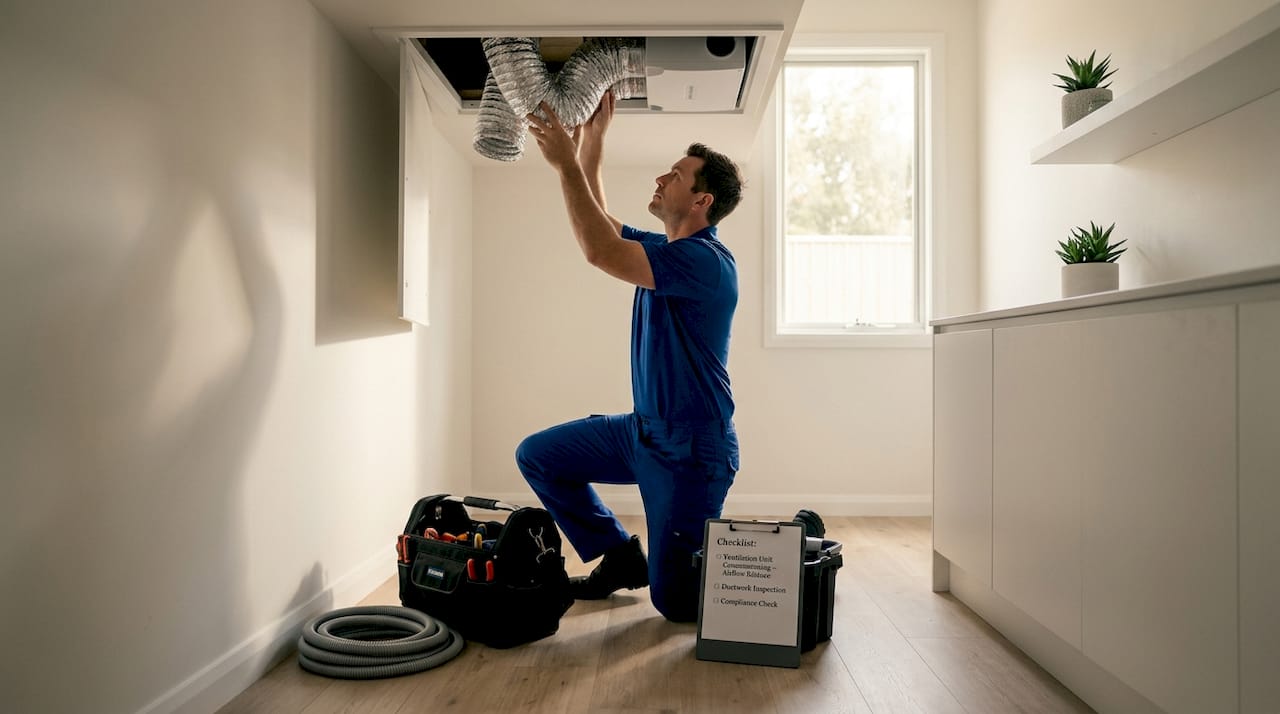
Mechanically, an ERV transfers both sensible heat and moisture (latent energy) between the exhaust and supply air streams. This is the critical distinction from simpler heat recovery ventilators (HRVs), which transfer heat only. In UAE conditions, moisture transfer is just as important as temperature transfer because outdoor air carries a very high latent heat load.
Component breakdown
| Component | Function |
|---|---|
| Supply fan | Draws outdoor air into the building through the core |
| Exhaust fan | Draws stale indoor air out of the building through the core |
| Energy recovery core | Transfers heat and moisture between the two air streams |
| Supply-side filters | Remove particles and allergens from incoming outdoor air |
| Exhaust-side filters | Protect the core from indoor dust and contamination |
| Ducting network | Distributes fresh supply air and collects exhaust air from rooms |
Step-by-step airflow process
- Exhaust collection: Stale air from bathrooms, kitchens, and living areas is collected and drawn towards the ERV unit via exhaust ducting.
- Core exchange: The warm, moist exhaust air passes through one side of the energy-recovery core. Heat and moisture transfer across the core membrane to the incoming outdoor air stream.
- Pre-conditioned supply: Outdoor air, now cooler and partially dehumidified by the exchange, continues through the supply side of the core.
- Filtration: Supply air passes through filters to remove dust, pollen, and particulates before entering the living space.
- Distribution: Fresh, pre-conditioned air is delivered to bedrooms, living areas, and other occupied zones via supply ducting.
- Continuous cycle: Both fans run simultaneously, maintaining a balanced and steady airflow rate around the clock.
Placement of the ERV unit and careful ducting design directly affect performance. Units installed in ceiling voids or utility rooms with short, straight duct runs deliver better airflow efficiency than those with long, convoluted paths. Duct leakage is a common installation problem and can reduce cleaner indoor air benefits significantly.
Pro Tip: When planning an ERV installation, ask the installer to provide a commissioning report that confirms measured airflow rates at each supply and exhaust point. Balanced airflow, within 10% between supply and exhaust, is essential for correct operation and pressure neutrality in the home.
ERV versus HRV: Which is better for UAE homes?
Understanding how ERVs shuffle both heat and moisture leads to an obvious question: how do they compare to heat recovery ventilators (HRVs), which are often mentioned alongside ERVs in ventilation discussions?
ERV implies enthalpy exchange, covering both heat and moisture, while HRV implies sensible heat-only exchange. In practical terms, an HRV transfers warmth between air streams but does not transfer moisture. This works well in cold, dry climates where the priority is retaining warmth in winter. It does not suit UAE conditions, where the outdoor air carries substantial moisture load for most of the year.
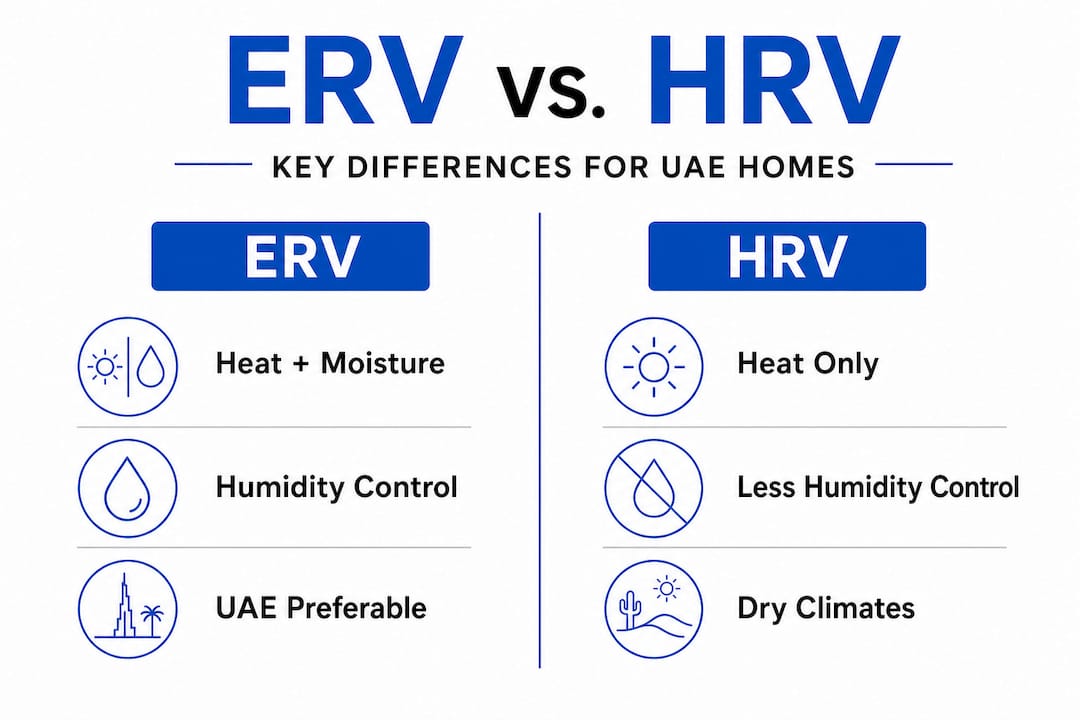
ERVs are generally favoured in humid and mixed climates where moisture control is needed alongside ventilation. The UAE falls squarely in this category. Without moisture transfer, an HRV would allow large amounts of latent heat to pass unchecked into the home, increasing the dehumidification burden on the AC unit and raising indoor relative humidity.
ERV versus HRV comparison
| Feature | ERV | HRV |
|---|---|---|
| Heat transfer | Yes | Yes |
| Moisture transfer | Yes | No |
| Best climate | Hot, humid | Cold, dry |
| UAE suitability | High | Low |
| Moisture management | Active | None |
| Typical energy recovery | 70 to 80% sensible + latent | 70 to 85% sensible only |
Which system suits which situation in the UAE:
- ERV: Recommended for coastal UAE locations such as Abu Dhabi, Dubai Marina, and Sharjah, where outdoor humidity is persistently high.
- ERV: The correct choice for modern airtight apartments and villas where AC runs year-round.
- HRV: Only considered in extremely dry inland areas where dehumidification is not a priority, which is rare in UAE residential settings.
- Neither without professional sizing: Both systems require proper airflow calculations based on floor area and occupancy. Undersized units fail to deliver adequate air exchange rates.
For households already dealing with indoor humidity issues, pairing an ERV with dehumidifiers for humidity control can address moisture that enters through sources other than ventilation, such as cooking, bathing, and occupant respiration.
Real-life performance: What impacts ERV efficiency and air quality?
Understanding the design differences matters, but the real question for UAE homeowners is what to expect from day-to-day ERV operation and what factors affect actual outcomes.
Performance depends strongly on design and commissioning details, and real-world efficiency can be affected by operating conditions such as temperature extremes, frost protection, and airflow control strategy. In the UAE context, temperature extremes are a constant reality, not an occasional edge case. An ERV core specified for mild European conditions may not perform as rated at consistent 42°C outdoor temperatures, making correct product selection critical.
Factors that affect real-world ERV performance in UAE homes:
- Core material and specification: Enthalpy cores made for hot, humid climates use different membranes to rotary wheel cores designed for cold climates. Confirm that the unit is rated for the intended outdoor conditions.
- Airflow balancing: An unbalanced system, where supply and exhaust rates differ significantly, creates pressure differences that cause doors to slam, reduce effectiveness, or draw unfiltered air through gaps.
- Filter condition: Dirty or restrictive filters can reduce airflow and heat exchange efficiency. In the UAE, where outdoor dust and sand are prevalent, supply-side filters load up faster than in cleaner environments.
- Duct sealing and insulation: Ducts running through unconditioned roof voids or wall cavities gain heat and moisture from surrounding surfaces, reducing the quality of supply air reaching occupants.
- Ventilation rate control: Some ERVs allow variable speed operation. Running the system at a lower rate during unoccupied periods and higher rates when rooms are in use improves both air quality and energy efficiency.
Filter choice is particularly significant. A field study of ERVs found that high-performance filters reduced indoor PM2.5 by up to 50% compared to low-efficiency filters. For households with allergy sufferers, children, or pets, investing in higher-grade air filter replacement media delivers measurable air quality benefits, not just marginal ones.
Filtration level has a direct impact on indoor particle concentrations. Choosing high-efficiency filters in an ERV system reduces fine particle exposure for occupants, particularly in urban environments where outdoor particulate levels are elevated.
Maintenance pitfalls that frequently undermine ERV performance:
- Skipping filter checks for more than six months, especially during the dusty season from March to June.
- Neglecting to clean the energy-recovery core annually, which can reduce transfer efficiency by 15 to 20%.
- Failing to inspect ducting joints and seals after building works or pest control treatments.
- Ignoring changes in airflow noise, which often signals a blocked filter or failed fan bearing.
Pro Tip: Set a calendar reminder to inspect ERV filters every three months in the UAE. During the spring dusty season, monthly checks are advisable. Track the date of each filter change to establish a realistic replacement cycle for your specific location and household dust load. Consistent maintenance is the single most effective way to protect long-term system performance. Understanding air changes for ventilation helps confirm whether your ERV is actually delivering the air exchange rates your home requires.
Why picking the right ERV approach in the UAE is about more than just comfort
Technical specifications and comparison tables are useful, but they do not tell the full story. Feedback gathered from UAE homeowners and tenants over time reveals a consistent pattern: the households most satisfied with their ERV investment are those who treated the decision as part of a broader air quality strategy, not simply as a box-ticking exercise in mechanical ventilation.
The most common regret among UAE adopters is not the initial capital outlay. It is the decision to cut corners on ongoing maintenance and filter upgrades after installation. A well-specified ERV installed with low-grade filters, or one that sits unchecked for twelve months, often delivers worse air quality outcomes than a simpler air purifier with a disciplined filter replacement schedule. The system is only as effective as the attention given to it.
There is also a widely held but flawed assumption that ERVs solve all indoor air quality problems. They do not. An ERV manages ventilation and recovers energy. It does not remove gaseous pollutants such as formaldehyde from new furniture, neutralise cooking odours completely, or address localised humidity from a poorly ventilated bathroom. Homes with persistent moisture or odour problems need complementary solutions, not a single device installed and forgotten.
The practical starting point is to identify your actual needs before specifying a system. A household with young children, allergy sufferers, or pets has different requirements from a compact apartment occupied by a single professional. Homes with active cooking, large numbers of occupants, or ground-floor units near traffic all have distinct ventilation priorities. Engaging a qualified mechanical engineer or IAQ specialist, rather than simply buying the lowest-cost unit available, consistently produces better long-term outcomes. Consulting broader air quality advice during the planning phase helps ensure the ERV is part of a coherent approach rather than an isolated purchase.
The counterintuitive lesson is this: in the UAE, the technology itself is rarely the limiting factor. The limiting factor is almost always the quality of the commissioning, the discipline of maintenance, and the clarity of what the occupant actually needs the system to achieve.
Next steps for healthier air: Find a solution for your UAE home
If you are ready to improve indoor air quality and manage humidity more effectively in your UAE home or office, there are practical options available at different investment levels. ERV systems represent a significant installation project, but complementary solutions such as standalone air purifiers and dedicated dehumidifiers address many of the same core concerns with lower upfront commitment.

ClimatePro UAE stocks a curated range of UAE air purifiers suited to apartments, villas, nurseries, and commercial spaces across Dubai, Abu Dhabi, Sharjah, and all seven emirates. For households contending with coastal humidity or condensation problems, the range of dehumidifier options offers targeted moisture control without the complexity of a full ERV installation. Browse the full catalogue online, with delivery available across the UAE, to find products matched to your specific air quality priorities.
Frequently asked questions
Is an ERV better than an HRV for the UAE climate?
In the UAE’s hot, humid environment, an ERV is generally the better choice because it manages both heat and moisture, preventing excess indoor humidity. ERVs are favoured in humid and mixed climates where moisture control is needed alongside energy recovery.
Can an ERV help with indoor air quality in apartments?
Yes, ERVs steadily exchange indoor and outdoor air, reducing pollutants like CO2 and fine particles when paired with appropriate filters. A field study found that high-performance filters in ERV systems reduced indoor PM2.5 concentrations by up to 50% compared to low-efficiency alternatives.
How often should I change or clean ERV filters?
Check ERV filters every three to six months and clean or replace them as recommended by the manufacturer to avoid reduced airflow and efficiency. Dirty or restrictive filters directly reduce both airflow rates and heat exchange performance, which diminishes energy savings and air quality benefits simultaneously.
Will running an ERV increase my energy bill?
ERVs are designed to lower energy costs by recovering energy from exhausted air, so they typically reduce rather than raise overall cooling loads. ERVs reduce the cooling energy penalty of bringing in outdoor air, which is particularly significant in UAE conditions where outdoor temperatures remain high for the majority of the year.