Most homeowners assume their indoor air is reasonably clean. It rarely is. Indoor air can carry two to five times more pollutants than outdoor air, yet the problem stays invisible until symptoms appear. A proper step by step air quality assessment gives you the data to act on, not just assumptions. This guide walks you through the full air quality measurement process, from gathering the right tools to interpreting your results, so you can make targeted decisions about filtration, ventilation, and source control in every room of your home.
Table of Contents
- Key takeaways
- Preparing for your air quality assessment
- Room by room assessment steps
- Interpreting results and deciding next steps
- Long-term monitoring and maintenance
- My take on what most assessments get wrong
- Improve your air with the right tools from Climatepro
- FAQ
Key takeaways
| Point | Details |
|---|---|
| Measure before you filter | Buying an air purifier without data is the most common and costly mistake homeowners make. |
| Each room has a unique pollutant profile | Bedrooms, kitchens, and basements all require different metrics and different interventions. |
| Four steps guide every assessment | The process follows a clear sequence: measure, control sources, ventilate, then filter. |
| Radon needs specific action thresholds | The EPA action level is 4.0 pCi/L, but WHO recommends acting at 2.7 pCi/L for sensitive households. |
| Ongoing monitoring matters | A single assessment is a starting point. Regular re-testing confirms whether your interventions are working. |
Preparing for your air quality assessment
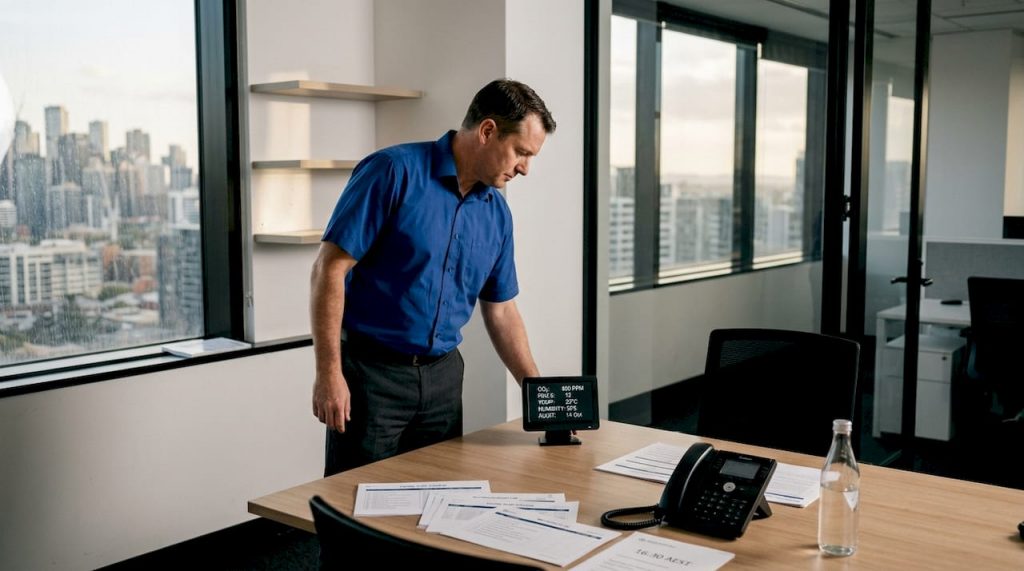
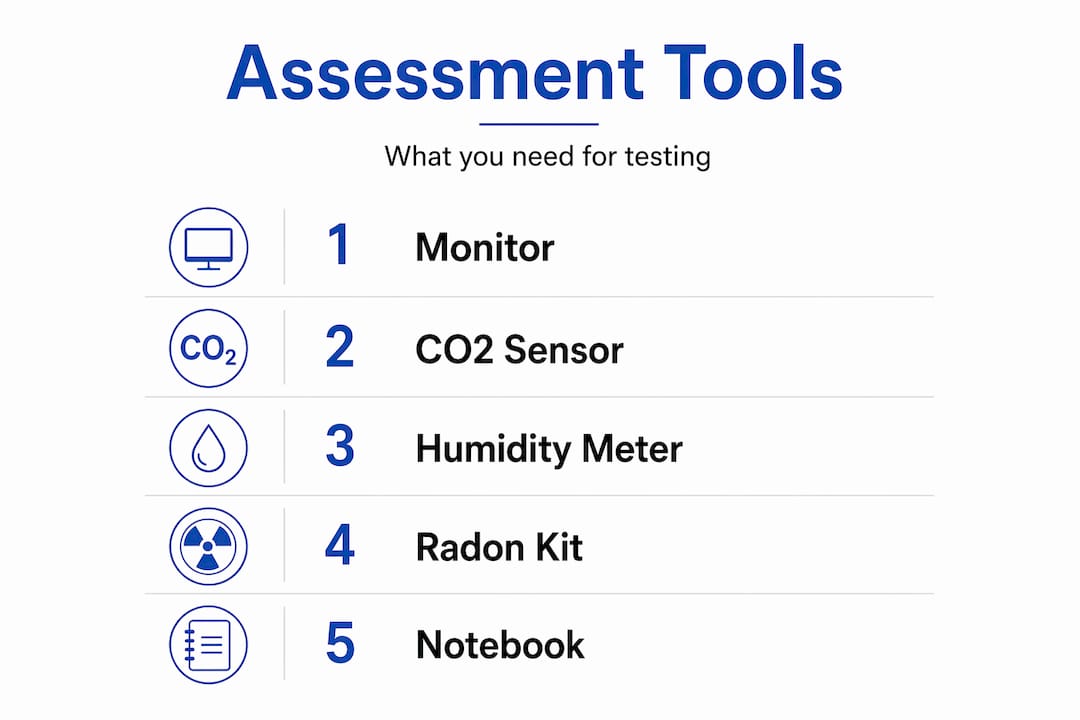
Before taking any measurements, you need to understand what you are looking for and what tools will give you reliable data. Consumer-grade air quality monitors now measure PM2.5, CO2, humidity, and total volatile organic compounds (TVOCs) at prices between $100 and $300 AUD equivalent. Radon test kits are available for as little as $15 to $30. These are not professional-grade instruments, but they are accurate enough to identify problem areas and guide your decisions.
Key pollutants to measure
- PM2.5 (fine particulate matter): Sources include cooking fumes, dust, and outdoor pollution entering through gaps.
- CO2 (carbon dioxide): A reliable indicator of ventilation quality; elevated levels signal poor air exchange.
- Relative humidity (RH): Target range is 40 to 50%; below 30% causes dryness and above 60% promotes mould growth.
- TVOCs: Released from paints, adhesives, cleaning products, and furniture.
- Radon: A naturally occurring radioactive gas; most critical in basements and ground-floor rooms.
- Carbon monoxide (CO): Produced by gas appliances, heaters, and attached garages.
Tools and requirements summary
| Tool | What it measures | Approx. cost (AUD) |
|---|---|---|
| Multifunction air quality monitor | PM2.5, CO2, TVOC, humidity, temperature | $100–$300 |
| Radon test kit (short-term) | Radon gas concentration | $15–$30 |
| CO detector/alarm | Carbon monoxide levels | $30–$80 |
| Hygrometer (if not in monitor) | Relative humidity | $15–$40 |
Pro Tip: Place your monitor at breathing height (around 1.2 to 1.5 metres from the floor) and keep windows closed for at least two hours before recording baseline readings. This gives you the true resting state of the room, not a ventilated snapshot.
Room by room assessment steps
A room-by-room approach is necessary because pollutant sources and profiles differ significantly between spaces. A kitchen assessment is nothing like a bedroom assessment. The following sequence covers the most critical rooms.
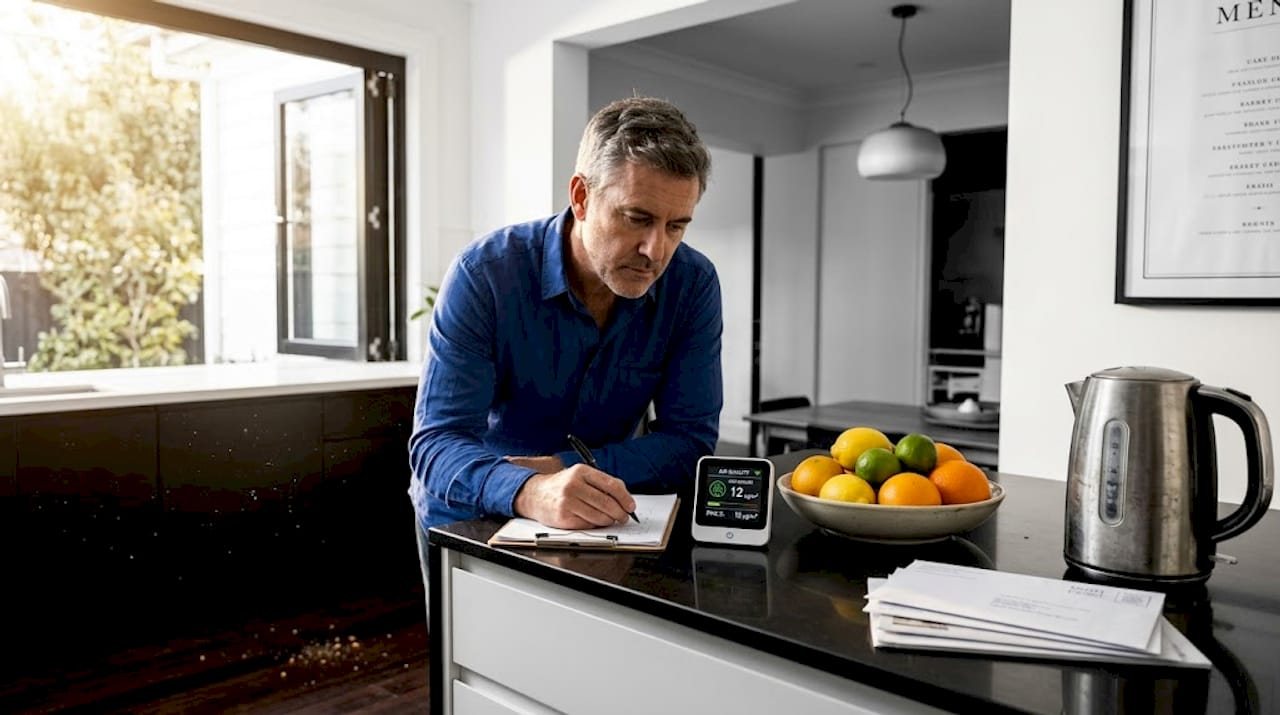
The four-step framework for each room
The assessment framework follows a consistent order: measure pollutants first, then control sources, then optimise ventilation, then apply filtration. Skipping to filtration without completing the first three steps produces unreliable results and wasted spending.
-
Bedroom: Target CO2 below 1,000 ppm and PM2.5 below 8 µg/m³. Bedrooms accumulate dust mite allergens, off-gassing from mattresses and synthetic fabrics, and CO2 from overnight breathing. Check under the bed and inside wardrobes where stagnant air collects. Source control here means washing bedding weekly in hot water and avoiding synthetic air fresheners.
-
Kitchen: The priority pollutant is CO, with a target below 9 ppm during and after cooking. Gas cooktops can spike CO and NO2 levels significantly within minutes of use. Run the range hood at full speed while cooking and for 10 minutes afterwards. If you do not have a range hood vented to the outside, open a window and use a portable air purifier rated for cooking fumes.
-
Bathroom: The main risks are excess humidity and mould spores. Aim for RH below 60% within 30 minutes of a shower. Extract fans must run during and after use. Check sealant around tiles and the base of the toilet for mould growth, which releases spores continuously even when not visible.
-
Living room: TVOCs are the key metric here, especially in recently renovated or furnished spaces. New furniture, rugs, and painted walls off-gas for months. Measure TVOC levels and compare readings taken with and without ventilation to understand the contribution of indoor sources versus infiltration from outside.
-
Basement: Radon is the primary concern. The EPA action level is 4.0 pCi/L, and mitigation systems can reduce levels by 80 to 99%. Place a short-term radon kit in the lowest occupied area and leave it undisturbed for the duration specified on the packaging, typically 48 to 96 hours. Also monitor for humidity above 60%, which signals drainage or waterproofing issues.
-
Home office: CO2 builds quickly in small rooms with one or two occupants and a door kept closed. Readings above 1,200 ppm correlate with reduced concentration and productivity. Check whether your ventilation system supplies fresh air to this room or simply recirculates existing indoor air.
Pro Tip: Create a simple spreadsheet to record readings from each room at the same time of day, on two separate days. Variation between readings tells you as much as the readings themselves — a kitchen that spikes to 25 µg/m³ of PM2.5 every evening confirms a cooking-related source rather than a structural one.
Ventilation strategy is also room-specific. Effective ventilation depends on outdoor air quality and room usage. On low-pollution days, cross-ventilation through opposite-facing windows is effective. In high-traffic urban areas or during dust events, mechanical ventilation with filtration is preferable to opening windows.
Interpreting results and deciding next steps
Once you have readings across all rooms, compare them against the target values in the table above. Most homeowners find one or two rooms with consistently elevated readings. Those rooms become your remediation priority.
For radon, the picture is not simply above or below 4.0 pCi/L. WHO recommends action at 2.7 pCi/L for households with smokers or vulnerable occupants, because radon and tobacco smoke have a synergistic effect on lung cancer risk. If your basement reads between 2 and 4 pCi/L and you have children or a smoker in the home, consult a certified radon mitigation specialist rather than waiting for the EPA threshold.
For other pollutants, the decision tree is more straightforward:
- PM2.5 above 12 µg/m³ consistently: Source control first (check for infiltration from outside, cooking habits, candles, incense), then add HEPA filtration rated for the room size.
- CO2 above 1,000 ppm in sleeping areas: Increase fresh air supply. A mechanical ventilation unit with a MERV 13 or higher filter is the most reliable solution where opening windows is not practical.
- RH above 60% persistently: A dehumidifier addresses the root cause. An air purifier alone will not correct excess humidity.
- TVOCs elevated in a recently renovated room: Accelerate off-gassing by ventilating with fresh air for several hours daily for two to four weeks. After that period, re-test and consider an activated carbon air purifier if levels remain high.
- CO readings above 9 ppm: Do not attempt to filter CO. Have gas appliances and flues inspected by a licensed technician immediately.
Retesting is not optional. Monitoring AQI at home gives you a feedback loop. Test again two to four weeks after making changes to confirm the intervention has worked. One-off assessments give you a baseline. Periodic testing tells you whether your home is improving.
Long-term monitoring and maintenance
A single DIY air quality assessment tells you where you stand today. Maintaining healthy air quality requires a schedule and consistent habits.
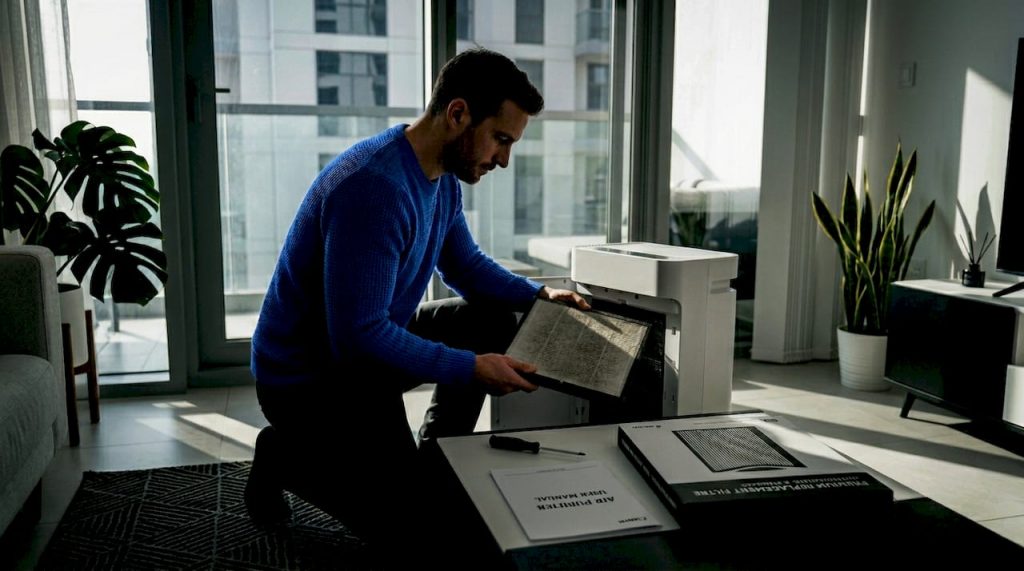
- Filter maintenance: Replace HEPA and carbon filters according to manufacturer recommendations, typically every six to twelve months. In high-pollution areas or homes with pets, check filters every three months. A clogged filter reduces purifier performance significantly before any indicator light alerts you.
- Seasonal re-assessment: Run a full assessment at the start of summer and winter when heating, cooling, and humidity conditions change. The UAE’s seasonal dust events and high summer humidity make this especially relevant for residents.
- HVAC filters: Use MERV 13 or better filters in ducted systems. Combining stable humidity and ventilation with high-grade HVAC filtration is more effective than addressing either factor in isolation.
- Humidity control devices: Calibrate your hygrometer against a known reference once a year to confirm readings are still accurate. Dehumidifiers and humidifiers should be cleaned monthly to prevent bacterial or mould growth inside the unit itself.
- Track health outcomes: Note whether allergy symptoms, sleep quality, or morning headaches change after interventions. These qualitative signals validate your measurements and help you prioritise future spending.
Pro Tip: Set a recurring calendar reminder every three months for a quick spot-check of key rooms. You do not need a full assessment every time — just check CO2, humidity, and PM2.5 in the bedroom and kitchen. Those two rooms cover the most common problem areas for most households.
My take on what most assessments get wrong
I have seen many homeowners start with an air purifier and then ask why their indoor air quality has not improved. The answer is almost always the same. They skipped the assessment entirely.
Buying filtration without measuring first is the equivalent of taking medication for a diagnosis you have not confirmed. You might get lucky, but you are more likely to spend money on the wrong solution. I have watched people put a large air purifier in the living room when their actual problem was CO2 in the bedroom and mould spores in a poorly ventilated bathroom.
What I find most useful is the room-by-room framing. Every room in your home has a different source profile and a different occupancy pattern. Treating the whole house as one air mass misses the specificity that makes interventions work. A bedroom with two sleeping occupants behaves very differently at midnight than a kitchen with gas cooking at 7pm.
My realistic expectation for first-time assessors: you will find two or three actionable problems. Not ten. Not zero. Focus on those findings, apply targeted fixes, then retest. Air quality improvement is an iterative process, not a single purchase. The data you collect in your first assessment is the most valuable thing you can generate, because it tells you exactly where to spend your time and money.
I also want to be honest about professional help. For radon above the action threshold, for persistent CO readings, or for suspected asbestos in older homes, do not attempt DIY remediation. Those situations require licensed specialists. The assessment identifies the problem. The response has to match the severity.
— Nevel
Improve your air with the right tools from Climatepro
Once your assessment is complete and you know which rooms need attention, Climatepro has the products to support every stage of the measure, control, ventilate, and filter framework. Whether your results point to fine particle infiltration, excess humidity, or both, the right device makes a measurable difference.

For rooms where PM2.5 or TVOC readings are elevated, the Honeywell Air Touch P2 is a reliable HEPA option suited to medium and large rooms. For smaller spaces or as a second unit, the Honeywell Air Touch P1 offers solid filtration at a lower price point. If your results show persistent humidity above 60%, a dehumidifier addresses the root cause rather than masking symptoms. For rooms running dry below 40% RH, a humidifier brings conditions back into the safe range. Climatepro delivers across Dubai, Abu Dhabi, Sharjah, and all seven emirates.
FAQ
What is a step by step air quality assessment?
A step by step air quality assessment is a structured process of measuring pollutants room by room, identifying sources, optimising ventilation, and applying filtration where needed. It follows the sequence: measure, control sources, ventilate, then filter.
How do I assess air quality at home without professional help?
Use a consumer-grade monitor to measure PM2.5, CO2, humidity, and TVOCs in each room, and a separate radon test kit for basements and ground-floor spaces. Compare readings against guideline targets and prioritise rooms with consistently elevated results.
What rooms should I prioritise in a DIY air quality assessment?
The bedroom and kitchen are the highest priorities, as they generate the most significant pollutant loads and have the greatest impact on sleep quality and daily health. Basements require separate attention for radon.
When should I call a professional instead of using a DIY approach?
Contact a licensed specialist if you record CO readings above 9 ppm from gas appliances, radon above 4.0 pCi/L, or if you suspect asbestos or severe mould contamination. These situations require remediation beyond what consumer devices or air purifiers can address.
How often should I repeat a home air quality assessment?
Run a full assessment at least twice a year, at the start of summer and winter, and re-test any room where you have made a specific intervention within two to four weeks of making the change. Spot-check key rooms every three months using a continuous monitor.
Recommended
- How to interpret air quality index for healthy homes — Blog | ClimatePro UAE
- Nursery air quality checklist for healthier UAE spaces — Blog | ClimatePro UAE
- Why monitoring AQI at home protects your family’s health — Blog | ClimatePro UAE
- How to improve air quality in UAE apartments — Blog | ClimatePro UAE