

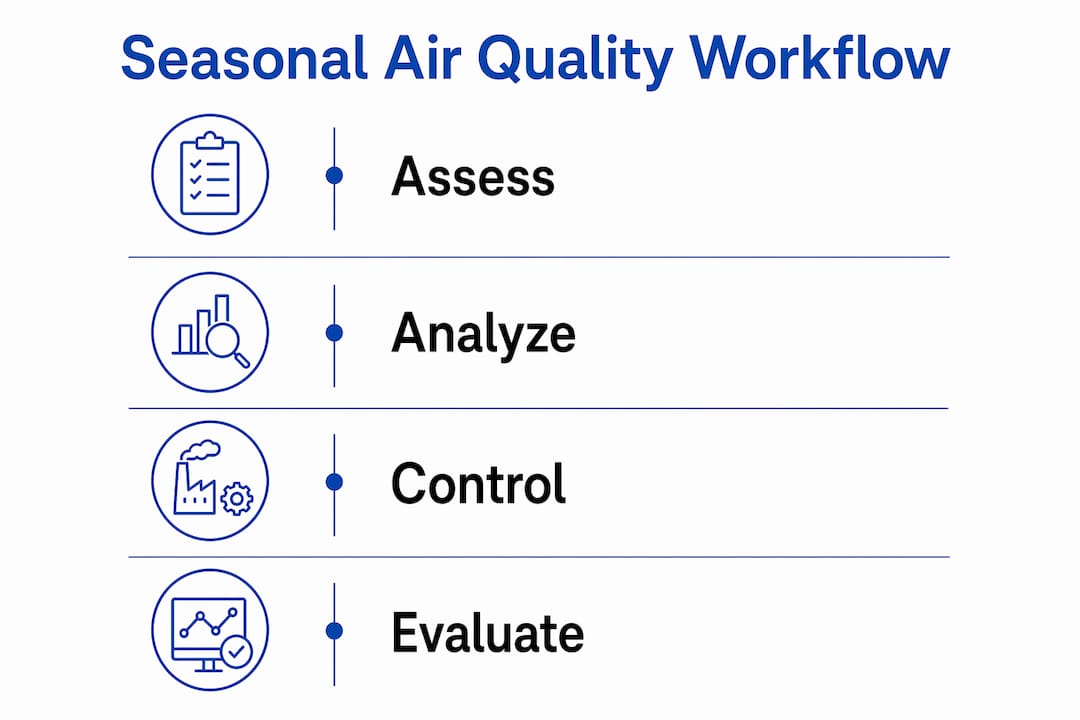
A seasonal air quality workflow is a structured, repeating cycle of assessment, pollutant pattern identification, control strategy development, implementation, and ongoing evaluation. The U.S. EPA air quality management process confirms this cyclical approach as the foundation of effective air quality management, and it applies equally to indoor environments as it does to outdoor regulatory programmes.
Table of Contents
- How the seasonal air quality workflow is structured
- Step 1: How do you conduct a seasonal air quality assessment?
- Step 2: What seasonal pollutant patterns should you look for?
- Step 3: Developing and applying targeted control strategies
- Step 4: How do you evaluate and adjust the workflow over time?
- Choosing products that support a seasonal workflow
- How Australian environmental data and regulations shape indoor air quality management
- Key takeaways
How the seasonal air quality workflow is structured
Effective indoor air quality management is not a one-time task. It follows a repeating cycle that must be revisited as seasons change, pollutant sources shift, and building conditions evolve. The core elements of the workflow are:
- Assessment: Collect baseline indoor air quality data and identify monitoring gaps.
- Pattern identification: Analyse seasonal pollutant trends and local climate influences.
- Strategy development: Design targeted control measures matched to identified risks.
- Implementation: Deploy products, adjust HVAC systems, train staff, and document actions.
- Evaluation: Measure outcomes, refine strategies, and restart the cycle.
The European Environment Agency and the German Environment Agency both reinforce that air quality plans must integrate climate and pollutant data to remain relevant. A static plan quickly becomes obsolete as seasonal conditions change.
Step 1: How do you conduct a seasonal air quality assessment?
A thorough indoor air quality assessment starts with collecting existing data and identifying where gaps exist. Without a reliable baseline, any intervention is guesswork.
Key actions at this stage include:
- Inventory current monitoring equipment and confirm sensors cover relevant pollutants: PM2.5, PM10, CO₂, VOCs, and humidity.
- Place monitors strategically across zones with different occupancy levels, ventilation rates, and proximity to outdoor air intakes.
- Run monitoring across multiple seasons to capture the full range of pollutant variation, not just a single snapshot.
- Apply quality assurance checks to raw data, flagging anomalies caused by sensor drift or temporary events.
- Document baseline concentrations for each pollutant, noting the time of day, day of week, and season when readings were taken.
Pro Tip: Schedule monitoring sessions at the same times across different seasons. Consistent timing removes time-of-day variation from your seasonal comparisons, making pattern identification far more reliable.
The German Environment Agency’s workflow guidance specifies that an effective air quality plan must collect existing data, identify the need for additional data, start supplementary measurements, and check all inputs before any analysis begins. Following this sequence prevents decisions based on incomplete or unreliable information.
Step 2: What seasonal pollutant patterns should you look for?
Seasonal pollution is rarely linear. The Copernicus Atmosphere Monitoring Service documents that ozone concentrations spike in summer due to high temperatures and precursor transport, while winter brings elevated particulate matter driven by thermal inversions and heating emissions. Both dynamics affect indoor air quality directly, particularly in buildings with natural ventilation or older HVAC systems.

Cross-referencing indoor pollutant readings with local climate data reveals which external conditions drive indoor peaks. The table below illustrates typical seasonal patterns and their primary causes.
| Season | Common indoor pollutants | Typical drivers |
|---|---|---|
| Summer | Ozone (O₃), PM2.5 | High temperatures, precursor transport, open windows |
| Winter | PM10, PM2.5, NO₂ | Thermal inversions, heating emissions, reduced ventilation |
| Spring | PM10, pollen-related particles | Wind-driven dust, vegetation activity |
| Autumn | PM2.5, VOCs | Biomass burning, reduced air circulation |
Research using seasonal forecasting models confirms that incorporating seasonal variables considerably improves prediction accuracy for pollutants including NO₂, PM10, and O₃. Seasonal heatmaps built from historical data allow facilities managers to anticipate high-risk months and schedule pre-season equipment adjustments before conditions deteriorate.
Mitigating secondary pollutants like ground-level ozone requires strategies that address precursor pollutants and meteorological conditions, not just immediate indoor sources. This complexity is why cross-referencing outdoor atmospheric data with indoor readings is a non-negotiable part of the air quality management process.
Step 3: Developing and applying targeted control strategies
Proactive seasonal adjustments to filtration and ventilation consistently outperform reactive responses to poor air quality events. Once seasonal patterns are clear, control strategies can be matched precisely to the pollutants and conditions identified.
Common control measures include:
- Air purifiers with HEPA and activated carbon filtration for removing particulate matter and VOCs year-round, with filter grades selected to match the dominant seasonal pollutant.
- HVAC system adjustments such as increasing fresh air intake during low-ozone periods and tightening recirculation during high-particulate seasons.
- Humidity management using humidifiers in dry winter conditions and dehumidifiers during humid summer months to keep relative humidity in the 40–60% range, which limits both mould growth and dust mite activity.
- Source control by scheduling high-emission activities (cleaning, painting, cooking in commercial kitchens) during periods of maximum ventilation capacity.
- Ventilation timing aligned with outdoor air quality forecasts, opening windows when outdoor AQI is low and relying on filtered recirculation when outdoor conditions are poor.
Staff training and stakeholder communication are part of implementation, not afterthoughts. Occupants who understand why ventilation schedules change seasonally are far more likely to follow protocols consistently. Documentation of every strategy change, including the date, rationale, and expected outcome, creates the audit trail needed for ongoing evaluation. Businesses managing commercial air quality across multiple tenancies benefit particularly from formalised documentation, as it supports compliance reporting and tenant communication.
Step 4: How do you evaluate and adjust the workflow over time?
Ongoing evaluation is what separates a genuine air quality management process from a one-off equipment purchase. The German Environment Agency recommends reassessment every two years as a minimum to verify that control measures remain effective and to update plans in response to changing pollutant sources or climatic conditions.
Practical evaluation steps include:
- Repeat monitoring at the same locations and times used during baseline assessment, enabling direct before-and-after comparison.
- Compare post-intervention readings against baseline concentrations to confirm whether targets have been met.
- Review filter replacement records and HVAC maintenance logs to identify whether equipment performance has degraded between seasons.
- Update seasonal heatmaps with new data each year, refining the picture of which months carry the highest risk.
- Revise protocols and staff training whenever monitoring reveals persistent exceedances or new pollutant sources.
The U.S. EPA describes this as a dynamic process where continuous review and assessment of goals and strategies is informed by scientific research. Reliable air quality forecasting at scale depends on continual data updates and automated retraining, a principle that translates to indoor management as the discipline of scheduled, documented review rather than ad hoc responses.
Choosing products that support a seasonal workflow
Selecting the right products is inseparable from the workflow itself. Hardware that cannot adapt to seasonal changes in pollutant load or humidity will underperform regardless of how well the surrounding process is designed. Combining hardware selection with ongoing workflow processes is where many consumers and businesses fall short, leading to suboptimal outcomes despite significant investment.
Key product categories and selection criteria:
- Air purifiers: Look for multi-stage filtration (pre-filter, HEPA, activated carbon) and real-time air quality sensors that adjust fan speed automatically. Units with filter-life indicators support scheduled maintenance aligned to seasonal use cycles. Climatepro stocks the Honeywell Air Touch P2 as a capable option for medium to large indoor spaces.
- Humidifiers: Select models with adjustable output and built-in hygrometers to maintain target humidity without manual adjustment as outdoor conditions shift across seasons.
- Dehumidifiers: In humid summer conditions, continuous-drain models reduce the maintenance burden in commercial settings. The Xiaomi Smart Dehumidifier Lite available through Climatepro offers app-based monitoring suited to workflow integration.
- Replacement filters: Seasonal workflows require filter replacement on a schedule tied to pollutant load, not just calendar months. High-particulate seasons demand more frequent changes.
For a broader view of office air quality strategies that align product selection with seasonal management, Climatepro’s resource library covers both residential and commercial contexts across the UAE.

Climatepro supplies air purifiers, humidifiers, dehumidifiers, and replacement filters across Dubai, Abu Dhabi, Sharjah, and all seven emirates. Browse the full air purifier catalogue to find products matched to your seasonal workflow requirements.
How Australian environmental data and regulations shape indoor air quality management
Australia’s indoor air quality management draws on a combination of national guidelines and state-level environmental frameworks. The National Environment Protection (Ambient Air Quality) Measure, administered by the Department of Climate Change, Energy, the Environment and Water, sets standards for pollutants including PM2.5, PM10, ozone, nitrogen dioxide, and carbon monoxide. These standards inform what constitutes an acceptable indoor environment, particularly in commercial buildings where occupational health obligations apply.
State environment protection authorities, including the NSW EPA and Environment Protection Authority Victoria, publish seasonal air quality data and forecasts that facilities managers can use to time ventilation adjustments and pre-season equipment checks. The air quality measurement practices recommended for residential settings translate directly to commercial applications, with the added layer of Work Health and Safety Act obligations that require employers to maintain safe indoor environments.
Australian conditions introduce specific seasonal challenges. Summer brings elevated ozone and bushfire smoke events, particularly across New South Wales, Victoria, and South Australia, that can drive indoor PM2.5 concentrations well above safe thresholds even in well-sealed buildings. Winter in southern states produces localised particulate peaks from wood heater emissions. A workflow for air quality monitoring that does not account for these regional seasonal triggers will miss the periods of greatest risk.
Key takeaways
A well-executed seasonal air quality workflow requires baseline assessment, seasonal pattern analysis, targeted control strategies, and scheduled evaluation repeated across every annual cycle.
| Point | Details |
|---|---|
| Cyclical structure | The workflow repeats: assess, identify patterns, develop strategies, implement, and evaluate each season. |
| Seasonal pattern data | Cross-reference indoor readings with local climate data to identify which months carry the highest pollutant risk. |
| Proactive control | Adjust filtration, HVAC settings, and humidity management before seasonal peaks, not after air quality deteriorates. |
| Scheduled evaluation | Reassess control measures at least every two years to confirm effectiveness and update plans as conditions change. |
| Product integration | Select air purifiers, humidifiers, and dehumidifiers with monitoring capability so hardware adapts to seasonal variation automatically. |