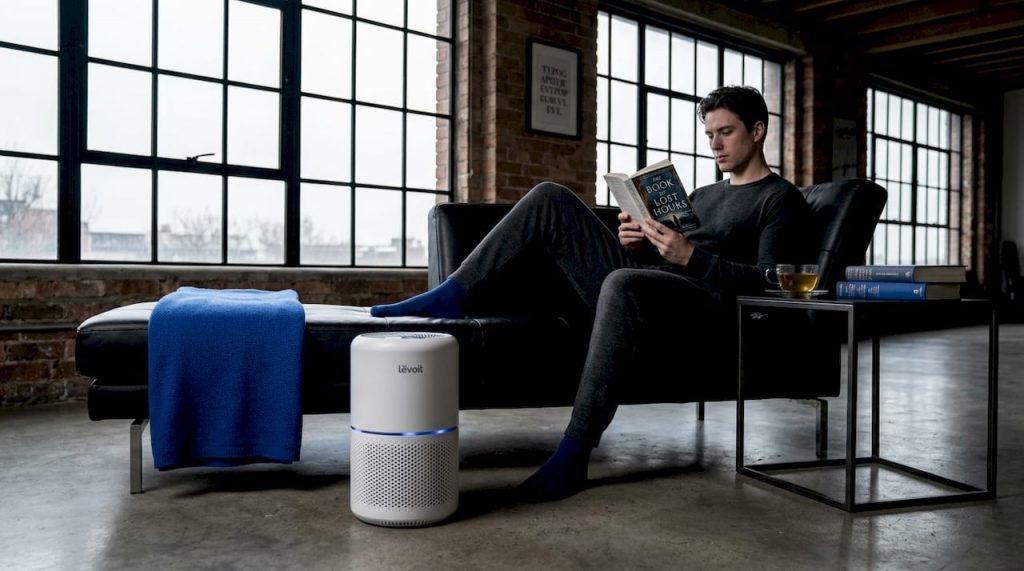
If you suffer from allergies or asthma, the air inside your home can be just as problematic as outdoor pollution. Not all air purifiers deliver the same results, and marketing terms like “HEPA-type” or “HEPA-style” create real confusion at the point of purchase. The Levoit Vital 100 true HEPA air purifier cuts through that ambiguity with verified filtration performance built around a certified H13 True HEPA filter. This article breaks down exactly what the Vital 100 does, who it suits best, and how to get the most from it in a real home environment.
Table of Contents
- Key takeaways
- Levoit Vital 100 filtration system and performance specs
- How the Vital 100 helps allergy and respiratory sufferers
- Using and maintaining the Vital 100 for best results
- Comparing the Vital 100 to similar models
- My take on the Vital 100 after years of reviewing purifiers
- Find your ideal air purifier at Climatepro
- FAQ
Key takeaways
| Point | Details |
|---|---|
| True HEPA certification matters | The H13 True HEPA filter captures 99.97% of particles at 0.3 microns, unlike uncertified “HEPA-type” filters. |
| Designed for smaller rooms | A CADR of 130 CFM covers rooms up to 300 sq ft effectively, making it best suited to bedrooms and studies. |
| Three-stage filtration | A pre-filter, True HEPA, and activated carbon layer work together to address particles, allergens, and odours. |
| Maintenance drives performance | Cleaning the washable pre-filter regularly prevents CADR loss and extends the main filter’s usable life. |
| Budget-friendly running costs | Filter replacement every 6 to 8 months keeps ongoing costs predictable without complex maintenance. |
Levoit Vital 100 filtration system and performance specs
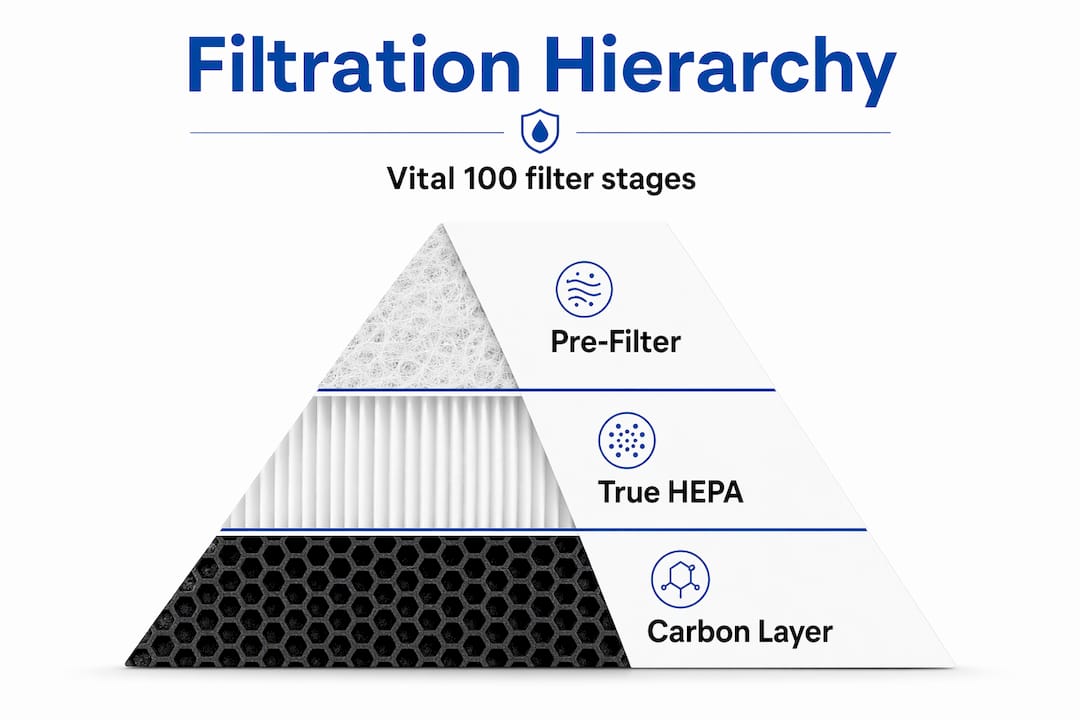
The Vital 100 uses a three-stage filtration system composed of a washable pre-filter, an H13 True HEPA filter, and an activated carbon filter. Each layer handles a distinct job. The pre-filter catches larger particles such as hair, dust, and visible debris before they reach the more sensitive layers below. The True HEPA filter then does the heavy work, and the activated carbon stage addresses gaseous pollutants.
The H13 grade is the industry-recognised standard for medical-grade particulate filtration. It traps 99.97% of airborne particles at 0.3 microns in diameter. That size matters because 0.3 microns is the most penetrating particle size. Filters verified to capture particles at this size will also capture larger and smaller particles effectively.
Performance data at a glance
| Specification | Vital 100 value |
|---|---|
| CADR rating | 130 CFM (221 m³/h) |
| Recommended room size | 300 sq ft (approx. 28 m²) |
| Estimated purification time (300 sq ft) | ~18 minutes at max settings |
| Noise level range | 23 to 50 dB |
| Power consumption | ~55W |
The CADR rating of 130 CFM means the unit can deliver clean air across a 300 sq ft room in roughly 18 minutes on its highest fan setting. In a larger 500 sq ft space that time extends to around 30 minutes, which reduces its effectiveness as a standalone solution. The unit operates at a minimum of 23 dB on its lowest speed, which is quieter than a whispered conversation and suitable for overnight bedroom use.
Key specifications worth noting:
- Pre-filter: Washable and reusable, reducing ongoing costs
- True HEPA grade: H13 certified, not simply “HEPA-type”
- Activated carbon: Adsorbs smoke, odours, and VOCs though in limited quantities
- Power draw: Approximately 55W at full speed, reasonable for continuous use
- Dimensions: Compact vertical design suited to floor or shelf placement
Pro Tip: Run the Vital 100 on its highest setting for 30 minutes when entering a room after outdoor exposure during high pollen periods, then drop to low speed for ongoing maintenance while you sleep.
How the Vital 100 helps allergy and respiratory sufferers
The distinction between True HEPA and lower-grade filters is not just technical. It has direct implications for allergy management. Allergist Purvi Parikh endorses HEPA filters as the gold standard for removing dust, pollen, and allergens from indoor air. The H13 rating in the Vital 100 meets that clinical recommendation.
“HEPA filters are the gold standard for allergy sufferers. Look for True HEPA certification to 0.3 microns at 99.97% efficiency — that is what actually removes the fine particles that trigger symptoms.”
— Allergist Purvi Parikh, as cited by AOL Health
The types of allergens the Vital 100 is particularly effective against include:
- Pollen: Fine grass and tree pollen particles, typically 10 to 100 microns, are well within the filter’s capture range
- Dust mite debris: Faecal particles from dust mites, often 0.5 to 20 microns
- Pet dander: Protein-laden particles shed by cats and dogs, often 2.5 microns and smaller
- Mould spores: Typically 2 to 20 microns, captured reliably by the True HEPA stage
- Fine smoke particles: Tobacco and wildfire smoke in the 0.1 to 1 micron range
The activated carbon layer provides a secondary benefit. It adsorbs smoke, odours, and VOCs such as formaldehyde and cleaning chemicals. For people with chemical sensitivities, this adds value. That said, the carbon quantity in the Vital 100 is relatively small. It handles everyday household odours and low-level VOC exposure well, but it is not designed for heavy industrial or persistent smoke environments. Understanding how different air cleaning technologies work helps set realistic expectations here.
The 99.97% efficiency at 0.3 microns is the critical specification for clinically meaningful allergen removal. Products labelled “HEPA-type” or “HEPA-grade” without independent certification may perform significantly below this threshold.
Using and maintaining the Vital 100 for best results
Getting the performance the specs promise depends on how you position and maintain the unit. Here is a practical approach:
-
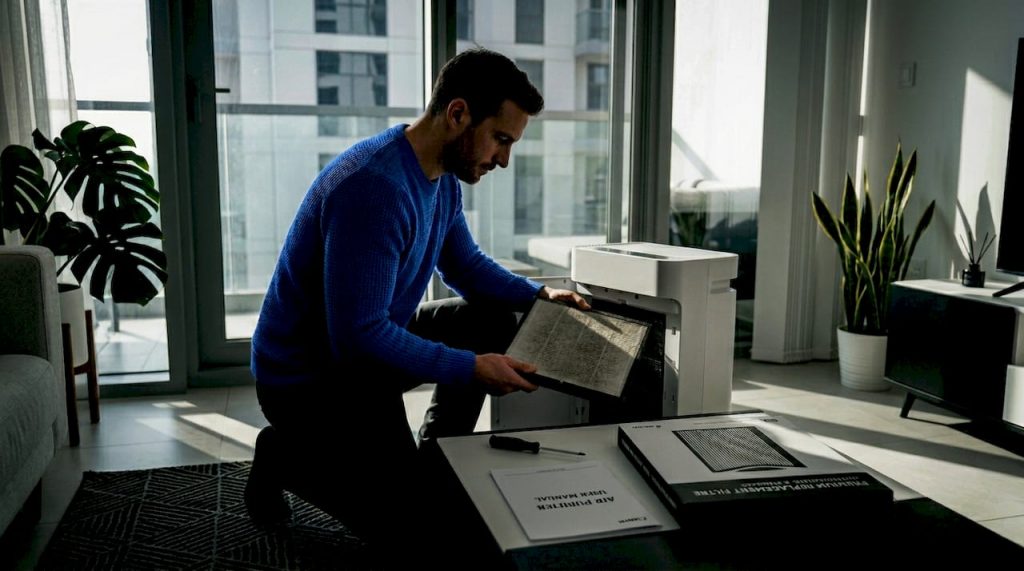
Place it in the room where you spend the most time. For allergy sufferers, this is almost always the bedroom. Put the unit within 1 to 2 metres of your sleeping position, on the floor or a low shelf, with the air intake unobstructed on all sides.
-
Keep intake and exhaust vents clear. Unobstructed airflow is required for the rated CADR to be delivered. Placing the unit against a wall or inside a cabinet significantly reduces output.
-
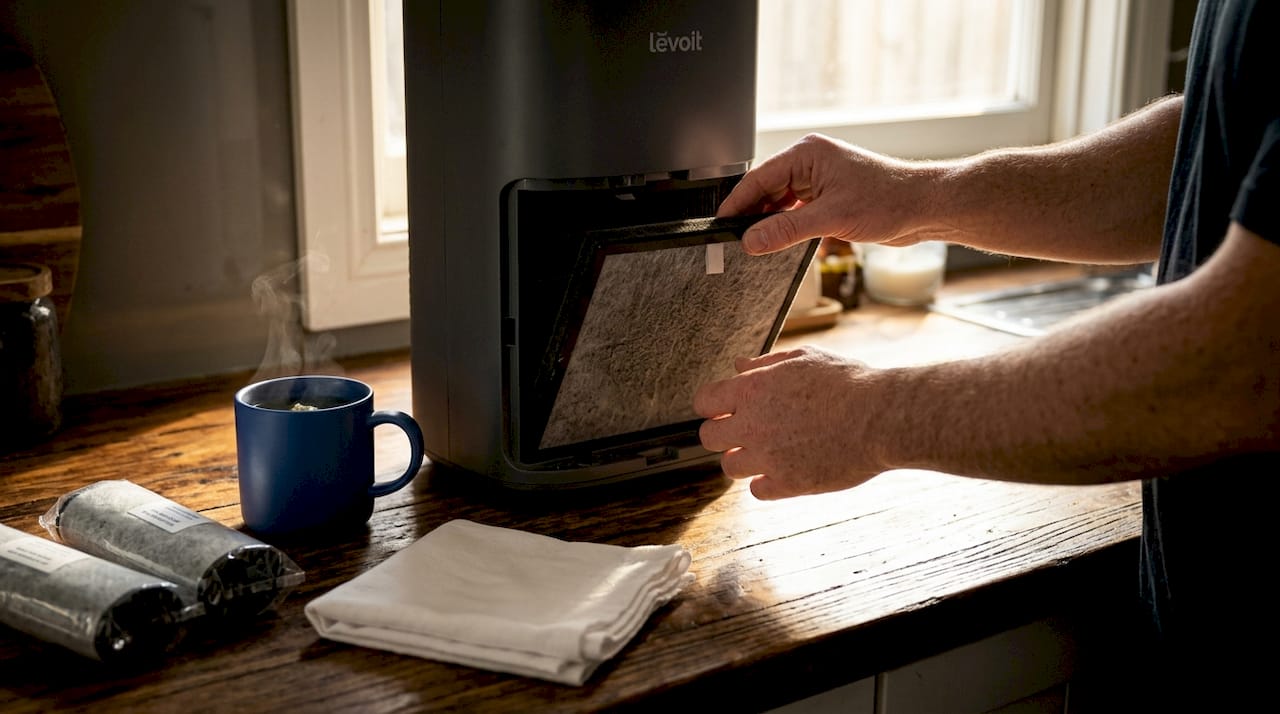
Clean the pre-filter every two to four weeks. The washable pre-filter should be removed and gently rinsed under cool water, then allowed to dry fully before reinstallation. Neglecting pre-filter cleaning causes the CADR to drop and accelerates clogging of the True HEPA layer beneath.
-
Replace the combined HEPA and carbon filter every 6 to 8 months. The recommended replacement interval is based on standard household use. In dusty environments such as homes in arid climates or near construction, replacement may be needed closer to the six-month mark.
-
Run the purifier continuously, not just when symptoms appear. Intermittent use allows allergen levels to rebuild between cycles. Continuous low-speed operation is more effective than occasional high-speed bursts.
-
Avoid placing the unit near open windows. Drawing in unfiltered outdoor air faster than the unit can process it defeats the purpose in high-pollen or high-dust conditions.
Pro Tip: Set the Vital 100 filter replacement reminder using a phone calendar alert at the time of installation. Waiting for the indicator light alone means the filter may already be past optimal performance before you notice.
Comparing the Vital 100 to similar models
The Vital 100 occupies a specific position in the market. It is a single-room unit without smart connectivity, auto mode, or air quality sensors. That is not a weakness in the context of its price point. It is a deliberate trade-off that keeps the cost of ownership low while maintaining genuine True HEPA filtration.
| Feature | Vital 100 | Compact smart purifiers | Larger multi-room units |
|---|---|---|---|
| CADR (CFM) | 130 | 80 to 120 | 200+ |
| Room coverage | 300 sq ft | 150 to 250 sq ft | 500+ sq ft |
| Noise at low speed | 23 dB | 22 to 28 dB | 25 to 35 dB |
| Air quality sensor | No | Yes (most models) | Yes |
| Filter replacement cost | Low to moderate | Moderate | Moderate to high |
| Smart app control | No | Yes (most models) | Yes |
Where the Vital 100 holds its own is in CADR for its size category and its genuine H13 filtration. Many budget-tier compact units carry HEPA-style filters that do not meet the 99.97% at 0.3 micron threshold. The trade-offs to consider include:
- No auto mode. You manage fan speed manually based on conditions. This is simple but requires more attention than sensor-driven models.
- Limited carbon capacity. For heavy smokers or kitchens with persistent cooking odours, the carbon load in the Vital 100 may be insufficient as a standalone solution.
- Room size ceiling. In open-plan UAE apartments above 30 m², a single Vital 100 unit will not maintain optimal air changes per hour. Two units or a higher-CADR model would be more appropriate.
For users comparing models within the Levoit range, the Levoit LV-H132 offers an even more compact option for very small spaces, while the Vital 100 provides meaningfully higher airflow for standard bedrooms.
My take on the Vital 100 after years of reviewing purifiers
I’ve reviewed enough air purifiers to know that most buying decisions come down to two mistakes. People either over-buy for their room size, expecting a large unit to do something a smaller one can’t, or they under-estimate how much maintenance matters to sustained performance.
The Vital 100 is straightforward to use, and that’s actually its biggest strength. I’ve seen customers invest in feature-rich smart purifiers and never correctly configure the auto modes, so the unit ends up running on the wrong setting most of the time. The Vital 100 removes that risk.
What I’d flag to anyone considering it: placement and filter upkeep will deliver more real-world benefit than the specs page. I’ve spoken to users who placed the unit in a corner behind a door and then wondered why their allergy symptoms persisted. The physics are simple. If air can’t flow freely through the unit, the CADR number on the box means nothing.
I also think the Vital 100 holds up well even with newer models on the market. The absence of a smart sensor is a genuine limitation if you want automated responses to air quality changes. But for a bedroom where you run it continuously at low speed, it covers the job at a price point that makes a second unit for another room financially practical.
The carbon filter limitation is real. If you cook frequently with strong spices, or if there’s a smoker in the household, pairing the Vital 100 with additional ventilation or a supplementary carbon-focused unit would serve you better. On its own, it is a strong performer within its design parameters.
— Nevel
Find your ideal air purifier at Climatepro

Climatepro stocks a curated range of air purifiers suited to UAE homes, offices, clinics, and commercial spaces, with delivery across Dubai, Abu Dhabi, Sharjah, and all seven emirates. Whether you are managing allergies, reducing dust in a nursery, or improving air quality across a hotel suite, the selection includes models from leading brands with verified True HEPA filtration.
For those comparing options in the allergy-friendly category, the Honeywell Air Touch P2 is a strong alternative with a higher CADR and auto-sensing capability. If you are ready to browse the full range by room size, filtration type, or budget, the complete air purifier catalogue at Climatepro makes it straightforward to find the right fit. Replacement filters for Levoit models are also stocked, so maintaining performance over the long term is simple.
FAQ
What does True HEPA mean compared to HEPA-type?
True HEPA refers to filters independently verified to capture 99.97% of particles at 0.3 microns. HEPA-type filters carry no certified standard and may perform significantly below this threshold.
Is the Vital 100 suitable for a UAE bedroom?
Yes. Its noise level of 23 dB at low speed and CADR suitable for rooms up to 28 m² make it well matched to standard bedroom sizes in UAE apartments.
How often should the Vital 100 filter be replaced?
The combined HEPA and carbon filter should be replaced every 6 to 8 months under typical use, or more frequently in dusty or high-pollution environments.
Can the Vital 100 remove pet dander effectively?
Yes. Pet dander particles typically fall between 0.5 and 2.5 microns, well within the capture range of the H13 True HEPA filter at 99.97% efficiency.
Does the Vital 100 handle cooking odours and smoke?
It reduces light odours and VOCs through the activated carbon stage, but the carbon load is limited for persistent cooking smells or tobacco smoke in heavily used kitchens or shared living spaces.
Recommended
- Levoit Vital 100S Review: Specs, Pros & Cons — Blog | ClimatePro UAE
- Levoit Vital 200S Review: Smart Air Purifier Guide — Blog | ClimatePro UAE
- Buy Levoit Vital 100S Pet Care Smart Air Purifier in Dubai | Best Price AED 627 | ClimatePro UAE
- Buy Levoit LV-H132 HEPA Air Purifier in Dubai | Best Price AED 240 | ClimatePro UAE