
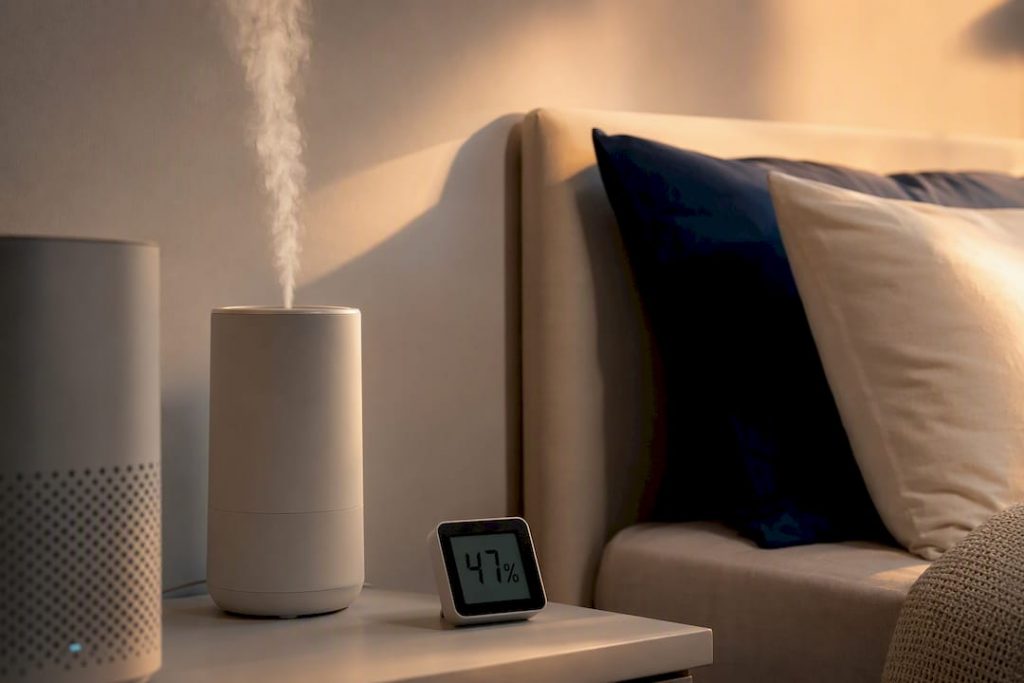
Most homes run best between 40% and 55% relative humidity (RH) year‑round, a band the EPA and ASHRAE both endorse for comfort and mould prevention (EPA sets the floor at 30%, ASHRAE allows up to 60% for thermal comfort). Below that range, dry air irritates skin, throats and sinuses. Above it, condensation and mould risk climb.
The fastest first step is not buying equipment. It is checking a digital hygrometer against the room you are worried about.
- Buy a cheap digital hygrometer and check readings in the bedroom and any problem room for a few days.
- Run exhaust fans during and after showers, cooking or laundry drying.
- If humidity sits high across multiple rooms, add a dehumidifier; if it’s persistently low in winter, add a humidifier.
Prioritise ventilation first. Mechanical humidity control matters most once ventilation alone can’t keep pace with the moisture your household produces.
Key Takeaways
Controlling home humidity works best when you measure first with a hygrometer, then apply room‑specific ventilation and mechanical fixes matched to whether the problem is localised or whole‑house.
| Point | Details |
|---|---|
| Target 40 to 55% RH | This range balances comfort and mould risk for most homes year‑round. |
| Measure before you buy | Log hygrometer readings for a week in the bedroom and problem rooms first. |
| Fix the source first | Exhaust fans and outdoor‑vented dryers cut moisture before it spreads through the house. |
| Match equipment to scope | Portable units suit one room; whole‑house dehumidification suits recurring, multi‑room problems. |
| Buy the right size device | Climatepro’s dehumidifier and humidifier ranges cover both single‑room and larger household needs. |
Table of Contents
- How to measure indoor humidity indoors reliably
- What causes high or low indoor humidity?
- Step‑by‑step ways to lower indoor humidity
- How do you safely raise indoor humidity when air is too dry?
- Room‑by‑room humidity fixes that actually work
- How do you choose the right dehumidifier or humidifier?
- Maintenance and seasonal humidity tips
- When does humidity become a mould or structural risk?
- Where to find reliable dehumidifiers, humidifiers and filters
- Frequently asked questions
- Sources
How to measure indoor humidity indoors reliably
A hygrometer is the cheapest, highest‑value tool in this entire process. Basic digital models cost little and give you a real baseline instead of a guess, and combined thermohygrometers that track temperature alongside RH are worth the small premium. Smart sensors that log data over time are useful, but treat smartphone app readings as rough estimates only. Check them against a dedicated device before trusting them.
Placement matters more than the device itself. Keep sensors away from direct sunlight, air vents and exterior walls, since all three skew readings.
- Place one hygrometer in the main bedroom and one in any suspected problem room.
- Log readings for at least a week to catch daily and weekly patterns, not just a single snapshot.
- Compare morning and evening readings, since cooking and showering spike RH temporarily.
What causes high or low indoor humidity?
Showers, cooking, indoor laundry drying, unvented dryers and basement seepage all push humidity up, and so does humid outdoor air leaking in during warmer months. Low humidity usually comes from heating cold, dry outdoor air through winter, running high‑temperature heating systems for long stretches, or living in a very tight home without a dedicated moisture recovery system.
- High humidity sources: showers, cooking steam, drying clothes indoors, unvented dryers, basement seepage, humid air infiltration.
- Low humidity sources: heating cold outdoor air, prolonged heating seasons, tightly sealed homes, high‑temperature HVAC systems.
Home construction and season both decide which of these actually bites. A leaky older home in a humid climate faces different risks to a tightly sealed apartment through a long, dry winter.
Step‑by‑step ways to lower indoor humidity
Start at the source, then work outward to mechanical fixes and, if needed, structural changes.
- Contain moisture where it’s created. Run exhaust fans during and after showers and cooking, keep pot lids on while cooking, and vent your clothes dryer outdoors rather than into a laundry or roof space.
- Move air deliberately. Run ceiling fans to mix air, and briefly boost whole‑house ventilation right after a moisture event like a long shower or a big cook‑up.
- Add mechanical removal where containment isn’t enough. A portable dehumidifier suits a single damp room; a whole‑house dehumidifier is justified when the problem recurs across multiple rooms or seasons. If a unit runs constantly without reaching its set point, or the tank fills within hours, it’s undersized for the space, not faulty.
- Fix the building, not just the symptom. Seal ground‑level air leaks, repair plumbing leaks promptly, improve drainage around foundations, and add vapour barriers where your climate and construction call for them.
Dehumidification alone won’t solve everything. It’s energy intensive, and pairing a dehumidifier with basic envelope sealing gets you a better result for less running cost than relying on the machine alone. Houseplants, despite the popular claim, add only a marginal amount of moisture and aren’t a real substitute for either approach.
Use this decision guide: if the damp is confined to one room (a bathroom or basement), start with a portable unit plus better ventilation. If it keeps reappearing in different rooms across seasons, that’s your signal to look at whole‑house dehumidification and envelope repairs together, since appliances alone can’t fix drainage or envelope problems underneath them.
How do you safely raise indoor humidity when air is too dry?
Winter heating strips moisture fast, and the fix depends on which humidifier type suits your household. Cool‑mist (evaporative) units are low‑maintenance and safer around kids, though they need regular filter changes. Warm‑mist (steam) humidifiers kill more bacteria in the tank but carry a burn risk near young children. Ultrasonic models run quietly but can leave a fine white mineral dust if you’re not using demineralised water.
- Hang a damp towel near (not on) a heater for a short‑term boost.
- Boil water briefly on the stove if you need quick relief, not a permanent fix.
- Keep a hygrometer nearby so you’re not humidifying blind.
Standards caution against over‑humidifying, since pushing RH too high in cold weather causes window condensation and can drive moisture into wall cavities where you can’t see it.
Room‑by‑room humidity fixes that actually work
Different rooms create and hold moisture differently, so the fix needs to match the room.
- Bathroom: run the extraction fan during showers and for 20 minutes after, and confirm the duct discharges outdoors, not into the roof space.
- Kitchen: use a rangehood vented outdoors while cooking, keep lids on pots, and run the dishwasher’s exhaust cycle if it has one.
- Laundry: always vent tumble dryers outdoors; if you dry clothes indoors, capture and exhaust that moisture rather than letting it drift through the house.
- Basement or lower‑ground rooms: use a dedicated dehumidifier with auto‑drain, check external drainage, and consider sump or pit drainage if water is actually getting in.
- Bedroom and living areas: keep a hygrometer near the bed, keep moisture sources away from sleeping areas, and use a humidifier sparingly in winter rather than running it all night at a high setting.
How do you choose the right dehumidifier or humidifier?
Sizing comes down to coverage area and extraction rate, usually listed as litres per day. A unit that runs constantly without ever reaching its target humidity, or a tank that needs emptying within hours, is telling you it’s too small for the space rather than broken.
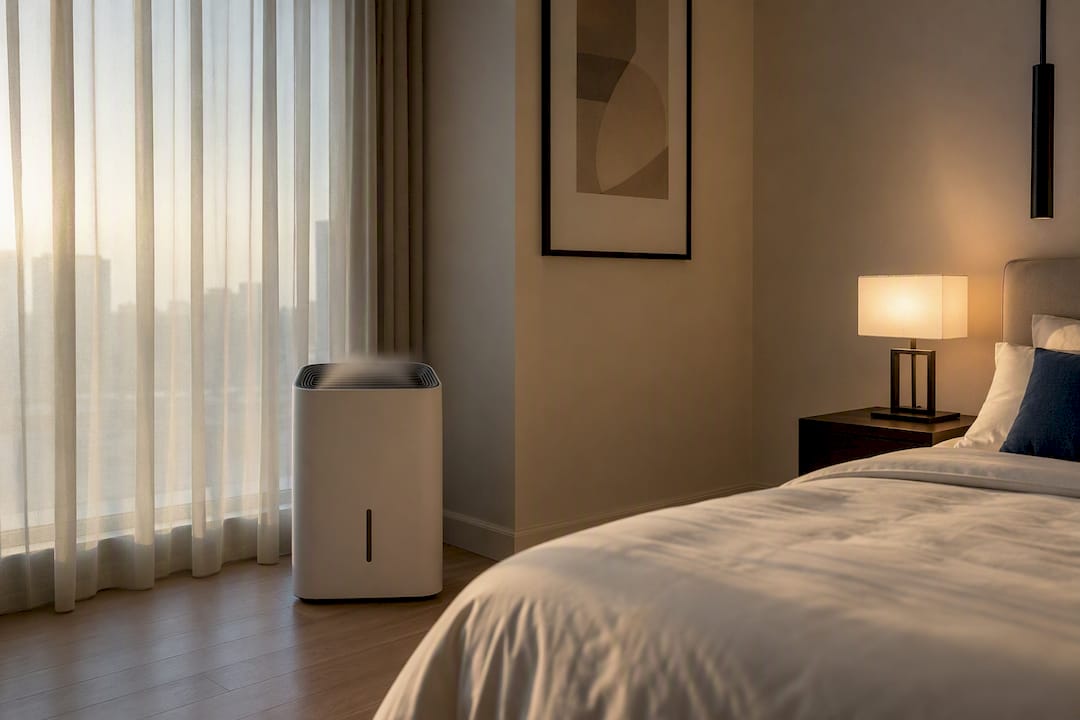
Match the scope of the problem to the scope of the fix. A single damp room calls for a portable dehumidifier; a home with persistent, multi‑room humidity problems is a better candidate for a whole‑house system tied into ductwork.
When comparing units, look past the price tag to auto‑drain capability (fewer manual empties), control accuracy (how close it holds to your set point), noise level, energy use and how easily you can access filters for cleaning. Sensor placement and high‑limit humidistats matter just as much on the buying side. A unit measuring air in the wrong spot will chase the wrong number all day.
Rough cost bands: portable dehumidifiers and humidifiers sit at the lower end of household appliance pricing, whole‑house units cost considerably more once you add ducted installation, and running costs vary with how many hours a day the unit works to hold its target.
Pro Tip: Don’t assume your air conditioner is doing dehumidification’s job. An oversized AC unit cools the room quickly and then shuts off before it has run long enough to actually pull moisture out of the air, leaving humidity high even though the thermostat says the room is comfortable.
Maintenance and seasonal humidity tips
A dehumidifier or humidifier only works as well as its upkeep. Clean or replace filters monthly, or per the manufacturer’s schedule, and check auto‑drain hoses and condensate lines for blockages before they back up.
- Empty portable tanks before they overflow, especially in humid months when they fill faster.
- Lower humidifier set points as outdoor temperatures drop, to avoid window and in‑wall condensation.
- Increase ventilation during humid seasons rather than relying on the dehumidifier alone.
If a unit won’t reach its set point despite regular maintenance, check for undersizing, blocked ducts or a hidden moisture source you haven’t found yet.
When does humidity become a mould or structural risk?
Call a tradesperson or mould remediation specialist when you see mould covering a large area, condensation forming repeatedly inside walls, a persistent damp smell that won’t clear despite your fixes, or water intrusion from the foundation. These aren’t jobs for a portable unit and a fan.
The risk is real and measurable. Prolonged indoor RH above roughly 50% increases mould growth risk, and repeated interstitial condensation, the kind you can’t see because it’s happening inside a wall cavity, can rot framing and insulation over time.
- Large or recurring mould patches, especially in bathrooms, basements or behind furniture.
- Persistent musty smell that returns after cleaning.
- Water stains, bubbling paint or damp patches on external walls after rain.
A professional will investigate plumbing, drainage and envelope leaks, test how humidity behaves across seasons rather than on one bad day, and recommend structural fixes like improved drainage or cavity ventilation where appliances can’t reach the actual source.
A practical note on getting this right
Writing about indoor air quality and humidity control for Climatepro means spending a lot of time in the gap between what a product label promises and what a room actually needs. For deeper product‑specific guidance, the humidity control workflow guide is a useful next stop.
Where to find reliable dehumidifiers, humidifiers and filters
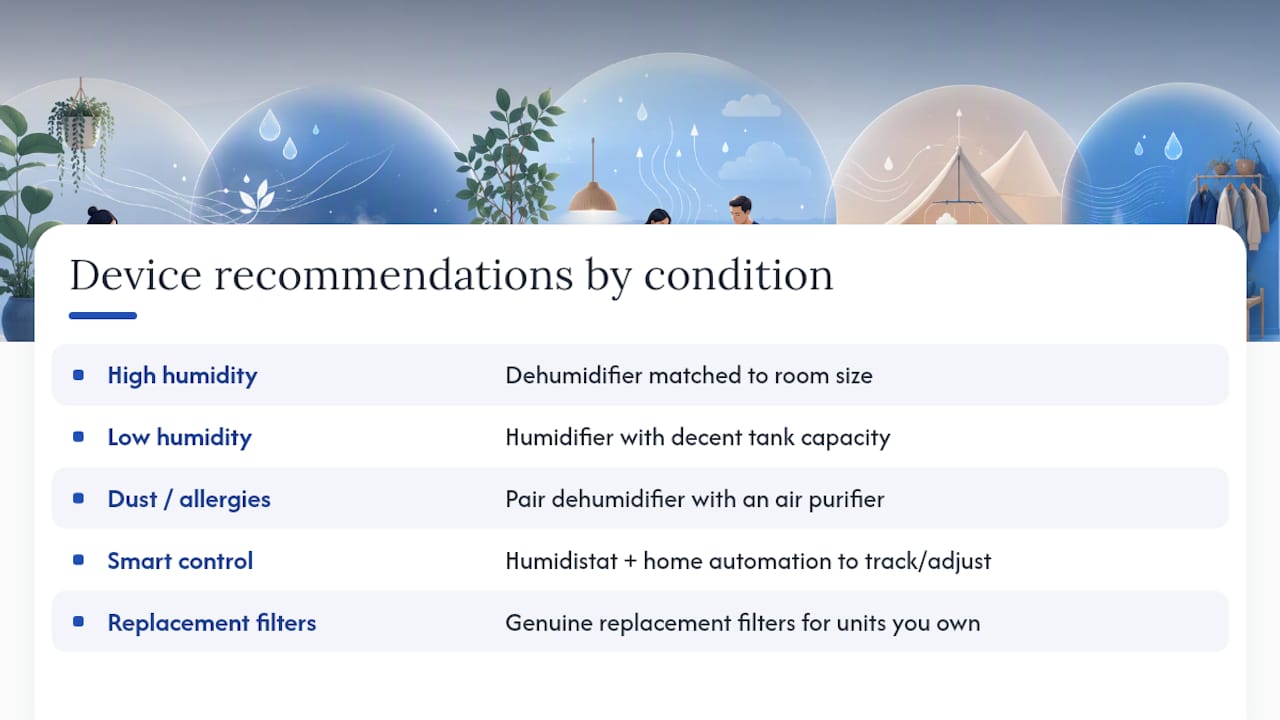
Climatepro stocks the equipment this guide keeps pointing to: dehumidifiers for damp basements and bathrooms, humidifiers for dry winter air, and genuine replacement filters for the units you already own. If a room test showed persistent RH above 55%, a dehumidifier matched to that room’s size will do more than any towel‑on‑a‑radiator trick. If winter heating is dropping your bedroom below 30%, a humidifier with a decent tank capacity solves it without you refilling it twice a night.
Households managing dust or allergy symptoms alongside humidity issues often pair a dehumidifier with an air purifier, since damp air and airborne allergens tend to show up together. For readers weighing smart controls into the mix, pairing a humidistat with home automation can help you track and adjust settings without checking a hygrometer manually every day. This is a product suggestion, not a substitute for measuring your own space first. Match capacity to your room size before you buy, and Climatepro’s team can help confirm the right model for your home when you check the category pages above.
Frequently asked questions
How long does it take to see results after fixing home humidity?
Ventilation fixes like running exhaust fans show a change within hours. Dehumidifiers or humidifiers typically bring a room to its target RH within a day or two, though whole‑house improvements from sealing or insulation work can take a few weeks to stabilise fully.
Can I just open a window to control humidity?
Sometimes. Opening a window helps when outdoor air is drier than indoor air, but it makes things worse during humid outdoor conditions, so check both readings before relying on it.
It sits at the upper edge of the comfort range ASHRAE allows, and prolonged RH above roughly 50% raises mould risk, so 60% is worth treating as a signal to act, not a comfortable resting point.
Do houseplants really help control humidity?
Not meaningfully. They add only a small amount of moisture to a room and shouldn’t replace a hygrometer, ventilation and mechanical dehumidification as your actual plan.
What’s a reasonable cost range for whole‑house dehumidification versus a portable unit?
Portable units cost far less upfront and suit single rooms. Whole‑house systems cost considerably more once ducted installation is included, but they solve recurring, multi‑room problems that portables can’t reach.
Sources
For technical system commissioning, check ASHRAE’s humidifier and control guidance. For homeowner‑level advice, the NCC condensation handbook and Ohio State University’s GreenHome guidance cover practical building and ventilation fixes.
- Home Humidity Control: Complete Indoor RH Guide (40-60%)
- ASHRAE guidance: humidifiers and controls (chapter extract)
- Whole‑house humidity control guide (Climate Control Lab)
- NCC 2025 condensation in building handbook
Recommended
- Humidity control workflow: your step-by-step home guide — Blog | ClimatePro UAE
- Why manage dry air: health, home, and what to do — Blog | ClimatePro UAE
- Relative humidity explained: what it is and why it matters — Blog | ClimatePro UAE
- Humidifier for dry air: your practical home guide — Blog | ClimatePro UAE