For most Australian homes dealing with everyday humidity, a portable refrigerant dehumidifier rated 10–20 litres per day suits rooms up to 50 m², while spaces above 50 m² or with persistent condensation need 20–35 litres per day. In cool, unheated rooms or during winter, a desiccant model maintains performance where a compressor unit slows down significantly.
Three steps to get started right now:
- Measure the floor area of the problem room (length × width in metres). Include any open-plan space that flows directly into it.
- Check the humidity with a hygrometer before you buy. Target a relative humidity (RH) range considered comfortable for most people; higher levels generally indicate a dehumidifier may be needed.
- Pick one capacity band larger than the chart suggests if you see visible condensation, mould spots, or a persistent musty smell.
Pro Tip: If your dampness problem only occurs in summer and you already own a split-system air conditioner, try the dry mode first. It may resolve the issue without any additional purchase.
The sizing chart below maps room area and dampness level to the right capacity band.
Key takeaways
Choosing the right dehumidifier comes down to three inputs: room area in m², baseline relative humidity, and the room’s typical temperature during the problem season.
| Point | Details |
|---|---|
| Measure before you buy | Calculate floor area in m² and check RH with a hygrometer; target 40–60% RH for comfort and mould control. |
| Match capacity to conditions | Use the sizing table to select litres per day based on area and dampness level; go one band larger for persistent condensation or mould. |
| Choose technology by temperature | Refrigerant units suit warm conditions (18°C+); desiccant units maintain extraction in rooms regularly below 15°C. |
| Prioritise a pump for drainage | Built-in pumps are worth the premium for laundries, basements, and any room without a convenient floor-level drain. |
| Fix intrusion before buying | Address leaks, gutters, and structural damp first; a dehumidifier is a secondary tool, not a substitute for building repairs. |
| Climatepro for product matching | Climatepro’s dehumidifier catalogue lets you filter by capacity and features, with warranty support confirmed at purchase. |
Table of Contents
- How do dehumidifiers actually remove moisture from the air?
- How to measure your room and check current humidity
- What size dehumidifier do you need?
- Which type of dehumidifier suits Australian homes?
- What features matter when comparing dehumidifier models?
- How much will a dehumidifier add to your electricity bill?
- Where to place a dehumidifier and how to maintain it
- Room-by-room recommendations for Australian homes
- When a dehumidifier is not the right solution
- Final buying checklist and practical recommendations
- What experience actually teaches you about choosing a dehumidifier
- Climatepro makes it straightforward to find the right dehumidifier
- Sources
How do dehumidifiers actually remove moisture from the air?
Two technologies dominate the market, and choosing between them depends largely on the temperature of the room you want to treat.
Refrigerant (compressor) dehumidifiers draw humid air across a set of cooled coils. Moisture condenses on the coils, drips into a collection tank or drains away, and the dried air is reheated slightly before being returned to the room. The process is energy-efficient in warm conditions, which makes these units the standard choice across most of Australia’s coastal and subtropical zones. According to Choice, refrigerant models perform best in warm, humid conditions, while desiccant models hold their effectiveness better in cool, damp environments.
Desiccant dehumidifiers pass air through a rotor coated with a moisture-absorbing material, typically silica gel or zeolite. The rotor regenerates continuously using a small heater, releasing the captured moisture as warm, humid exhaust. Because there are no cold coils to freeze, desiccant units keep extracting at temperatures where compressor models lose a significant share of their rated capacity.
Manufacturers typically quote extraction rates at 30°C and 80% relative humidity. A compressor dehumidifier can lose a substantial portion of that rated capacity at 10–15°C, so if winter condensation control is your goal, always ask for the low-temperature extraction figure before buying.
Pro Tip: If dampness is seasonal and you already have a split-system air conditioner, Choice notes that using the air conditioner’s dry mode is often the more energy-efficient solution than running a separate dehumidifier.
How to measure your room and check current humidity
Getting the right unit starts with two measurements: floor area and baseline relative humidity. Neither requires specialist equipment.
Measuring floor area
Multiply the room’s length by its width in metres to get the area in m². For open-plan living areas, include any connected space that shares the same airflow, such as a dining area that opens directly to a kitchen. If a hallway or doorway separates two rooms, treat them as separate spaces unless the door stays open permanently.
Checking humidity with a hygrometer
A hygrometer is a small, inexpensive device that displays current relative humidity and temperature. Consumer Reports recommends using one as a low-cost way to establish a baseline before buying, and to verify performance after installation. Many dehumidifiers include a built-in humidistat, but an external hygrometer gives independent readings that are useful for cross-checking.
Place the hygrometer at mid-height on an interior wall, away from windows and air vents. Take readings at different times of day over several days, particularly in the morning when humidity tends to peak.
Information to gather before you shop
- Floor area of the problem space in m²
- Baseline RH reading (average and peak)
- Typical season when the problem is worst (summer heat and humidity vs. winter condensation)
- Whether the room has a convenient drain point or floor drain
- Approximate ambient temperature in the room during the problem season
What size dehumidifier do you need?
Capacity is measured in litres of water extracted per 24 hours. The right capacity depends on both the floor area and how damp the space is. Choosing a dehumidifier somewhat larger than the minimum capacity needed can improve energy efficiency by cycling off earlier, while an undersized unit may run continuously without effectively lowering humidity.
Consumer Reports’ sizing guidance groups units into small, medium and large capacity bands based on area and relative-humidity conditions, and recommends choosing a slightly larger unit for persistent dampness.
| Room area | Moderately damp conditions with elevated relative humidity values | Very damp conditions with higher relative humidity levels | Wet conditions characterized by very high humidity or visible moisture |
|---|---|---|---|
| Up to 50 m² | Small capacity suitable for light moisture removal | Small to medium capacity suitable for moderate moisture removal | 10–20 L/day (medium) |
| Above 50 m² | 10–20 L/day (medium) | 20–35 L/day (medium) | Medium to large capacity suitable for substantial moisture removal |
| 50–80 m² | Large capacity suitable for significant moisture removal | Large capacity suitable for heavy-duty moisture removal | Large capacity or higher suitable for severe moisture removal |
| 80 m²+ | Large capacity or higher suitable for severe moisture removal | Large or higher capacity suitable for very severe moisture issues | Whole-house or industrial scale units |
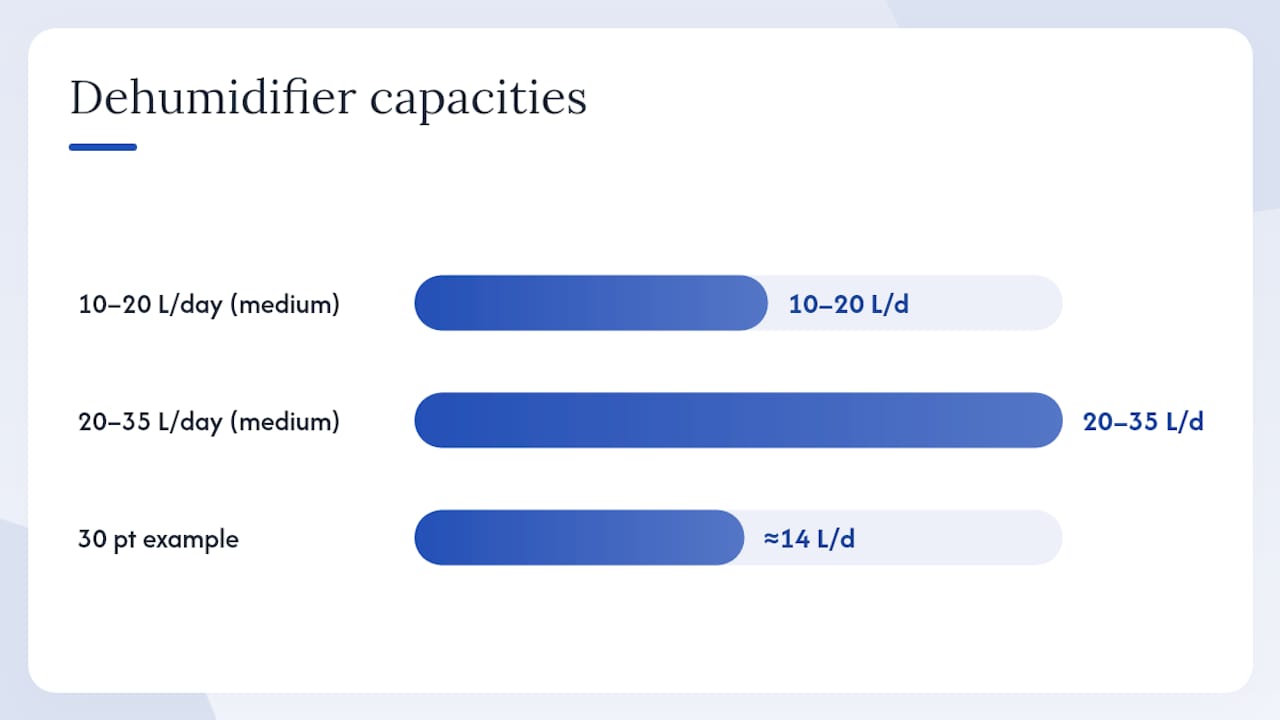
Note on unit conversion: Some imported product listings quote capacity in pints per day. One pint equals approximately 0.473 litres, so a 30-pint unit extracts roughly 14 litres per day. Always confirm the unit of measurement before comparing models.
For basements or any space with standing water or visible water ingress, Consumer Reports recommends prioritising models with a built-in pump. Gravity-fed drain hoses only work where a lower-level drain is accessible or the unit can be raised safely above the drain point.
Capacity callout: If you can see condensation on windows or walls, or smell mould, select the next capacity band up from what the table suggests. Running a slightly larger unit intermittently is more effective than running a smaller unit at full capacity around the clock.
Which type of dehumidifier suits Australian homes?
The right technology depends on your climate zone, the room’s typical temperature, and how the space is used. Understanding the dehumidification process helps match the unit to the job.
Portable refrigerant (compressor) units
These are the most widely available and cost-effective option for most Australian homes. They perform well in the warm, humid conditions typical of Queensland, coastal New South Wales, and the Northern Territory, and they handle the summer moisture load in Victoria and South Australia. Extraction rates are strong at temperatures above 18°C, and running costs are generally lower than desiccant models in warm conditions. Most portable units include a tank, a drain hose outlet, and a humidistat.
Desiccant units
Desiccant models suit unheated garages, cool southern-state winters, and any room where the ambient temperature regularly drops below 15°C. Choice advises checking low-temperature extraction figures if winter condensation control is the primary goal, since compressor models can lose significant capacity in the cold. Desiccant rotors also tend to run more quietly at equivalent extraction levels, though they rarely match high-volume refrigerant units for heavy-duty warm-climate drying.
Whole-house and industrial units
Whole-house dehumidifiers connect to the home’s ducted HVAC system and treat all rooms simultaneously. They suit larger homes with persistent humidity problems across multiple zones, and installation typically requires a licensed HVAC contractor. For context on how humidity control integrates with broader HVAC systems, the guidance on HVAC in home renovation is a useful reference. Industrial units are designed for construction drying, flood remediation, and commercial spaces, and are generally hired rather than purchased for residential use.
| Unit type | Best season | Temperature range | Typical locations |
|---|---|---|---|
| Portable refrigerant | Summer / year-round (warm zones) | 18°C+ | Living areas, bedrooms, laundries |
| Desiccant | Winter / year-round (cool zones) | Below 15°C | Garages, unheated rooms, southern states |
| Whole-house | Year-round | Any | Larger homes with ducted HVAC |
| Industrial | As needed | Any | Flood remediation, construction drying |
- Portable refrigerant units are the default choice for most Australian homes.
- Desiccant units are worth the premium when winter condensation is the main problem.
- Whole-house systems require professional installation and suit larger, persistently humid homes.
What features matter when comparing dehumidifier models?
Humidistat and controls
A digital humidistat that displays and holds a specific RH percentage is far more useful than a dial with vague “low/medium/high” settings. Good Housekeeping identifies drainage options, frost control, and noise ratings as critical selection factors alongside capacity.
Drainage options
- Tank: Most portable units include a 2–4 litre tank. Check the tank capacity relative to the extraction rate; a 10 L/day unit with a 2 L tank needs emptying five times daily at full extraction.
- Continuous drain hose: A gravity-fed hose routes water to a floor drain or sink without manual emptying. The unit must sit higher than the drain outlet.
- Built-in pump: A pump pushes water upward and horizontally, allowing drainage to a sink or window even when the unit sits at floor level. This is the most practical option for basements and laundries.
Auto-defrost and filter access
Auto-defrost (frost control) prevents ice forming on the coils in cooler conditions, protecting the compressor and maintaining extraction. Without it, a refrigerant unit operating below about 18°C will ice up and stop working. Filter access matters for maintenance; a filter that requires tools or partial disassembly to remove will be cleaned less often.
Noise
Dehumidifier noise is measured in decibels (dB). Units in the 35–45 dB range are suitable for bedrooms; anything above 50 dB is better suited to laundries, garages, or spaces where background noise is already present. RTINGS tested more than 20 dehumidifiers and publishes hands-on extraction and noise measurements, which are useful for verifying manufacturer claims before purchase.
Smart features and warranty
Wi-Fi connectivity and app controls allow scheduling and remote monitoring, which can reduce energy use by avoiding unnecessary run time. These are genuinely useful rather than gimmicks, particularly for managing a dehumidifier in a room that is not used daily. For Australian buyers, check that the warranty is backed by a local distributor; a 12-month warranty supported by an Australian service centre is more practical than a longer warranty that requires shipping overseas.
Pro Tip: Check the ENERGY STAR testing and capacity standards when comparing models. Units tested under standardised conditions give you a reliable basis for comparison, unlike models with unverified extraction claims.
How much will a dehumidifier add to your electricity bill?
Running cost depends on the unit’s wattage, how many hours per day it operates, and your local electricity tariff. In Australia, residential electricity rates vary by state and retailer, but a useful working figure is around 30–35 cents per kWh for general consumption.
Calculating daily running cost
- Find the unit’s wattage (listed in the specifications, typically 200–700 W for portable models).
- Divide by 1,000 to convert to kilowatts (kW).
- Multiply by hours of daily operation.
- Multiply by your electricity rate in dollars per kWh.
Example: A 400 W medium-capacity unit running 8 hours per day at $0.32/kWh costs approximately $1.02 per day, or around $31 per month. A smaller 200 W unit on the same schedule costs roughly $0.51 per day.
Efficiency: Integrated Energy Factor (IEF)
IEF measures litres of water extracted per kilowatt-hour of energy consumed. A higher IEF means more water removed for each dollar spent on electricity. Natural Resources Canada notes that ENERGY STAR certified dehumidifiers typically use nearly 15% less energy than standard models, and recommends choosing units with a high IEF for better efficiency. When comparing two models of similar capacity, the one with the higher IEF will cost less to run over its lifetime.
Efficiency callout: A dehumidifier with a higher IEF rating will typically pay back the price difference in electricity savings within one to two cooling seasons, depending on how many hours per day it runs.
Pro Tip: Run the dehumidifier with windows and doors closed, use the humidistat to avoid over-running, and set a timer to operate during off-peak electricity hours where your tariff supports it. These three habits can cut running costs noticeably without reducing effectiveness. For more on energy-efficient air management, the workflow guide covers scheduling and placement in detail.
Where to place a dehumidifier and how to maintain it
Placement rules
- Position the unit at least 20–30 cm from walls and furniture to allow free airflow around the intake and exhaust vents.
- Avoid placing it in direct sunlight or near a heat source, which can affect the humidistat reading.
- Do not tuck it into a cupboard or enclosed alcove unless the manufacturer’s specifications explicitly allow confined-space operation.
- In open-plan areas, place the unit centrally rather than in a corner to maximise air circulation.
- For a laundry or bathroom, position near the source of moisture (washing machine, shower) rather than at the far end of the room.
Drainage setup
- If using the tank, check it daily during high-humidity periods. Most units auto-shut when the tank is full, but a full tank means the unit has stopped extracting.
- For a gravity drain hose, confirm the hose runs continuously downhill to the drain outlet with no upward loops that would trap water.
- For a pump drain, route the outlet hose to a sink, laundry tub, or external drain point. Secure the hose so it cannot slip out of the drain.
- Inspect hose connections monthly for blockages or kinks.
Maintenance checklist
- Filter: Clean the air filter every two to four weeks during heavy use. Rinse with warm water, allow to dry fully before reinserting.
- Tank: Wipe the tank with a diluted white vinegar solution monthly to prevent mould and mineral build-up.
- Coils and fan: Inspect annually for dust accumulation. A soft brush or vacuum with a brush attachment removes debris without damaging the fins.
- Winter storage: If storing the unit during winter, drain all water from the tank and hose, clean the filter, and store upright in a dry location.
- Troubleshooting: If extraction drops noticeably, check the filter first, then confirm the room temperature is within the unit’s operating range. Ice on the coils indicates the room is too cold for a refrigerant model.
Room-by-room recommendations for Australian homes
Laundries and bathrooms
Both spaces generate concentrated moisture bursts rather than sustained humidity. An extractor fan running during and for 15–20 minutes after showering or drying clothes removes a significant portion of the moisture load before it spreads. A dehumidifier in these rooms works best as a secondary measure, running after the fan has cleared the initial steam. For laundries, a unit with a built-in pump is worth the extra cost; the alternative is manually emptying a tank multiple times on washing days.
Open-plan areas and multi-room strategies
A single large-capacity unit placed centrally in an open-plan area generally outperforms two smaller units in separate corners, because airflow from one unit can cover the connected space more evenly. Where rooms are separated by walls or doors, a unit in each room is more effective. The role of portable dehumidifiers in Australian homes covers multi-room strategies and airflow positioning in more detail.
- For open-plan areas above 60 m², choose a unit rated for the full area rather than splitting capacity across two smaller units.
- Keep internal doors open when running a single unit to allow air to circulate between connected spaces.
- In multi-storey homes, humidity tends to be higher on lower floors; prioritise dehumidification at ground level first.
When a dehumidifier is not the right solution
A dehumidifier treats airborne moisture. It cannot fix the source of water entering a building, and running one against a continuous water source is both ineffective and expensive.
Signs that a dehumidifier is not the primary fix:
- Water staining on walls or ceilings that reappears after drying, indicating active roof or plumbing leaks.
- Rising damp visible as a tide mark on lower walls, which requires damp-proofing or subfloor ventilation.
- Condensation on windows that disappears entirely in warmer months, suggesting the issue is seasonal and may be resolved by the air conditioner’s dry mode.
- Pooling water or standing moisture after rain, which points to drainage or waterproofing problems.
- Mould that returns within weeks of cleaning, indicating a moisture source that the dehumidifier cannot overcome on its own.
Consumer Reports advises addressing moisture intrusion at the source first: gutters, downspouts, and external drainage should be checked and cleared before any dehumidifier is purchased. Structural damp, rising damp, and flood-related moisture require specialist remediation, not appliance-based solutions.
Pro Tip: If you suspect structural moisture intrusion, contact a licensed building inspector or remediation specialist before spending money on a dehumidifier. A dehumidifier is a secondary tool, not a substitute for fixing the building.
Final buying checklist and practical recommendations
Match the room area and dampness level to the sizing table, then apply these filters when comparing specific models:
- Capacity at temperature: Confirm the extraction rate at a temperature relevant to your room, not just the headline figure quoted at 30°C/80% RH.
- IEF or litres per kWh: Higher is better. Prefer ENERGY STAR certified models where available.
- Drainage type: Tank only is acceptable for small, easily accessible rooms. Built-in pump is worth the premium for laundries, basements, and any room without a convenient drain.
- Noise rating: Below 45 dB for bedrooms; up to 55 dB is acceptable for laundries and garages.
- Auto-defrost: Required for any room that drops below 18°C regularly.
- Warranty and local support: Confirm Australian distributor support before purchasing.
The core decision rule is straightforward: measure the space, check the RH with a hygrometer, select the capacity band that matches the area and dampness level, and go one band larger if the problem is persistent. Prefer a pump for any space without easy drain access, and choose a desiccant model if the room is regularly below 15°C.
Pro Tip: Before finalising a purchase, cross-reference the manufacturer’s extraction claim against independently tested figures from sources such as RTINGS, which has tested more than 20 models with hands-on measurements. Manufacturer claims and real-world performance can differ, particularly at lower temperatures.
What experience actually teaches you about choosing a dehumidifier
The most common mistake is buying on capacity alone without accounting for temperature. A homeowner in Melbourne’s inner suburbs purchases a well-reviewed 20 L/day compressor unit for a south-facing bedroom that sits at 12°C through winter. The unit runs constantly, extracts far less than rated, and the condensation problem persists. The fix is either a desiccant model or addressing the room’s insulation, not a larger compressor unit.
The second common error is placement. A dehumidifier pushed into the corner of a laundry behind the washing machine will circulate the same small pocket of air rather than treating the room. Moving it to a central, unobstructed position often produces a visible improvement without any change to the unit itself.
On the noise-versus-power trade-off: desiccant rotors are typically quieter at equivalent extraction levels, but they do not match high-volume refrigerant models for heavy-duty warm-climate drying. For a bedroom, the quieter desiccant unit is usually the better choice even if the extraction rate is slightly lower, because a unit that disturbs sleep will be switched off. A unit that runs quietly through the night extracts more total moisture than a louder unit that gets turned off at 10 PM.
Sizing conservatism is worth repeating. The upfront cost difference between capacity bands is usually modest compared to the running-cost difference over a season.
Climatepro is a useful starting point for matching product specifications to room requirements, particularly for readers who want to compare portable and smart-enabled models without visiting a physical store.
Climatepro makes it straightforward to find the right dehumidifier
Choosing the right unit is one part of the process. Finding a model that matches your specifications, arrives promptly, and comes with reliable after-sales support is the other.

Climatepro stocks a range of dehumidifiers suited to different room sizes and use cases, including portable units with built-in pumps and smart-enabled models such as the Xiaomi Smart Dehumidifier Lite for compact spaces. The catalogue is organised by capacity and feature set, so you can filter directly by what the sizing chart and checklist above identified as your requirements. Support is available for product-matching queries, and warranty coverage is confirmed at the point of purchase. Browse the dehumidifier range at Climatepro and compare specifications against the checklist from this guide before adding to cart.
Sources
- How to buy a dehumidifier for your home
- Dehumidifier Buying Guide – Consumer Reports
- Choosing the right dehumidifier – Natural Resources Canada
- Rtings
- Dehumidifier Buying Guide: 6 Things to Consider
The difference can be substantial for compressor models.