Apartment ventilation is the deliberate exchange of stale indoor air with fresh outdoor air to protect health, regulate humidity, and maintain comfort in enclosed living spaces. The reasons to ventilate apartments go well beyond comfort. Modern apartments, particularly those built after 1990, are constructed to tight energy standards that significantly reduce natural air infiltration. Without a planned ventilation strategy, indoor pollutants accumulate rapidly. ASHRAE 62.2 recommends at least 0.35 air changes per hour for residential spaces. That standard exists because the air inside your apartment can become measurably more harmful than the air outside.
Why ventilate apartments: the health and air quality case
Poor ventilation causes a predictable chain of problems. Carbon dioxide builds up from breathing. Volatile organic compounds, known as VOCs, off-gas from furniture, cleaning products, and building materials. Fine particulate matter, classified as PM2.5, accumulates from cooking, candles, and dust. In a sealed apartment, these pollutants have nowhere to go.
The consequences are well documented. Tight buildings trap VOCs, CO2, and moisture, producing what building scientists call “sick building syndrome.” Residents experience headaches, fatigue, eye irritation, and recurring respiratory issues. Many attribute these symptoms to stress or illness without realising the air in their home is the source.
Humidity control is equally critical. Indoor relative humidity between 30% and 50% inhibits mould growth and reduces respiratory distress. In multi-unit buildings, moisture from cooking, showering, and breathing accumulates fast. When humidity exceeds 50% consistently, mould spores find ideal conditions on walls, ceilings, and inside cabinetry.
The importance of air circulation becomes clear when you consider what a single day of normal activity adds to your indoor air:
- Cooking releases PM2.5, nitrogen dioxide, and grease particles into the air
- Showering adds significant moisture, raising humidity levels within minutes
- Sleeping produces CO2 continuously throughout the night
- Cleaning products release VOCs that linger for hours without airflow
- Synthetic furnishings off-gas formaldehyde and other compounds at room temperature
Each of these sources compounds the others. Without adequate airflow, your apartment accumulates a mixture of pollutants that no amount of cleaning will address.
Natural vs mechanical ventilation: what works in apartments?
The two primary approaches to residential ventilation are natural ventilation and mechanical ventilation. Each has distinct advantages and limitations in apartment settings.
| Feature | Natural Ventilation | Mechanical Ventilation |
|---|---|---|
| Method | Open windows, doors, passive airflow | Fans, exhaust systems, HRV/ERV units |
| Cost | No running cost | Ongoing energy use |
| Control | Weather and layout dependent | Consistent and adjustable |
| Effectiveness | Variable, limited in single-aspect units | Reliable, meets ASHRAE 62.2 standards |
| Best suited for | Older, leakier buildings | Modern airtight apartments |
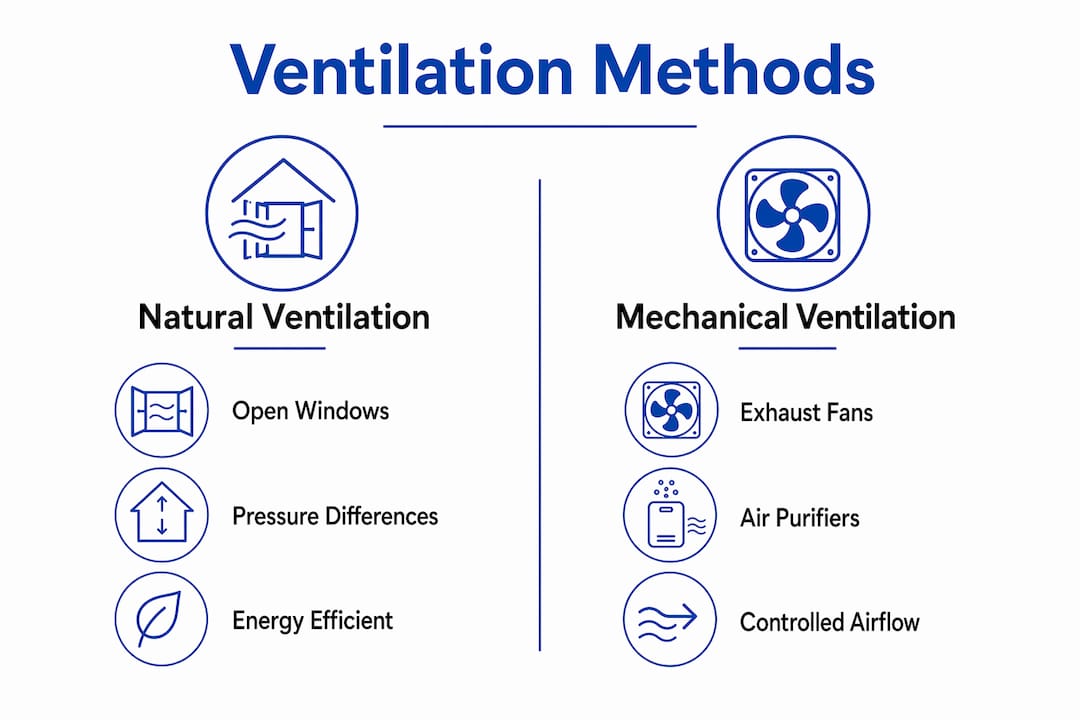
Natural ventilation relies on pressure differences and wind to move air through openings. The challenge in apartments is that many units have windows on only one side, which limits cross-ventilation significantly. Opening a single window creates minimal airflow without a corresponding outlet for air to exit. Natural ventilation during cooking does reduce indoor PM2.5 by around 46–47%, which demonstrates real benefit when conditions allow it. That reduction, however, depends on outdoor air quality and window placement.
Modern airtight apartments built after 1990 measure below 7 ACH50 in airtightness testing, meaning natural infiltration alone cannot meet ventilation requirements. These buildings require designed mechanical ventilation systems. Heat recovery ventilation, or HRV, is one of the more efficient solutions. It exchanges stale indoor air with fresh outdoor air while recovering up to 80–90% of the heat from the outgoing air, reducing the energy cost of ventilation. You can read more about how air changes per hour directly affect indoor air quality and energy use.
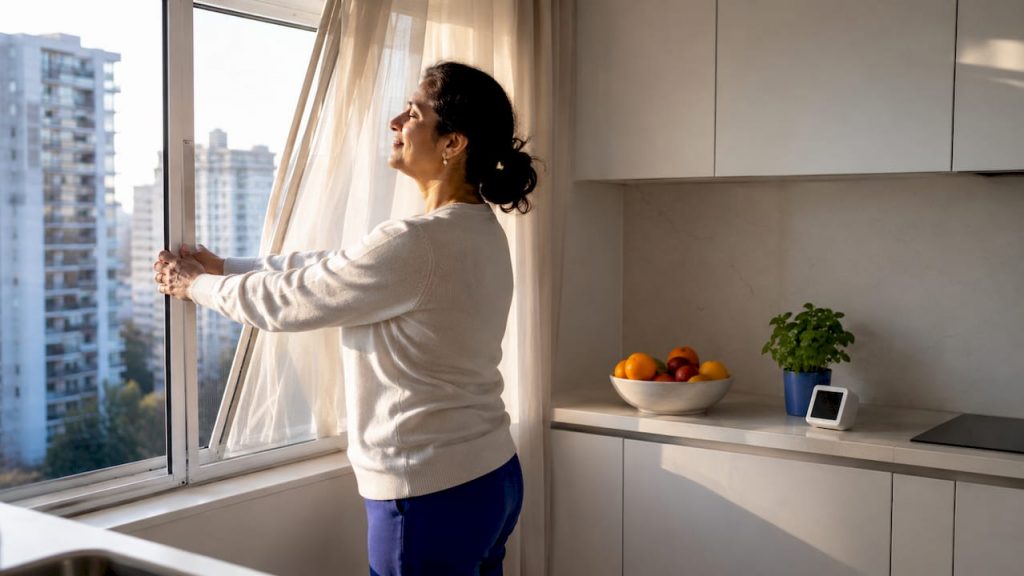
Timing matters for natural ventilation. Short, timed airing is superior to leaving windows open continuously, particularly in humid climates. Opening windows for 5–10 minutes in the early morning, when outdoor air is cooler and drier, achieves meaningful air exchange without flooding the apartment with humidity.
Pro Tip: Open windows on opposite sides of your apartment simultaneously for 5–10 minutes rather than leaving one window open all day. This creates cross-ventilation that exchanges air far more effectively than prolonged single-window opening.
Poor airflow also reduces HVAC efficiency, leading to longer running times and higher energy costs. Keeping ventilation paths clear is not just a health measure. It directly affects your electricity bill.
How to ventilate your apartment: practical steps that work
Apartment residents face real constraints. You may not control the building’s mechanical systems, and your window placement may limit natural airflow. These practical steps work within those constraints.
-
Run exhaust fans during and after cooking and showering. Exhaust fans in kitchens and bathrooms remove moisture and odours at the source. Run the bathroom fan for at least 15–20 minutes after showering to clear residual humidity.
-
Open interior doors when airing the apartment. Closed interior doors block airflow between rooms. Opening them allows air to circulate through the full apartment when windows are open.
-
Keep air vents and grilles clear. Furniture placed against walls often blocks supply or return air vents. Check that no vents are obstructed by sofas, beds, or storage.
-
Time window opening to outdoor conditions. Avoid opening windows during peak humidity or when outdoor pollution is high, such as during dust events common in the UAE. Early morning is generally the best window for fresh air exchange.
-
Report maintenance issues promptly. A broken exhaust fan or a blocked duct is a building maintenance issue, not a resident problem to work around. Report these faults in writing and follow up.
-
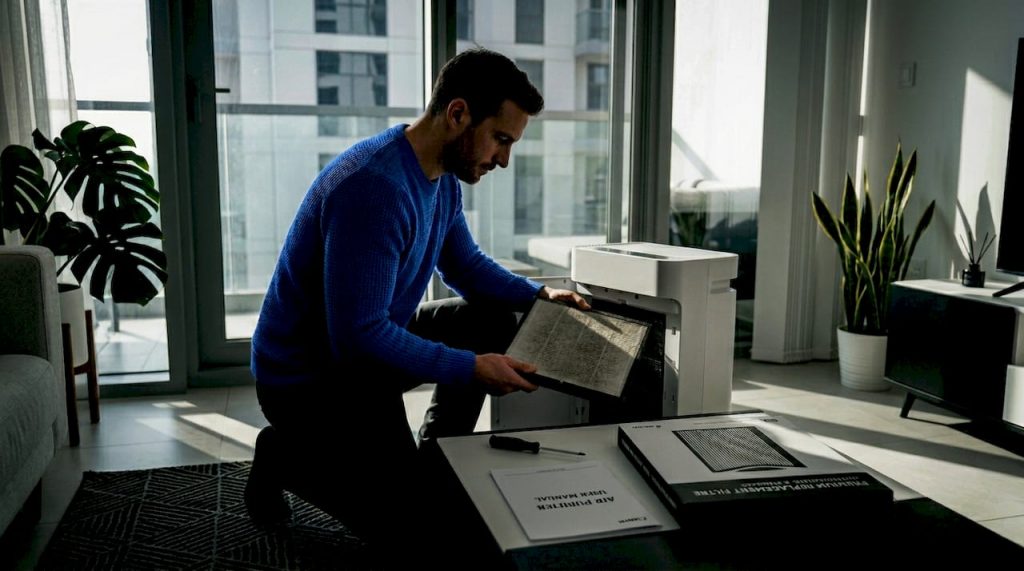
Use a portable air purifier in high-use rooms. Air purifiers with HEPA filtration capture PM2.5, dust, and allergens that ventilation alone may not remove. They are particularly useful in bedrooms and living areas.
-
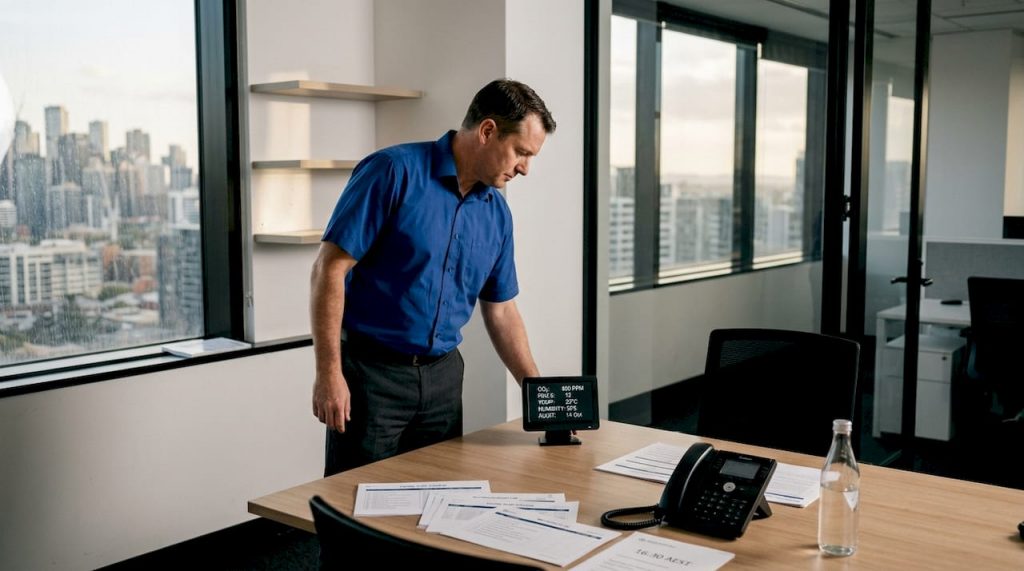
Monitor indoor humidity. A basic hygrometer costs very little and tells you whether your humidity is within the healthy 30%–50% range. If it consistently reads above 55%, a dehumidifier is a practical solution.
Pro Tip: Place a portable air purifier near the kitchen when cooking. Cooking is one of the highest sources of indoor PM2.5, and a purifier running during meal preparation significantly reduces particle exposure in the living area.
For residents in the UAE, the practical steps for improving air quality in apartments are particularly relevant given the region’s dust levels and high outdoor humidity during summer months.
Does your building’s design affect your indoor air quality?
Building design and shared systems have a direct impact on individual apartment air quality, and this is one of the most overlooked reasons for apartment airflow problems. Residents often assume their air quality issues are self-contained. The evidence says otherwise.
Residents’ indoor air quality issues can stem 30–70% from external sources entering via shared HVAC systems and building leaks. That figure reframes the problem entirely. You can follow every ventilation tip available and still have poor air quality if the building’s systems are contaminated or poorly maintained.
Key building-level factors that affect your apartment’s air include:
- Shared HVAC ducts that carry pollutants, odours, and biological contaminants between units
- Corridor and common area air that infiltrates under doors and through gaps around pipes
- Parking exhaust from basement car parks that enters ground-floor and lower-level apartments through structural gaps
- Neighbouring unit activities such as smoking, cooking, or renovation work that migrate through shared walls and ventilation paths
- Infrequent filter changes in central air handling units that reduce system effectiveness and spread accumulated particles
Persistent ventilation issues often require building management intervention because the root cause is systemic. A resident cannot fix a contaminated central duct or a poorly sealed corridor. Raising these issues with building management, supported by documentation of symptoms or air quality readings, is the appropriate path.
Airtight building envelopes in modern construction reduce energy loss but concentrate indoor pollutants. This is not a flaw in design. It is a trade-off that requires mechanical ventilation to be part of the building’s infrastructure from the outset. When that infrastructure is absent or poorly maintained, residents bear the health consequences.
Key takeaways
Proper apartment ventilation requires both resident action and building-level systems working together to maintain healthy indoor air quality.
| Point | Details |
|---|---|
| Ventilation removes indoor pollutants | CO2, VOCs, and PM2.5 accumulate rapidly in airtight apartments without regular air exchange. |
| Humidity must stay between 30% and 50% | Exceeding 50% relative humidity consistently creates conditions for mould growth and respiratory issues. |
| Modern apartments need mechanical ventilation | Buildings constructed after 1990 are too airtight for natural infiltration to meet ASHRAE 62.2 standards. |
| Timed short airing outperforms open windows | Brief, purposeful window opening in dry conditions exchanges air more effectively than continuous opening. |
| Building systems drive up to 70% of IAQ issues | Shared HVAC and structural gaps mean individual actions alone cannot fully resolve air quality problems. |
Ventilation is not just about opening windows
From my experience working with indoor air quality across residential and commercial spaces, the most persistent misconception I encounter is that ventilation simply means opening a window. That view misses the majority of what actually drives air quality in a modern apartment.
The buildings most people live in today were designed to minimise energy loss. That is a reasonable goal. The consequence, though, is that the same envelope keeping conditioned air inside is also keeping pollutants in. When I look at the data showing that up to 70% of apartment IAQ issues originate outside individual units, it confirms that residents are often managing a building-wide problem with individual-level tools.
What I find works in practice is a layered approach. Exhaust fans, timed airing, and portable air purifiers address what residents can control. Engaging building management about shared system maintenance addresses what they cannot. Neither layer alone is sufficient. The residents I see with the best outcomes treat ventilation as an ongoing practice rather than a reactive measure taken when a room smells stale.
The UAE context adds specific complexity. Outdoor air during summer months carries high humidity and dust loads that make continuous window opening counterproductive. In that environment, mechanical ventilation and air purification are not optional upgrades. They are the practical baseline for healthy indoor air. Understanding what air solution experts recommend for these conditions is worth the time for any resident serious about their indoor environment.
— Nevel
Improve your apartment’s air quality with Climatepro
Ventilation addresses airflow, but it does not filter the particles, allergens, and pollutants already present in your indoor air. Air purifiers and humidity control devices work alongside ventilation to deliver genuinely clean air in apartments where building systems fall short.

Climatepro stocks a full range of Honeywell air purifiers suited to apartments of all sizes, including the Honeywell Air Touch P2 at AED 705 and the Honeywell Air Touch U1 at AED 935 for larger spaces. For humidity management, the range of dehumidifiers available through Climatepro helps maintain the 30%–50% indoor humidity range that prevents mould and supports respiratory health. Delivery is available across Dubai, Abu Dhabi, Sharjah, and all UAE emirates.
FAQ
What is apartment ventilation and why does it matter?
Apartment ventilation is the controlled exchange of indoor air with fresh outdoor air to remove pollutants, control humidity, and maintain occupant health. Without it, CO2, VOCs, and PM2.5 accumulate to levels that cause respiratory issues and sick building syndrome.
How often should air be exchanged in an apartment?
ASHRAE 62.2 recommends at least 0.35 air changes per hour for residential spaces, which replaces the full volume of indoor air approximately every three hours.
Does opening windows ventilate an apartment effectively?
Opening windows provides useful ventilation when done in short, timed sessions during drier outdoor conditions. Continuous window opening in humid weather can worsen indoor humidity and encourage mould growth.
Can i improve air quality if my building’s ventilation system is poor?
Residents can reduce exposure using exhaust fans, portable air purifiers, and timed airing, but up to 70% of apartment air quality issues originate from shared building systems. Persistent problems require building management to address systemic infrastructure.
What humidity level should i maintain in my apartment?
Indoor relative humidity between 30% and 50% is the recommended range. Above 50%, mould growth and dust mite activity increase significantly, particularly in bathrooms and kitchens with limited exhaust ventilation.