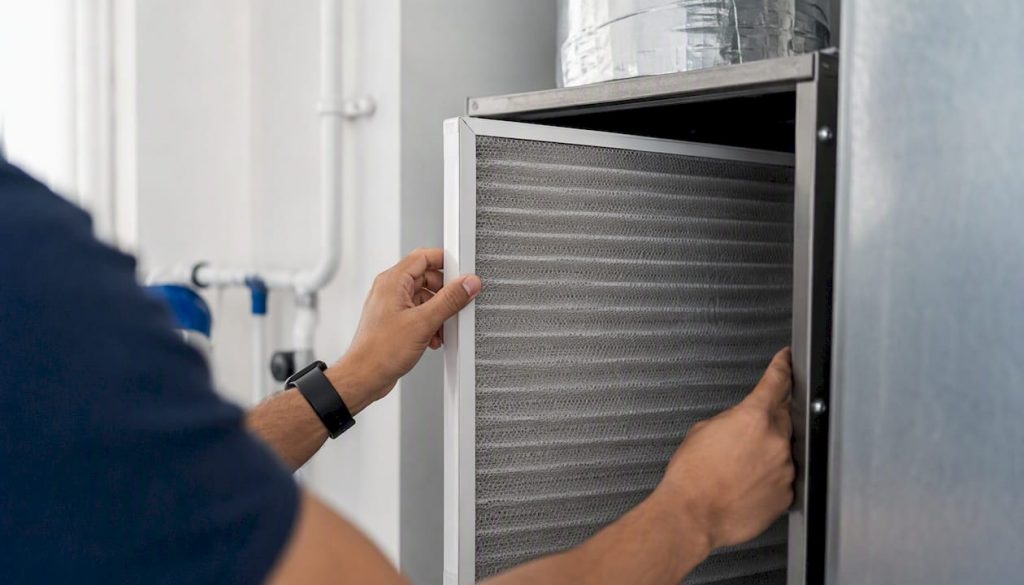
Replace air filters to protect occupant health, cut energy waste, and prevent expensive equipment failure. A clogged filter forces your system to work harder, lets fine dust reach sensitive components, and stops your air purifier or HVAC unit from doing the one job you bought it for. The EPA’s guide to air cleaners and ENERGY STAR’s HVAC efficiency guidance both treat filter changes as a maintenance basic, not an optional extra. Suppliers such as Climatepro exist largely because most people underestimate how often this needs doing.
- Inspect filters monthly.
- Replace on schedule or the moment you notice warning signs.
- Match the replacement to your system, not just the cheapest box on the shelf.
Key Takeaways
Replacing air filters on schedule protects occupant health, keeps energy use down by roughly 5 to 15 percent, and prevents the coil and motor damage that leads to expensive repairs.
| Point | Details |
|---|---|
| Inspect monthly | Check filters every month, more often during heavy-use seasons or with pets and smokers in the home. |
| Match interval to filter type | Disposable HVAC filters need replacement at least every three months; HEPA typically every 6 to 12 months. |
| Watch for warning signs | Reduced airflow, returning odours, and rising energy bills all signal a filter is overdue. |
| Never wash standard HEPA | Washing doesn’t restore capture capacity and can damage the media permanently. |
| Buy genuine, correctly sized filters | Climatepro stocks Honeywell Air Touch and Blueair Classic replacement filters matched to your model. |
Table of Contents
- Why replace air filters: the real health, energy and equipment stakes
- How often should you replace different filter types?
- Signs your air filter needs replacing right now
- How to replace air filters step by step
- Choosing the right replacement filter: MERV, HEPA H13 and beyond
- Simple habits that extend filter life and cut costs
- What filter upkeep actually costs you
- Common mistakes and safe disposal of used filters
- What happens to used filters after disposal?
- Simple maintenance prevents the expensive kind
- Where to find genuine replacement filters that fit
- Frequently asked questions
- Sources
Why replace air filters: the real health, energy and equipment stakes
A dirty filter doesn’t just look grubby. It changes three things at once, and homeowners usually only notice one of them.
Health comes first. A loaded filter still lets fine particles and allergens slip past the edges or through saturated media, which matters for anyone managing asthma, hay fever, or a household with young children. The EPA is blunt about limits here too: filtration works best as one layer among several, alongside source control and ventilation, not as a stand-alone fix.
Energy is the part people feel in their power bill without connecting the dots. A clogged filter restricts airflow, so the fan motor works harder to push the same volume of air. Trane’s own maintenance guidance puts the potential saving from a clean filter at roughly 5 to 15 percent on energy use, depending on how neglected the old one was.
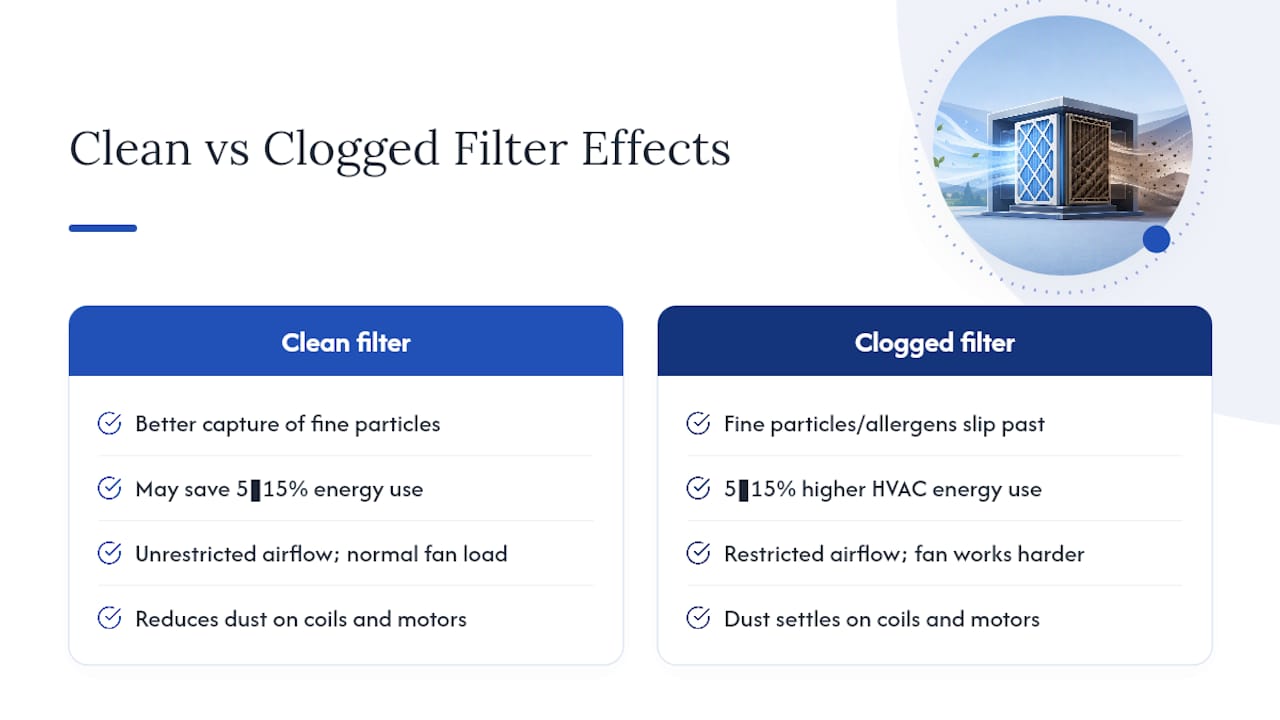
Equipment longevity is where the real money sits. Dust that bypasses a spent filter settles on evaporator coils and blower motors, and ACHR News documents this as a leading cause of avoidable breakdowns, from frozen coils to overheated motors.
Indoor air can run two to five times more polluted than outdoor air, which is exactly why filtration deserves consistent attention rather than a “replace it when I remember” approach.
Pro Tip: Pair every filter change with a quick check of your rangehood and window habits. Filtration handles what’s already airborne, but source control stops the pollutant load building up in the first place.
How often should you replace different filter types?
There’s no single number that covers every filter, because runtime, pollutant load, and media type all shift the timeline. Use these as starting points, then adjust for your household or facility.
- Disposable HVAC filters: check monthly, replace at least every three months. ENERGY STAR treats this as the floor, not the ideal, for continuously run systems.
- HEPA filters in air purifiers: typically every 6 to 12 months, though IQAir’s guidance notes this depends heavily on runtime and pollutant density.
- Activated carbon filters: anywhere from 3 to 12 months, shorter if you’re managing cooking odours, smoke, or a busy kitchen.
- Washable pre-filters: clean every 2 to 4 weeks to protect the finer stage behind them.
Certain conditions shrink all of these windows fast. Pets, indoor smoking, wildfire smoke events, high occupancy (think clinics, nurseries, or hotel lobbies), and units left running on high fan speed continuously all load a filter faster than the average home. If you’re managing a facility with variable occupancy, build your replacement calendar around your busiest month, not your average one.
Signs your air filter needs replacing right now
Most filters give you warning before they fail completely. The trick is knowing what to look for.
- Visible grey or brown soiling across the filter face.
- Noticeably weaker airflow at vents or the purifier outlet.
- Odours that were previously being controlled start returning, a sign carbon media has saturated.
- The unit runs louder than usual as it strains against the blockage.
- An indicator light, app alert, or reset prompt has triggered.
- Energy bills climb or rooms heat and cool unevenly despite no change in usage.
Run through this list monthly, and don’t wait for all six signs to appear before acting.
Pro Tip: A cheap PM2.5 monitor near the outlet, or simply holding your hand a few centimetres from a vent, tells you more than eyeballing the filter alone. Reduced airflow is often the first honest signal you’ll get.
How to replace air filters step by step
For HVAC and furnace filters:
- Power off the unit before touching anything.
- Locate the filter slot and note the airflow arrow printed on the frame.
- Remove the old filter carefully to avoid dislodging trapped dust.
- Slide in the correct-size replacement with the arrow pointing toward the blower.
- Seal the access panel fully, no gaps.
- Reset any runtime or maintenance counter if your system has one.
For room air purifiers:
- Power off and unplug the unit.
- Open the intake panel and remove the pre-filter first.
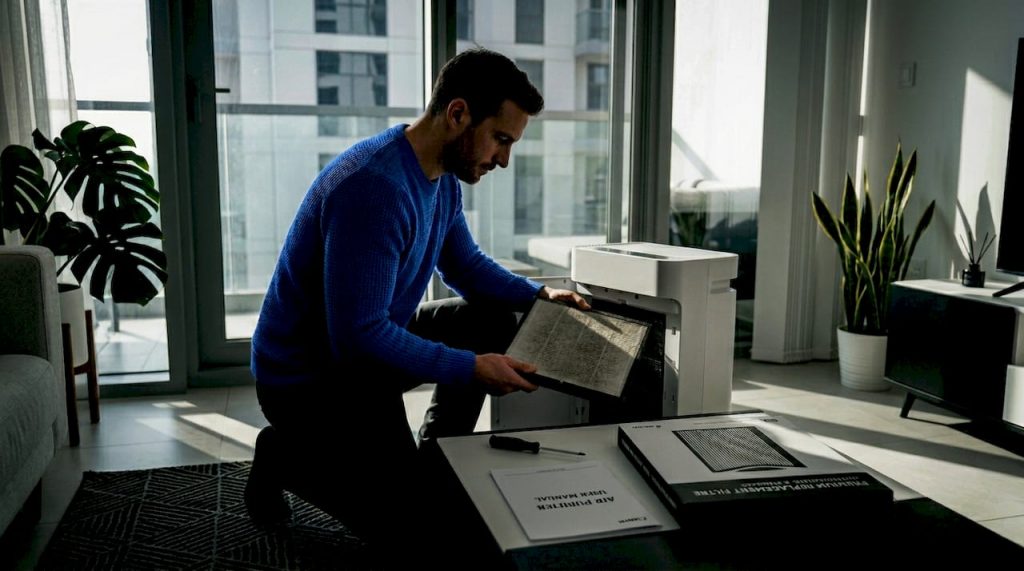
- Remove HEPA and carbon stages in the order the manual specifies.
- Fit new stages, checking orientation markers match the housing.
- Run at medium speed for one to two hours and confirm airflow feels normal at the outlet.
Wear gloves and a mask if the old filter is heavily soiled, and never shake a spent filter indoors to clean it. Climatepro’s step-by-step replacement guide covers model-specific quirks if your unit deviates from the general pattern above.
Pro Tip: Buy the genuine replacement rated for your model before you start the job, not after you’ve already pulled the old one out. A mismatched filter can sit loose enough to let unfiltered air bypass it entirely.
Choosing the right replacement filter: MERV, HEPA H13 and beyond
Filter ratings tell you what size particle the media actually stops, and getting this wrong either wastes money or leaves gaps in protection.
MERV 13 and above captures fine particles including much of the size range linked to respiratory irritation, making it a sensible baseline for general home use. HEPA H13 goes further, capturing at least 99.95 percent of particles at its tested size, which is why clinics, nurseries, and allergy-heavy households tend to specify it. The trade-off is pressure drop: denser media resists airflow more, and ACHR News’ technical guidance warns that MERV 13+ filters can strain an undersized blower if the system wasn’t built for that resistance.
On OEM versus aftermarket, fit and edge seal matter more than brand loyalty. A loose-fitting aftermarket filter lets air slip around the media instead of through it, defeating the purpose. If you do use aftermarket filters, shorten your replacement interval slightly as a safety margin.
- Clinics and nurseries: HEPA H13 or MERV 13+ whole-home filtration, backed by a facility maintenance plan.
- Pet-heavy households: HEPA stages paired with frequent pre-filter cleaning to stop hair and dander overwhelming the main media early.
- General allergy relief: MERV 13 or a HEPA-equipped purifier sized correctly for the room.
Pro Tip: After fitting a denser filter, listen for new motor noise or check that airflow hasn’t dropped. That’s your signal the blower is struggling with the added resistance.
Simple habits that extend filter life and cut costs
Small changes upstream slow down how fast a filter loads, which stretches your budget further.
- Use your rangehood when cooking and skip indoor smoking to cut the pollutant load hitting the filter.
- Fit washable pre-filters where your unit supports them, to shield the finer HEPA or carbon stage.
- Run purifiers sized slightly larger than the room at a lower, steadier speed rather than a smaller unit on high.
- Close windows during high-pollution or high-pollen periods and keep intake vents free of furniture or curtains.
- Inspect monthly during heavy-use seasons, and clean pre-filters on a fixed schedule rather than waiting for visible dust.
Buying filters in multi-packs or through a replacement subscription also removes the temptation to delay a change because a spare isn’t on hand.
What filter upkeep actually costs you
Replacement filters typically range from budget disposables through to premium HEPA cartridges, with higher-efficiency media costing more upfront but protecting equipment and health more consistently. The real trade-off isn’t cheap versus expensive, it’s timely versus delayed. Replacing on schedule adds a modest recurring cost; delaying it risks a coil repair or motor replacement that dwarfs years of filter spend.
- Staggering replacement dates across multiple units avoids one large bill hitting at once.
- Multi-packs reduce per-unit cost for households or facilities running several systems.
- A subscription delivery service removes the guesswork around timing altogether.
Common mistakes and safe disposal of used filters
A few errors show up repeatedly, and most are easy to avoid once you know to check for them.
- Washing a standard HEPA filter, which CleanAirWiki confirms doesn’t restore capture capacity and can damage the media.
- Fitting the wrong size, or ignoring the airflow arrow entirely.
- Leaving an access panel unsealed, which lets unfiltered air bypass the new filter.
For disposal, bag the used filter before binning it to stop dust escaping, and check local rules if it’s carbon-laden or came from a smoke event, since some areas treat that waste differently.
Warning: If a filter smells musty or shows dark, fuzzy growth, stop using the system and call a professional. Mould inside ductwork or a purifier housing isn’t a DIY fix.
What happens to used filters after disposal?
Most spent HVAC and purifier filters end up in general household or commercial waste, and that’s largely unavoidable given the materials involved. Standard media combines synthetic fibres, cardboard or plastic frames, and trapped particulate matter that isn’t practically separable at the point of disposal.
The bigger environmental question is what the filter absorbed before it reached the bin. A filter used during a wildfire smoke event or in an industrial setting can carry a heavier pollutant load than a filter replaced on a routine home schedule, which is why some regions apply hazardous-waste handling to filters from specific contexts, particularly commercial or clinical settings. Check with your local municipal waste service if you manage a facility that regularly disposes of contaminated media, since the rules differ from standard household rubbish collection.
There are ways to reduce the footprint without cutting corners on replacement frequency. Washable pre-filters cut down on the volume of disposable media reaching landfill, since only the finer HEPA or carbon stage behind them needs regular replacement. Buying correctly sized filters the first time also avoids the waste of an ill-fitting filter that gets discarded and replaced almost immediately. None of this changes the core rule: a filter that’s done its job and needs replacing should be replaced, not stretched further to reduce waste. The environmental cost of a failed coil, an inefficient system running longer to compensate, or a household breathing degraded air outweighs the modest waste saving from delaying a change.
Simple maintenance prevents the expensive kind
The pattern that stands out across HVAC and purifier maintenance is how disproportionate the payoff is. A filter change costs little and takes minutes. Skipping it repeatedly is what leads to the coil repairs and motor replacements that actually hurt. Climatepro’s experience matching customers to the right replacement filters points to the same conclusion every time: the households and facilities that treat filter changes as a fixed calendar item, not an afterthought, are the ones that rarely call about a failed unit. The maintenance itself isn’t sophisticated. It’s just consistent.
Where to find genuine replacement filters that fit
Once you know what your system needs, the harder part is usually finding a filter that actually fits properly rather than one that’s merely close enough. Climatepro stocks genuine replacement filters for popular purifier ranges, including the Honeywell Air Touch P2, Air Touch P1, and Air Touch U1, alongside Blueair Classic 200/400/500 series filters and the Blueair ComfortPure T20i replacement filter.
Buying the correct model-matched filter, rather than a generic near-fit, protects the edge seal and airflow performance covered earlier in this guide. Browse the full air purifier range if you’re still choosing a unit, or get in touch if you need help confirming fitment for an existing model. Climatepro also arranges subscription delivery so you’re never scrambling to find a replacement the week your old filter finally gives out.
Frequently asked questions
Why replace air filters if the unit still seems to be running fine?
A filter can look functional while airflow has already dropped and dust is bypassing it toward sensitive components. By the time performance visibly suffers, some component strain may already have occurred.
What happens if you don’t replace air filters for a long time?
Airflow drops, energy use climbs, and dust that bypasses the spent filter can settle on coils and motors, raising the risk of overheating or frozen components according to ACHR News.
How do I know which MERV or HEPA rating I need?
General homes do well with MERV 13, while clinics, nurseries, and allergy-sensitive households often benefit from HEPA H13. Always confirm your blower can handle the added airflow resistance before upgrading.
Can I clean and reuse a HEPA filter instead of replacing it?
No. Standard HEPA media isn’t designed to be washed or vacuumed clean, and doing so typically fails to restore its capture capacity.
How does filter maintenance affect energy bills?
A clean filter can lower energy consumption by roughly 5 to 15 percent compared to a clogged one, since the fan no longer has to work against unnecessary resistance.
Sources
- Keeping HVAC systems running clean: the importance of proper filter maintenance — ACHR News
- Guide to air cleaners in the home — U.S. Environmental Protection Agency (EPA)
- 4 top reasons to change your HVAC air filters — Trane
- When to replace HEPA filters — CleanAirWiki
- How often should you change an air purifier filter? — IQAir