
Regular air testing is the scientific process of sampling and analysing the air inside your home to measure pollutant levels and identify hidden health hazards. The World Health Organization recognises air pollution as the leading environmental health risk, responsible for approximately 6.6 million deaths globally each year. That figure covers outdoor and indoor exposure combined. For homeowners and renters, the indoor environment is where the risk is most controllable. Understanding why regular air testing matters is the first step toward making informed decisions about the air your household breathes every day.
Why regular air testing matters for indoor health
Indoor air quality monitoring, the recognised industry term for what most people call air testing, involves collecting air samples from inside a home and comparing them against established health benchmarks. Indoor pollutant levels can be 2 to 5 times higher than outdoor levels. That gap exists because modern homes are built tightly to conserve energy, which traps contaminants with nowhere to go.

Professional testing costs approximately $400 for a full assessment and delivers lab-verified results that distinguish harmless dust from genuinely dangerous hazards. That is a meaningful investment, but it replaces guesswork with quantitative data. Without testing, you cannot know whether the headaches your family experiences are caused by poor ventilation, mould spores, or elevated carbon monoxide. A step-by-step air quality assessment gives you a clear picture of what is actually present in your home’s air.
What are the common indoor air pollutants detected through testing?
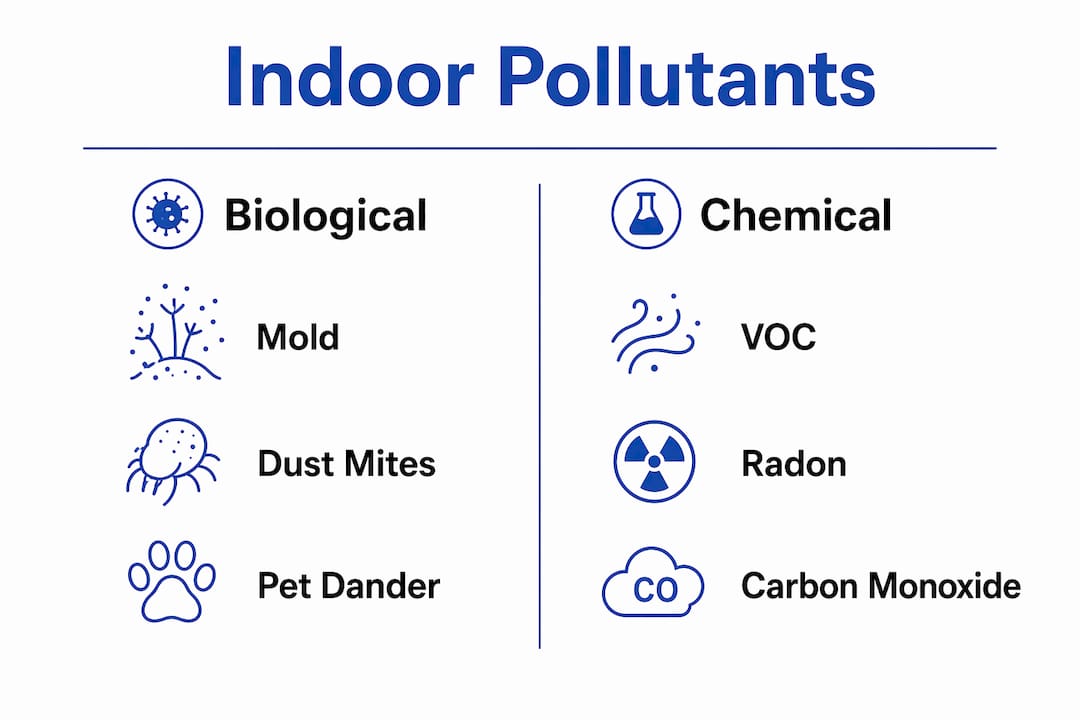
Air quality monitoring uncovers a range of contaminants that are invisible to the naked eye and undetectable by smell alone. Each pollutant carries its own health risk profile, and many accumulate indoors far more readily than outdoors.
- Mould spores. Mould grows behind walls, under flooring, and inside HVAC systems. Spores circulate through the air long before visible growth appears. Testing identifies active mould sources by comparing indoor and outdoor spore counts. An indoor-to-outdoor ratio above 2 indicates an active indoor pollution source requiring remediation.
- Radon gas. Radon is a colourless, odourless radioactive gas that seeps from soil and rock into homes through foundations. It is the second leading cause of lung cancer, responsible for approximately 21,000 lung cancer deaths annually in the United States. Homes in radon-prone geological areas require dedicated radon testing.
- Volatile organic compounds (VOCs). VOCs are gases released by paints, adhesives, cleaning products, furniture, and flooring materials. They include formaldehyde and benzene, both of which carry long-term health risks at sustained exposure levels.
- Carbon monoxide (CO). Carbon monoxide is colourless, odourless, and tasteless, making it impossible to detect without instruments. It is produced by gas appliances, heaters, and vehicles. High concentrations are fatal; lower chronic levels cause neurological damage over time.
- Particulate matter (PM2.5). Fine particles smaller than 2.5 micrometres penetrate deep into the lungs. Sources include cooking smoke, candles, outdoor pollution entering through gaps, and wildfire smoke. PM2.5 is strongly linked to cardiovascular and respiratory disease.
- Biological allergens. Dust mites, pet dander, and pollen accumulate in soft furnishings and circulate through air systems. These trigger allergic responses and worsen asthma, particularly in children.
Each of these pollutants requires a different remediation approach. Testing identifies which ones are present at harmful concentrations, so you address the actual problem rather than applying a generic fix.
How does poor indoor air quality affect your health?
Poor indoor air quality produces both immediate and long-term health effects. The two categories are distinct, and understanding both helps explain why routine monitoring is worth the effort.
Immediate symptoms
- Headaches and fatigue. Elevated CO and VOC levels reduce oxygen availability and irritate the central nervous system. Symptoms often appear within hours of exposure.
- Eye, nose, and throat irritation. Particulate matter and mould spores inflame mucous membranes. Persistent irritation that clears up when you leave the home is a reliable indicator of an indoor source.
- Respiratory distress. Asthma attacks, wheezing, and shortness of breath worsen when PM2.5 and allergen levels are elevated indoors.
- Brain fog and poor concentration. Poor indoor air quality causes immediate symptoms including cognitive impairment, which is particularly significant for people who work or study from home.
Long-term health risks
Prolonged exposure to indoor pollutants causes respiratory diseases, heart disease, and cancer. The WHO links 84% of air pollution deaths to noncommunicable diseases, which include cardiovascular conditions and lung cancer. Children, elderly residents, and people with existing respiratory or cardiac conditions face the greatest risk from sustained exposure.
“Temporary events such as wildfire smoke or painting can impact indoor air quality and stress cardiovascular and respiratory systems, making testing critical at these times.”
A telling pattern appears in households with unexplained illness: symptoms improve when residents spend time away from home and return when they come back. That pattern points directly to an indoor air quality problem. Testing confirms the source and removes the uncertainty.
How does regular testing help you maintain better air quality?
Testing provides lab-verified, quantitative data on specific pollutants. That data is the foundation of every effective remediation decision. Without it, you are choosing air purifiers, ventilation upgrades, or remediation services based on assumption rather than evidence.
Testing identifies pollutants for targeted solutions rather than broad-spectrum fixes. If your results show elevated mould spores but normal VOC levels, you need remediation and improved humidity control, not a VOC-specific air purifier. If results show high PM2.5 from outdoor infiltration, a HEPA-rated air purifier addresses the actual problem. This specificity saves money and produces better health outcomes.
Testing also establishes a baseline. A first test gives you a reference point. Subsequent tests measure whether your interventions are working. This is how smart air monitors and periodic professional testing work together: continuous monitoring tracks trends, while professional lab analysis confirms precise pollutant concentrations.
Professional air testing is a foundational control point, not a one-off procedure. Qualified testing partners use accredited sampling methods that produce results you can act on with confidence. Sampling quality directly affects result reliability. A poorly conducted test can miss active mould sources or underestimate radon concentrations.
Pro Tip: Request that your testing provider supply both indoor and outdoor air samples. The comparison between the two is what identifies active indoor pollution sources. An indoor-only sample cannot tell you whether elevated spore counts originate inside your home or simply reflect outdoor conditions.
When should homeowners and renters consider air testing?
Testing without a specific purpose is often not cost-effective. Experts recommend testing when triggered by specific circumstances rather than on a fixed calendar schedule alone. The following situations warrant prompt testing.
- Unexplained or persistent symptoms. Recurring headaches, fatigue, respiratory irritation, or allergy flare-ups that improve when you leave home indicate a likely indoor source.
- Musty or chemical odours. A persistent musty smell suggests active mould growth. Chemical odours point to elevated VOCs from building materials or household products.
- Water damage or flooding. Moisture events create ideal conditions for mould within 24–48 hours. Testing after water damage confirms whether mould has established in the air before visible growth appears.
- Major renovations. Sanding, painting, adhesive use, and new flooring all release VOCs and particulate matter. Testing after renovation work confirms when levels have returned to safe concentrations.
- Moving into a new home. Air testing before or shortly after moving in reveals pre-existing issues, including radon, mould, or elevated CO from ageing appliances. In real estate transactions, test results provide quantitative grounds for requesting repairs or price adjustments.
- Older homes or radon-prone areas. Homes built before 1980 may contain asbestos-containing materials and older gas appliances with higher CO risk. Radon risk varies by geology, and local geological surveys identify high-risk postcodes.
- Vulnerable household members. Households with infants, elderly residents, or people with asthma, allergies, or cardiac conditions benefit from more frequent testing, generally every 2–3 years rather than only when symptoms appear.
For typical homes without specific triggers or vulnerable occupants, a professional assessment every 2–3 years provides a reasonable baseline. Pairing periodic professional testing with an energy-efficient air cleaning workflow keeps ongoing costs manageable while maintaining air quality between formal assessments.
Key takeaways
Regular air testing is the most reliable method for identifying hidden indoor pollutants and making targeted decisions that protect the health of everyone in your home.
| Point | Details |
|---|---|
| Indoor air is often more polluted | Indoor pollutant levels can be 2–5 times higher than outdoor levels, making testing a priority for enclosed living spaces. |
| Testing replaces guesswork | Lab-verified results identify specific hazards like mould, radon, or VOCs so remediation targets the actual problem. |
| Health risks are serious and varied | Prolonged exposure to indoor pollutants causes respiratory disease, heart disease, and cancer, with children and elderly most at risk. |
| Test when triggers are present | Testing is most valuable after water damage, renovations, unexplained symptoms, or before moving into a new home. |
| Accreditation determines reliability | Choosing a qualified, accredited testing provider is the single most important factor in getting results you can act on. |
What I have learned from watching homeowners test their air
The most consistent pattern I have observed is that people test their air after something goes wrong, not before. A family member develops persistent respiratory symptoms, a musty smell appears after a wet season, or a renovation leaves the home smelling of chemicals for weeks. Testing at that point is absolutely the right call. But the results often reveal that the problem has been building for months or years before the trigger event.
What I find genuinely underappreciated is the role of accreditation. Homeowners often focus on the cost of testing and overlook the credentials of the provider. A poorly conducted test using non-accredited sampling methods can return results that are technically useless. You spend $400 and learn nothing reliable. Choosing a qualified testing partner is not a secondary consideration. It is the primary one.
The other thing worth stating plainly: testing is not the solution. It is the diagnosis. A test result showing elevated PM2.5 does not clean your air. It tells you what to buy, what to fix, and what to prioritise. Homeowners who treat testing as the end of the process rather than the beginning of it miss the point entirely. The value of testing is in the targeted action it enables, whether that is installing a HEPA purifier, improving ventilation, or arranging professional mould remediation.
— Nevel
Air quality solutions from Climatepro
Once testing identifies what is in your air, the next step is addressing it with the right equipment. Climatepro stocks a full range of air purifiers for UAE homes, including models suited to different room sizes, pollutant types, and budgets. The Honeywell Air Touch range, available through Climatepro, covers options from the Air Touch P1 at AED 591 through to the Air Touch U1 at AED 935, giving households a clear path from test results to effective filtration.

Climatepro delivers across Dubai, Abu Dhabi, Sharjah, and all seven emirates. If your test results point to humidity-related mould risk, the store also carries dehumidifiers and humidifiers to bring moisture levels into the range that prevents mould growth. Matching the right product to your specific test findings is how you get lasting results rather than a temporary fix.
FAQ
What is air quality testing?
Air quality testing is the scientific process of collecting air samples from inside a home and analysing them in a laboratory to measure pollutant concentrations. Results are compared against established health benchmarks to identify hazards like mould, radon, VOCs, and particulate matter.
How often should you test indoor air quality?
For most homes, a professional assessment every 2–3 years is appropriate. Testing more frequently is recommended after water damage, major renovations, or when household members have respiratory conditions or allergies.
Can you test indoor air quality yourself?
Consumer-grade monitors track real-time levels of CO2, PM2.5, and humidity, but they do not replace professional lab analysis. Professional testing identifies a broader range of pollutants, including radon and mould spores, with accredited accuracy.
What triggers the need for immediate air testing?
Musty odours, unexplained or recurring health symptoms, water damage, and major renovation work all warrant prompt testing. In real estate transactions, testing before purchase provides quantitative data for negotiating repairs or price adjustments.
Is indoor air really more polluted than outdoor air?
Indoor pollutant levels are commonly 2–5 times higher than outdoor levels. Modern homes trap contaminants through tight construction and limited ventilation, which allows pollutants to accumulate to concentrations that would not occur outdoors.