
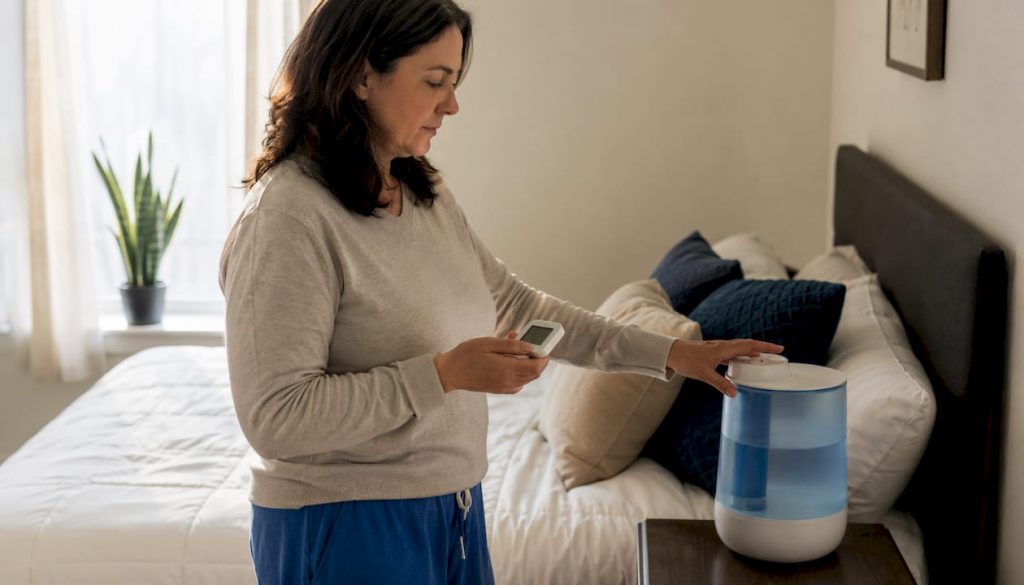
Managing dry indoor air keeps relative humidity in the recommended 30–50% range, reducing respiratory irritation, lowering the risk of airborne infection, and protecting timber furniture and flooring from shrinkage and cracking. The fix is straightforward once you know what you are dealing with.
Three immediate steps to take right now:
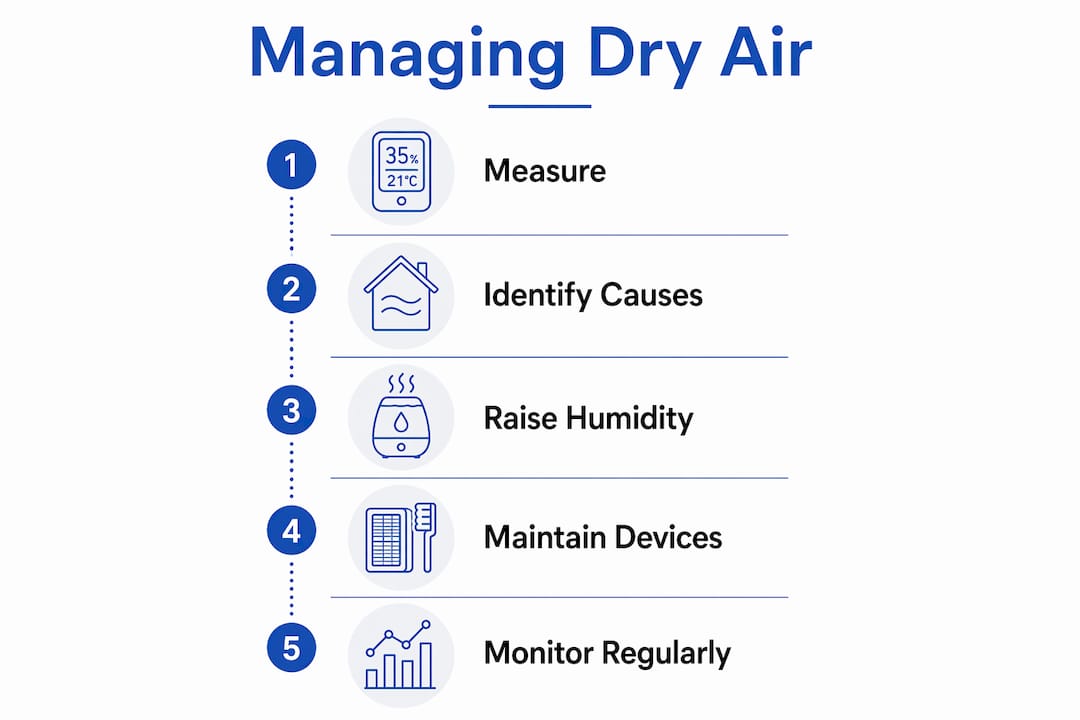
- Check your readings. Use a hygrometer to measure current indoor relative humidity (RH). Readings below 30% require prompt action.
- Use a humidifier correctly. Place it in the room where you spend the most time, set it to maintain a healthy range of relative humidity, and use distilled water.
- Stay hydrated. Drinking adequate water supports mucous membrane function even while you address the air around you.
A healthy home environment checklist can help you track humidity alongside other indoor air quality factors.
Table of Contents
- What causes indoor air to become dry?
- How dry air affects your health
- How dry air damages your home and possessions
- How to tell if your indoor air is too dry
- Practical ways to raise indoor humidity safely
- Choosing and using a humidifier safely
- Why monitoring matters: the evidence behind RH targets
- Key takeaways
- Dry air management: what most homeowners get wrong
- Useful sources and further reading
- Climatepro stocks the right tools for humidity control
What causes indoor air to become dry?
Cold outdoor air holds very little moisture. When heating systems draw that air in and warm it, the relative humidity drops sharply without any water vapour being added. This is the primary driver of dry indoor air in cooler months, and opening windows in winter rarely raises indoor RH significantly because the replacement air is just as dry.
Several mechanical and behavioural factors compound the problem:
- Forced-air heating and ducted systems circulate warm, low-humidity air throughout the home continuously.
- Reverse-cycle air conditioning in cooling mode removes moisture as a by-product of the refrigeration process.
- Exhaust fans and whole-home ventilation expel humid indoor air and replace it with drier outdoor air.
- Poor sealing and insulation allow cold, dry air to infiltrate through gaps around windows, doors, and skirting boards.
- Tumble dryers vented indoors are sometimes recommended as a humidity source, but unvented dryers that exhaust externally remove moisture-laden air from the home.
- Low indoor plant count reduces the passive transpiration that contributes small amounts of moisture to the air.
- Frequent hot showers with bathroom doors closed concentrate moisture in one room rather than distributing it through the home.
Understanding which of these applies to your home helps you prioritise fixes that address the root cause rather than just the symptoms.
How dry air affects your health

When indoor RH drops below 30%, the mucous membranes lining the nose, throat, and airways dry out. Those membranes are the body’s first line of defence against pathogens: they trap particles and move them away from the lungs. Low indoor humidity impairs this function, making households more susceptible to colds, flu, and other respiratory infections.
Common symptoms of dry indoor air include:
- Dry, itchy, or flaking skin and chapped lips
- Sore or scratchy throat, particularly on waking
- Dry, irritated eyes, especially for contact lens wearers
- Frequent nosebleeds from dried nasal tissue
- Persistent dry cough or worsened asthma and bronchitis
- Disrupted sleep and increased snoring
Research indicates that some respiratory viruses survive longer at low humidity levels, which is one reason winter illness rates tend to rise alongside indoor heating use. A properly maintained humidifier can reduce dry cough and help keep airways lubricated, though it is worth noting that humidifiers support the body’s defences rather than acting as a direct medical treatment.
Certain groups face greater risk from dry air. Infants, older adults, and people with chronic respiratory conditions such as asthma or COPD are more sensitive to low RH. People recovering from throat or airway surgery, including laryngectomy or tracheostomy procedures, require tailored humidification and should follow medical-grade guidance rather than general household advice.
Pro Tip: Running a humidifier in the bedroom at night, set to maintain comfortable humidity, can reduce snoring and improve sleep quality by keeping the throat and nasal passages moist throughout the night.
How dry air damages your home and possessions
The impact of dry air on health is well documented, but the material consequences are just as real. Timber shrinks and cracks when it loses moisture to the surrounding air. Hardwood floors develop gaps between boards, wooden furniture joints loosen, and door frames warp enough to affect how doors close. Wallpaper can peel at the edges, and paint finishes become brittle and prone to flaking.
Other material effects worth noting:
- Static electricity builds up more readily in dry air, causing shocks from door handles and metal surfaces, and attracting dust to screens and upholstery.
- Houseplants lose moisture through their leaves faster than roots can absorb it from the soil, leading to wilting and browning tips.
- Dust circulation can increase as dry air reduces the natural settling of airborne particles.
The financial case for managing indoor humidity is straightforward: protecting timber floors, furniture, and joinery from repeated shrink-and-swell cycles extends their lifespan considerably.
How to tell if your indoor air is too dry
Physical symptoms are often the first signal, but they are easy to attribute to other causes. These practical signs point more directly to a humidity problem:
- Frequent static shocks when touching metal surfaces or other people
- Cracked or gapping timber floorboards and door frames
- Flaky skin that persists despite regular moisturising
- Recurring nosebleeds with no other explanation
- Houseplants showing stress: drooping, browning leaf tips, or rapid soil drying
The most reliable method is direct measurement with a hygrometer, a small, inexpensive device that reads current RH. Place it at sitting or sleeping height in the room you use most, away from windows and exterior walls, for an accurate representative reading. Many modern humidifiers include a built-in humidistat that both measures and responds to RH automatically.
| RH level | Likely conditions | Recommended action |
|---|---|---|
| Below 30% | Dry skin, nosebleeds, static shocks, timber cracking | Use a humidifier; check for drafts and sealing gaps |
| 30–50% | Comfortable; low mould and dust mite risk | Maintain current conditions; monitor seasonally |
| 50–60% | Borderline; condensation may appear on windows | Reduce humidifier output; improve ventilation |
| Above 60% | Mould and dust mite risk increases significantly | Use a dehumidifier; check for leaks or poor ventilation |
Practical ways to raise indoor humidity safely
The most effective approach depends on how far below the 30–50% target your home sits and how much control you need. Starting with low-cost measures makes sense before investing in powered devices.
Low-effort options:
- Place shallow bowls of water near (not on) heat sources such as radiators; the warmth accelerates evaporation.
- Hang damp towels or laundry to dry indoors rather than using an externally vented dryer.
- Add more indoor plants; species such as peace lilies, spider plants, and Boston ferns transpire measurable amounts of moisture.
- Lower the thermostat by one or two degrees where comfortable; cooler air holds relatively more moisture at the same absolute water content.
Medium-effort options:
- A portable room humidifier placed in the bedroom or living area is the most direct fix. Follow the humidity control workflow to size and position it correctly.
- Leave the bathroom door open during and after a hot shower to share steam with adjacent rooms.
- Use evaporative trays placed on or near indoor plants to add gentle, passive moisture.
Higher-control options:
- Whole-home humidifiers integrated into ducted heating systems maintain consistent RH across all rooms without manual adjustment.
- Smart humidifiers with built-in hygrostats adjust output in real time, preventing both under- and over-humidification.
Keep RH below 50% to prevent mould growth and dust mite proliferation. At-home measures such as bowls of water and indoor plants are effective first steps, but a powered humidifier gives more precise control when readings consistently fall below 30%.
Pro Tip: Position a humidifier near the centre of a room rather than against a wall. This allows moisture to distribute evenly and prevents localised over-humidification on nearby surfaces, which can encourage mould on walls or window frames.
Choosing and using a humidifier safely
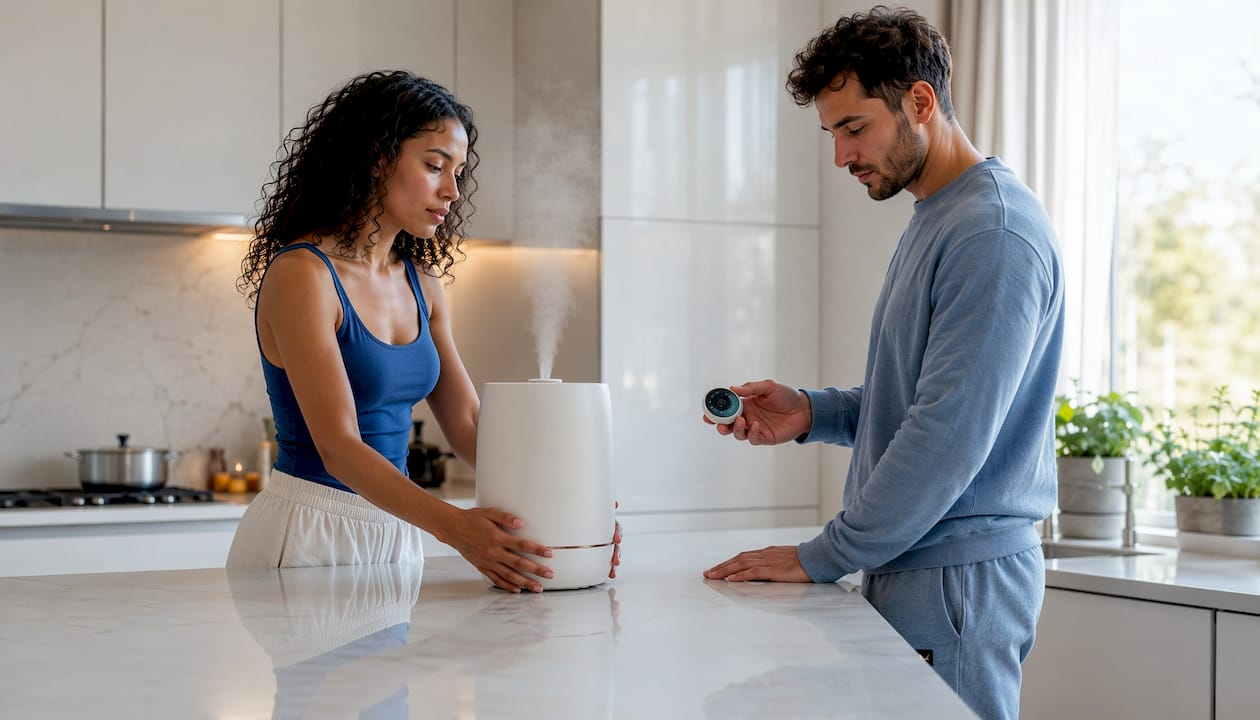
Not all humidifiers work the same way, and the right choice depends on room size, health needs, and maintenance capacity.
Humidifier types at a glance:
- Evaporative humidifiers draw air through a wet wick or filter; they self-regulate to some extent because evaporation slows as RH rises. Good for general household use.
- Ultrasonic humidifiers use high-frequency vibration to produce a fine cool mist. Quiet and energy-efficient, but require distilled or demineralised water to avoid white mineral dust settling on surfaces.
- Warm-mist humidifiers boil water to produce steam, which kills most bacteria in the process. Suitable for bedrooms; keep away from children due to the hot water reservoir.
- Whole-home humidifiers connect to ducted heating systems and humidify the entire building from a single unit. Higher upfront cost but minimal daily maintenance.
For a detailed comparison of ultrasonic devices specifically, the ultrasonic humidification guide covers the trade-offs in depth.
Maintenance checklist for safe humidifier use:
- [ ] Set the target RH to 30–50% using the built-in humidistat or an external hygrometer.
- [ ] Empty and dry the water tank daily; stagnant water encourages bacterial growth.
- [ ] Deep-clean the tank every 2–3 days using a manufacturer-recommended disinfectant or a 3% hydrogen peroxide solution, then rinse thoroughly.
- [ ] Use distilled or demineralised water to prevent mineral residue and reduce bacterial risk.
- [ ] Replace filters or wicks on the schedule specified by the manufacturer.
- [ ] Place the unit away from walls and furniture to allow even moisture distribution.
- [ ] Avoid running at maximum output continuously in small rooms; monitor RH and adjust.
Cleaning humidifiers daily and doing a deeper sanitise every few days prevents biofilm, mould, and bacterial aerosolisation, which can worsen the respiratory symptoms you are trying to relieve.
Why monitoring matters: the evidence behind RH targets
Maintaining relative humidity within a recommended moderate range addresses two competing risks simultaneously: too low humidity dries mucous membranes and reduces pathogen clearance, while too high humidity promotes mould growth and dust mite populations, creating a different set of respiratory and structural problems. The optimal zone balances both.
Research published in peer-reviewed literature supports the link between low RH and respiratory virus survival, with some studies finding that certain viruses remain viable longer in low-humidity environments. Maintaining adequate indoor humidity may reduce this risk, though it works alongside, not instead of, ventilation and hygiene practices.
For ongoing control, a basic digital hygrometer, affordable and available at most hardware retailers is sufficient for most households. For more automated management, smart humidity control devices pair sensors with automatic output adjustment, removing the need for manual monitoring.
Pro Tip: Avoid “set and forget” humidifier use. Seasonal changes, occupancy patterns, and heating adjustments all shift indoor RH. Check your hygrometer reading weekly and adjust humidifier output accordingly rather than leaving it at a fixed setting year-round.
Key takeaways
Managing dry indoor air protects both respiratory health and the structural integrity of your home by keeping relative humidity consistently within the 30–50% range.
| Point | Details |
|---|---|
| Measure first | Use a hygrometer to confirm RH before choosing a fix; readings below 30% need prompt action. |
| Target RH range | Keep indoor humidity at 30–50%; below 30% harms health, above 60% risks mould and dust mites. |
| Start low-cost | Bowls of water, indoor plants, and drying laundry indoors raise RH with no running costs. |
| Maintain your device | Empty and dry humidifier tanks daily; deep-clean every 2–3 days using distilled water only. |
| Climatepro for product selection | Climatepro stocks humidifiers, dehumidifiers, and hygrometers suited to homes and offices across the UAE. |
Dry air management: what most homeowners get wrong
The most common mistake is treating dry air as a winter-only problem. In climates where air conditioning runs for extended periods, indoor RH can drop well below 30% in summer too, driven by the same dehumidifying effect that makes cooling systems effective. The season changes; the mechanism does not.
A second mistake is over-humidifying. Homeowners who install a humidifier and set it to maximum output often push RH above 55–60%, which creates condensation on windows, encourages mould on walls, and raises dust mite populations. The goal is a specific range, not simply “more moisture.”
The third mistake is neglecting maintenance. A humidifier with a contaminated tank aerosolises bacteria and mould spores directly into the breathing zone, which is worse than the dry air it was meant to address. Daily emptying and regular deep-cleaning are not optional steps.
Climatepro’s range of humidifiers, dehumidifiers, and monitoring devices is designed for exactly this kind of precision management. If you want guidance on which product suits your room size and usage pattern, the humidifier selection guide is a practical starting point.
Useful sources and further reading
- Memorial Sloan Kettering Cancer Center: Using moisture to manage dry air — clinical guidance on humidification for people with airway sensitivities or post-surgical needs.
- Cleveland Clinic: How dry air affects your health — explains the mucous membrane mechanism and infection risk.
- Mayo Clinic: Humidifiers guidance — water quality, maintenance, and safe use recommendations.
- WebMD: Managing dry indoor air — practical cleaning cadence and hygiene steps for humidifier users.
- Medical News Today: Effects of dry air — symptom overview and evidence on humidification benefits.
- Healthline: Dry air prevention tips — low-cost household measures and safe RH thresholds.
- NIH/PubMed: Humidity and respiratory virus survival — peer-reviewed research on RH and airborne pathogen viability.
- Climatepro: Humidifier for dry air guide — product selection and practical use guidance from the publisher.
Climatepro stocks the right tools for humidity control

Dry air is a measurable problem with measurable solutions, and Climatepro carries the full range of products to address it: humidifiers for bedrooms and living areas, dehumidifiers for when RH climbs too high, and replacement filters for combined purifier-humidifier units. Every product in the range is available for delivery across Dubai, Abu Dhabi, Sharjah, and the wider UAE.
For readers who want a combined air quality and humidity solution, the Dyson Purifier Humidify+Cool PH2 purifies, humidifies, and monitors RH automatically in one unit. For those starting with a dedicated humidifier, browse the full humidifier range to find the right capacity and type for your space.