Filtering airborne pet dander does reduce allergen concentrations in your home, and when a correctly sized unit runs continuously, most people notice fewer night-time symptoms and less frequent allergy flares. The American Lung Association classifies filtration as a useful part of multi-faceted allergen management, though it works best alongside surface cleaning and source control rather than as a standalone fix.
What you can realistically expect from filtration:
- Reduced airborne allergen load in treated rooms, particularly bedrooms
- Fewer night-time symptoms and faster recovery after grooming or vacuuming spikes
- Less surface dust accumulation over time, which eases cleaning
- Modest but measurable improvement in asthma and rhinitis symptoms for around 70% of cat-allergic individuals, based on clinical experience with consistent HEPA filtration use.
Filtration addresses the airborne fraction of allergens. Settled reservoirs in carpets and upholstery require separate cleaning strategies.
Table of Contents
- What is pet dander and why does it trigger allergies?
- How does air filtration actually remove pet dander?
- What health and household benefits does filtration deliver?
- How effective are purifiers for pet dander — what research says
- How to choose an air purifier for pet dander
- How to use and maintain your air purifier for best results
- Other practical steps to reduce pet dander indoors
- Key takeaways
- Filtration works, but expectations need to be calibrated
- Climatepro’s HEPA purifiers for pet owners
What is pet dander and why does it trigger allergies?
Pet dander is not simply fur. It is microscopic skin flakes shed continuously by cats, dogs, and other animals, combined with proteins from saliva and urine that attach to those flakes during grooming. The primary cat allergen, Fel d 1, is produced by oil glands in the skin and salivary glands; the primary dog allergen, Can f 1, behaves similarly. According to Ohio State University’s College of Veterinary Medicine, all cats produce allergens regardless of breed or coat length, and there is no such thing as a truly allergen-free cat or dog.
The particle physics matter here. Dander particles range from 1–20 µm, with cat dander averaging 2–5 µm. Their irregular, jagged shape increases aerodynamic drag, which keeps them suspended in air for hours rather than settling quickly. Fel d 1 also attaches to very fine particle fractions under 5 µm, meaning it can travel further and penetrate deeper into the respiratory tract than larger particles.
Clinically, pet allergen exposure is a recognised trigger for both allergic rhinitis and asthma exacerbations. Symptoms typically include sneezing, itchy or watery eyes, nasal congestion, and in sensitised individuals, wheezing or chest tightness.
How does air filtration actually remove pet dander?
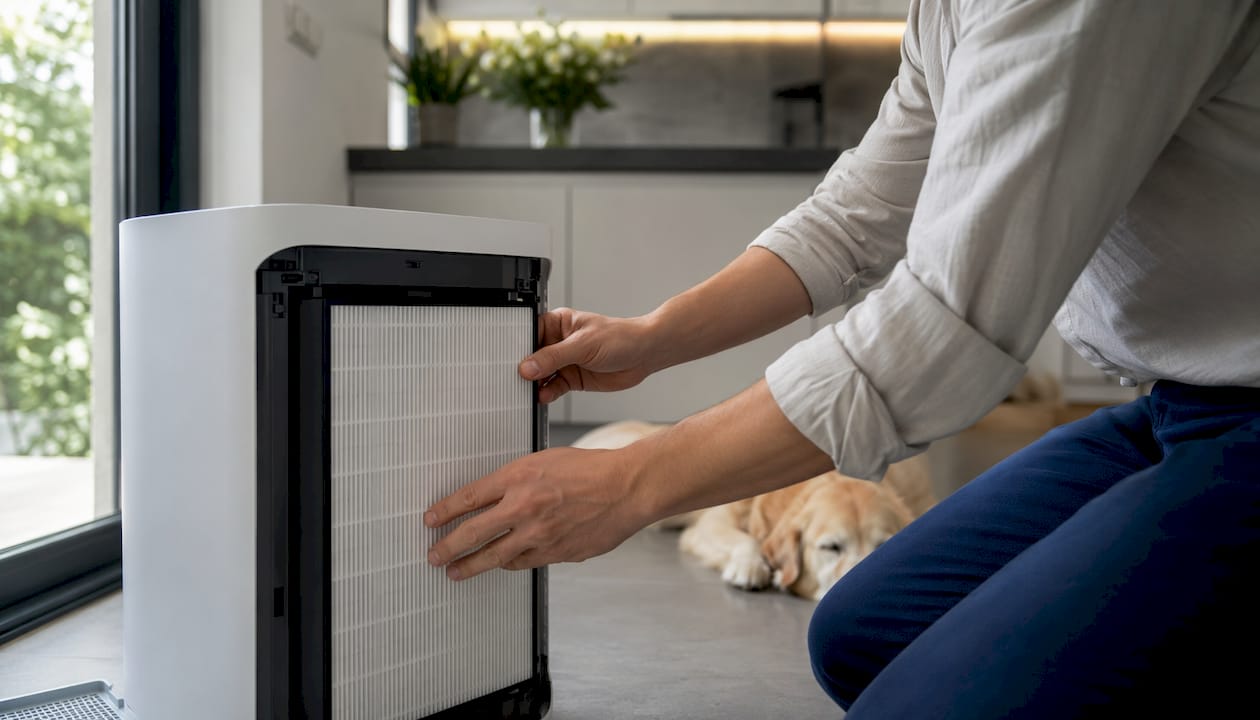
A HEPA filter works by mechanical capture across three mechanisms: impaction, interception, and diffusion. Particles are physically trapped in a dense fibre matrix rather than absorbed or neutralised. True HEPA filters capture 99.97% of particles at 0.3 µm, the most penetrating particle size. Because common dander particles are generally larger than 0.3 µm, capture rates for dander are typically even higher than that baseline figure.
Filter layers and their roles:
- Pre-filter: captures larger particles such as pet hair and visible dust, extending the life of the main HEPA filter
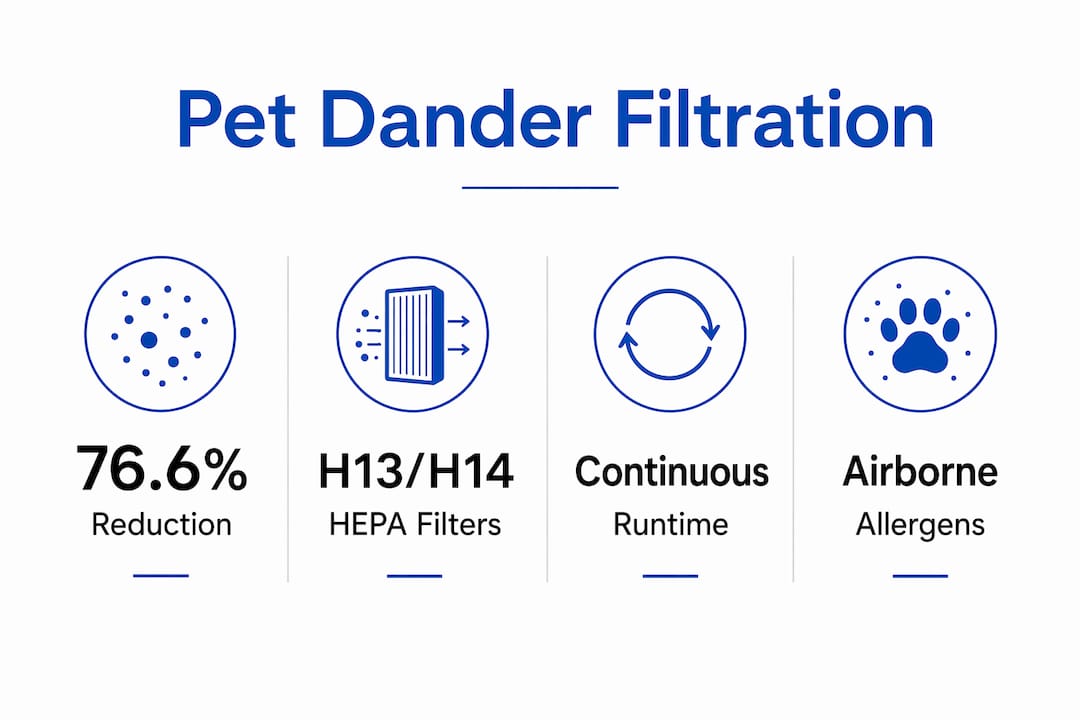
- HEPA layer (H13/H14): captures fine dander and allergen-carrying particles; H13 and H14 grades offer higher efficiency than standard True HEPA
- Activated carbon layer: adsorbs odour-causing gases and volatile organic compounds; it does not capture dander particles, but reduces pet odour meaningfully
Two metrics determine whether a unit is sized correctly for your room. CADR (Clean Air Delivery Rate) measures the volume of filtered air delivered per minute; a higher CADR means faster allergen removal. ACH (air changes per hour) tells you how many times the unit processes the full room volume each hour. For allergy management in bedrooms, 4–6 ACH is the practitioner-recommended target. To estimate the CADR you need, multiply room area (m²) by ceiling height (m) to get volume, then multiply by your target ACH and divide by 60 to get the required m³/min figure.
What health and household benefits does filtration deliver?
The clinical evidence for HEPA filtration in pet-allergen households is reasonably strong. A PMC-published study reported median reductions of Fel d 1 by approximately 76.6% and Can f 1 by approximately 89.3% with appropriate portable filtration in bedrooms. A separate PubMed study on dog allergen found airborne Can f 1 fell by roughly 75% when a HEPA air cleaner was active with the dog present, and by approximately 90% when the dog was in another room.
Symptom outcomes: Clinical experience indicates that around 70% of cat-allergic individuals noticed reduced symptoms with consistent HEPA filtration use.
Practical benefits beyond symptom relief:
- Reduced airborne allergen concentrations lower the cumulative dose inhaled during sleep, which is when the immune system is most active in managing inflammatory responses
- Less airborne dander settling onto surfaces means less frequent deep cleaning is needed
- Combined with an activated carbon layer, filtration also reduces pet odour, which is a separate but common concern for pet owners.
- People with asthma may experience fewer exacerbations during high-allergen periods such as moulting seasons
Filtration does not eliminate allergens from your home. It reduces the airborne fraction. Settled allergens in carpets, upholstery, and bedding remain until physically removed. For a broader overview of purifier benefits for families, the combination of HEPA filtration and regular HEPA vacuuming consistently outperforms either measure alone.
How effective are purifiers for pet dander — what research says
The honest clinical position, as stated by the American Lung Association, is that filtration provides a modest health benefit compared with removing the pet entirely. For people with severe sensitivity, source removal remains the most certain avoidance measure. For the majority of pet owners who will not or cannot re-home their animals, filtration is a practical and evidence-supported reduction strategy that delivers measurable symptom improvement for about 70% of cat-allergic individuals.
A review published by the US Department of Energy’s Office of Scientific and Technical Information found that particle filtration can be modestly effective in reducing adverse allergy and asthma outcomes, particularly in homes with pets, and that filtration delivering air to the breathing zone of sleeping individuals may be more consistently effective than whole-house approaches.
The main practical limits are worth understanding clearly. Settled allergen reservoirs in carpets can contain significantly more allergen than smooth floors, and walking or vacuuming re-aerosolises them. An undersized unit, or one placed in a corner with obstructed airflow, will not achieve the ACH needed for meaningful overnight benefit. Continuous runtime is the key differentiator: units run intermittently show substantially smaller reductions than those run around the clock.
How to choose an air purifier for pet dander
The most important decision is matching the unit’s CADR to your room size and target ACH. A unit rated for a large open-plan area will underperform in a bedroom if the manufacturer’s coverage figure assumes only two air changes per hour.
Key criteria checklist:
- Filter grade: prefer H13 or H14 HEPA for allergy use; standard True HEPA is the minimum acceptable
- CADR and room coverage: verify the CADR figure against your actual room volume at 4–6 ACH, not the manufacturer’s headline coverage area
- Pre-filter: a washable pre-filter extends main filter life and reduces running costs
- Noise level: check the decibel rating at the fan speed you will actually use overnight (typically medium or auto)
- Filter replacement cost and availability: factor in annual filter costs, not just the upfront price
- Energy consumption: units running 24 hours a day accumulate meaningful electricity costs; check wattage
For guidance on CADR, room sizing, and filter types, the calculation is straightforward once you have your room dimensions.
Pro Tip: Start with one correctly sized unit in the bedroom rather than buying a single large unit for the whole home. A closed bedroom treated to 4–6 ACH overnight delivers more consistent symptom relief than a whole-house unit achieving 1–2 ACH across multiple rooms.
| Criterion | What to look for | Why it matters |
|---|---|---|
| Filter type | True HEPA H13/H14 | Captures fine allergen-carrying particles efficiently |
| CADR / ACH | Sized for 4–6 ACH in target room | Determines how quickly airborne allergens are cleared |
| Noise level | Below typical sleep noise levels | Enables continuous overnight operation |
| Filter replacement cost | Genuine replacement filters available locally | Ongoing cost affects total value; skipped changes reduce performance |
| Energy use | Check wattage at typical fan speed | 24-hour runtime adds up; energy-efficient models reduce running costs |
| Pre-filter | Washable preferred | Extends HEPA filter life and reduces replacement frequency |
How to use and maintain your air purifier for best results
Getting the most from a HEPA unit comes down to three operational habits: run it continuously, place it correctly, and maintain the filters on schedule.
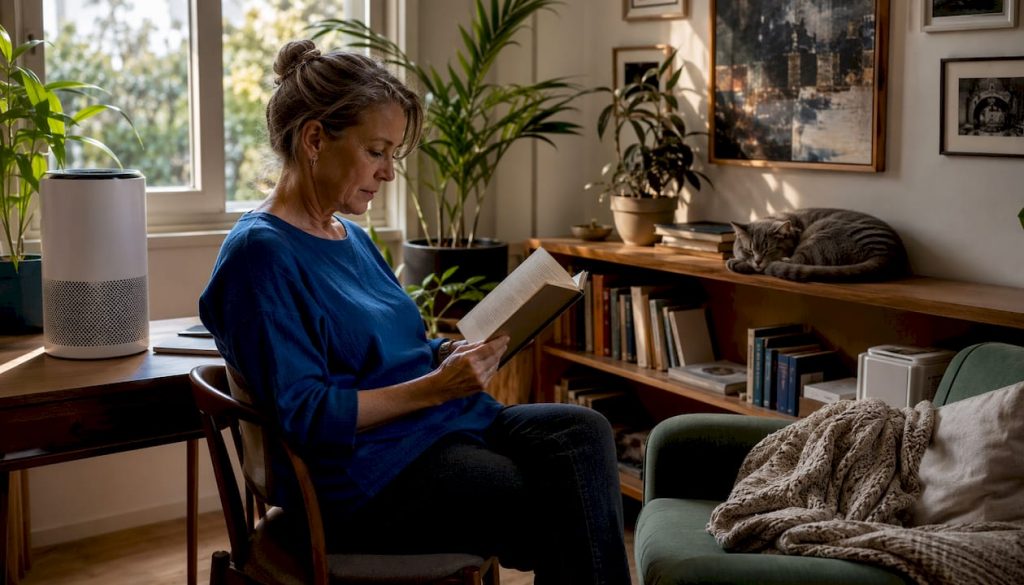
- Run continuously in the bedroom. Because people spend roughly one-third of each day sleeping, overnight filtration in a closed bedroom delivers the greatest per-unit benefit for symptom relief.
- Close the door when treating a single room. An open door increases the effective volume the unit must process, reducing ACH and slowing allergen clearance.
- Increase fan speed after grooming or vacuuming. After activities that spike airborne dander, run the unit at high speed for 60–90 minutes to return concentrations toward baseline.
- Place the unit away from walls and furniture. Obstructed intake or exhaust vents reduce effective CADR. Position the unit at least 30 cm from any surface, ideally near the centre of the room or close to where you sleep.
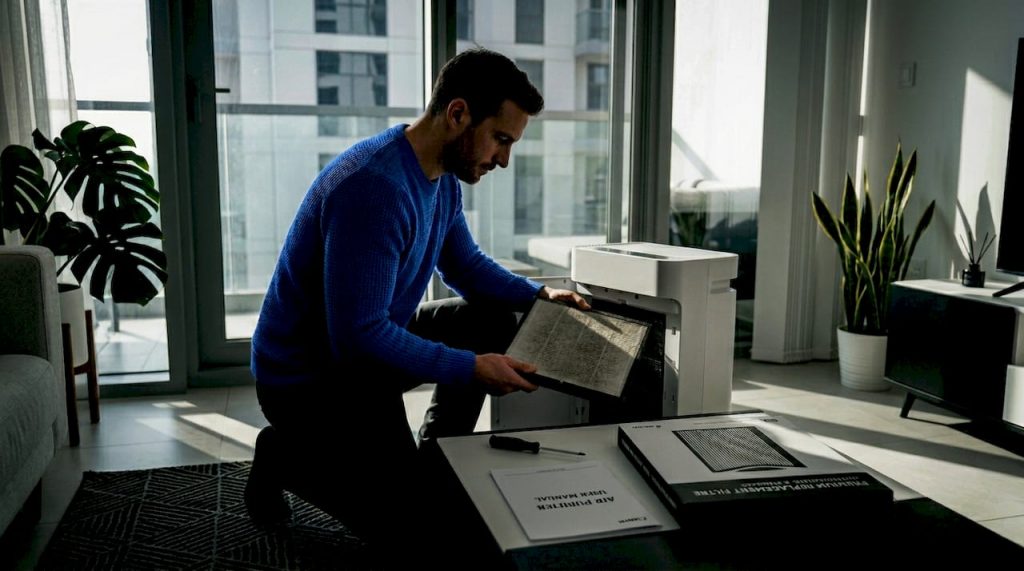
- Replace filters on schedule. A clogged HEPA filter loses efficiency and can increase motor strain. Most H13 filters require replacement every 6–12 months depending on pet load and runtime.
Pro Tip: Place the unit on the floor or a low surface near the bed rather than high on a shelf. Dander particles are heavier than many pollutants and tend to concentrate lower in the room, so intake at that level captures more allergen per cycle.
| Maintenance task | Frequency | Notes |
|---|---|---|
| Clean pre-filter | Every 2–4 weeks | Wash or vacuum; allow to dry fully before reinstalling |
| Replace HEPA filter | Every 6–12 months | Shorten interval with multiple pets or high-shedding breeds |
| Replace activated carbon layer | Every 3–6 months | Carbon saturates faster than HEPA; odour return signals replacement |
| Check unit seals and housing | Every 6 months | Gaps around filter housing allow unfiltered air to bypass the media |
| Wipe exterior vents | Monthly | Prevents dust build-up from restricting airflow |
For practical guidance on balancing continuous runtime with energy-efficient operation, running a well-matched unit at medium speed around the clock typically uses less energy than running a larger unit at high speed intermittently.
Other practical steps to reduce pet dander indoors
Filtration addresses airborne allergens. The settled reservoir requires physical removal. These measures work alongside a HEPA purifier to reduce total allergen load.
- Pet-free bedroom policy. Keeping pets out of the bedroom reduces the allergen load in the space where you spend the most time. Airborne allergen levels are measurably higher in rooms where pets are physically present.
- Weekly bedding washes at high temperature. Hot water and detergent remove allergens from sheets and pillowcases more effectively than cool washing.
- HEPA-sealed vacuum cleaner. A standard vacuum without a sealed HEPA filter can exhaust fine allergen particles back into the air. Vacuum at least twice a week, and expect airborne levels to spike for a few hours after vacuuming.
- Replace carpet with smooth flooring where feasible. Carpets can contain significantly more cat allergen than smooth floors, according to Ohio State University’s veterinary guidance. Hard floors are far easier to damp-mop clean.
- Regular pet grooming or bathing (as vet-advised). Bathing a cat weekly can reduce the concentration of allergen by up to 84% according to veterinary guidance. Brush pets outdoors to prevent dander dispersal inside.
- Damp cleaning over dry dusting. Dry brooms and feather dusters aerosolise settled allergens. Use damp cloths or electrostatically charged wipes to trap and remove particles.
- Restrict pets to hard-floored areas. Upholstered furniture and carpeted rooms accumulate allergen rapidly; limiting pet access to easy-clean surfaces reduces reservoir build-up.
For severe allergy cases where symptoms persist despite all these measures, clinical guidance from the Mayo Clinic and the American Lung Association is consistent: removing the animal from the home remains the most certain avoidance measure. That is a clinical observation, not a recommendation to re-home a pet without exhausting other options first.
Key takeaways
HEPA filtration reduces airborne pet allergen concentrations significantly, but sustained benefit requires continuous runtime, correct room sizing, and regular filter maintenance alongside surface cleaning.
| Point | Details |
|---|---|
| Filtration reduces airborne allergens | Bedroom HEPA units can reduce Fel d 1 by ~76.6% and Can f 1 by ~89.3% in trials. |
| Bedroom-first strategy | Start with one correctly sized unit in the bedroom; 4–6 ACH overnight gives the greatest symptom benefit. |
| Continuous runtime matters | Units run around the clock outperform intermittent use; spike recovery after grooming takes 60–90 minutes. |
| Combine with surface cleaning | Settled allergen reservoirs in carpets and upholstery require HEPA vacuuming and damp cleaning, not just filtration. |
| Climatepro for ready solutions | Climatepro stocks HEPA H13/H14 purifiers and genuine replacement filters suited to bedroom and living-area use. |
Filtration works, but expectations need to be calibrated
The evidence for HEPA filtration in pet-allergen households is real and reasonably consistent. What often gets lost in the conversation is the distinction between reducing airborne allergen load and eliminating the allergen problem entirely. Those are very different outcomes, and conflating them leads to disappointment.
The most common mistake is buying a unit, placing it in a corner of the living room, and running it on low speed when the pet is nearby. That approach will show almost no measurable benefit. The clinical data that supports filtration, including the studies cited by the American Lung Association and Mayo Clinic, comes from correctly sized units running continuously in closed bedrooms, not from occasional use in shared spaces.
The other underappreciated point is that settled allergen reservoirs are the dominant source of ongoing exposure for most households. A HEPA purifier cannot reach allergens embedded in carpet fibres or upholstery. That is not a failure of the technology; it is simply outside what airborne filtration can do. Pairing a good purifier with a HEPA vacuum, damp cleaning, and a pet-free bedroom policy is the combination that actually moves the needle on symptoms.
For people with mild to moderate pet allergies who are not willing to re-home their animals, this combined approach is practical, affordable, and supported by the evidence. For severe sensitivity, the clinical guidance is unambiguous: filtration is a supportive measure, not a substitute for source removal.
Climatepro’s HEPA purifiers for pet owners
For pet owners ready to act, Climatepro stocks a curated range of HEPA H13/H14 air purifiers and genuine replacement filters suited to bedrooms, living areas, and larger spaces across the UAE. The practical starting point is a bedroom-focused unit sized to your room volume, with a genuine replacement filter available when the time comes.

The Honeywell Air Touch P2 is a solid bedroom and medium-room option with HEPA filtration and a pre-filter stage. For a broader look at the full range, the Climatepro air purifier catalogue covers units from compact bedroom models through to larger-room options, with Blueair, Dyson, Winix, IQAir, and other trusted brands available alongside genuine replacement filters. Delivery is available across Dubai, Abu Dhabi, Sharjah, and all seven emirates.
Further reading and authoritative sources
- American Lung Association: pet dander and indoor air — public-health guidance on pet allergen management and the role of filtration
- Mayo Clinic: pet allergy treatment and management — clinical guidance on filtration as a supportive measure for night-time symptom reduction
- PMC: effect of air filtration on cat and dog allergens — peer-reviewed trial reporting Fel d 1 and Can f 1 reduction figures
- PubMed: effect of air filtration on airborne dog allergen — controlled study on HEPA performance for Can f 1 in homes with dogs
- Ohio State University College of Veterinary Medicine: cat allergen guide — veterinary source on allergen biology, bathing efficacy, and household controls
- IQAir: pet owners, allergies and air purifiers — industry guidance on settled allergen reservoirs and combined cleaning strategies
This article provides general information about pet allergen management and air filtration. It is not medical advice. Consult a qualified healthcare provider or allergist for guidance specific to your situation.
Recommended
- Advantages of air purifiers: what families need to know — Blog | ClimatePro UAE
- Guide to allergy proofing apartments: practical steps for renters — Blog | ClimatePro UAE
- The role of pre-filters in home air purification — Blog | ClimatePro UAE
- Buy Levoit Core 300/300S Pet Allergy Replacement Filter in Dubai | Best Price AED 97 | ClimatePro UAE