The right replacement filter is the exact manufacturer part number that matches your purifier model, not just a filter of the same rough size. Locate your unit’s model or part number on the label or inside the filter compartment, then order the matching filter SKU or an authorised equivalent that explicitly lists that model. Visually similar filters can differ in pleat count, seals or connector tabs, so size alone is never a reliable guide.
TL;DR:
- Matching the exact filter SKU is essential, as visual similarity does not guarantee compatibility in pleat count, connector tabs, or gasket placement.
- Confirm the filter type—HEPA, ULPA, carbon, or pre-filter—since using the wrong media type can reduce filtration efficiency and airflow.
- Always verify the full SKU suffix and compare it to the manufacturer’s official parts list before purchasing, especially when replacing filters in sensitive environments.
- Measure dimensions and check connector types only if the model number is unavailable, but remember that size alone does not ensure proper fit.
- Replace filters based on usage and signs of loading or reduced airflow, not just elapsed time, to maintain optimal air cleaning performance.
Table of Contents
- Quick checklist: identify the exact filter you need
- Understand filter types and which one you actually need
- How to read model labels and match to the manufacturer’s filter SKU
- Measuring and verifying physical fit: dimensions, seals and connector types
- When to replace filters and how to spot a tired filter
- Why choose genuine or authorised replacement filters
- Common mistakes owners make and quick fixes
- How to order the correct replacement filter
- Sources
- FAQ
Quick checklist: identify the exact filter you need
Before ordering anything, work through a short verification process. It takes a few minutes and prevents a returned parcel or a filter that will not seat properly.
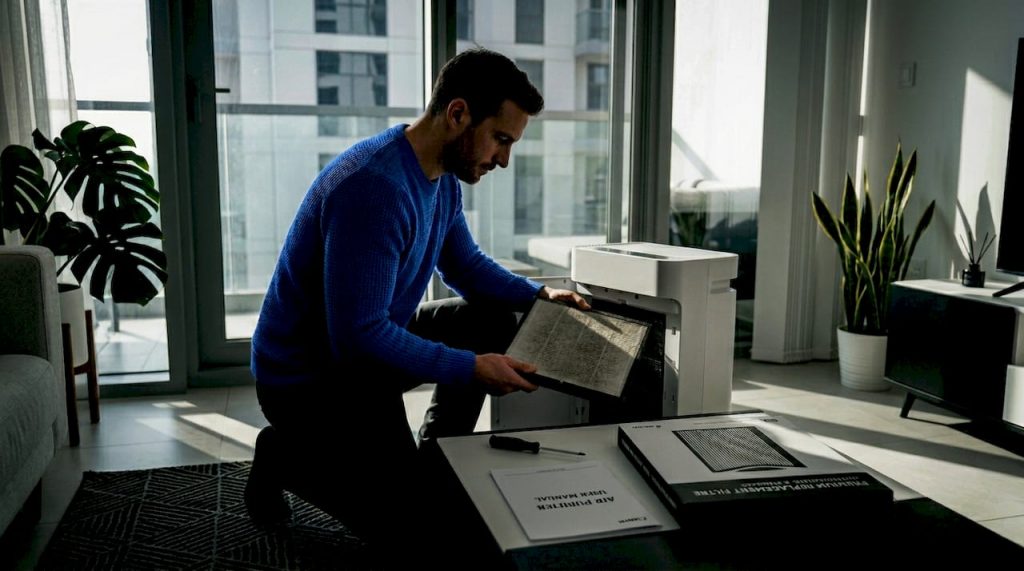
- Switch off the unit and remove the front grille to expose the device label or the sticker inside the filter chamber.
- Photograph the label and the installed filter, including any printed part numbers or barcodes.
- Search the manufacturer’s compatibility list or an authorised parts page and match the complete SKU, not a shortened code.
- Confirm the filter type (HEPA, ULPA, carbon or pre-filter), the exact dimensions and the connector or tab arrangement.
- If anything looks uncertain, send the photo and SKU to an authorised dealer or to ClimatePro for verification before you buy.
A few habits make this process faster next time:
- Keep the photo of your label saved in a dedicated folder or note app.
- Write the full SKU down rather than relying on memory or a partial code.
- Check the air filter compatibility guide if your unit’s manual is missing or unclear.
Pro Tip: Photograph the filter from the side as well as from above, since connector tabs and gasket depth often sit on the edge, not the face.
Understand filter types and which one you actually need
Purifiers use different filter media for different jobs, and choosing the wrong one wastes money even when the size is correct.
- Pre-filters catch large particles like hair and dust and extend the life of the main filter.
- True HEPA filters capture fine particles, allergens and most smoke, and are the standard choice for allergy relief.
- ULPA filters trap even finer particles than HEPA and suit specialist environments with strict sub-micron requirements.
- Activated carbon filters absorb odours and volatile organic compounds but do little for particles on their own.
A true HEPA filter is rated to capture 99.97% of particles at 0.3 microns, which is why it remains the benchmark for allergy and dust control.
Combination cartridges that pair HEPA with a carbon layer are common because most households deal with both particles and odours at once. The trade-off is airflow: denser media filters more effectively but restricts airflow slightly more and may need replacing sooner. Before ordering a different media type than the one currently fitted, confirm your purifier’s housing actually supports it. Not every unit accepts a carbon or ULPA cartridge in place of standard HEPA, even if the outer dimensions match, a point covered further in our air purifier buying tips.
How to read model labels and match to the manufacturer’s filter SKU
The model and part information you need is usually printed in one of three places: the sticker on the base or rear of the unit, a label inside the filter chamber itself, or the original packaging and manual. If none of these are available, the manufacturer’s website often lets you search by unit model name.
Once you have the model number, look at the filter SKU suffixes, which usually indicate the media type:
- -HEPA or -H typically denotes a true HEPA cartridge.
- -ULPA denotes the finer ULPA grade.
- -C or -CARB usually signals an added activated carbon layer.
- A family code before the suffix (for example a shared model series number) tells you which filters are interchangeable within that product line.
Cross-check the full SKU against the manufacturer’s parts page, an authorised retailer listing, or a verified parts database such as the Find my filter service. The complete SKU matters because it locks in pleat count, gasket placement and connector type, details that a shortened or guessed code will not guarantee.
Measuring and verifying physical fit: dimensions, seals and connector types
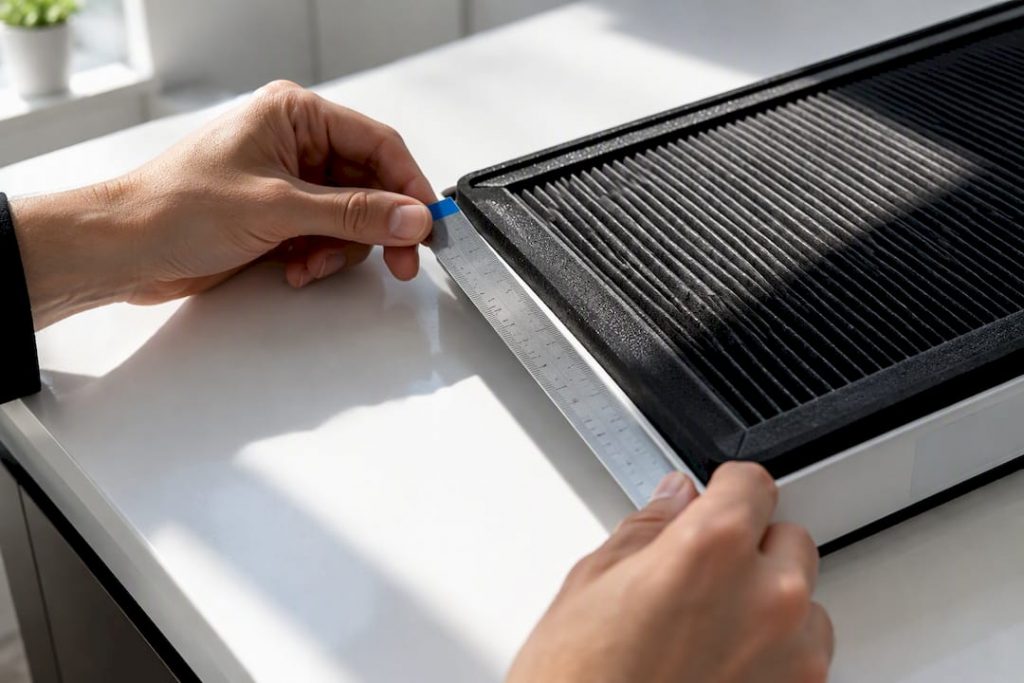
If you cannot locate a model number, measuring the existing filter is the fallback method, though it should be a last resort rather than the first step.
- Measure length, width and depth with a tape measure or ruler, recording all three dimensions in millimetres.
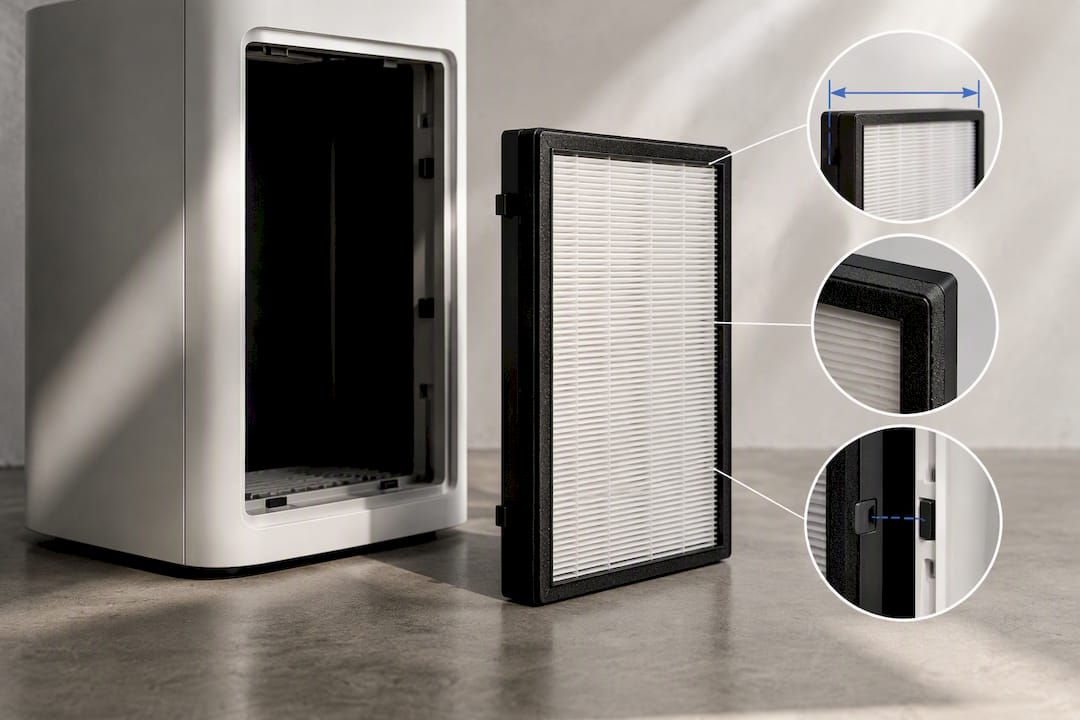
- Check for locking tabs, foam gaskets and the pleat footprint, and photograph these details for a supplier to review.
- Watch for filters that share outer dimensions but use different connector tabs or pleat densities, since these will not seal properly even if they slide in.
- After fitting a new filter, close the grille fully, check for gaps around the edge, and run the unit briefly to listen for rattles or a drop in airflow.
Pro Tip: A filter that needs force to fit is usually the wrong one. Genuine replacements seat with light pressure and no visible gap around the frame.
Our step-by-step replacement workflow covers the full install process if you want a walk-through alongside these checks.
When to replace filters and how to spot a tired filter
Most manufacturers suggest a replacement window of roughly 6 to 24 months, though the right timing depends heavily on usage hours and how much dust or pollutant load the unit handles day to day, as outlined in our HEPA filter lifespan guide. A unit running constantly in a dusty environment will need a fresh filter far sooner than one used occasionally in a clean office.
Watch for these signs rather than relying on the calendar alone:
- A persistent musty or stale odour that air freshener does not fix.
- Visible grey or brown loading across the filter’s fibres.
- Noticeably reduced airflow from the outlet vents.
- A change-filter indicator light, where the unit has one.
Delaying replacement reduces the unit’s clean air delivery rate and increases energy use as the motor works harder to push air through a clogged filter. When in doubt, follow the manufacturer’s recommended cadence rather than guessing, and check our maintenance tips for homeowners for simple airflow checks you can do at home.
Why choose genuine or authorised replacement filters
Genuine filters are built and tested to the manufacturer’s original specifications, which preserves the performance rating the unit shipped with and usually keeps any device warranty intact. Authorised sellers can also confirm SKU compatibility before you buy, rather than leaving you to guess from a product photo.
- The store specialises in air purifiers and stocks branded replacement filters, including Honeywell and Blueair lines.
- Product pages list the full SKU alongside the unit models it fits, so you can check compatibility before ordering.
- Delivery covers homes, offices, clinics, nurseries and hotels across various locations.
Before buying, match your SKU against the listing, compare product photographs against your own filter, and use the product page itself to place the order.
Common mistakes owners make and quick fixes
Two mistakes come up repeatedly. The first is ordering by outer dimensions alone: a filter can be the right size and the wrong fit, so always confirm the full SKU and connector details before paying. The second is skipping the pre-filter, which shortens the life of the main HEPA or carbon media by letting it catch large debris it was never meant to handle.
A simple habit fixes both: keep a labelled photo of your unit’s label next to the SKU of the filter you last bought, so reordering takes a minute instead of a search.
— Nevel
How to order the correct replacement filter
Once you have your model number and SKU confirmed, ordering the right filter should be straightforward rather than a guessing game. Search ClimatePro’s Filters category using your model number or SKU, check the listing against your photos, and add it to your cart once the match is confirmed.

The store delivers across multiple Emirates and carries authorised branded filters, including Honeywell and Blueair, with product pages that list the compatible SKUs directly. If you already own a unit like the Honeywell Air Touch P2, its product page links to the matching filter so you are not left cross-referencing codes manually. When a SKU still looks uncertain, send a photo of your label along with the part number to the product support team before you place the order, so the compatibility check happens ahead of the purchase rather than after a return.
Sources
For further verification, manufacturer parts pages and the EPA’s guide to air cleaners remain the most reliable references for performance and CADR context.
- Air purifier filter compatibility guide
- Guide to air cleaners in the home (EPA)
- Find my filter — ReplacerGuide
FAQ
How can I find an air filter by size?
Measuring length, width and depth is a fallback when the model number is missing, but size alone does not guarantee fit. Pleat count, gasket placement and connector tabs vary between filters of identical outer dimensions, so cross-check the SKU wherever possible.
How do I know what size filter to get?
Check the sticker on your unit’s base or inside the filter chamber for the model number, then match that to the manufacturer’s listed filter SKU. If the label is missing, measure the existing filter’s length, width and depth as a backup method.
Are air purifier filters universal?
No, filters are generally model-specific rather than universal, since pleat density, connector tabs and housing shapes differ even between similarly sized units. A filter needs to list your exact model or match your verified SKU before you rely on it fitting.
What are the four main types of filters?
The four common types are pre-filters, true HEPA filters, ULPA filters and activated carbon filters. Pre-filters catch large debris, true HEPA filters capture 99.97% of particles at 0.3 microns, ULPA filters trap even finer particles, and activated carbon targets odours and gases rather than particles.