

Relative humidity is the percentage of water vapour actually present in the air compared to the maximum amount that air could hold at the same temperature and pressure. The Bureau of Meteorology defines it formally as the ratio of the partial pressure of water vapour to the saturation vapour pressure at the same temperature, expressed as a percentage. Two things make this measure particularly useful: it tells you how close the air is to its saturation point, and it shifts with temperature even when the actual moisture content stays the same.
A few key terms help clarify how relative humidity works:
- Water vapour: Water in its gaseous form, invisible and always present in the atmosphere to varying degrees.
- Saturation: The point at which air holds the maximum water vapour possible at a given temperature. At 100% relative humidity, the air is fully saturated and any additional moisture or cooling triggers condensation.
- Partial pressure: The pressure that water vapour alone contributes to the total atmospheric pressure, used in the formal calculation of relative humidity.
- Saturation vapour pressure: The maximum pressure water vapour can exert at a specific temperature, which rises as temperature increases.
Relative humidity does not tell you how much moisture is in the air in absolute terms. It tells you how full the air is, relative to its current capacity.
How relative humidity changes with temperature
Temperature is the single biggest driver of relative humidity, and understanding this relationship clears up most of the confusion people have about the measure. The Royal Meteorological Society explains it plainly: warm air can hold significantly more moisture than cold air, so warmer air holds many times more water vapour than colder air. If the actual moisture content stays constant but the temperature rises, relative humidity falls. If the temperature drops, relative humidity rises, sometimes all the way to saturation.

A practical example: imagine a room where the air contains a fixed amount of water vapour. As temperature rises during the day, the relative humidity reading can drop significantly even though moisture amounts stay constant. No water was added or removed. The air simply became capable of holding more, so the ratio shifted.
At 100% relative humidity, the air cannot absorb any more water vapour at that temperature. Cooling the air further, or adding more moisture, forces water out of the vapour phase as dew, fog, or condensation on surfaces. This is exactly what happens on a cold window on a humid morning.
It is also worth noting that water vapour molecules do not actually bind to air molecules. The concept of air “holding” moisture is a simplified model. What actually governs saturation is the balance between evaporation and condensation at the molecular level, driven by temperature and vapour pressure.
Key effects of temperature on relative humidity:
- Rising temperature lowers relative humidity if moisture content stays the same.
- Falling temperature raises relative humidity, potentially reaching saturation and causing condensation.
- Heating indoor air in winter reduces relative humidity, which is why heated rooms often feel dry.
- Cooling air in an air-conditioned space can raise relative humidity near cold surfaces.
Why relative humidity matters for health and environment
Relative humidity has a direct effect on how comfortable and healthy an indoor or outdoor environment feels. When humidity is too high, the air feels heavy and oppressive because sweat evaporates slowly from the skin, reducing the body’s ability to cool itself. When it is too low, mucous membranes in the nose and throat dry out, making people more susceptible to respiratory irritation and airborne infections.

Beyond personal comfort, high relative humidity accelerates mould growth on walls, ceilings, and furnishings. Mould spores thrive when surfaces stay damp, which happens readily when indoor humidity is consistently elevated. Condensation on walls and windows is often the first visible sign that relative humidity has exceeded what the building fabric can safely handle. For anyone managing a healthy home environment, keeping humidity within a controlled range is as important as temperature.
Relative humidity also plays a central role in weather forecasting. Meteorologists track it to predict fog, frost, thunderstorm development, and the likelihood of precipitation. When surface air reaches saturation, clouds form and precipitation becomes possible. In climate science, long-term humidity data helps researchers understand how warming temperatures alter precipitation patterns and the frequency of extreme weather events.
Pro Tip: Many health and building standards recommend maintaining indoor relative humidity within a moderate range to minimise issues like static electricity, respiratory discomfort, and mould risk.
Absolute humidity and dew point: how they differ from relative humidity
Relative humidity is the most widely used humidity measure, but two related concepts often appear alongside it: absolute humidity and dew point. Each describes moisture in the air differently, and confusing them leads to misinterpretation of weather data and indoor climate readings.
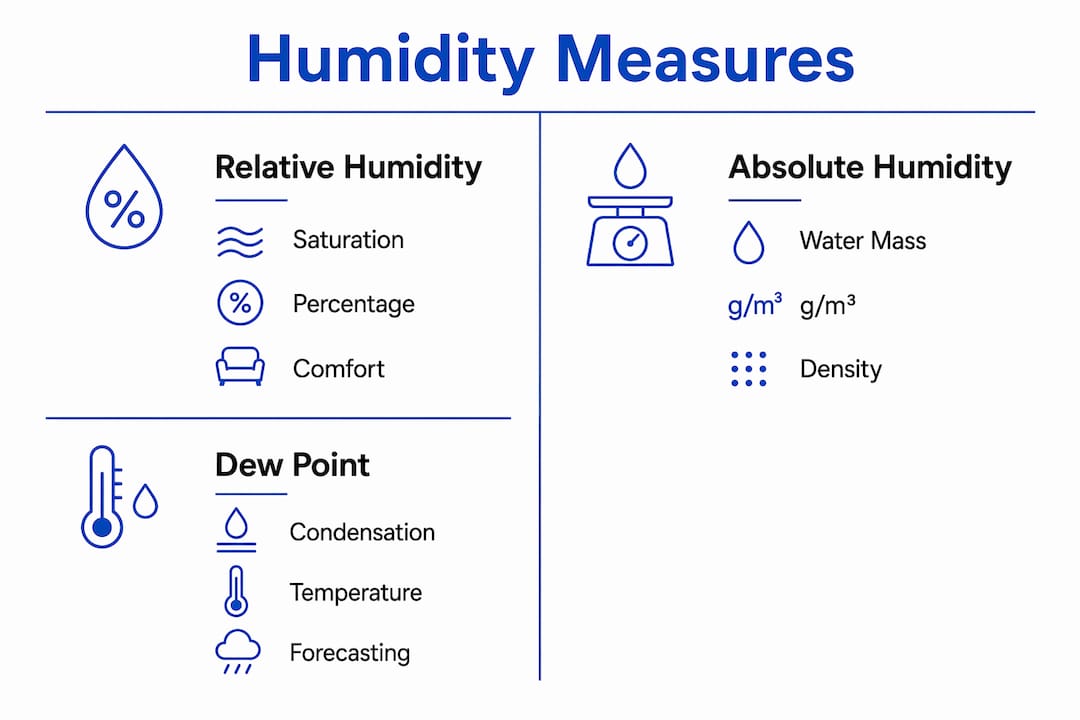
Absolute humidity measures the actual mass or density of water vapour present in a given volume of air, typically expressed in grams per cubic metre. It does not change with temperature. If you heat a sealed room, the absolute humidity stays the same because no moisture was added or removed. Relative humidity, by contrast, drops because the air’s capacity increased.
Dew point is the temperature at which a parcel of air, cooled at constant pressure, reaches saturation and condensation begins. It is an absolute measure of moisture content: a high dew point means there is genuinely a lot of water vapour in the air, regardless of the current temperature. Meteorologists often prefer dew point over relative humidity when describing how muggy conditions feel, because dew point does not shift with temperature.
| Measure | What it describes | Unit | Practical use |
|---|---|---|---|
| Relative humidity | How close air is to saturation at current temperature | Percentage (%) | Comfort assessment, condensation risk, weather forecasting |
| Absolute humidity | Actual mass of water vapour per unit volume | Grams per cubic metre (g/m³) | Industrial drying, precise moisture calculations |
| Dew point | Temperature at which air reaches saturation | Degrees Celsius (°C) | Muggy weather assessment, frost prediction |
The three measures are related but answer different questions. Relative humidity answers “how full is the air right now?” Absolute humidity answers “how much water vapour is actually present?” Dew point answers “at what temperature will condensation start?”
How to measure humidity: instruments and methods
Meteorological instruments measure relative humidity because it reflects human comfort and condensation risk more directly than absolute humidity. Several instrument types are in common use, ranging from traditional mechanical devices to modern digital sensors.
Traditional instruments
Hair hygrometers use the physical property of human or synthetic hair to expand and contract with changes in humidity. As humidity rises, the hair lengthens and moves a needle on a calibrated dial. These devices are simple and require no power, but they drift over time and need periodic recalibration.
Wet and dry-bulb thermometers, also called psychrometers, use the cooling effect of evaporation. One thermometer bulb is kept dry; the other is wrapped in a damp cloth. The difference in temperature between the two readings corresponds to a specific relative humidity value, read from a psychrometric table. This method is reliable when used correctly, though it requires careful technique.
Digital sensors
Modern digital humidity sensors use capacitive or resistive elements that change their electrical properties as moisture levels shift. They are compact, fast, and capable of around 1% precision under stable conditions. However, the Royal Meteorological Society notes that calibration drift and environmental factors can introduce inaccuracies, particularly in high-humidity settings. Consumer-grade sensors are convenient but benefit from periodic checks against a reference instrument.
For those managing indoor air quality at home or in a commercial space, smart humidity control systems pair digital sensors with automated humidifiers or dehumidifiers to maintain target ranges without manual adjustment.
Key points on humidity measurement:
- Relative humidity is always expressed as a percentage from 0% to 100%.
- Hair hygrometers suit low-tech applications but require regular recalibration.
- Wet and dry-bulb psychrometers are accurate when used with proper technique.
- Digital sensors offer speed and convenience, with around 1% precision under good conditions.
- All instruments benefit from correct placement away from direct heat, cold drafts, and moisture sources.
Pro Tip: When using a digital hygrometer at home, place it at roughly head height in the centre of the room, away from windows, air vents, and exterior walls. Readings near cold surfaces or draughts will not represent the room’s actual humidity.
Common misunderstandings about relative humidity
The most persistent misunderstanding about relative humidity is treating it as a fixed measure of how much moisture is in the air. It is not. As the Royal Meteorological Society makes clear, relative humidity is a snapshot of how near the air is to saturation at a specific temperature. The same body of air can read 30% relative humidity at noon and 75% at midnight, with no change in actual moisture content, simply because the temperature dropped.
This temperature dependence has real consequences for how people interpret humidity readings. A reading of 70% relative humidity on a cool morning does not mean the air is dangerously damp. It may simply reflect that the temperature is low. Conversely, 50% relative humidity on a very hot day can still carry a large absolute amount of water vapour, making conditions feel oppressive.
Sensor placement is another area where errors are common. Sensors positioned near windows, exterior walls, or air conditioning vents pick up localised conditions rather than the room’s average humidity. A sensor next to a cold window may read 90% relative humidity while the rest of the room sits at 55%. Proper positioning, away from temperature gradients and moisture sources, is the only way to get a reading that represents the actual indoor environment.
Digital humidity sensors used in consumer devices frequently experience calibration drift over time, meaning their readings shift gradually away from true values. Professional environmental control relies on regularly calibrated instruments and an awareness of each device’s limitations. For home use, comparing a consumer sensor against a freshly calibrated reference unit every six to twelve months is a practical way to catch drift before it leads to poor decisions about humidification or dehumidification.
Pro Tip: If your hygrometer reads unusually high or low and you suspect drift, place it in a sealed bag with a small amount of salt solution for several hours. A saturated sodium chloride solution stabilises at approximately 75% relative humidity at room temperature, giving you a reliable reference point for calibration.
Managing indoor humidity with the right equipment
Understanding relative humidity is the foundation, but acting on that knowledge requires the right tools. In environments like the UAE, where outdoor humidity can swing between very dry desert air and intensely humid coastal conditions, indoor humidity management is a practical necessity rather than a luxury. Climatepro stocks humidifiers and dehumidifiers suited to homes, offices, clinics, and commercial spaces across Dubai, Abu Dhabi, Sharjah, and the wider UAE.

Whether the goal is raising humidity in a dry, air-conditioned office or reducing it in a coastal apartment prone to condensation, Climatepro’s range covers both ends of the spectrum. Products are available for delivery across all seven emirates, with options at a range of price points to suit different room sizes and usage requirements.
Key takeaways
Relative humidity measures how close air is to its saturation point at a given temperature, expressed as a percentage, and shifts with temperature even when actual moisture content stays constant.
| Point | Details |
|---|---|
| Definition | Relative humidity is the ratio of actual water vapour to the maximum possible at the same temperature, expressed as a percentage. |
| Temperature dependence | Rising temperature lowers relative humidity; falling temperature raises it, even with no change in moisture content. |
| Health and comfort range | Most standards recommend indoor relative humidity between 40% and 60% to minimise mould risk and respiratory discomfort. |
| Measurement accuracy | Digital sensors offer around 1% precision but are subject to calibration drift and require correct placement to give reliable readings. |
| Related measures | Absolute humidity measures actual vapour mass per volume; dew point is the temperature at which saturation and condensation begin. |
Recommended
- Humidifier for dry air: your practical home guide — Blog | ClimatePro UAE
- Why regulate office humidity: a guide for facility managers — Blog | ClimatePro UAE
- Humidity control workflow: your step-by-step home guide — Blog | ClimatePro UAE
- What is smart humidity control: a homeowner’s guide — Blog | ClimatePro UAE