Removing volatile organic compounds from indoor air requires high-capacity gas-phase media, meaning activated carbon or a specialised chemisorbent, combined with sufficient airflow to pull air through that media repeatedly. HEPA filtration alone does nothing for gases; it only captures particles. A purifier makes sense for ongoing off-gassing from new furniture, persistent cooking or cleaning odours, or a home near heavy traffic. But for a fresh renovation or a one-off paint job, ventilation and source control come first. Specialized purifiers and replacement media built for effective gas-phase removal are available from various sources.
TL;DR:
- HEPA filters only capture particles and do not remove gaseous VOCs, which require activated carbon or chemisorbent media for effective removal.
- Gas-phase media performance depends on the amount and type of activated carbon, with impregnated or catalytic options being more effective for reactive gases like formaldehyde.
- Properly sizing an air purifier involves matching its airflow and carbon load to the room size and VOC source intensity, emphasizing the importance of media weight and media placement near emission sources.
- Continuous operation during heavy off-gassing and combining ventilation with filtration significantly enhances VOC reduction, especially in homes with persistent chemical sources.
- Regular cartridge replacement is crucial, with typical carbon filters lasting three to twelve months, depending on VOC levels and environmental conditions, and performance decline signals re-emerging odors.
Table of Contents
- How does a VOC air purifier actually remove gases?
- What to check before buying a VOC removal air purifier
- How do you match purifier capacity to your room and VOC source?
- How long do VOC filters last and what should you budget?
- How do you test and measure VOC levels indoors?
- What certifications matter for VOC removal claims?
- When should you buy a purifier versus just ventilating?
- Where to start if you need a VOC-capable purifier now
- Sources
- FAQ
How does a VOC air purifier actually remove gases?
Volatile organic compounds are carbon-based chemicals that evaporate easily at room temperature. They come off paints, varnishes, new furniture, laminate flooring, cleaning products, adhesives, air fresheners, and even cooking oil heated past its smoke point. Formaldehyde, benzene, toluene, and various glycol ethers are common examples, and they’re the reason a freshly painted room or a newly delivered sofa carries that distinctive chemical smell for days or weeks after installation.
That smell is the giveaway that particle filtration can’t help you. A HEPA filter is a mechanical sieve. It captures dust, pollen, pet dander, and smoke particles by trapping them in a dense mat of fibres as air passes through. VOC molecules are gases, not particles, and they’re small enough to pass straight through a HEPA filter’s fibre structure without ever being caught. This is one of the most misunderstood points in the entire air purifier category: a unit can carry a HEPA H13 rating and still do almost nothing for a room that smells like fresh paint.
Gas-phase removal works on an entirely different principle called adsorption, not to be confused with absorption. Activated carbon is ordinary carbon (often derived from coconut shells or coal) that has been processed to be riddled with microscopic pores, giving it an enormous internal surface area. Quality activated carbon can carry a very large surface area, often compared to that of several tennis courts per gram. As air passes through this porous structure, VOC molecules physically stick to the carbon’s internal surfaces, held there by weak molecular forces called van der Waals attraction. The gas doesn’t get destroyed, it gets trapped.
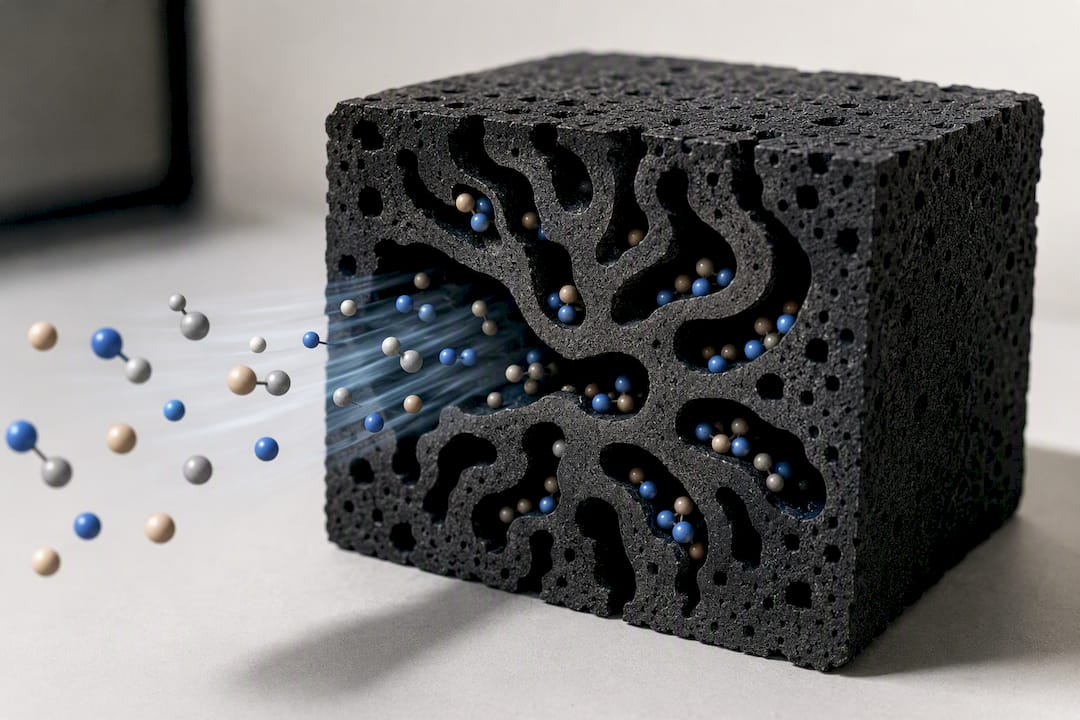
Research on VOC adsorption technologies confirms that activated carbon and related chemisorption media remain the primary practical technologies for removing a broad spectrum of VOCs from indoor air. Not every VOC binds equally well to plain activated carbon, though. Formaldehyde in particular is a small, reactive molecule that slips past standard carbon more easily than larger compounds like toluene or benzene. This is why some purifiers use impregnated or chemisorbent media, carbon that has been treated with chemicals such as potassium permanganate specifically to react with and neutralise problem gases rather than simply trapping them by physical attraction. Studies on advanced media for reactive gaseous pollutants show that this kind of impregnated or catalytic media becomes necessary when formaldehyde is a significant concern, which matters if you’ve just installed new engineered wood furniture or flooring.
A smaller category of purifiers uses catalytic oxidation instead of, or alongside, adsorption. These systems pass air over a catalyst, often at low heat, that converts certain VOCs into carbon dioxide and water vapour rather than storing them on a filter surface. In theory this avoids the “filter fills up” problem entirely. In practice, catalytic stages tend to target specific compounds like formaldehyde rather than the full range of household VOCs, so they usually work best as a supplement to carbon media rather than a replacement for it.
The practical takeaway for anyone comparing products:
- HEPA filters capture particles (dust, pollen, smoke, pet dander) but do nothing for gases.
- Activated carbon adsorbs a broad range of VOCs by trapping molecules in its pore structure.
- Impregnated or chemisorbent carbon targets specific reactive gases like formaldehyde more effectively than plain carbon.
- Catalytic stages convert certain VOCs into harmless byproducts, usually as a complement to carbon rather than a standalone solution.
- Combined multi-stage units (HEPA plus carbon, sometimes plus a catalytic layer) are needed for homes with both particle pollution and chemical odours, which describes most real households.
Field studies on gas-phase pollutant removal reinforce that adsorption capacity and the specific media used are what determine real-world VOC removal performance, not the marketing badge on the box. A unit advertised as an “air purifier” without any mention of carbon mass, media type, or gas-phase capability is very likely a particle-only device dressed up for a broader market. If odour and chemical smell are your problem, that spec sheet detail matters more than almost anything else on the listing.
What to check before buying a VOC removal air purifier
Most VOC air purifier listings bury the details that actually matter behind generic marketing language. Here’s what to look for, in the order it matters most.
- Gas media type and specificity. Granular activated carbon handles a broad range of common VOCs reasonably well. If formaldehyde or a specific chemical odour is your main concern (new furniture, a recent renovation), look for a listing that explicitly mentions impregnated or chemisorbent carbon rather than plain activated carbon.
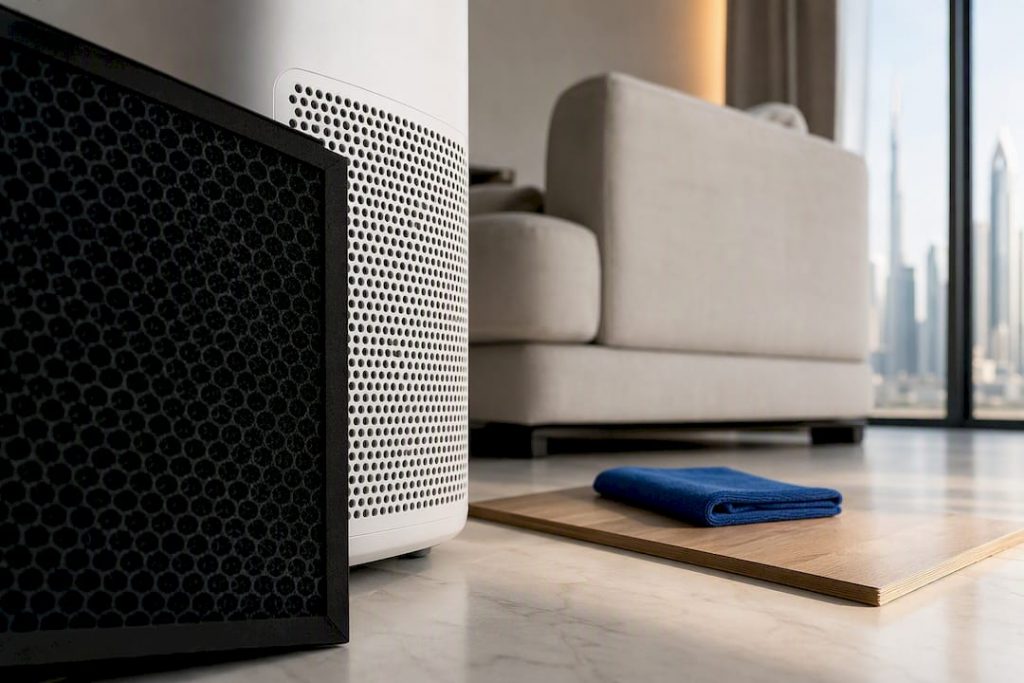
- Media quantity, not just media presence. Many budget units include a thin carbon-coated pre-filter that weighs a few grams. That’s enough to dull mild cooking smells, not enough to handle sustained off-gassing from new flooring. Genuine gas-phase capacity is measured in hundreds of grams to a few kilograms of carbon in a dedicated cartridge. When a listing states a carbon weight, treat it as a real spec worth comparing; when it doesn’t state one at all, assume the media load is minimal.
- Airflow and CADR matched to your room. Clean Air Delivery Rate tells you how much filtered air a unit produces per minute, and it needs to match your room’s volume to hit a useful number of air changes per hour. A general guide is 2 to 3 air changes per hour for a bedroom and slightly higher for busier living spaces. Working out the right CADR figure for your room size is worth doing before you compare specific models, because an undersized unit in a large room will underperform its lab rating badly.
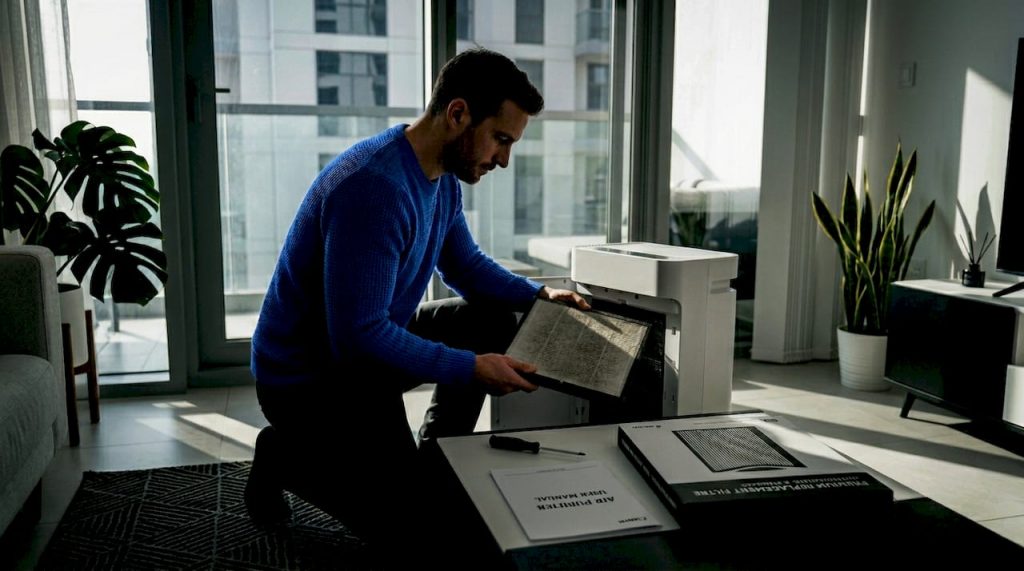
- Filter configuration and how it’s serviced. Some units use a single combined filter (HEPA and carbon fused together), which is convenient but means you’re paying to replace particle filtration even when only the carbon is exhausted. Others use a dedicated gas cartridge you can swap independently. For heavy VOC sources, a separate, replaceable carbon cartridge is generally the more cost-effective long-term setup.
- No ozone, ever. Ionisers and “ozone generators” marketed as VOC solutions are not a legitimate gas-phase technology for home use; ozone itself is a lung irritant, and some of these devices produce it at levels that create a new indoor air problem while doing little to remove the VOCs you started with. Choosing HEPA purifiers without ozone output is a baseline safety filter to apply before you even look at CADR numbers.
- Total cost of ownership. A cheap unit with a tiny carbon cartridge that needs replacing every six weeks can cost more over two years than a pricier unit with a substantial cartridge rated for six to twelve months. Factor in what running an air purifier actually adds to your electricity bill alongside filter costs when comparing options.
Pro Tip: Search the product listing for the word “carbon” and see if a weight in grams or kilograms appears anywhere nearby. If it doesn’t, the unit almost certainly isn’t built for serious VOC reduction, no matter how the title describes it.
Media quality and correct staging matter as much as raw carbon mass. A large amount of low-grade carbon impregnated incorrectly, or positioned after a dense HEPA stage that restricts airflow too much, can underperform a smaller but well-designed cartridge. This is one reason independent testing bodies matter more than spec sheets alone; Consumer Reports’ product testing exists precisely because lab-rated capacity and real-world performance don’t always match, and cross-checking a model against independent reviews before buying is a sound habit for anyone spending real money on this category.
How do you match purifier capacity to your room and VOC source?
Buying the right unit is a measurement exercise, not a guessing game, and it takes four steps.
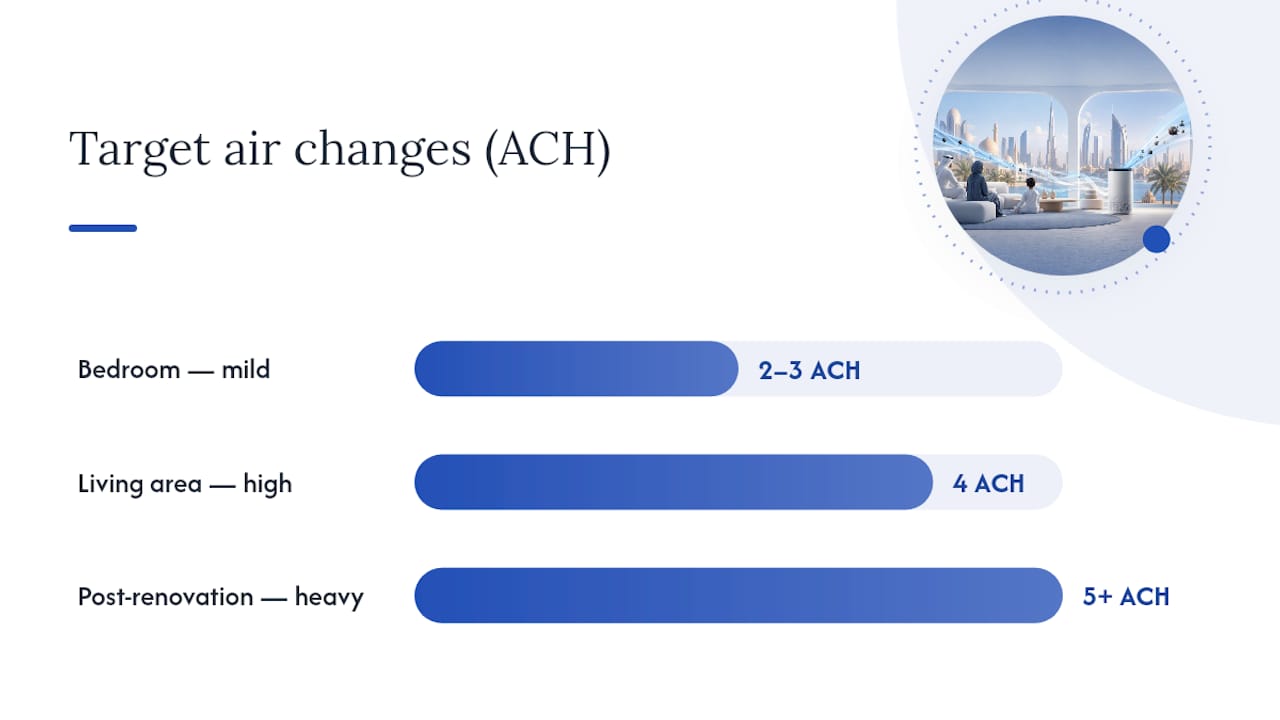
Step 1: measure the room and work out your target air changes. Multiply length by width by ceiling height to get room volume in cubic metres. A bedroom with mild, ongoing VOC exposure (an older mattress, general household products) typically needs 2 to 3 air changes per hour. A living area with a fireplace, gas cook top, or frequent cleaning product use benefits from being closer to 4. A room recovering from a heavy VOC source, fresh paint, new carpet glue, post-renovation off-gassing, needs considerably more, often 5 or more air changes per hour until the initial off-gassing spike subsides.
Step 2: pick media capacity based on how intense and how persistent the source is. An intermittent source, someone frying food twice a week, occasional solvent-based cleaning, doesn’t demand the largest cartridge on the market; moderate carbon capacity with decent CADR handles it fine. A continuous source, new engineered flooring throughout an entire apartment, calls for the largest practical carbon load you can fit, because the off-gassing curve for materials like this can run for weeks rather than hours.
Step 3: place the unit close to the source, not just anywhere convenient. VOCs disperse from their source before diluting into the wider room, so a unit placed near new furniture or a freshly finished surface intercepts a much higher concentration than one pushed against a far wall. In open-plan living areas, position the purifier between the source and the space you spend the most time in, rather than assuming one unit in a corner will handle a large connected floor plan evenly.
Step 4: treat purification as one layer, not the whole solution.
- Open windows and use extractor fans whenever you can, particularly in the first 48 to 72 hours after painting, gluing, or installing new furnishings, when off-gassing rates are at their peak.
- Run the purifier continuously during heavy off-gassing periods rather than intermittently, since carbon needs sustained airflow contact to keep adsorbing effectively.
- If odours persist for weeks despite ventilation and a properly sized purifier, or if you’re dealing with a known chemical spill or industrial-grade adhesive, that’s the point to bring in an indoor air quality professional rather than buying a bigger unit and hoping.
Combining source control, ventilation, and air cleaning consistently outperforms relying on any single measure, and real-world tests back this up: rooms that pair a properly sized purifier with even modest additional ventilation show substantially larger drops in measured VOC concentration than rooms using filtration alone. A purifier compensates for limited ventilation; it doesn’t replace opening a window when you actually can.
How long do VOC filters last and what should you budget?
Activated carbon’s capacity to adsorb VOCs is finite, and once every pore in the structure is occupied, the cartridge stops working even though it might look and smell fine from the outside. This is fundamentally different from a HEPA filter, which fails visibly (it gets clogged with visible dust) rather than invisibly.
Several factors shorten carbon life faster than expected. High humidity competes with VOC molecules for space on the carbon’s surface, which is part of why environmental conditions measurably affect adsorption performance in field studies, humid climates genuinely burn through carbon capacity faster than dry ones. Elevated temperatures also reduce how strongly VOC molecules bind to the carbon surface, letting some re-release back into the air. And obviously, a heavier VOC load, a home undergoing renovation, versus a stable, low-emission household, exhausts a cartridge far sooner.
Typical carbon cartridges last anywhere from three to twelve months under normal household conditions, though units serving spaces with heavy or continuous VOC sources may need replacement closer to the three-month end of that range. The clearest sign a cartridge is exhausted is the return of a smell the purifier had previously eliminated; if an odour that disappeared weeks ago starts creeping back, the carbon has likely reached saturation rather than the unit malfunctioning.
Annual running cost has three components worth budgeting separately:
- Replacement carbon cartridges, which vary widely in price depending on cartridge size and how frequently your household’s VOC load requires swaps.
- Electricity, which is modest for most residential units but adds up when a purifier runs continuously during heavy off-gassing periods, detailed further in this running-cost breakdown.
- Occasional servicing or deep cleaning of the unit housing and fan, particularly in dusty environments where particle buildup can restrict airflow to the carbon stage.
For persistent problems that don’t resolve with ventilation, a properly sized purifier, and fresh cartridges, home instinct alone won’t tell you whether the issue is genuinely gone or just below your nose’s detection threshold. That’s the point to consider proper VOC testing rather than continuing to guess.
How do you test and measure VOC levels indoors?
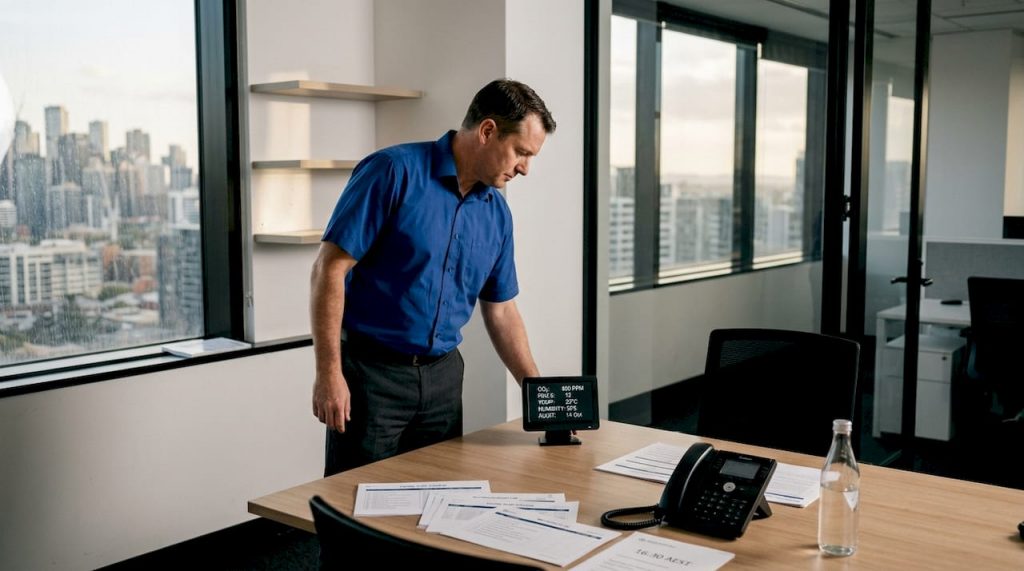
Consumer-grade VOC meters use a sensor called a metal-oxide or photoionisation detector to give you a rough total VOC reading, usually displayed as a single number on a small handheld or plug-in device. These are useful for tracking relative change (did the number drop after I opened windows and ran the purifier for a week?) but they typically can’t tell you which specific compound is present, and their accuracy varies a fair amount between brands and price points.
DIY test kits, the kind you order online, expose an absorbent badge or tube to your indoor air for a set period, then mail it to a lab for analysis. These give you actual identified compounds and concentrations rather than a vague single number, which matters if you’re trying to work out whether formaldehyde specifically is the issue or something else entirely.
Professional testing goes further again, typically involving calibrated equipment and, for serious cases, an indoor air quality consultant who can pinpoint the source rather than just the symptom. This level of testing costs more and takes longer to arrange, but it’s the right call when a consumer meter keeps flagging elevated readings despite ventilation and filtration, or when a health-vulnerable household member is experiencing ongoing symptoms with no obvious cause. For most households, a decent consumer meter paired with common sense about known VOC sources (new furniture, recent renovation, chemical storage) covers the practical need.
What certifications matter for VOC removal claims?
Certification labels tell you a purifier has been independently tested against a defined standard rather than just marketed with unverified claims, and a small number of them are worth actually checking for.
AHAM (the Association of Home Appliance Manufacturers) issues CADR ratings through standardised testing, which is where the airflow figures discussed earlier in this guide come from. An AHAM-verified CADR number is far more trustworthy than a manufacturer’s own unverified airflow claim, because it comes from a consistent, repeatable test protocol rather than in-house marketing figures.
CARB (California Air Resources Board) certification specifically addresses ozone emissions, confirming a unit doesn’t produce ozone above a defined safety threshold. Given how many ionising and “plasma” devices on the market do generate measurable ozone while marketing themselves as air quality solutions, CARB certification (or an equivalent no-ozone confirmation) is one of the simplest filters you can apply when shortlisting products.
Neither certification directly measures VOC removal capacity itself, which is the gap most shoppers don’t realise exists. A unit can carry a CARB certification for ozone safety and an AHAM CADR rating for particles, and still lack any meaningful gas-phase media at all. This is exactly why checking carbon mass and media type directly on the listing, rather than relying on certification badges alone, remains the more reliable signal for VOC-specific performance.
When should you buy a purifier versus just ventilating?
The honest answer is that most households need both, applied in the right order and for the right situation, and getting that sequencing wrong is where people waste money.
If you’ve just painted a room, installed new flooring, or brought home furniture that still smells strongly of adhesive or finish, ventilation is your first move, not a purifier. Off-gassing from these sources tends to be most intense in the first few days and tapers over weeks, so opening windows and running extractor fans during that initial period does more good per dollar than any purifier could. Buying a purifier at that stage is reasonable as a supplement, particularly if you can’t ventilate as much as you’d like, but it shouldn’t be the only response.
Where a purifier earns its place is in the ongoing, harder-to-ventilate situations: apartments in dense urban buildings with limited window access, homes near busy roads where opening windows brings outdoor pollution in, households with a family member sensitive to chemical odours, or spaces with a persistent low-level source that ventilation alone never fully clears. In these cases, a properly sized unit with genuine gas-phase media running continuously does something ventilation on its own can’t sustain.
Prolonged exposure to indoor VOCs has been linked to respiratory and other health outcomes in systematic reviews of the topic, which is worth taking seriously if anyone in the household has asthma, allergies, or chemical sensitivity, and it’s a reasonable argument for erring toward action rather than waiting to see if a smell fades on its own. Some retailers offer units and replacement cartridges chosen specifically for gas-phase capability, along with local warranty support for easier service. That doesn’t replace opening a window during a renovation. It does mean the purifier you eventually buy is one actually built for the job.
— Nevel
Where to start if you need a VOC-capable purifier now
Certain sellers provide purifiers selected for genuine gas-phase performance, not just a HEPA badge and marketing claims, with local delivery and warranty handling in the UAE. Local support can be important for timely replacement of carbon cartridges or servicing, avoiding lengthy international return processes.

If you’re ready to shortlist a model, a few starting points make the search faster:
- Browse the full air purifiers category to compare units with genuine carbon capacity against your room size and VOC source.
- Check the filters category for replacement cartridges once you know which model you’re running, so budgeting the ongoing cost isn’t a surprise later.
- Look at the Honeywell Air Touch P2, priced at AED 705, as an example of a consumer unit built with combined particle and gas-phase filtration for a mid-sized room.
For anyone running a commercial kitchen alongside residential VOC concerns, extraction hardware like the Unox Pure Filter handles grease and cooking byproducts at the source, complementing rather than replacing indoor gas-phase purification. Start with the room that smells the worst, match the unit to that space’s volume, and go from there.
Sources
- Consumer Reports — product testing and ratings
- Systematic review: indoor PM2.5, VOCs and asthma outcomes (ECEHH — 2023)
FAQ
What Does VOC Mean for an Air Purifier?
VOC stands for volatile organic compound, a category of carbon-based gases released by paints, furniture, cleaning products, and adhesives. A “VOC air purifier” refers specifically to a unit with gas-phase media, usually activated carbon, capable of adsorbing these gases, as opposed to standard particle-only filtration.
How Can I Remove VOCs From the Air?
The most reliable combination is ventilation (opening windows, using extractor fans) alongside a purifier that carries substantial activated carbon or chemisorbent media, since combining source control with air cleaning produces far larger reductions than either measure alone. Reducing the source itself, such as letting new furniture off-gas in a garage before bringing it indoors, also helps considerably.
Is VOC Exposure Harmful to Humans?
Prolonged exposure to elevated indoor VOC levels has been linked to respiratory issues and other health outcomes in systematic reviews, particularly for people with asthma or chemical sensitivities. Short-term exposure to strong sources like fresh paint typically causes milder symptoms such as headaches or eye irritation that ease once the air clears.
Which Air Purifier Is Best for Removing VOCs?
The best VOC air purifier for your situation is whichever unit combines substantial activated carbon or chemisorbent media with airflow matched to your room size, rather than any single named model. Climatepro’s air purifier range includes units like the Honeywell Air Touch series, chosen specifically for combined particle and gas-phase filtration suited to UAE homes.