
Yes, you can use a purifier with a humidifier at the same time, and doing so often improves indoor comfort more than running either device alone. The key is control: keep relative humidity in a moderate range with a humidistat, position the units at least a couple of meters apart, and check filters more often than you would with a single device.
TL;DR:
- Using a purifier and humidifier together is safe and can improve indoor comfort, but humidity must be kept between 40-50% to prevent mold and dust mites.
- Keep devices at least two meters apart, with the humidifier pointing away from the purifier, and monitor room humidity with a simple hygrometer.
- Ultrasonic humidifiers add mineral dust unless using distilled water, while evaporative models produce less particulate but require regular wick replacement.
- Adjust the purifier’s fan speed for 10-15 minutes after humidifier use to clear residual mist and avoid filter dampness or musty odors.
- Consider a combined purifier and humidifier for small spaces, but be aware that separate units offer more flexibility and lower risk of simultaneous failure.
Table of Contents
- Why humidity levels change how well your purifier works
- Safe rules for running both devices at once
- Placement and airflow: keeping mist away from the intake
- Choosing a humidifier that won’t clog your purifier’s filter
- Keeping both devices maintained: a schedule that actually works
- Warning signs that mean you need to act now
- Should you buy a combined purifier and humidifier unit instead?
- What most people get wrong about running these together
- Where to find compatible purifiers, humidifiers and genuine filters
- Sources
- FAQ
Why humidity levels change how well your purifier works
Air isn’t just air. Its moisture content changes how particles behave, how filters perform, and how easily mould and dust mites take hold.
Higher humidity makes small airborne particles clump together and settle out of the air faster, which sounds like a win for a purifier. But push relative humidity too high and you create a different problem: mould, mildew and dust mites thrive above roughly 60%, while the Lawrence Berkeley National Laboratory’s indoor air quality research links controlled humidity directly to reduced dust mite allergen exposure. The sweet spot sits well below that threshold.

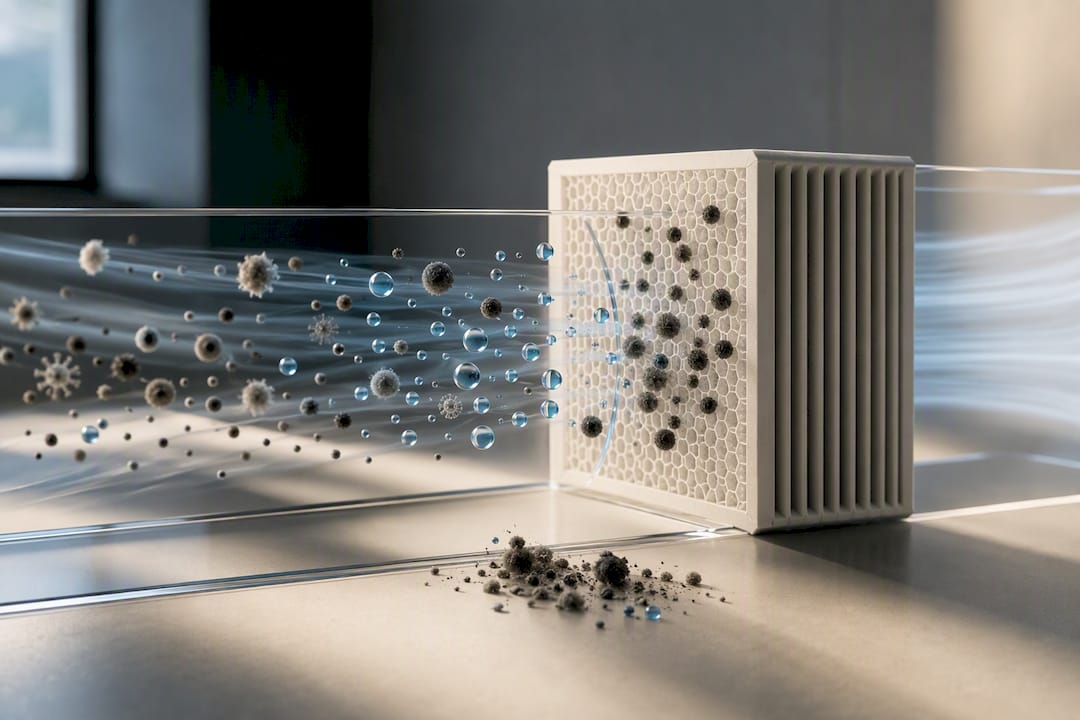
There’s a mechanical issue too. A HEPA filter that absorbs stray moisture from a nearby humidifier loses efficiency and can develop a musty smell as trapped fibres turn damp. Ultrasonic humidifiers add another wrinkle: they vibrate water into a fine mist without heating it, and if that water isn’t distilled, minerals travel with the mist and settle as a fine white dust on nearby surfaces, including your purifier’s prefilter. Research on humidifier particulate emissions confirms this mineral aerosol is a genuine air quality consideration, not a cosmetic nuisance.
The US EPA’s indoor air quality guidance recommends keeping indoor humidity moderate specifically to avoid moisture damage and microbial growth, while Mayo Clinic’s overview of humidifiers stresses that any comfort benefit depends on regular cleaning. Two things happen when RH is well managed:
- Airborne allergens and dry-air irritation both drop, easing symptoms for people with asthma or sinus issues.
- Filter life extends because the media stays dry and doesn’t clog with mineral residue.
Statistic callout: Authoritative guidance converges on 40 to 50% relative humidity as the practical middle ground, high enough to ease dry skin and airways, low enough to keep mould and mites in check.
Safe rules for running both devices at once
Getting the balance right isn’t complicated once you have a routine. These are the operating rules that prevent most of the problems people run into.
- Set a humidistat target of moderate RH levels. Most modern humidifiers include this feature; if yours doesn’t, buy a standalone hygrometer and treat 55% as your hard ceiling.
- Keep the purifier running continuously on a low or medium fan setting. Cycling it on and off lets humidity and particle levels swing more than they need to.
- Boost the purifier’s fan speed for 10 to 15 minutes after each humidifier cycle. This clears any residual mist or mineral aerosol from the air before it has a chance to settle on the intake.
- Watch for condensation on windows, damp patches on the purifier’s prefilter, or a musty smell. Any of these means you stop humidifying immediately and work through the troubleshooting steps.
- Reassess your setup seasonally. A room that needs humidification in a dry, air-conditioned winter may need none at all once conditions change.
The transmission-risk research is worth noting here too: a scientific review on humidity and respiratory infection links moderately controlled humidity with reduced viral persistence, as described in scientific research in aerosols, which is one more reason a moderate humidity band matters beyond comfort alone.
Pro Tip: Buy a cheap digital hygrometer and place it roughly halfway between the two devices, not right next to either one. A reading taken directly beside the humidifier will always look artificially high.
Placement and airflow: keeping mist away from the intake
Where you put each device matters as much as how you run it. The goal is simple: let the humidifier’s mist fully disperse into the room’s air before it ever reaches the purifier’s intake.
- Keep the two units at least a couple of meters apart, and stagger their height where the room allows (one on a shelf, one on the floor, for example).
- Point the humidifier’s mist outlet away from the purifier, not toward it.
- Avoid placing them directly opposite each other, especially in a narrow hallway or small ensuite where airflow has nowhere to go.
- In a bedroom, put the purifier near the door where air circulates and the humidifier near the centre of the room, away from soft furnishings that trap moisture.
- In a living room, position the purifier where it can draw air from the whole space, and keep the humidifier off to one side rather than in a direct sightline.
- In a nursery, prioritise distance over anything else. Cot-adjacent placement is common for humidifiers, but the purifier belongs on the opposite wall.
A ClimatePro UAE guide on air purifier placement covers airflow patterns in more detail if your layout is unusual, such as an open-plan living and dining area or a room with a single small window for ventilation.
Choosing a humidifier that won’t clog your purifier’s filter
Not all humidifiers create the same maintenance burden. The technology behind the mist determines how much extra cleaning your purifier will need.
- Ultrasonic humidifiers are quiet and energy efficient, but they aerosolise whatever is in the water tank. Hard tap water means mineral dust in the air. Use distilled water or a demineralisation cartridge to cut this risk substantially, a point backed by research into humidifier particulate emissions.
- Evaporative humidifiers pull water through a wick and rely on airflow to release moisture, which produces far less particulate output. They’re more forgiving with tap water, though the wick itself needs regular replacement.
- Warm-steam humidifiers boil water before releasing vapour, killing most microbes in the process, but they use more electricity and pose a burn risk around children.
Whatever type you choose, look for a model with a built-in humidistat and adjustable output.
Pro Tip: If you’ve got hard water and no interest in buying distilled water regularly, an evaporative humidifier will save you a lot of hassle over an ultrasonic one.
Keeping both devices maintained: a schedule that actually works
Running two devices means twice the maintenance, but the schedule doesn’t need to be complicated.
- Check the purifier’s prefilter weekly. This is the first line of defence against dust and any mineral residue, and it’s the cheapest, fastest thing to inspect.
- Inspect the HEPA and carbon stages every two to three months, sooner if you notice discolouration, a musty smell, or reduced airflow.
- Clean the humidifier tank every few days, and follow the manufacturer’s schedule for wick or filter replacement, generally every one to three months depending on water hardness.
- Use distilled water in ultrasonic units to prevent scale buildup inside the tank as well as mineral dust in the room.
- Log your hygrometer reading 30 to 60 minutes after any change, whether that’s a new humidifier setting, a new room layout, or a new season. This confirms your adjustment actually landed in the 40 to 50% target rather than overshooting it.
ClimatePro UAE’s maintenance guide for homeowners sets out filter replacement intervals by device type if you want specifics. A weekly visual check takes under a minute and catches most problems before they become expensive ones.
Warning signs that mean you need to act now
A handful of symptoms tell you the balance between the two devices has tipped the wrong way. None of them require panic, but all of them need a same-day response.
- Visible dampness or a soft, wet feel on the purifier’s prefilter.
- Condensation forming on windows, mirrors, or interior walls near either device.
- A persistent musty or mildew smell in the room, even after airing it out.
- Noticeably reduced airflow from the purifier, or an error alert on models fitted with sensors.
If you spot any of these, switch the humidifier off first. Dry the affected filter in open air, or replace it if it’s been wet for more than a few hours, since damp HEPA media doesn’t fully recover. Run the purifier on its highest fan setting for an hour to clear residual moisture, and open a window if outdoor air quality allows. Persistent issues, or anything that looks like mould growth inside the purifier housing, are worth raising with the manufacturer or with ClimatePro UAE’s support team for model-specific advice rather than guessing.
Should you buy a combined purifier and humidifier unit instead?
An integrated device solves the placement problem outright, because there’s only one airflow path to manage instead of two. Units like the Blueair 2-in-1 Purify + Humidify DH3i and the Dyson Purifier Humidify+Cool Autoreact PH03A pair matched fan and humidistat controls in a single footprint, which suits smaller apartments or anyone who doesn’t want two appliances competing for shelf space.
The trade-off is redundancy. If one function fails, you lose both, and servicing an integrated unit can cost more than replacing a single component in a separate device.
- Pros: one sealed airflow path, synchronised controls, smaller footprint, fewer cables and plugs.
- Cons: a single point of failure, potentially higher repair costs, less flexibility in where you place each function.
A 2-in-1 makes sense when floor space is tight and convenience matters more than granular control. Separate devices make more sense in larger rooms where you want to position each unit for its own optimal airflow.
What most people get wrong about running these together
The mistake I see most often isn’t a mechanical one. It’s assuming that because both devices are “good for air quality,” running them in the same corner of a room at full output all day is automatically fine. It isn’t. The interaction between moisture and filtration is where most of the damage happens, quietly, over weeks rather than days.
The single habit that prevents nearly every problem covered here is cheap and unglamorous: keep a small hygrometer in the room and check it after any change to either device. Not a smart sensor, not an app, just a $10 dial or digital readout. Most support queries about mouldy filters or ineffective humidifiers trace back to nobody actually knowing what the room’s RH was doing.
If you’re unsure whether a specific model pairing will work in your space, you can seek advice on capacity and placement for your room size before you buy anything.
— Nevel
Where to find compatible purifiers, humidifiers and genuine filters
Getting the pairing right starts with choosing devices sized correctly for your room, and that’s where a lot of DIY research runs into trouble. There are local providers offering genuine replacement filters and assistance to match a device’s coverage rating to your actual room size before purchase.

Browse the air purifier range or the humidifier catalogue to compare capacity and humidistat features side by side. If you already own a unit and need genuine replacement filters rather than generic third-party media, that’s worth checking before your current filter shows any of the warning signs covered above. Delivery may be available across multiple locations in the UAE, so wherever you’re setting up, consider contacting providers to confirm the right model for your room before you commit to a purchase.
Sources
- Care for your air: A guide to indoor air quality (US EPA)
- Humidifiers: Do they help? (Mayo Clinic)
- Humidity and dust‑mite allergies (Lawrence Berkeley National Laboratory IAQ Science)
- Scientific review on humidity and respiratory transmission (PMC)
- Study discussing particulate emissions and health impacts related to humidifiers (PMC)
FAQ
Can you use an air purifier with a humidifier?
Yes.
Is it good to use an air purifier and humidifier together?
It can improve comfort and air quality simultaneously, easing dry air symptoms while the purifier keeps particle levels down, provided humidity stays controlled and does not become too high to encourage mould.
Which is better: a humidifier or a purifier?
They solve different problems. A purifier removes particles, allergens and odours from the air, while a humidifier adds moisture to ease dryness, so most homes benefit from having both rather than choosing one over the other.
Do you need an air purifier if you have a humidifier?
A humidifier doesn’t remove dust, pollen or smoke, so if particle pollution or allergies are a concern, a purifier still does a job the humidifier can’t. Options like the Blueair 2-in-1 Purify + Humidify DH3i combine both functions if you’d rather run one device instead of two.