
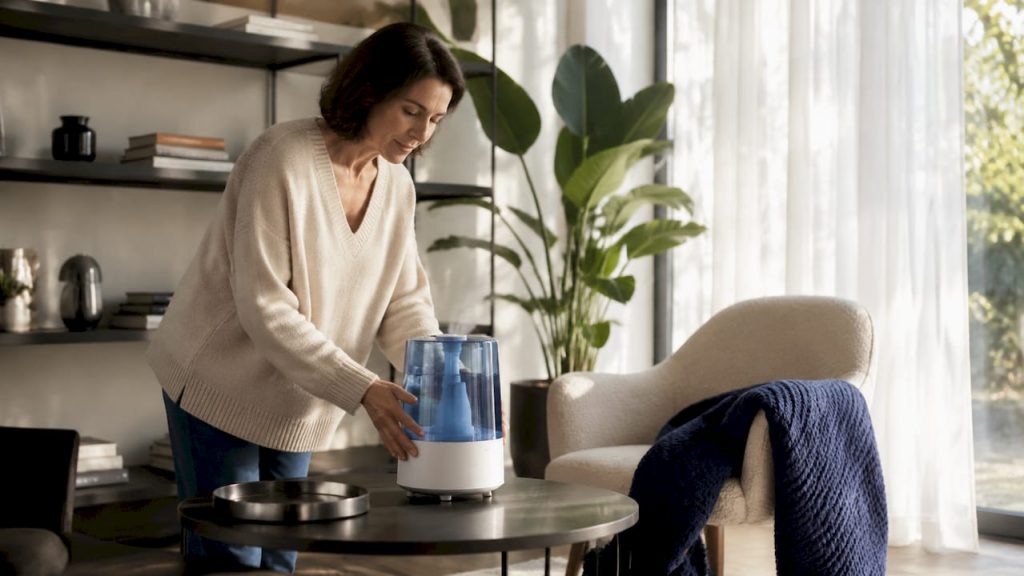
Ultrasonic humidification is defined as the process of converting water into a fine cool mist using piezoelectric transducers that vibrate at frequencies above 1.5 million times per second. No heat is involved, which makes this technology quieter, safer, and more energy-efficient than steam-based alternatives. Products like the Levoit Classic 300S and the Blueair InvisibleMist H35i have brought ultrasonic technology into mainstream homes, offering instant mist output and near-silent operation. For homeowners and renters dealing with dry indoor air, cracked skin, or irritated airways, understanding how this technology works and how to use it correctly makes a real difference to comfort and health.
How does ultrasonic humidification work?
Ultrasonic humidification relies on a piezoelectric transducer, a small ceramic disc that vibrates at frequencies above 1.5 million Hz to break water into microscopic droplets. These droplets are so fine they appear as a visible cool mist, which a small fan then disperses into the room. Because no heating element is required, the unit draws very little power and produces almost no noise during operation.

The quality of the mist depends on several variables. Water quality is the most significant factor. Hard tap water contains dissolved minerals that the transducer atomises along with the water, releasing fine white particles into the air. Droplet size is controlled by the frequency and power of the transducer, and most consumer-grade units produce droplets in the 1–5 micrometre range. Placement also affects performance. A unit positioned too close to walls or furniture will wet surfaces rather than humidify the air.
Common features found on modern ultrasonic cool mist humidifiers include:
- Adjustable mist output levels to match room size and personal comfort
- Large water reservoirs (typically 3–6 litres) for extended run times
- Auto shut-off when the tank runs dry, preventing motor damage
- 360-degree mist nozzles for flexible directional output
- Built-in hygrometers on smart models to maintain a target humidity level automatically
Pro Tip: If you notice a fine white powder settling on furniture near your humidifier, your transducer is atomising tap water minerals. Switch to distilled water immediately to stop the issue at its source.
Ultrasonic vs other humidifier types: benefits and drawbacks
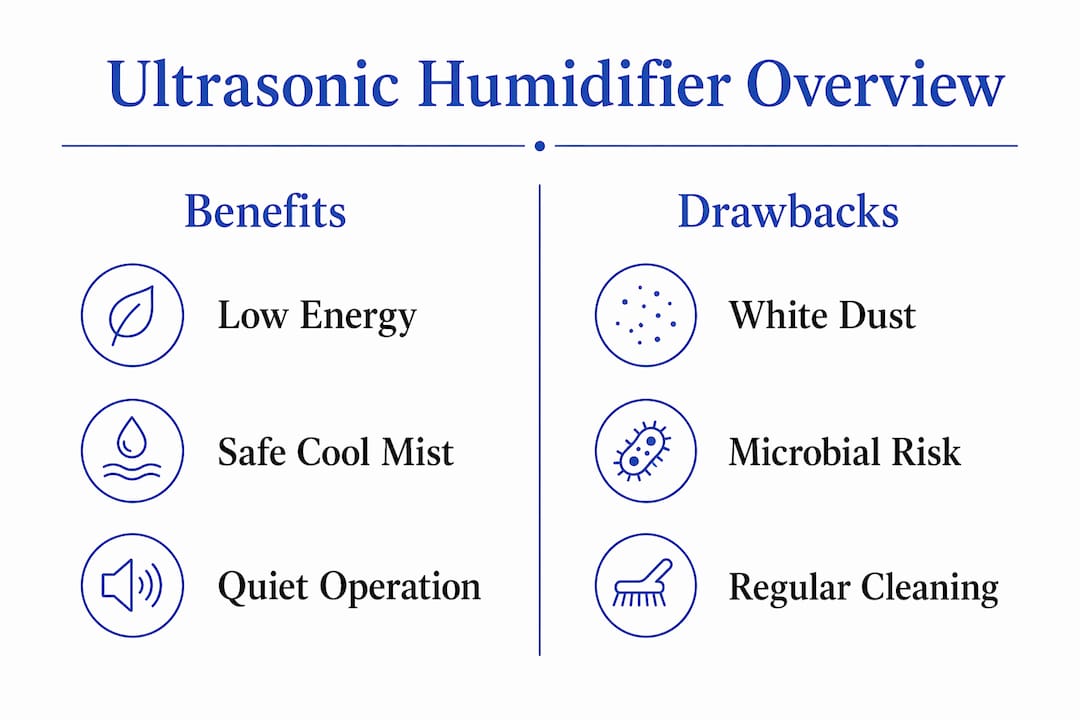
Ultrasonic humidifiers consume significantly less energy than steam humidifiers and deliver instant mist without any warm-up period. That combination of low running cost and immediate output makes them the most practical choice for everyday home use. Steam humidifiers must boil water continuously, which draws considerably more electricity and introduces a burn risk if the unit is knocked over.
Safety is a clear advantage for cool air mist humidifiers. Cool mist is safer around children and pets than warm mist, because there is no hot water or steam that can cause scalding. Warm mist models may feel more soothing for colds and congestion, but the safety trade-off is significant in family homes. Ultrasonic humidification is also ideal for temperature-sensitive environments such as nurseries and home offices, because the mist adds moisture without raising room temperature.
The main drawbacks are white dust and microbial risk. Tap water minerals become airborne particles when atomised, settling on surfaces as a fine white residue. Without regular cleaning, the water tank and transducer can harbour bacteria and mould, which then disperse into the air you breathe.
| Humidifier Type | Energy Use | Safety | Noise | Maintenance |
|---|---|---|---|---|
| Ultrasonic cool mist | Low | High (no heat) | Near silent | Daily cleaning required |
| Warm mist / steam | High | Lower (hot water) | Moderate | Weekly descaling |
| Evaporative | Medium | High | Moderate fan noise | Filter replacement needed |
| Warm and cool mist (dual) | Medium to high | Moderate | Low to moderate | Cleaning plus filter checks |
Pro Tip: A warm and cold humidifier that offers both modes gives you flexibility, but the warm mist setting still carries heat risks. Keep it on cool mist mode when children or pets are in the room.
How to maintain an ultrasonic humidifier safely
Maintenance is the most overlooked aspect of owning an ultrasonic humidifier. Daily cleaning prevents the tank from becoming a source of airborne mould and bacteria, despite many products being marketed as low-maintenance. A neglected tank can actively worsen indoor air quality rather than improve it.
Follow these steps to keep your unit safe and performing well:
- Empty and rinse the tank daily. Do not leave standing water in the reservoir between uses. Stagnant water is where bacteria multiply fastest.
- Clean the tank every three days. Use a diluted white vinegar solution to remove mineral scale from the tank walls and transducer disc. Rinse thoroughly before refilling.
- Use distilled or demineralised water. Distilled water prevents white dust and reduces the mineral load on the transducer, extending the unit’s working life.
- Place the unit on a table or shelf. Elevated placement allows mist droplets to evaporate fully before reaching the floor, preventing damp patches on carpet or timber surfaces.
- Disinfect weekly. A small amount of 3% hydrogen peroxide solution left in the tank for 30 minutes, then rinsed out, kills residual bacteria and mould spores effectively.
- Inspect the transducer disc monthly. Mineral scale on the disc reduces mist output. A soft cloth dampened with white vinegar removes buildup without scratching the surface.
Improper cleaning and tap water use can disperse microorganisms and cause lung inflammation. That risk is entirely preventable with a consistent cleaning routine and the right water source.
Pro Tip: Buy distilled water in bulk from a supermarket or pharmacy. The cost is minimal compared to the health and maintenance benefits, and it eliminates white dust entirely.
What to look for when choosing an ultrasonic humidifier
The right ultrasonic humidifier depends on your room size, lifestyle, and how much maintenance you are willing to do. Choosing based on price alone often leads to a unit that is either underpowered for the space or difficult to clean properly.
Key factors to consider:
- Room coverage. Match the humidifier’s rated coverage area to your room size. A unit rated for 20 square metres will struggle in a 40-square-metre open-plan living area. Check the manufacturer’s specifications carefully.
- Filter vs filterless design. A cool mist humidifier with no filter is easier to maintain and has no ongoing filter replacement cost. However, filterless models rely entirely on water quality and cleaning frequency to stay hygienic. Filtered models add a layer of protection against mineral and microbial output.
- Smart controls and automation. Models like the Levoit Classic 300S include app control, scheduling, and auto-humidity modes that maintain your target level without manual adjustment. These features are worth the price premium for busy households.
- Tank capacity and run time. A 4-litre tank running at medium output typically lasts 10–12 hours. If you want overnight operation without refilling, look for tanks of 4 litres or larger.
- Noise output. Most ultrasonic units operate below 30 decibels, which is quieter than a whisper. Check the decibel rating if you plan to use the unit in a bedroom or nursery.
- Energy efficiency. Ultrasonic models typically draw 20–30 watts, compared to 200–400 watts for steam humidifiers. Running cost over a year is substantially lower, which matters if the unit runs daily.
A humidifier for dry air in the UAE context also needs to account for the region’s extremely low ambient humidity, which means a higher-capacity unit will cycle on more frequently than it would in a temperate climate. Size up rather than down when in doubt.
Key takeaways
Ultrasonic humidification delivers the best balance of energy efficiency, safety, and quiet operation, but its performance depends entirely on consistent cleaning and the use of distilled water.
| Point | Details |
|---|---|
| Core technology | Piezoelectric transducers vibrate above 1.5 million Hz to produce cool mist without heat. |
| Safety advantage | Cool mist carries no burn risk, making it the safer choice for homes with children and pets. |
| Maintenance is non-negotiable | Daily rinsing and regular cleaning prevent bacterial and mould growth in the tank. |
| Water quality matters | Distilled water eliminates white dust and reduces mineral scale on the transducer. |
| Placement affects performance | Position the unit on a table or shelf so mist evaporates fully before reaching the floor. |
Why maintenance beats mist type every time
I have seen a lot of homeowners spend considerable time debating cool mist versus warm mist, when the real question they should be asking is how easy the unit is to clean. Experts consistently find that maintenance and water quality affect long-term satisfaction far more than mist temperature. Both cool and warm mist models deliver comparable moisture output when used correctly.
The mistake I see most often is treating an ultrasonic humidifier as a set-and-forget appliance. People buy a quality unit, use it for a few weeks, then stop cleaning it regularly because it still appears to be working. What they do not realise is that a dirty tank is actively dispersing bacteria into the air. The unit looks fine from the outside while the water reservoir has become a health risk.
My honest recommendation is to prioritise a model with a wide-mouth tank opening that is genuinely easy to clean by hand. Narrow-neck designs look elegant but make thorough cleaning difficult. If you cannot get your hand or a cleaning brush into the tank, you will not clean it as often as you should.
Pairing an ultrasonic humidifier with an air purifier and humidifier combination strategy gives you the most complete indoor air quality outcome. The humidifier addresses dryness; the purifier handles particulates, allergens, and any airborne contaminants the humidifier might inadvertently introduce if cleaning slips.
— Nevel
Find the right humidifier at Climatepro
Climatepro stocks a curated range of ultrasonic humidifiers suited to UAE homes, from compact bedroom units to larger models designed for open-plan living spaces. Whether you are looking for a filterless cool mist model, a smart humidifier with app control, or a combined purifier and humidifier unit, the range covers most household needs.

For homeowners who want to go beyond humidity control, Climatepro also carries a full selection of air purifiers in Dubai that complement ultrasonic humidifiers for a more complete indoor air quality setup. The Honeywell Air Touch P2 and the Blueair 2-in-1 Purify + Humidify DH3i are two strong options for those wanting purification and humidification in a single unit. Browse the full humidifier range or contact Climatepro’s team for product guidance tailored to your space.
FAQ
What is ultrasonic humidification?
Ultrasonic humidification uses a piezoelectric transducer vibrating at over 1.5 million times per second to convert water into a fine cool mist. No heating element is involved, making it energy-efficient and quiet.
Is cool mist or warm mist better for home use?
Cool mist is the safer choice for most homes, particularly those with children or pets, as it carries no burn risk. Warm mist may ease congestion symptoms, but the safety trade-off makes cool mist the more practical everyday option.
Why does my ultrasonic humidifier leave white dust on surfaces?
White dust is caused by mineral deposits from tap water being atomised and released into the air. Switching to distilled or demineralised water eliminates this issue entirely.
How often should i clean my ultrasonic humidifier?
The US EPA recommends rinsing the tank daily and performing a thorough clean every three days to prevent bacterial and mould growth. Neglecting this routine can turn the unit into a source of airborne pathogens.
Do ultrasonic humidifiers need filters?
Most ultrasonic cool mist humidifiers are filterless, which reduces ongoing maintenance costs. However, filterless models require more diligent cleaning and distilled water use to maintain safe air output.
Recommended
- Humidifier for dry air: your practical home guide — Blog | ClimatePro UAE
- Buy Levoit Classic 300S Ultrasonic Smart Humidifier in Dubai | Best Price AED 320 | ClimatePro UAE
- Buy Levoit Dual 150 Ultrasonic Cool Mist Humidifier in Dubai | Best Price AED 167 | ClimatePro UAE
- Home air quality improvement guide for UAE homeowners — Blog | ClimatePro UAE