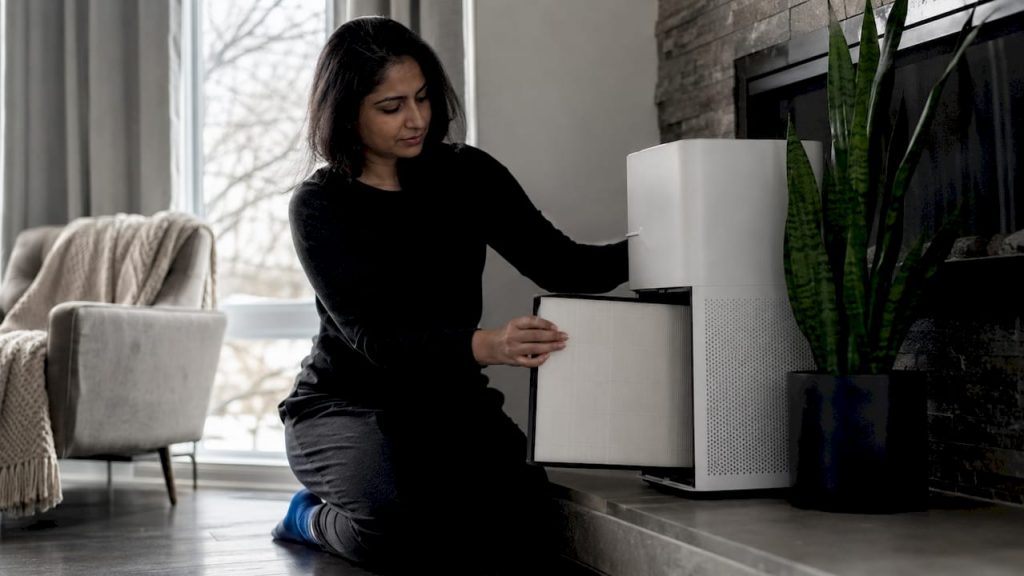
A pre-filter is defined as the first filtration stage in an air purification system, designed to capture large airborne particles before air reaches finer, more expensive downstream filters. Pre-filters trap particles 5 microns and larger, including dust, pollen, pet hair, and lint. This protective function is the core reason why pre-filters extend HEPA life by up to 40%, reducing how often you replace costly main filters. For homeowners and renters in dusty environments, understanding this function is the first step toward a cleaner, more cost-effective air quality system.
What is the role of pre-filters in air purification?
Pre-filters act as the system’s first line of defence, intercepting coarse particles that would otherwise clog and degrade the main filter. Without this stage, a HEPA filter faces the full burden of every particle in the air, from large dust clumps to fine allergens. That combined load accelerates wear and shortens the filter’s useful life significantly.
HEPA filters are 5–10 times more expensive than pre-filters. That cost difference makes the pre-filter one of the most economically important components in any air purification system. Protecting a more expensive filter with a cheaper one is straightforward logic, but many homeowners overlook it entirely.
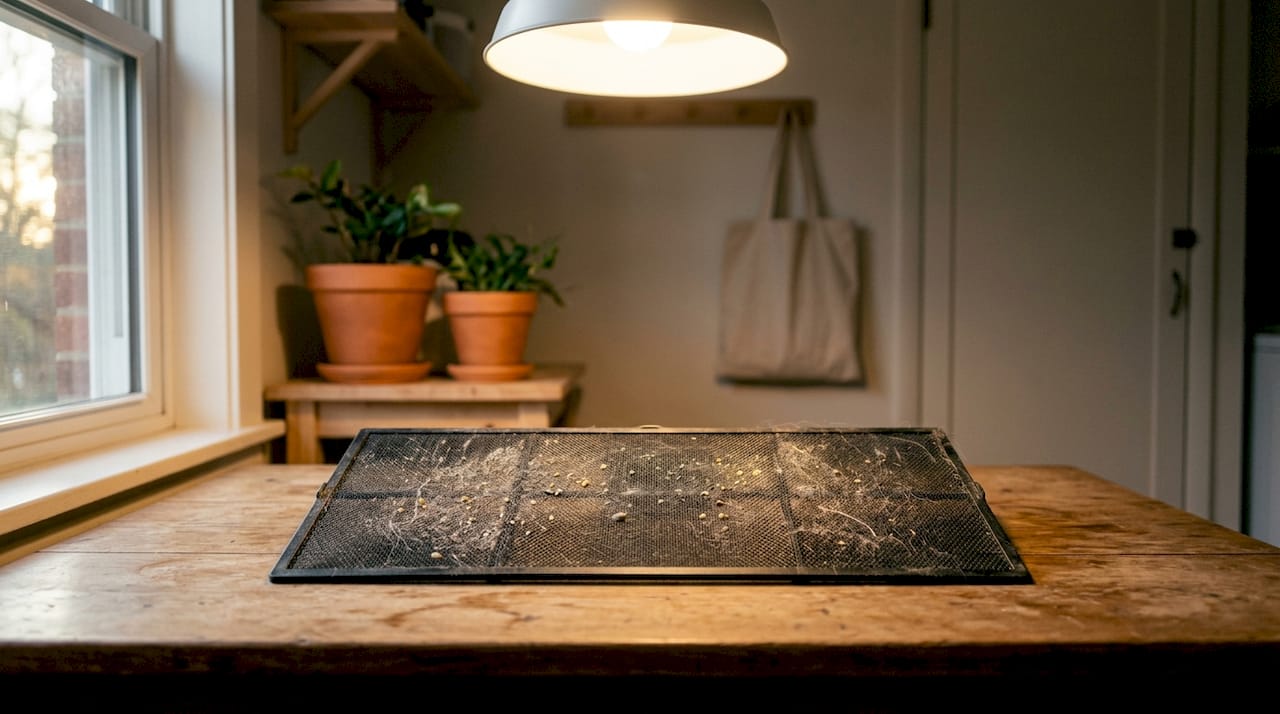
The industry term for this first stage is “primary filter” in commercial HVAC contexts, though “pre-filter” is the widely used term in residential air purification. Both refer to the same function: coarse particle capture upstream of finer filtration media. Climatepro stocks pre-filters compatible with a range of residential purifiers to support exactly this protective role.
How do pre-filters work and what particles do they capture?
Pre-filters use three mechanical capture methods to remove particles from passing air.
- Impaction: Larger particles travelling in the airstream cannot follow the air around filter fibres and collide directly with the media.
- Interception: Mid-sized particles follow the airflow path but make contact with a fibre as they pass close to it.
- Diffusion: Very small particles move erratically due to Brownian motion and contact fibres by chance rather than direction.
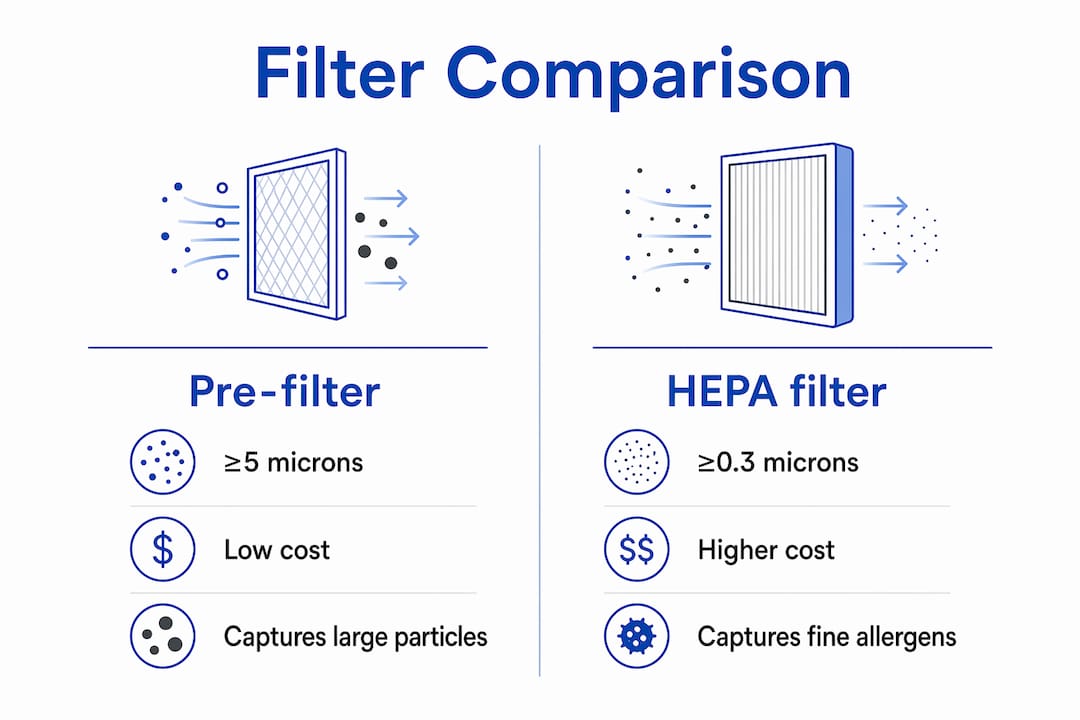
These mechanisms make pre-filters effective at capturing coarse particles 5 microns and larger. That size range covers visible dust, carpet lint, pollen grains, and pet hair. By contrast, HEPA filters are rated to capture particles as small as 0.3 microns, including fine allergens, smoke particles, and some pathogens.
Pre-filter materials vary by design. Synthetic fibre panels are common in residential purifiers because they balance airflow with particle capture. Foam and mesh variants are popular for washable pre-filters, where durability matters more than fine filtration. Each material type suits different dust loads and cleaning preferences.
Airflow resistance is a key consideration. Standard primary filters maintain an initial pressure drop of ≤55 Pa per the EN 779 standard, which keeps the fan motor working efficiently while still capturing coarse pollutants. Pre-filters are deliberately designed with lower resistance than HEPA filters to preserve overall system airflow.
What are the benefits of using pre-filters in your home air purifier?
The practical advantages of using a pre-filter are significant for any homeowner or renter running an air purifier regularly.
- Extended main filter life. Pre-filters capture large particles before they reach the HEPA stage, reducing HEPA loading and extending its service life by up to 40%. That translates directly into fewer replacements and lower annual costs.
- Lower energy consumption. A clean pre-filter maintains stable airflow through the system. Clogged pre-filters increase resistance, forcing the fan motor to work harder and draw more power. Keeping the pre-filter clean keeps energy bills lower.
- Simpler maintenance. Many pre-filters are designed to be vacuumed or washed rather than replaced. This makes routine upkeep quick and inexpensive compared to replacing a HEPA unit.
- Reduced purifier noise. A blocked pre-filter causes the motor to strain, which increases operating noise. Regular cleaning keeps the system running quietly.
- Odour reduction. Some pre-filters incorporate activated carbon media, which provides mild odour absorption alongside particle capture. This is particularly useful in kitchens or homes with pets.
- Consistent air quality. In homes with pets, carpets, or high foot traffic, pre-filters are essential to keep replacement costs manageable and maintain reliable air cleaning performance day to day.
Pro Tip: If you have a dog or cat, check your pre-filter every two weeks rather than monthly. Pet hair accumulates quickly and a blocked pre-filter will noticeably reduce your purifier’s airflow within days.
How to maintain and select the right pre-filter
Choosing and maintaining the correct pre-filter determines whether your air purification system performs as intended or degrades ahead of schedule.
Selecting the right pre-filter
- Match the pre-filter dimensions exactly to your purifier’s specifications. An improperly sized pre-filter either restricts airflow and strains the fan motor, or creates gaps that allow unfiltered air to bypass the media entirely.
- Choose the media type based on your household dust load. Synthetic fibre panels suit most homes. Foam or mesh variants suit high-dust environments where frequent washing is practical.
- If cooking odours or pet smells are a concern, select a pre-filter with an activated carbon layer for dual-function capture.
- Check compatibility with your specific purifier model before purchasing. Climatepro lists compatible pre-filters for models like the Honeywell Air Touch U2 and Blueair Blue Max 3350i, making it straightforward to find the correct fit.
Maintaining your pre-filter
- Inspect washable or vacuumable pre-filters every 2–4 weeks in heavily used systems or dusty homes.
- Replace disposable pre-filters every 1–3 months, depending on your dust load and the manufacturer’s guidance.
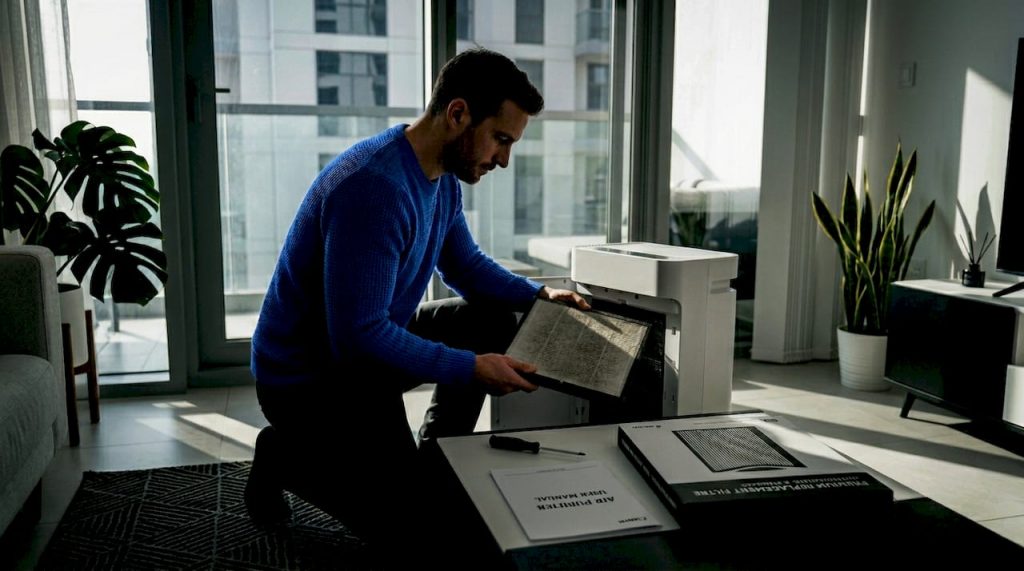
- When reinstalling a cleaned or new pre-filter, check that it seats firmly in the frame. Any gap around the edges allows dirty air to bypass the filter and reach the HEPA stage unfiltered.
- Neglecting the pre-filter is the most common cause of premature HEPA failure. Undersized or neglected pre-filters force downstream filters to handle tasks they are not designed for, causing early system fatigue and unexpected costs.
Pro Tip: Hold your pre-filter up to a light source after removing it. If you cannot see light through the media, it needs cleaning or replacement regardless of the time elapsed since the last service.
How do pre-filters and HEPA filters work together?
Pre-filters and HEPA filters form a sequential filtration system where each stage handles a specific particle size range. The pre-filter removes coarse particles 5 microns and larger. The HEPA filter then focuses on fine particulates down to 0.3 microns, including allergens, smoke, and microscopic dust. This division of labour is what makes the combined system effective.
The table below shows how the two filter stages differ in function and cost.
| Feature | Pre-filter | HEPA filter |
|---|---|---|
| Target particle size | ≥5 microns | ≥0.3 microns |
| Typical media | Synthetic fibre, foam, mesh | Dense fibre mat |
| Relative cost | Low | 5–10 times higher |
| Maintenance type | Washable or vacuumable | Replacement only |
| Primary function | Coarse particle capture | Fine allergen and pathogen removal |
Pre-filters and HEPA filters operate synergistically. The pre-filter reduces the particle load reaching the HEPA stage, which prevents premature clogging and maintains the HEPA’s efficiency over a longer service period. Without the pre-filter stage, the HEPA filter clogs faster and loses its rated efficiency sooner.
A common misconception is that a pre-filter alone provides adequate air cleaning. It does not. Pre-filters capture coarse particles but cannot remove fine allergens, bacteria, or smoke particles. Relying on a pre-filter without a downstream HEPA stage leaves the most health-relevant particles in circulation. For a deeper look at how HEPA filtration complements this process, Climatepro’s guide on HEPA filtration for UAE homes explains the full filtration sequence in detail.
The combined system also supports energy efficiency. A well-maintained pre-filter keeps the pressure drop across the entire system within design limits, which reduces motor load and power consumption. Climatepro’s article on energy-efficient air cleaning covers how filter maintenance directly affects running costs.
Key takeaways
Pre-filters are the primary cost-control mechanism in any air purification system, protecting HEPA filters from premature failure and keeping energy consumption stable.
| Point | Details |
|---|---|
| Pre-filters extend HEPA life | Capturing coarse particles first reduces HEPA loading and extends its service life by up to 40%. |
| HEPA filters cost significantly more | HEPA filters are 5–10 times more expensive than pre-filters, making pre-filter upkeep a direct cost saving. |
| Sizing and fit are critical | An incorrectly sized pre-filter either strains the fan motor or allows dirty air to bypass the media. |
| Regular maintenance prevents system failure | Neglected pre-filters cause premature HEPA clogging, higher energy use, and increased noise. |
| Pre-filters alone are insufficient | Fine allergens and pathogens require a downstream HEPA stage; pre-filters handle only coarse particles. |
Why pre-filters deserve more attention than they get
Most homeowners focus on the HEPA filter when thinking about air purifier maintenance. The pre-filter gets treated as an afterthought. That is a mistake I see reflected in the most common air purifier complaints: reduced airflow, higher energy bills, and HEPA filters that need replacing far sooner than expected. In nearly every case, the pre-filter was the neglected variable.
The pre-filter is the system balancer. It determines how hard every other component has to work. A clean pre-filter keeps pressure drop low, airflow stable, and the HEPA filter operating within its design parameters. A clogged one creates a cascade of problems that are expensive to fix and easy to prevent.
The other mistake I see regularly is poor pre-filter selection. Homeowners buy a purifier, use the included pre-filter until it disintegrates, then replace it with whatever is cheapest or easiest to find. Fit matters more than price. A pre-filter that does not seat correctly in the frame is functionally useless, regardless of its media quality.
My practical advice is simple. Build pre-filter inspection into your fortnightly routine. It takes less than two minutes. That habit alone will extend your HEPA filter’s life, reduce your energy consumption, and keep your purifier running at full capacity. The cost of a replacement pre-filter is trivial compared to the cost of replacing a HEPA unit ahead of schedule.
— Nevel
Climatepro’s pre-filter and air purifier range for UAE homes
Climatepro stocks a range of air purifiers and compatible pre-filters designed for residential use across the UAE, including homes in Dubai, Abu Dhabi, and Sharjah where dust loads are consistently high.
The Honeywell Air Touch P2 combines a pre-filter stage with a HEPA layer in a compact unit suited to bedrooms and living areas. For homeowners who want to browse the full range, Climatepro’s air purifier catalogue lists models across different room sizes and filtration configurations. Each product page includes compatible replacement pre-filter options, so you can keep your system maintained without searching for the correct part separately. Delivery is available across all seven UAE emirates.
FAQ
What does a pre-filter do in an air purifier?
A pre-filter captures large particles such as dust, pollen, pet hair, and lint before air reaches the main HEPA filter. This protects the HEPA stage from premature clogging and extends its service life.
How often should I clean or replace my pre-filter?
Washable and vacuumable pre-filters should be inspected every 2–4 weeks in busy or dusty homes. Disposable pre-filters typically require replacement every 1–3 months, depending on dust load and manufacturer guidance.
Can a pre-filter replace a HEPA filter?
A pre-filter cannot replace a HEPA filter. Pre-filters only capture coarse particles 5 microns and larger. Fine allergens, smoke particles, and pathogens require a HEPA filter rated to 0.3 microns.
Does a clogged pre-filter affect energy use?
A clogged pre-filter increases airflow resistance, forcing the fan motor to work harder and consume more energy. Keeping the pre-filter clean maintains stable airflow and lower running costs.
What happens if my pre-filter does not fit correctly?
An undersized pre-filter restricts airflow and strains the fan motor. An oversized or loose pre-filter allows unfiltered air to bypass the media and reach the HEPA stage, reducing overall filtration effectiveness.
Recommended
- List of air purification methods for healthier homes — Blog | ClimatePro UAE
- Advantages of air purifiers: what families need to know — Blog | ClimatePro UAE
- Why is air purification needed for your health? — Blog | ClimatePro UAE
- Air purifier buying tips: how to choose the right one — Blog | ClimatePro UAE