Effective allergy proofing requires three things working together: a HEPA H13 or H14 air purifier running continuously in your bedroom, indoor relative humidity held at a moderate level (measured with a hygrometer), and a consistent cleaning routine. Start with these three actions right now:
- Assess your bedroom and highest-traffic room for visible dust, mould, or pet access.
- Run your HEPA unit in the bedroom and check your hygrometer reading.
- Close windows on high-pollen days and switch your AC to recirculated air.
The AAFA recommends combining source control, ventilation, and air cleaning rather than relying on any single measure.
Table of Contents
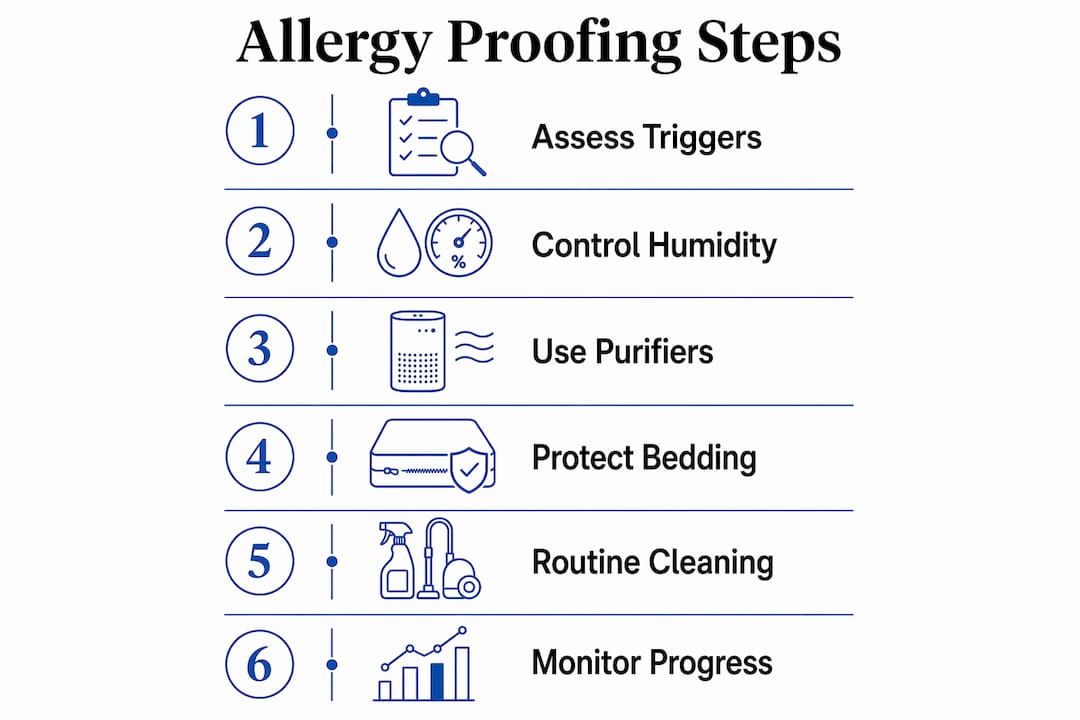
- Step 1: How do you assess triggers and prioritise rooms?
- Step 2: When should you use a humidifier vs a dehumidifier?
- Step 3: How do you choose and use an air purifier correctly?
- Step 4: How do you reduce allergens in bedding, textiles, and pet areas?
- Step 5: What cleaning routine actually removes allergens?
- Step 6: How do you monitor progress and know when to escalate?
- What do devices cost in Australia, and when will symptoms improve?
- Your 7-point action checklist: day 0 to 90
- Key takeaways
- The part most guides get wrong
- Climatepro: HEPA purifiers, humidifiers, and dehumidifiers for UAE homes
- Useful sources and further reading
Step 1: How do you assess triggers and prioritise rooms?
Knowing which allergens affect you most determines where to spend time and money first. The four main indoor triggers are dust mites, pet dander, pollen (tracked in from outside), and mould spores. Each concentrates in specific rooms.
- Bedroom: dust mites in mattresses and pillows; pollen transferred from hair and clothing.
- Living room: pet dander on upholstery; tracked-in pollen on rugs and soft furnishings.
- Bathroom and kitchen: mould from persistent moisture; mildew on grout and under sinks.
Run through this quick assessment before buying anything:
- Who sleeps where, and do pets enter those rooms?
- Are there carpeted floors, heavy drapes, or visible mould spots?
- Has there been a recent leak or persistent condensation on windows?
- Which rooms feel stuffy or smell musty after rain?
Prioritisation rule: bedrooms first (people spend roughly a third of their time there, so bedroom-focused interventions deliver the fastest symptom relief), then high-traffic living areas, then damp rooms.
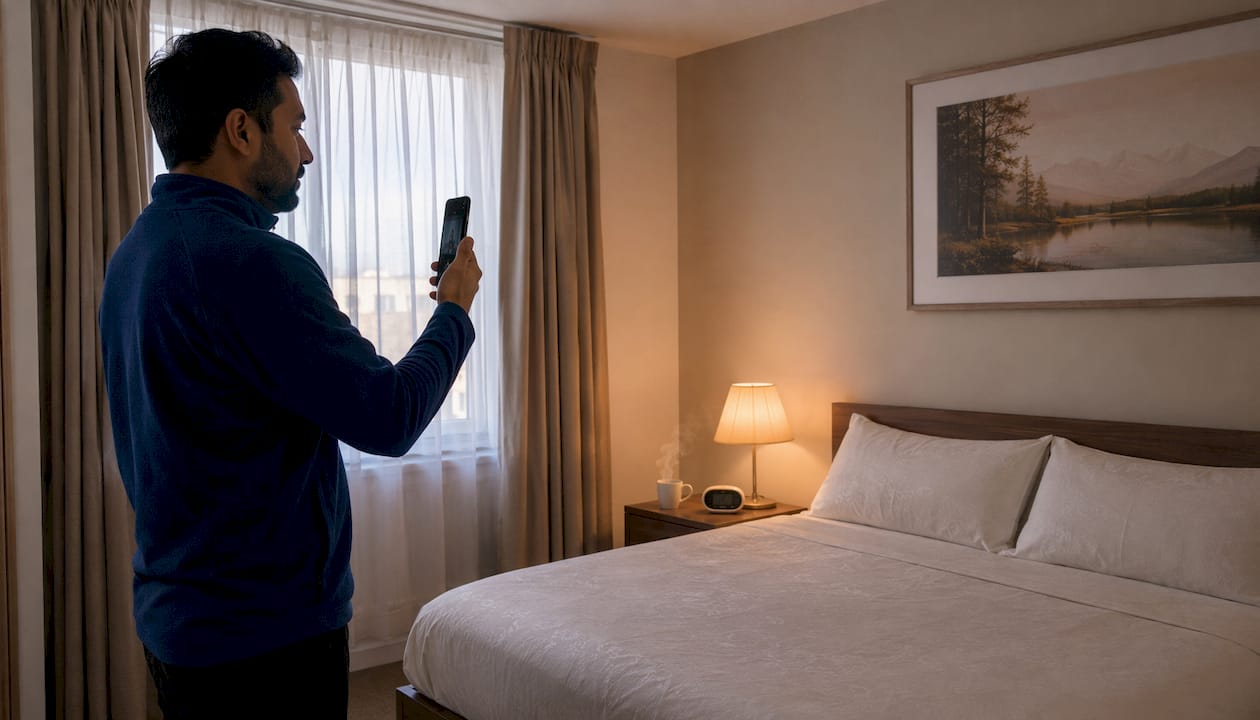
Pro Tip: Take a short video walkthrough of each room before you buy any device. It gives you a baseline to compare against in 30 days and helps a contractor or clinician understand your setup if symptoms persist.
Step 2: When should you use a humidifier vs a dehumidifier?
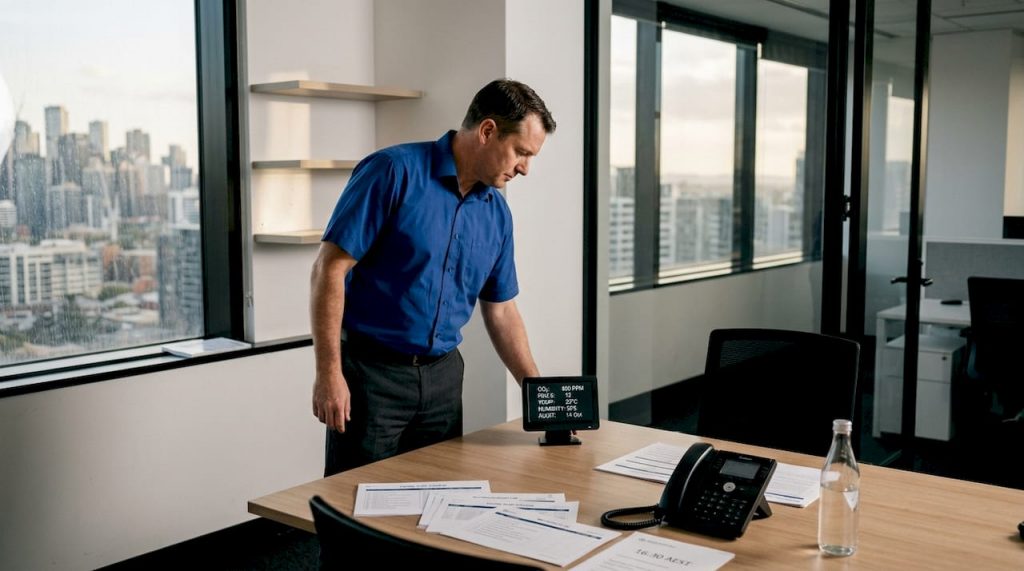
Humidity is the variable most people overlook. Mould and mildew thrive in damp environments and are major allergy triggers that filtration alone cannot solve. The target indoor relative humidity for allergy control is 35–50%. Above roughly 50%, dust mites and mould multiply; below 35%, dry air irritates nasal passages and airways.
Choose a dehumidifier when:
- Your hygrometer reads above 50% RH consistently.
- You have a bathroom, laundry, or any room with poor ventilation.
- Condensation appears on windows or walls after rain.
Choose a humidifier when:
- Indoor air is persistently dry (below 35% RH), causing throat irritation or dry skin.
- Your AC runs heavily and strips moisture from the air.
Placement matters. Position a dehumidifier centrally in the damp room, away from walls, and empty the tank daily. A humidifier works best near the bed but not directly beside it. Clean both units weekly — stagnant water in a humidifier tank can itself become a mould source. Exhaust fans in bathrooms and kitchens are a low-cost complement: run them during and for 20–30 minutes after showers to remove humid air before it spreads.
Pro Tip: A basic digital hygrometer costs very little and tells you whether you need a humidifier, a dehumidifier, or neither. Buy one before you buy any device.
For a deeper look at practical humidity and condensation control, building science guidance covers moisture management principles applicable to any indoor environment.
Step 3: How do you choose and use an air purifier correctly?
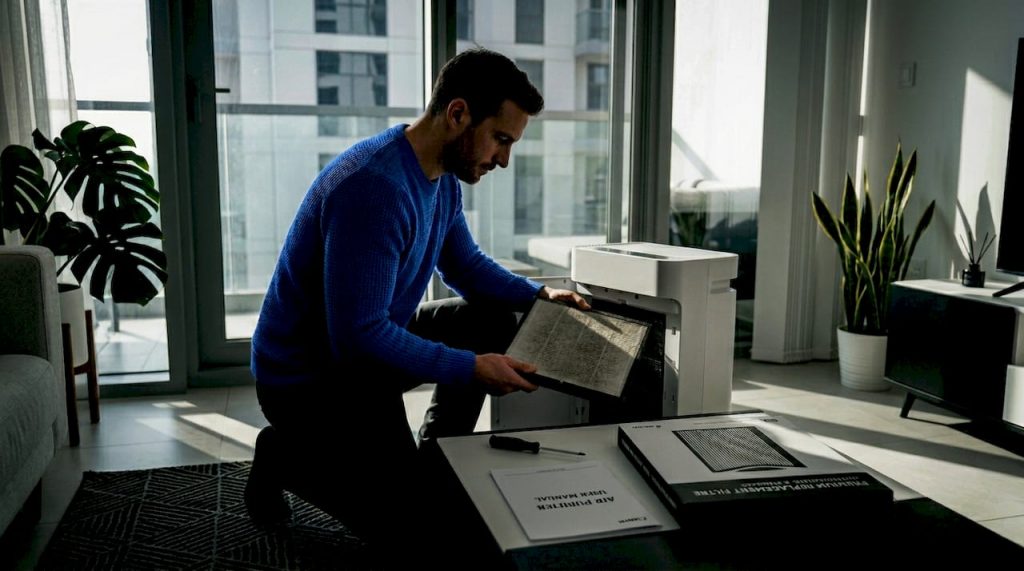
HEPA-filtered air purifiers capture airborne pollen, pet dander, and dust mites. For allergy relief, the minimum standard is true HEPA H13, which captures 99.95% of particles at 0.3 microns. H14 captures 99.995% and suits anyone with severe sensitivities.
Features to prioritise when selecting a unit:
- True HEPA H13 or H14 filter (not “HEPA-type” or “HEPA-style”).
- Washable pre-filter to extend main filter life.
- Programmable timer and low-noise night mode for bedroom use.
- CADR (Clean Air Delivery Rate) matched to your room size.
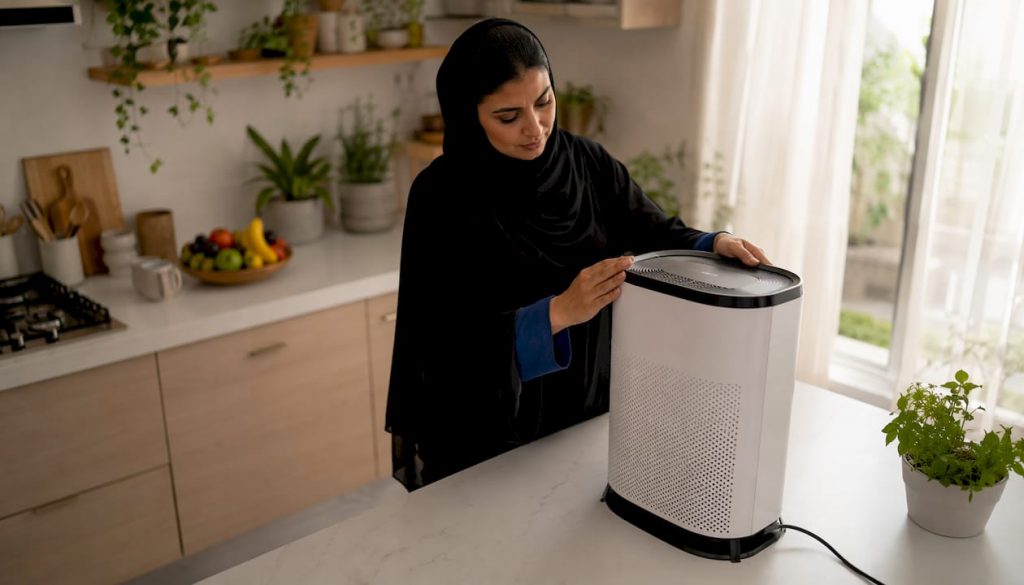
Matching CADR to room size: multiply your room’s floor area (in square metres) by roughly 10 to get a minimum CADR in m³/h. A 20 m² bedroom needs at least 200 m³/h. Run the unit continuously at night in the bedroom; during the day, medium speed in the living room is sufficient.
Placement rules:
- Place the unit in the breathing zone, not behind furniture or in a corner.
- Keep at least 30 cm clearance on all sides.
- Bedroom placement: near the head of the bed, not directly blowing onto the sleeper.
- High-traffic areas: central floor position for maximum air circulation.
Maintenance schedule:
| Component | Check | Replace |
|---|---|---|
| Pre-filter | Monthly | Every 3 months or when visibly dirty |
| HEPA H13/H14 filter | Every 3 months | Every 6–12 months (per manufacturer) |
| Carbon/odour filter | Every 3 months | Every 6 months |
| Exterior vents | Monthly wipe | N/A |
Pro Tip: After vacuuming or on high-pollen days, run the purifier on its highest fan speed for 1–2 hours to clear the spike in airborne particles quickly, then return to normal speed.
Step 4: How do you reduce allergens in bedding, textiles, and pet areas?
Soft furnishings are the largest allergen reservoir in most homes. Dust mites concentrate in mattresses and pillows; pet dander embeds in upholstery and rugs. Addressing these sources gives more symptom relief than filtration alone.
Bedding:
- Wash all bedding weekly at or above 55°C. Standard cold cycles do not kill dust mites; hot water laundering is required.
- Use zippered allergen-proof encasings on mattresses and pillows.
- Launder soft toys monthly using the same hot-wash method.
Textiles and furnishings:
- Replace heavy drapes with washable blinds or roller shades.
- Prefer hard floors where possible; if you keep rugs, choose washable, low-pile options.
- Avoid overstuffed upholstered furniture if symptoms are severe.
Pets: There is no truly hypoallergenic pet. All animals produce dander, saliva proteins, and urine allergens. Practical steps:
- Keep pets out of bedrooms entirely.
- Wash pet bedding weekly at high temperature.
- Groom pets outdoors where feasible to reduce indoor dander load.
- Wipe pets down with a damp cloth after they come inside.
Pro Tip: Zippered allergen-proof encasings are the single most cost-effective first-line intervention. Fit them before you buy any device.
Step 5: What cleaning routine actually removes allergens?
Dry dusting redistributes allergens into the air rather than removing them. Damp microfibre cloths trap particles on contact. The same logic applies to vacuuming: a vacuum without a sealed HEPA system exhausts fine particles back into the room.
- Daily: wipe high-touch surfaces with a damp microfibre cloth; remove outdoor clothing at the door; empty bins.
- Weekly: vacuum all floors and upholstery with a sealed HEPA vacuum; launder bedding and cushion covers on a hot cycle; mop hard floors.
- Monthly: wash curtains or blinds; deep-clean upholstery or use removable washable covers; inspect and clean AC vent registers and replace HVAC filters every 1–3 months.
Wear a NIOSH-rated N95 mask during heavy dusting or any mould removal. Change into clean indoor clothing after returning from outdoors, and shower before bed on high-pollen days to avoid transferring allergens to pillows.
Pro Tip: Empty your vacuum canister or replace the bag outside the home. Doing it indoors releases trapped allergens back into the air.
Step 6: How do you monitor progress and know when to escalate?
A hygrometer tracks RH; a basic indoor air-quality sensor measuring PM2.5 adds a second data point if symptoms persist despite control steps. Neither needs to be expensive.
- Keep a simple two-week diary: note purifier runtime, humidity readings, and symptom severity each day.
- Compare symptom changes against specific interventions (e.g., the day you added mattress encasings or increased purifier runtime).
Escalation triggers:
- Symptoms persist after four weeks of consistent control steps.
- Visible mould returns within days of cleaning.
- A leak source cannot be identified or fixed.
At that point, contact a licensed mould-remediation professional. Take dated photos and notes to share with the contractor or your clinician.
Pro Tip: A simple phone photo log with dates costs nothing and gives a professional a clear picture of the problem’s progression.
What do devices cost in Australia, and when will symptoms improve?
Entry-to-mid-range HEPA air purifiers for single rooms typically sit in the AUD 150–500 range; mid-range dehumidifiers run AUD 250–600; humidifiers range from AUD 50–300 depending on capacity. Replacement filters for HEPA units generally cost AUD 50–150 per set and need replacing every 6–12 months. For energy-efficient purifiers, running costs are modest but worth factoring in for continuous operation.
| Device | Typical upfront (AUD) | Est. annual running cost (AUD) |
|---|---|---|
| HEPA air purifier (single room) | 150–500 | 150 (filter + power) |
| Dehumidifier (mid-range) | 250–600 | 150–200 (power + maintenance) |
| Humidifier | 50–300 | 20–50 (power + cleaning) |
| Hygrometer | 15–30 | Negligible |
Airborne particle levels drop within hours of running a HEPA unit. Clinical symptom improvement typically takes 2–8 weeks of consistent control, depending on how thoroughly allergen sources are addressed.
Ways to reduce operating costs:
- Choose units with programmable timers to avoid running at full speed 24 hours a day.
- Keep pre-filters clean to extend main HEPA filter life.
- Use exhaust fans and AC to assist humidity control rather than running a dehumidifier continuously.
- Buy genuine replacement filters to maintain rated filtration efficiency.
Your 7-point action checklist: day 0 to 90
Immediate (0–24 hours):
- Close windows if pollen count is high; switch AC to recirculated air.
- Run your HEPA unit in the bedroom on high speed for 2 hours, then set to continuous night mode.
- Check your hygrometer. If RH is above 50%, run a dehumidifier or exhaust fan.
Short-term (1–14 days):
- Purchase and fit allergen-proof zippered encasings on all mattresses and pillows.
- Start the weekly laundry routine: bedding at ≥55°C, cushion covers, pet bedding.
- Position your air purifier correctly (breathing zone, 30 cm clearance) and begin the maintenance log.
Medium-term (15–90 days):
- Replace HVAC and purifier filters per the maintenance schedule.
- Review your two-week symptom diary and adjust device runtime or humidity set point as needed.
- Address any damp or mould issues identified in Step 1. If mould returns after cleaning, escalate to a professional.
Key takeaways
Effective home allergy proofing requires HEPA H13/H14 filtration in the bedroom, indoor humidity held at 35–50%, and weekly hot-wash laundering at ≥55°C — devices alone are not enough without consistent source control.
| Point | Details |
|---|---|
| Bedroom HEPA filtration | Run a true HEPA H13 or H14 unit continuously in the bedroom for symptom relief. |
| Humidity target | Keep indoor relative humidity at a moderate level, measured with a hygrometer, to limit dust mites and mould growth. |
| Hot-wash bedding weekly | Launder all bedding at high temperature; cold cycles do not reliably kill dust mites. |
| Source control first | Allergen-proof mattress encasings and pet exclusion from bedrooms reduce exposure more than filtration alone. |
| Climatepro for UAE buyers | Climatepro stocks HEPA purifiers, humidifiers, and dehumidifiers with delivery across all UAE emirates. |
The part most guides get wrong
Most allergy-proofing articles lead with device recommendations. The device is not the hard part. The hard part is the habit stack: the weekly hot wash, the damp cloth instead of a dry one, the mattress encasing fitted before the purifier arrives.
Filtration is genuinely useful, but it is secondary to source control. A HEPA H13 unit running in a bedroom where the mattress has no encasing and the bedding is washed in cold water will reduce airborne particles without touching the primary exposure reservoir. The allergens are in the fabric, not the air.
The other underestimated variable is humidity. In UAE homes, the AC often drives indoor RH very low in summer, which reduces dust-mite risk but can irritate airways directly. In winter or in poorly ventilated bathrooms, RH climbs above 50% and mould becomes the dominant problem. A single hygrometer tells you which direction to move, and that information is worth more than any device bought without it.
The practical sequence is: measure first, seal the mattress, fix the laundry temperature, then add filtration and humidity control. In that order, the devices do what they are supposed to do.
Climatepro: HEPA purifiers, humidifiers, and dehumidifiers for UAE homes
Climatepro is an online store built specifically for UAE residents who need reliable indoor air quality devices, not a generic catalogue. The range covers HEPA air purifiers, humidifiers, and dehumidifiers selected for continuous runtime, night modes, and local filter availability — the three factors that matter most for allergy control in UAE conditions.

For bedroom coverage, the Honeywell Air Touch P2 is a practical starting point with true HEPA filtration and a low-noise night mode. Delivery covers Dubai, Abu Dhabi, Sharjah, Ajman, Ras Al Khaimah, Fujairah, and Umm Al Quwain. Browse the full range at climatepro.ae and use the room-size guide to match a unit to your space before you buy.
Useful sources and further reading
These resources support the guidance in this article and are worth bookmarking for deeper reading.
- AAFA — Control indoor allergens: Evidence-based guidance on source control, pet management, and the three-pronged approach to indoor allergen reduction.
- Mayo Clinic — Allergy resources and cleaning guidance: Clinical detail on laundering temperatures and dust-mite control.
- WebMD — Allergy-proofing your environment: Practical room-by-room checklist covering humidity, mould, pets, and cleaning.
- Climatepro — HEPA filtration for UAE homes: Technical explainer on H13/H14 standards and maintenance for UAE conditions.
- Climatepro — Allergy proofing apartments: Room-by-room, renter-friendly steps with practical device placement advice.
- Climatepro — Air purifiers catalogue: Browse units by room size and filter type with current UAE pricing.
Recommended
- Allergens in the UAE: what residents need to know — Blog | ClimatePro UAE
- Guide to allergy proofing apartments: practical steps for renters — Blog | ClimatePro UAE
- HEPA filtration: Improve your UAE home’s air quality — Blog | ClimatePro UAE
- How to improve air quality in UAE apartments — Blog | ClimatePro UAE