
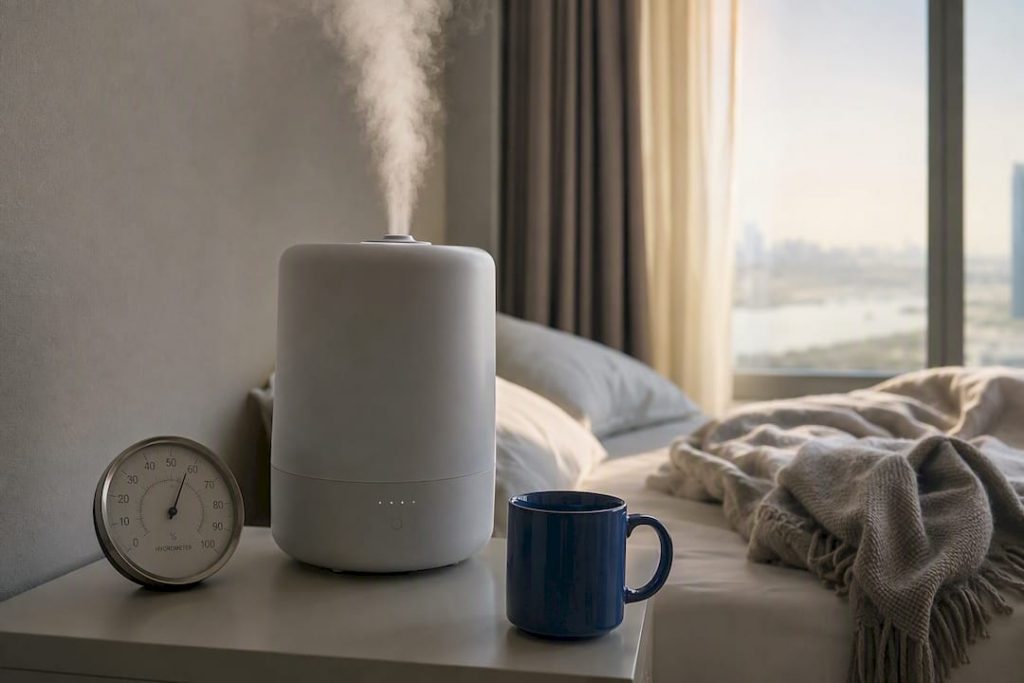
Sleeping with a humidifier is safe for most people when indoor humidity stays between 30% and 50% and the unit is cleaned on a regular schedule. Done properly, it can ease dry sinuses, reduce snoring and soothe irritated skin. Done poorly, with a dirty tank or tap water left standing for days, it becomes a source of mould spores and bacteria instead of relief. The sections below cover exact humidity targets, placement, and a cleaning routine that keeps the benefit without the risk.
TL;DR:
- Keep indoor humidity between 30% and 50% to prevent mold growth while ensuring respiratory comfort during sleep.
- Use a hygrometer placed at chest height to monitor room humidity accurately and adjust the humidifier accordingly.
- Ultrasonic cool-mist humidifiers are generally best for bedrooms due to their quiet operation and safety features.
- Place the humidifier on a raised, open surface at least 1 to 2 meters from the bed, filled with distilled water to reduce mineral dust.
- Clean the humidifier weekly with vinegar or bleach solutions to prevent bacteria and mold buildup that can harm respiratory health.
Table of Contents
- Health benefits of sleeping with a humidifier
- What humidity level is best for sleep, and how do you check it?
- Which type of humidifier suits sleeping in a bedroom?
- Where to place a humidifier for the safest, most even results
- How often should you clean a humidifier, and how?
- Who benefits most from a humidifier at night, and who should be careful?
- ClimatePro’s practical guidance and where to get help
- Quick checklist: how to use a humidifier safely tonight
- The gap between humidifier marketing and humidifier reality
- Get the right setup from ClimatePro
- Sources
Health benefits of sleeping with a humidifier
Dry air is the real target here, not humidity for its own sake. When the moisture content of bedroom air drops too low, the mucous membranes lining your nose and throat dry out, which increases airway resistance and makes breathing feel more laboured. Adding moisture back into the air reduces that resistance and helps air move more freely through your nasal passages, according to the Sleep Foundation.
That mechanical effect explains most of the benefits people report:
- Less snoring, because moist airways vibrate less than dry, irritated ones
- Looser mucus, which makes coughing productive rather than a dry, scratchy hack
- More comfortable use of a CPAP or other PAP device, since dry forced air is a common reason people abandon their machines
- Calmer skin and eyes, especially in air-conditioned bedrooms that strip moisture overnight
- Fewer nosebleeds in people prone to them during dry seasons
Sleep medicine specialists frame humidifiers as a genuine aid for people with colds, asthma symptoms, or obstructive sleep apnea, not a blanket fix for everyone’s sleep problems, according to Health. That distinction matters for how you use one. If your bedroom air already sits in a comfortable range, running a humidifier every night adds no real benefit and raises your mould risk for nothing. If you wake up with a dry mouth, a scratchy throat, or cracked lips through winter or heavy air conditioning, that’s the profile a humidifier is actually built to fix.
What humidity level is best for sleep, and how do you check it?
Indoor humidity between 30% and 50% relative humidity (RH) is the range health authorities recommend for bedrooms, balancing respiratory comfort against the risk of mould and dust mites, per the EPA. Below 30%, airways and skin dry out. Above 50%, you start creating exactly the damp conditions that let mould and dust mites multiply.
A hygrometer is the only reliable way to know where your room actually sits, since guessing from how the air “feels” is notoriously inaccurate. Follow these steps:
- Place a hygrometer at roughly chest height, away from windows, doors, and the humidifier’s direct mist stream.
- Check the reading before bed and again in the morning to see how much the room shifts overnight.
- Set your humidifier to auto mode targeting 40% to 45% RH if it has that feature, or run it on low and recheck after an hour.
- Run the unit only when readings fall below 30%, seasonally in winter or with heavy air conditioning, rather than as a fixed nightly habit.
- Watch for condensation on windows, damp patches on walls, or a musty smell. Any of these means you’re over-humidifying and should switch off until the room dries out.
A $15 to $30 digital hygrometer removes the guesswork entirely, and it’s the single cheapest safeguard against turning a health tool into a mould generator.
Which type of humidifier suits sleeping in a bedroom?
Not every humidifier belongs on a bedside table. The mechanism behind each type changes how quiet it runs, how it handles minerals in the water, and how safe it is around children.
- Ultrasonic cool-mist humidifiers use a vibrating plate to create a fine mist and run almost silently, which is why they’re the most common choice for bedrooms.
- Impeller (cool-mist) humidifiers use a spinning disc instead of ultrasonic waves, slightly noisier but with no heating element.
- Warm-mist (steam) humidifiers boil water to release vapour, which can add a touch of warmth in cold rooms but carries a scald risk, so they’re worth avoiding in a child’s room.
- Evaporative humidifiers pull air through a wet wick or filter, self-regulating since they release less moisture as the air becomes saturated, though the fan noise is more noticeable.
- Whole-home (central) systems attach to ducted air conditioning and humidify multiple rooms at once, suited to larger households rather than a single bedroom.
For most bedrooms, an ultrasonic cool-mist unit is the practical default: quiet, no heating element, and simple to place safely away from small hands. Check the tank capacity against your room size too. A 3 to 4 litre tank generally covers an eight-hour sleep cycle in a standard bedroom without needing a midnight refill.
Where to place a humidifier for the safest, most even results
Humidifier placement decides whether the moisture spreads evenly through the room or pools in one damp patch near the unit. Consumer air-quality guidance consistently points to the same rule: elevate it, give it airflow, and keep it clear of anything that shouldn’t get wet, according to The Spruce.
- Sit the unit on a raised, flat, waterproof surface, such as a dresser or side table, roughly 1 to 2 metres from the bed.
- Keep it away from walls, curtains, wooden furniture, and electronics, since direct mist contact causes staining and, over time, mould behind furniture.
- Avoid placing it directly under a window, where cold glass can encourage condensation to form faster.
- Use a small waterproof mat underneath if the only available surface is carpet or an unsealed wood floor.
- Point the mist outlet toward open floor space rather than at the bed or a wall, and add a low fan setting nearby if your room struggles with dispersion.
- Fill the tank with distilled or demineralised water rather than tap water, cutting down the white mineral dust that ultrasonic units can spray into the air.
Consumer air-quality guidance backs this in another way too: the same humidifier performs noticeably better once it’s moved into open airflow rather than jammed into a corner. Placement changes outcomes as much as the model itself does.
How often should you clean a humidifier, and how?
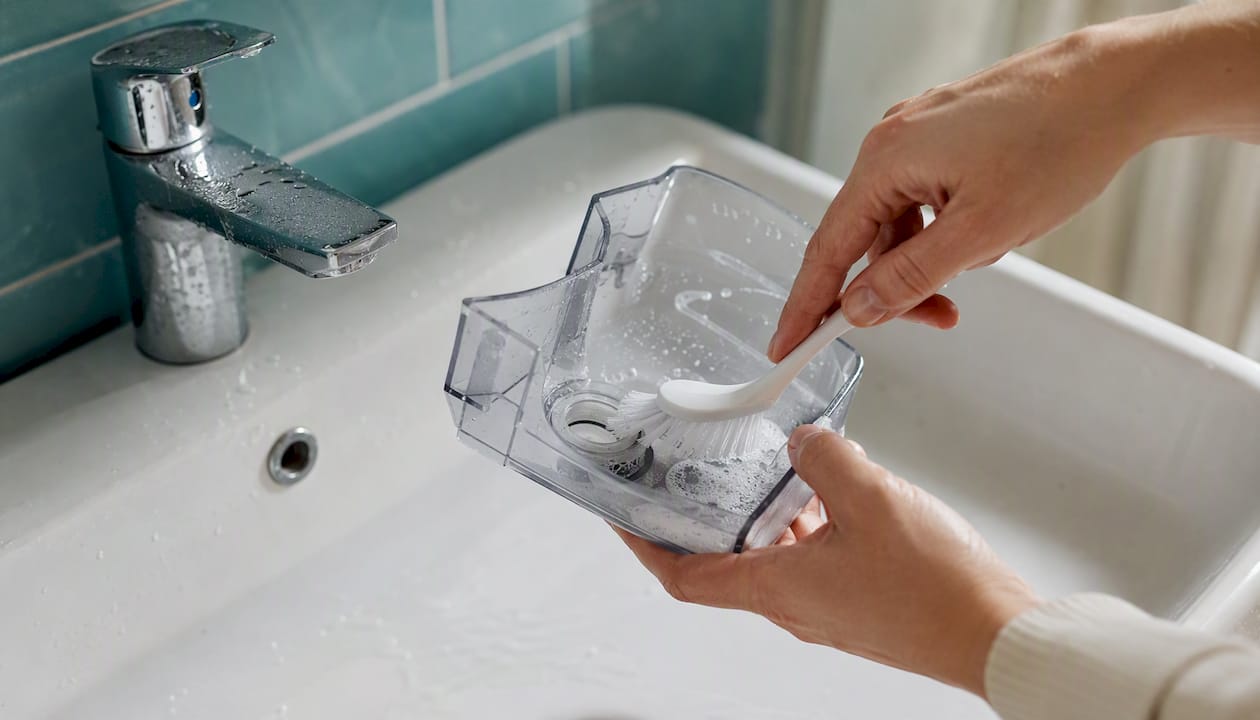
A humidifier tank is warm, damp, and sitting untouched for hours. Left unmaintained, that’s an ideal breeding ground for bacteria and mould, and running dirty water through the mist stream sends those contaminants straight into the air you breathe overnight, according to research on home humidifier microbiological risks. A simple schedule keeps that risk in check.
- Daily: Empty any leftover water, wipe the tank dry, and refill with fresh distilled water before use. Never top up standing water from the night before.
- Weekly: Scrub the tank, base, and any removable parts with a soft brush and a manufacturer-approved disinfectant (usually a diluted white vinegar or a mild bleach solution), then rinse thoroughly before refilling.
- Monthly: Deep-clean according to the manufacturer’s specific steps, and replace any filters or wicks that have reached their recommended lifespan.
Pro Tip: Run your finger along the inside of the tank before you refill it. If it feels slick or slightly slimy, that’s biofilm forming, and it’s a sign your weekly clean isn’t thorough enough, not that the schedule is wrong.
Stop using the unit immediately if you notice a visible film on the water, a musty or sour smell, or a sudden uptick in coughing, sneezing, or throat irritation after use. Deep-clean before you run it again, and if the smell or film returns quickly, it may be time to replace the tank seals or the unit itself, per the EPA.
Who benefits most from a humidifier at night, and who should be careful?
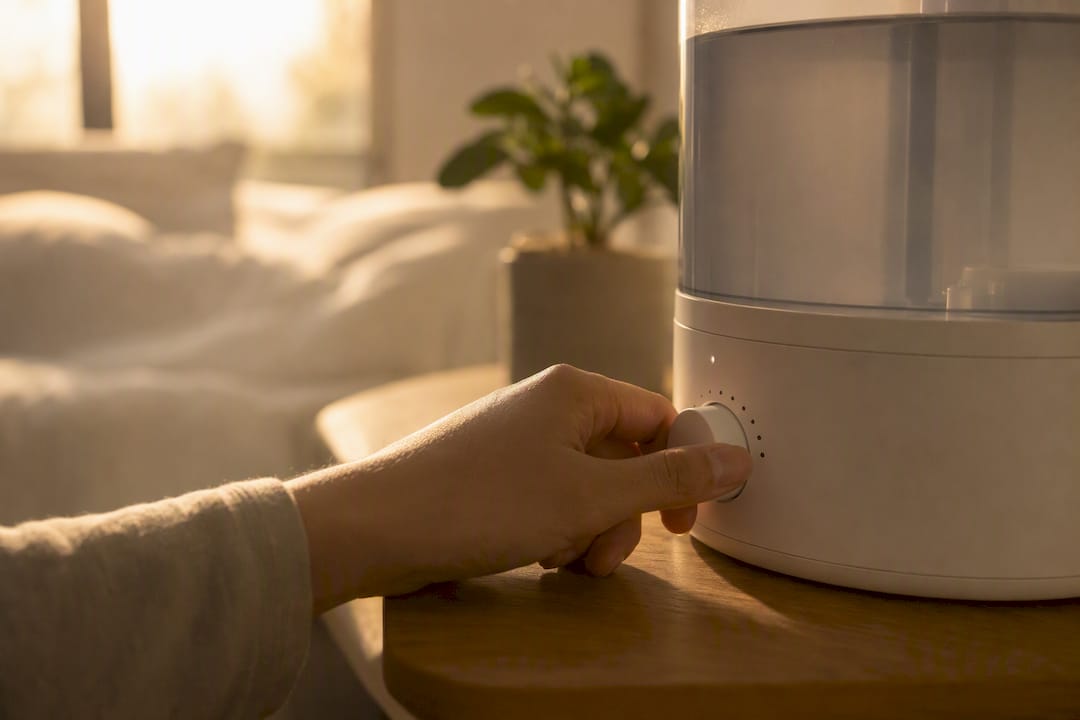
A humidifier earns its place in the bedroom for people with dry-air symptoms: cracked lips, a scratchy throat on waking, seasonal congestion, or the discomfort that stops CPAP users from sticking with their therapy. Some people with asthma find moist air eases irritation, though this varies from person to person and is worth discussing with a doctor rather than assuming it applies universally.
Caution is warranted for a different group:
- People with mould allergies, since even well-run humidifiers add moisture that can support mould growth if the room already runs damp
- Households with existing condensation on windows or walls, where extra humidity compounds a problem that already exists
- Anyone whose asthma or allergies are specifically triggered by damp conditions or dust mites, both of which thrive above 50% RH
Persistent respiratory symptoms, an unexplained wheeze, or allergies that worsen rather than improve after starting humidifier use are reasons to stop and speak with a doctor rather than push through. Humidity sits at the centre of the dust mite and mould equation either way: too little and your airways suffer, too much and you’re feeding the exact allergens you’re trying to avoid.
ClimatePro’s practical guidance and where to get help
Getting the settings and maintenance right matters more than which brand you buy, but the two aren’t unrelated. ClimatePro’s guide to ultrasonic humidification walks through why distilled water matters for these units specifically, and the dry air guide covers the broader health case for humidity control across a home, not just a bedroom.
If you’re weighing up a specific unit, check tank capacity and filter requirements against your room size before buying rather than after. The Blueair DreamWell Humidifier is one option built with quiet overnight operation in mind, worth comparing against your room’s dimensions and your tolerance for weekly cleaning. For a broader home-maintenance routine that covers humidity alongside dust and allergens, the healthy home checklist is a useful next stop.
Quick checklist: how to use a humidifier safely tonight
Getting this right doesn’t require any special skill, just a short routine repeated consistently.
- Check your hygrometer reading before switching anything on, and only run the humidifier if the room sits below 30% RH.
- Set the target to 40% to 45% RH if your unit has an auto mode, or run it on low and recheck after an hour.
- Place the unit on a raised, flat surface, 1 to 2 metres from the bed, filled with distilled water.
- Empty and dry the tank in the morning. Never leave water sitting in it through the day.
- Schedule a proper scrub weekly, not “when you remember”.
- Stop immediately if you see condensation on nearby surfaces, feel dampness, or smell anything musty.
Indoor humidity that sits in the 30% to 50% RH range is the one number worth memorising here. Everything else, the placement, the water type, the cleaning cadence, exists to keep your room inside that band without tipping into mould territory.
The gap between humidifier marketing and humidifier reality

Most advice on this topic treats humidifiers as either miracle sleep devices or mould machines waiting to happen. Neither framing holds up. The honest picture is that a humidifier is a targeted tool for dry-air symptoms, and its safety depends almost entirely on maintenance discipline rather than which model you buy.
Where conventional advice falls short is in treating “run it every night” as the default. That’s backwards. The right question isn’t whether to run a humidifier, it’s whether tonight’s air actually needs one, and a $20 hygrometer answers that better than any marketing claim on a box.
If there’s one thing to prioritise, it’s the weekly clean over the nightly habit. A humidifier run occasionally but cleaned properly will do more good than one run constantly but left to grow biofilm in the tank. The device is genuinely useful for the right conditions. It just isn’t a set-and-forget appliance, and treating it as one is where most of the reported problems with humidifiers actually start.
— Nevel
Get the right setup from ClimatePro
Climatepro gives you a straightforward way to match the right humidifier to your room, instead of guessing between models with no clear specs on tank size or noise output. Every listing on the humidifier catalogue shows capacity, mist type and filter requirements upfront, so you can check a unit suits an eight-hour sleep cycle before you buy rather than after.

If your bedroom runs the opposite problem, too much humidity rather than too little, the dehumidifier range covers that end of the same issue. And if you already own a unit and need replacement filters to keep it running clean, ClimatePro stocks genuine parts across major brands rather than generic substitutes that can affect performance. Browse the humidifier catalogue tonight, check the specs against your room size, and place your order for delivery across Dubai, Abu Dhabi, Sharjah, and the other Emirates.
This article is general information, not a substitute for advice from a qualified doctor. Consult a qualified healthcare professional about your own circumstances before acting on anything here.
Sources
- The Benefits of a Humidifier While Sleeping | Sleep Foundation
- Health
- Use and care of home humidifiers | EPA
- Research on home humidifiers and microbiological risks | PMC