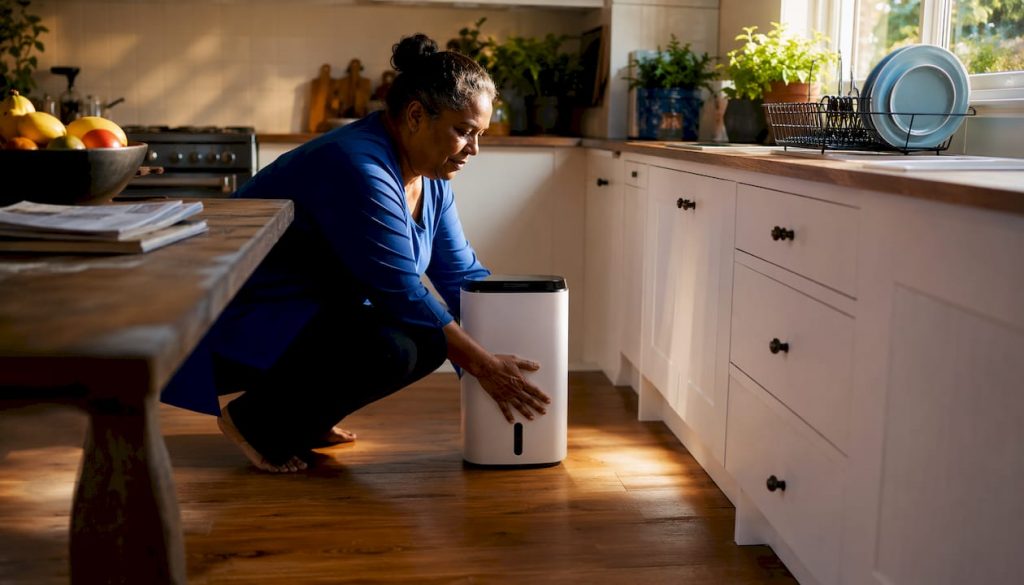
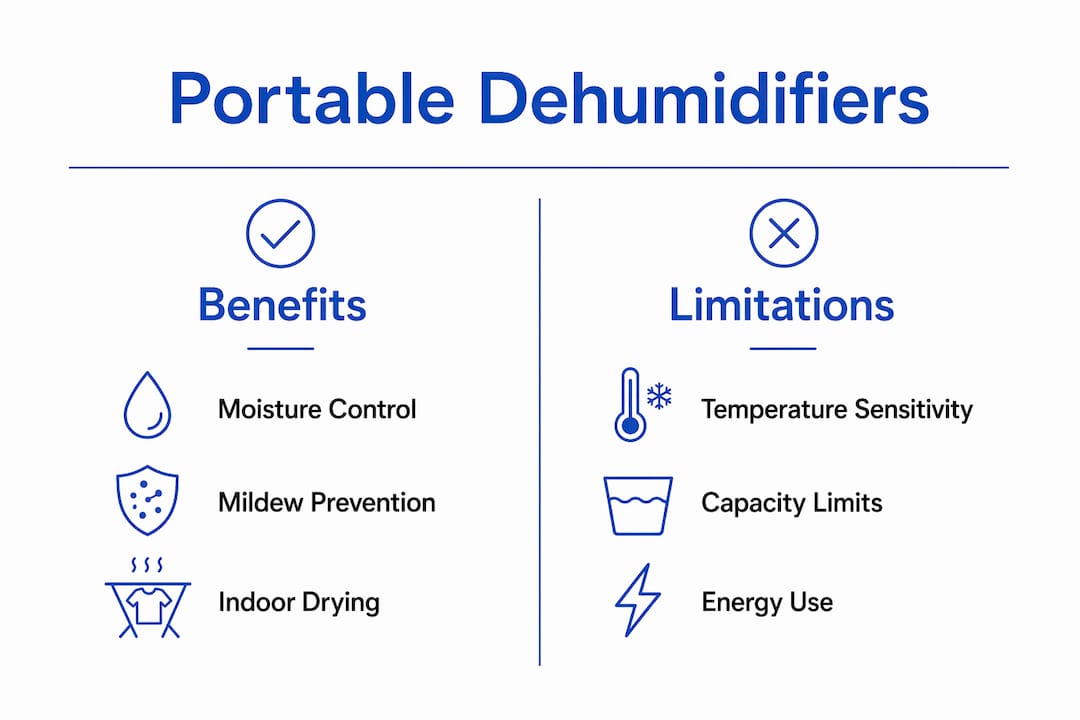
Portable dehumidifiers remove moisture from indoor air and are effective for localised, room-by-room humidity control. For a damp laundry, a condensation-prone bathroom, or a single bedroom with musty air, a portable unit is often the right, cost-effective fix. The recommended indoor relative humidity range is 30–50%; when readings consistently exceed 60%, action should be taken to reduce moisture. What a portable dehumidifier will not do is fix a leaking pipe, rising damp, or water entering through the building fabric. Those problems need a tradesperson first, a dehumidifier second.
- A portable unit suits one room or a defined damp zone, not an open-plan house.
- Signs you need one: condensation on windows, musty smells, visible mould spots, or a hygrometer reading consistently showing elevated relative humidity.
- Signs you need repairs instead: water stains on walls or ceilings, efflorescence on masonry, or relative humidity that stays high even after running a dehumidifier for several days.
Portable dehumidifiers are effective for targeted moisture control, but they should be used alongside fixing the sources of structural water ingress for lasting results.
Table of Contents
- How do portable dehumidifiers actually work?
- What problems does a portable dehumidifier solve for homeowners?
- What portable dehumidifiers won’t do — and the downsides to expect
- How can you tell if you need a portable dehumidifier?
- How to choose a portable dehumidifier for your home
- How to use a portable dehumidifier correctly
- Maintenance and common troubleshooting
- How much electricity does a portable dehumidifier use?
- What research and experts say about portable dehumidifiers
- Key takeaways
- A practical homeowner perspective
- Climatepro’s range for Australian homes
- Useful sources and further reading
How do portable dehumidifiers actually work?
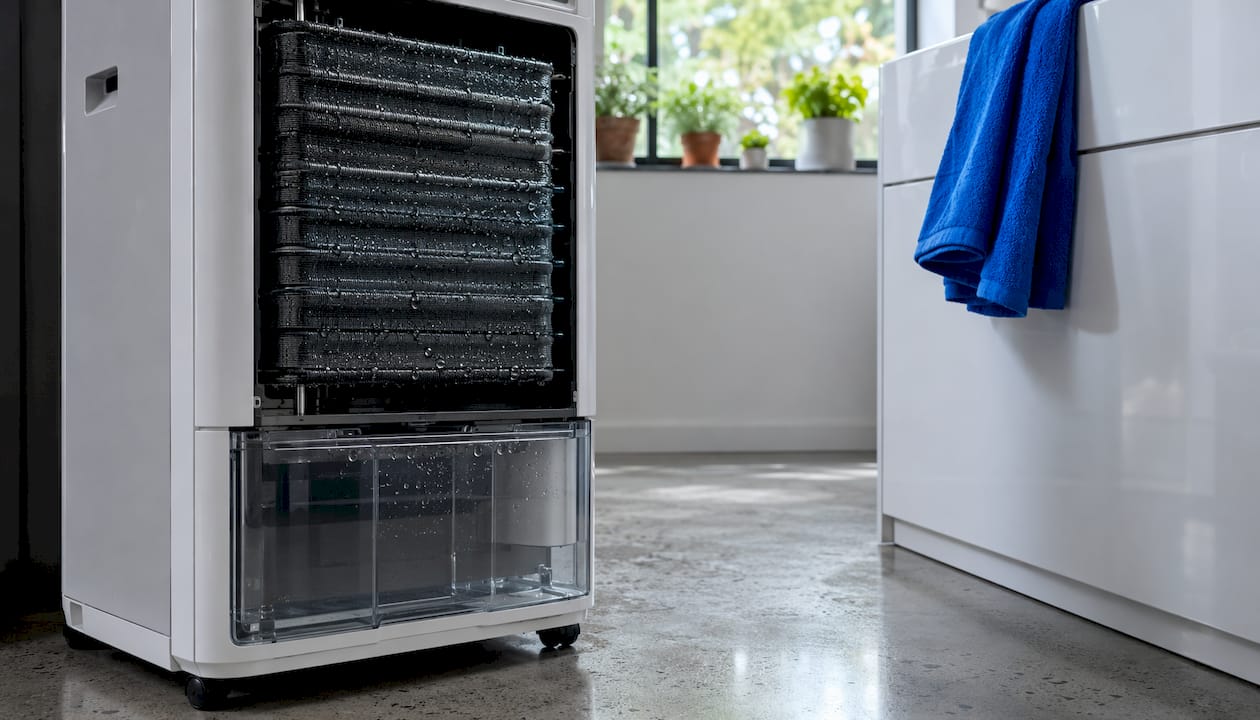
Dehumidifiers draw warm, moist air across a cold coil or through an absorbent material, extract the water, and return drier air to the room. The three technologies available differ in how they achieve that extraction, and each suits different conditions.
| Technology | How it works | Best suited to | Key limitation |
|---|---|---|---|
| Refrigerant (compressor) | Fan pulls air over a cold coil; moisture condenses and drips into a tank | Warm, humid rooms typically above room temperature range | Loses efficiency in cold rooms and may frost in cooler conditions. |
| Desiccant (absorption) | Air passes through a moisture-absorbing rotor (silica gel or zeolite); damp rotor is heated to release water | Cold, damp spaces; winter basements; cool-climate homes | Slightly higher energy use per litre removed in warm conditions |
| Thermoelectric (Peltier) | A Peltier junction creates a cold surface; moisture condenses | Small enclosed spaces: wardrobes, caravans | Very low extraction capacity; not suitable for rooms |
Refrigerant units struggle below about 18–20°C and enter defrost cycles that interrupt extraction. For a cool southern Australian basement in winter, a desiccant model maintains consistent performance where a compressor unit would not.
Drainage options
Three drainage configurations are available. The simplest is a removable plastic tank, which most portable units include as standard; an automatic shutoff prevents overflow when the tank is full. For continuous operation, a gravity hose connects to the tank outlet and drains to a floor drain or outside, but a pump is required when the drain point is at the same level or lower than the unit. A built-in or external condensate pump lifts water to a sink or external drain, removing the placement constraint entirely.
For a deeper look at the dehumidification process and how each technology handles different room conditions, Climatepro’s technical explainer covers the mechanics in detail.
What problems does a portable dehumidifier solve for homeowners?
Lowering indoor relative humidity addresses several overlapping problems at once: biological, structural, and comfort-related.
- Mould and mildew prevention. Mould spores germinate readily above 60% RH. Keeping humidity in the 30–50% range suppresses growth on walls, grout, and soft furnishings.
- Dust mite reduction. Dust mites thrive in humid conditions. Drier air reduces their population, which is directly relevant for asthma and allergy sufferers.
- Musty odour elimination. The smell comes from microbial activity, not dampness alone. Reduce the humidity and the odour source diminishes.
- Protection of building fabric and contents. Timber furniture, books, and electronics deteriorate and warp in persistently humid conditions. A dehumidifier slows that process measurably.
- Comfort and cooling efficiency. Humid air feels warmer than dry air at the same temperature. By reducing latent heat load, a dehumidifier can reduce how hard an air conditioner needs to work in summer, which matters in Queensland and northern Australian homes where humidity peaks alongside heat.
Drier air can also help keep allergies and other health problems at bay and just make your living quarters more comfortable. — Consumer Reports
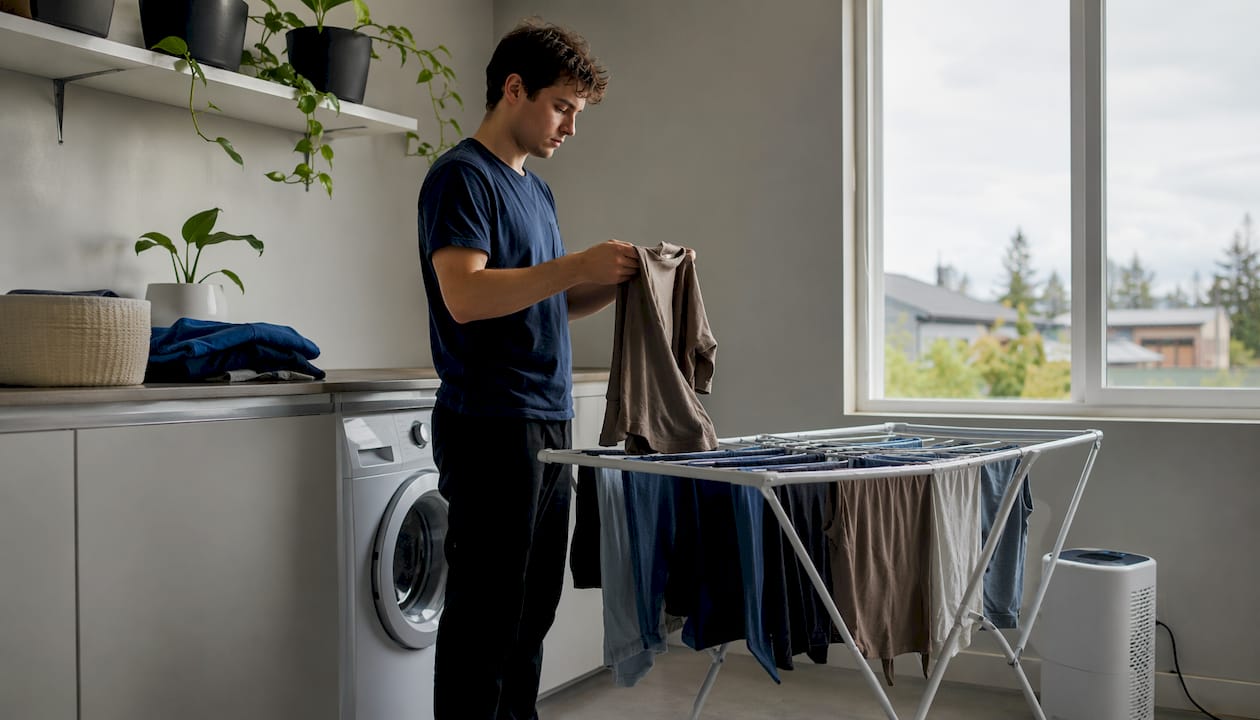
A dehumidifier also helps dry laundry indoors faster, which is useful during extended wet seasons or in apartments without outdoor drying space. That single use case alone justifies a mid-sized unit for many Australian households.
What portable dehumidifiers won’t do — and the downsides to expect
A portable unit is not a repair tool. Relying solely on a dehumidifier in a space with active leaks, rising damp, or water entering through wall cavities will not solve the underlying problem. The machine will extract moisture continuously, run harder than it should, and the RH will remain elevated because the source is still active. Fix the source first.
Beyond structural limits, there are practical trade-offs to weigh:
- Noise. Compressor units produce a low hum comparable to a refrigerator. In a bedroom, this is noticeable; look for models with a sleep or low-noise mode if bedroom use is the priority.
- Energy consumption. Dehumidifiers are among the larger plug loads in a home. Running a unit continuously without a hygrostat set-point wastes electricity and can overcool the air in winter.
- Bucket emptying. Without continuous drainage, a tank in a humid room can fill relatively quickly and will shut the unit off automatically. If you are not home to empty it, the room stays humid.
- Internal hygiene. Tanks and filters become a hygiene issue if left unattended. A neglected reservoir grows mould and bacteria, which the unit then circulates back into the room.
Pro Tip: If your RH stays above 60% after running a correctly sized portable unit for 48 hours with doors and windows closed, that is a signal to investigate structural moisture sources before continuing to run the machine.
How can you tell if you need a portable dehumidifier?
The clearest indicators are visual and sensory: condensation forming on windows in the morning, a persistent musty smell in a room, visible mould on walls or grout, or a clammy feeling in the air that does not clear with ventilation. Allergy symptoms that worsen indoors, particularly in bedrooms, are also a common trigger for investigation.
Measurement removes the guesswork. A digital hygrometer, typically low cost, can be purchased at hardware stores and provides real-time RH readings. Place it at mid-height in the centre of the room, away from windows and exterior walls, and log readings over 24 hours. A single high reading after a shower means little; sustained elevated readings across the day confirm the room has a humidity problem worth addressing.
| RH reading | Interpretation | Recommended action |
|---|---|---|
| Below 30% | Too dry | Consider a humidifier; not a dehumidifier issue |
| Moderate levels | Healthy range | No action needed |
| Elevated levels | Borderline | Improve ventilation; monitor |
| High levels | Elevated | Use a portable dehumidifier; check for sources |
| Very high levels | High risk | Dehumidifier plus investigation for structural moisture |
For a step-by-step approach to measuring and reducing indoor humidity, Climatepro’s home guide walks through the full workflow. Understanding relative humidity and what the numbers actually mean is the logical first step before buying any equipment.
How to choose a portable dehumidifier for your home
Capacity is the starting point. Extraction rate is measured in litres per day (L/day) and reflects how much moisture the unit can remove under test conditions. Manufacturers also quote a coverage area in square metres, but that figure assumes warm, very humid conditions. In a typical Australian home, the real-world extraction will be lower, so it is safer to size up rather than down.
| Room type | Approximate size | Suggested extraction rate |
|---|---|---|
| Living room | 30–50 m² | — |
| Basement or large open area | 50 m²+ | — |
ENERGY STAR certified dehumidifiers use more efficient coils, compressors, and fans to remove the same amount of moisture as a standard unit while using 20% less energy. In Australia, look for models with a comparable energy efficiency rating.
Features worth prioritising
Hygrostat and auto mode are the most useful features on any unit. Set the target RH (typically 50%) and the machine cycles on and off to maintain it, rather than running continuously. This saves electricity and prevents the room from becoming uncomfortably dry.
Continuous drain or pump. If the unit will run in a laundry or basement where you can route a hose to a drain, continuous drainage removes the bucket-emptying task entirely. Choose a pump-assisted model if the drain point is not above the unit.
Noise rating. Units rated below 45 dB(A) are suitable for bedrooms. Above that, restrict use to daytime hours or non-sleeping areas.
Frost or defrost mode is relevant for southern Australian homes in winter. A refrigerant unit without this feature will ice up and stop extracting in a cold room.
Washable filter. A filter that can be rinsed rather than replaced reduces ongoing cost and maintenance effort.
For homes where automated control matters, Climatepro’s guide to smart humidity control covers Wi-Fi-enabled models and integration with home automation systems.
How to use a portable dehumidifier correctly
Getting measurable results from a portable unit depends on setup as much as the machine itself.
- Choose the right room. Close all doors and windows before running the unit. A portable dehumidifier works by cycling the air in a contained space; open doors allow the whole building’s moisture to enter, and the unit will run indefinitely without achieving the target RH.
- Position for airflow. Place the unit away from walls and furniture so air can circulate freely around it. Clearance around side-discharge models supports better airflow, while top-discharge models can sit closer to walls.
- Set the hygrostat. Target a moderate RH level as a starting point. The unit will run until it reaches that level, then cycle off. Avoid very low settings which may dry out timber and cause issues.
- Connect continuous drainage if possible. Route the hose to a floor drain, laundry tub, or outside. This removes the need to monitor the tank and allows the unit to run overnight or while you are away.
- Run it during peak humidity periods. In a laundry, run the unit while drying clothes and for an hour afterwards. In a bathroom, run it after showers. In a bedroom, run it on auto mode overnight.
- Check the tank daily until you know the fill rate. In a very humid room, a tank can fill fairly quickly. Once you know the fill rate, you can plan emptying or switch to continuous drainage.
- Seasonal adjustment. In summer, the dehumidifier reduces latent load and can ease the burden on your air conditioner. In winter, if the room drops below 18°C, switch to a desiccant model or expect reduced output from a refrigerant unit.
Maintenance and common troubleshooting
Regular cleaning of the reservoir and filter is the single most important maintenance task. A neglected tank develops biofilm within days in warm conditions, and the unit will circulate that contaminated air through the room.
Routine tasks:
- Empty and rinse the tank every one to two days when in heavy use, or weekly on auto mode with continuous drainage.
- Wash the air filter every two to four weeks with warm water; allow it to dry fully before reinserting.
- Inspect the hose and pump path monthly for blockages or kinks.
- Wipe the condensate coils with a soft cloth at the start of each season to remove dust build-up.
Common faults and fixes:
- Unit runs but RH does not drop: Check that doors and windows are closed. If the room is large or open-plan, the unit may be undersized.
- Frost on the coils: Normal in cold rooms for refrigerant units. The defrost cycle will clear it automatically; if it persists, the room is too cold for that technology.
- Musty smell from the unit: The tank or filter has microbial growth. Remove, wash with a dilute white vinegar solution, rinse thoroughly, and dry before reassembling.
- Error light or auto shutoff: Usually indicates a full tank. Empty it and restart.
Off-season storage: Empty and dry the tank completely, remove and clean the filter, and store the unit upright in a dry location. Running a dehumidifier in storage for 30 minutes before putting it away removes residual moisture from internal components.
Pro Tip: Before storing for winter, run the unit for 30 minutes on its lowest setting with the tank removed and a towel underneath to draw out any moisture trapped in the internal components. This prevents mould growth during months of inactivity.
How much electricity does a portable dehumidifier use?
Portable dehumidifiers are among the larger plug loads in a home, and running costs depend on the unit’s wattage and your local electricity tariff. A straightforward calculation gives a reliable estimate.
Worked example:
A mid-sized unit running for several hours per day will consume electricity proportional to its wattage and runtime, resulting in a modest daily and monthly cost depending on local tariffs.
Energy-saving tactics:
- Use auto/hygrostat mode so the unit cycles off once the target RH is reached rather than running continuously.
- A correctly sized unit reaches the target faster and spends more time off than an undersized one that runs constantly.
- Pair the dehumidifier with a ceiling fan to distribute drier air through the room without running the unit longer.
- In summer, a dehumidifier that reduces latent load can allow the air conditioner to run at a higher set-point, partially offsetting its own running cost.
- Adopting smart home energy habits alongside dehumidifier use, such as scheduling operation during off-peak tariff periods, can reduce the monthly bill further.
When a home has persistent high humidity across multiple rooms, a whole-house system connected to existing ductwork becomes more economical than running two or three portable units simultaneously. The upfront cost is higher, but the energy efficiency per litre removed is generally better at scale. For guidance on energy-efficient air cleaning and how dehumidification fits into a broader home air quality strategy, Climatepro’s workflow guide covers the options.
What research and experts say about portable dehumidifiers
Research consistently confirms that portable units are effective for localised moisture control. A study of portable dehumidification in single-family homes found that dehumidifiers generally maintain humidity levels in basement spaces under a wide variety of conditions, and typically function until a mechanical failure such as compressor failure. The same research found that dehumidifiers are one of the largest plug loads in the home, using substantially more energy in cool basement conditions than efficiency ratings suggest.
The temperature limitation of refrigerant units is well established. Below approximately 18–20°C, compressor units frost and enter defrost cycles that reduce effective extraction. For cool-climate Australian homes in Victoria, Tasmania, or the ACT, a desiccant model is the more reliable choice through winter.
For Australian homeowners, the practical picture is clear. A mid-sized portable unit is a low-cost, fast remedy for seasonal laundry or bathroom dampness. For whole-house or chronic dampness, a long-term approach is required. The role of portable dehumidifiers is best understood as a targeted intervention tool, not a whole-home solution. Understanding how climate control devices fit together helps homeowners decide when a portable unit is sufficient and when a more integrated approach is warranted.
Key takeaways
Portable dehumidifiers are effective, low-cost tools for room-level humidity control when sized correctly, used in a closed space, and maintained regularly.
| Point | Details |
|---|---|
| Target RH range | Keep indoor humidity between 30–50%; act when readings consistently exceed 60%. |
| Match capacity to room | Size by extraction rate (L/day), not just square metres; oversizing is safer than undersizing. |
| Close the space | Shut doors and windows during operation so the unit cycles room air, not the whole building’s moisture. |
| Maintain the tank and filter | Clean the reservoir and wash the filter every two to four weeks to prevent microbial growth inside the unit. |
| Climatepro for dehumidifier options | Climatepro stocks portable dehumidifiers suited to Australian home conditions, with options across capacity ranges. |
A practical homeowner perspective
There is a tendency to treat a portable dehumidifier as a set-and-forget appliance, which is where most of the disappointment comes from. A unit placed in the middle of a large open-plan living area with the back door open will run all day and achieve almost nothing. The same unit moved into a closed laundry and set to 50% RH will have the room under control within a few hours and cycle off for most of the day.
The energy cost question is also more nuanced than it first appears. Running a 400 W unit on auto mode for eight hours costs under a dollar a day at typical Australian tariffs. That is a reasonable price for a dry laundry, a mould-free bathroom, or a bedroom where allergy symptoms have been a problem. Where the calculation changes is when the unit runs continuously because the room has a structural moisture source it cannot overcome. In that situation, the electricity bill climbs and the problem does not resolve. The dehumidifier is doing its job; the building is not.
For most Australian households, the right sequence is: measure with a hygrometer, identify the room or zone with the problem, rule out structural water ingress, then choose a correctly sized unit with a hygrostat and continuous drainage if possible. That sequence produces results. Buying the largest unit available and placing it in the hallway does not.
Climatepro’s range for Australian homes

Climatepro stocks a curated range of portable dehumidifiers suited to Australian home conditions, from compact units for bathrooms and laundries through to mid-capacity models for bedrooms and living areas. Every unit in the range is selected for reliable extraction performance, practical drainage options, and energy-efficient operation. For homeowners who have worked through the guidance in this article and are ready to choose a unit, the Climatepro dehumidifier range is the direct next step. For those also looking at indoor air quality more broadly, the Xiaomi Smart Dehumidifier Lite offers Wi-Fi control and auto mode in a compact form suited to Australian apartments and smaller rooms. Browse the full range and use the capacity guidance above to select the right model for your space.
Useful sources and further reading
- ENERGY STAR: Dehumidifiers — Capacity sizing guidance, efficiency ratings, and certified model information.
- HowStuffWorks: How dehumidifiers work — Plain-language technical explainer covering refrigerant, desiccant, and drainage options.
- De’Longhi FAQ: How does a dehumidifier work? — Temperature performance notes for refrigerant vs desiccant units.
- Nordic Design Blog: Portable dehumidifiers — 7 tips for best results — Practical operational guidance including room containment and RH targets.
- Consumer Reports: Dehumidifier buying guide — Feature comparison and performance testing context.
- Centre for Energy and Environment: Portable dehumidification in single-family homes — Research study on real-world energy use and performance.
- Apollo Home: Whole-house vs portable dehumidifiers — Comparison of portable and whole-house approaches.
- Climatepro: Humidity control workflow — Step-by-step home guide for measuring and reducing indoor humidity.
- Climatepro: What is the dehumidification process for homes? — Technical explainer on dehumidification processes and maintenance.
- Climatepro: Relative humidity explained — RH measurement, targets, and why the numbers matter.
- Climatepro: Humidifier for dry air — Useful reference for readers comparing humidification and dehumidification needs.