Air filters reduce airborne particulate contaminants in healthcare spaces and, when correctly specified and maintained as part of an integrated HVAC infection-control strategy, lower the risk of airborne transmission. They are not a standalone solution. The immediate actions for facility managers: confirm the final filter class in each air handling unit (AHU), run a pressure-drop check across filters in critical areas, and schedule a joint review with infection control and estates before any planned changes.
The primary outcomes filtration delivers in healthcare settings are:
- Reduced particulate load — fewer viable and non-viable particles circulating in clinical air
- HVAC equipment protection — pre-filters extend the service life of final filters and coils
- Support for isolation and airborne infection isolation room (AIIR) function — high-efficiency filtration in exhaust or recirculation paths reduces downstream contamination
- Improved environmental comfort — lower dust and allergen levels benefit both patients and staff
Immediate check: Verify that central AHUs serving operating theatres, AIIRs, and protective environments carry at least MERV 14 final filters (or H13/H14 HEPA where specified). A single clogged or incorrectly rated filter can compromise the air quality in healthcare across an entire zone.
Table of Contents
- How filtration works in healthcare HVAC and portable units
- Common filter types in hospitals and where each is used
- Where filtration delivers the most value in your facility
- Standards and performance metrics to specify
- How to choose and deploy filters and air-cleaning devices in your facility
- Maintenance, commissioning, and recordkeeping for sustained performance
- How filtration fits into a broader HVAC infection-control strategy
- What filtration cannot do: limits and common misconceptions
- A practical checklist for facility managers
- Key takeaways
- An operational perspective on filtration in practice
- Useful standards and guidance documents
- Climatepro: portable air purifiers for clinical and surge spaces
How filtration works in healthcare HVAC and portable units
Filters capture particles through three physical mechanisms: inertial impaction (large particles unable to follow airstream curves collide with fibres), interception (mid-sized particles following streamlines contact fibres directly), and diffusion (sub-micron particles moving erratically via Brownian motion contact fibres by chance). All three operate simultaneously, and their relative contributions shift with particle size.
The critical design point is the most-penetrating particle size (MPPS), which sits at approximately 0.3 µm. Particles at this diameter are too small for efficient impaction and interception, yet too large for strong diffusion capture. HEPA filters are rated at the MPPS precisely because it represents worst-case performance: H13 HEPA efficiency is ≥99.95% at MPPS, and H14 reaches ≥99.995%.
Filtration effectiveness in a room depends not just on filter efficiency but on the volume of air passing through the filter relative to the room volume. A high-efficiency filter operating at low flow rate will clean air slowly; the same filter at the designed flow rate can achieve meaningful air changes per hour.
Single-pass efficiency describes how well a filter captures particles in one pass through the media. Room-level removal depends on the air changes per hour (ACH) the system delivers and on how well supply air mixes with room air before returning to the filter. Clean air delivery rate (CADR) combines filter efficiency and airflow into a single figure representing the volume of fully cleaned air produced per unit time, making it the most practical metric for sizing portable units.
Bypass is the other critical variable. Air that travels around a filter through gaps in the frame or housing contributes nothing to particle removal, regardless of the filter’s rated efficiency. This is why frame sealing and installation integrity matter as much as the filter’s own specification.
Common filter types in hospitals and where each is used
| Filter type | Primary use in healthcare | Key limitations |
|---|---|---|
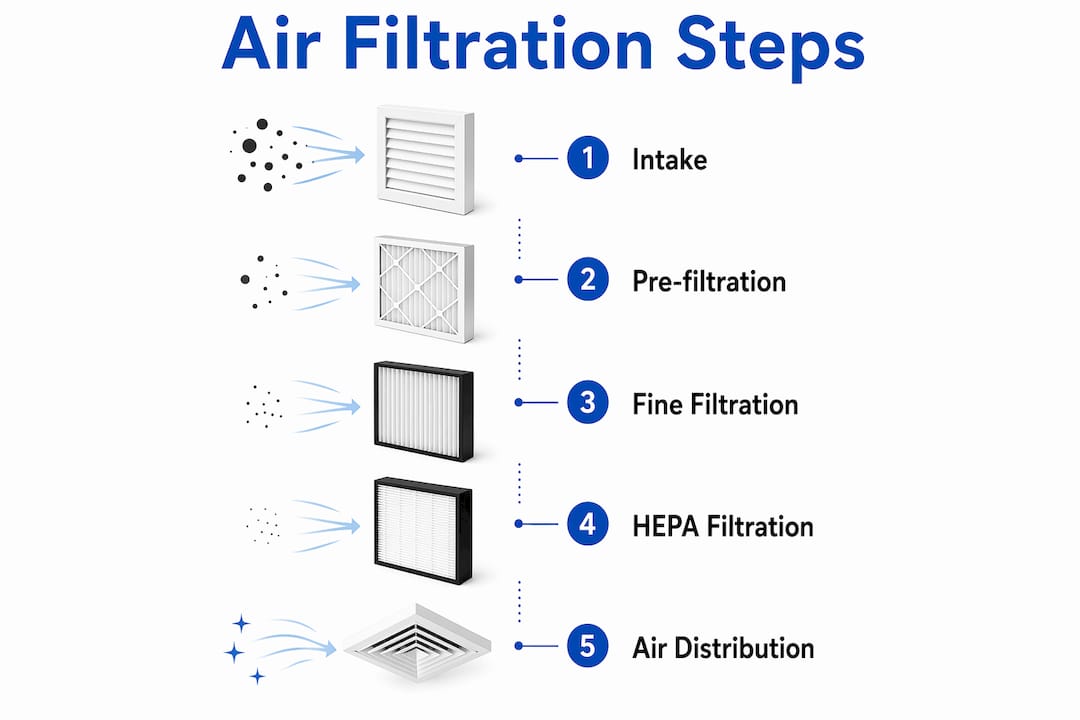
| Pre-filter (MERV 6–8) | First stage in AHUs; protects downstream filters and coils | Captures only coarse particles (>3 µm); ineffective for fine particulate or pathogens |
| Mid-range filter (MERV 11–13) | Intermediate stage in AHUs; general ward supply | Partial capture of fine particles; not suitable for critical areas without a HEPA final stage |
| High-efficiency final filter (MERV 14–16) | AHU final stage for general inpatient areas | Higher pressure drop than mid-range; requires fan capacity assessment before upgrade |
| HEPA H13/H14 (EN 1822/ISO 29463) | AHU final stage for ORs, AIIRs, PEs; ceiling supply units; portable air cleaners | Highest pressure drop; requires integrity testing after installation; does not remove gases or odours |
| Activated carbon / gas-phase adsorber | Odour and volatile organic compound (VOC) control; pharmacy compounding areas | Does not capture particles; adsorption capacity is finite and media requires scheduled replacement |
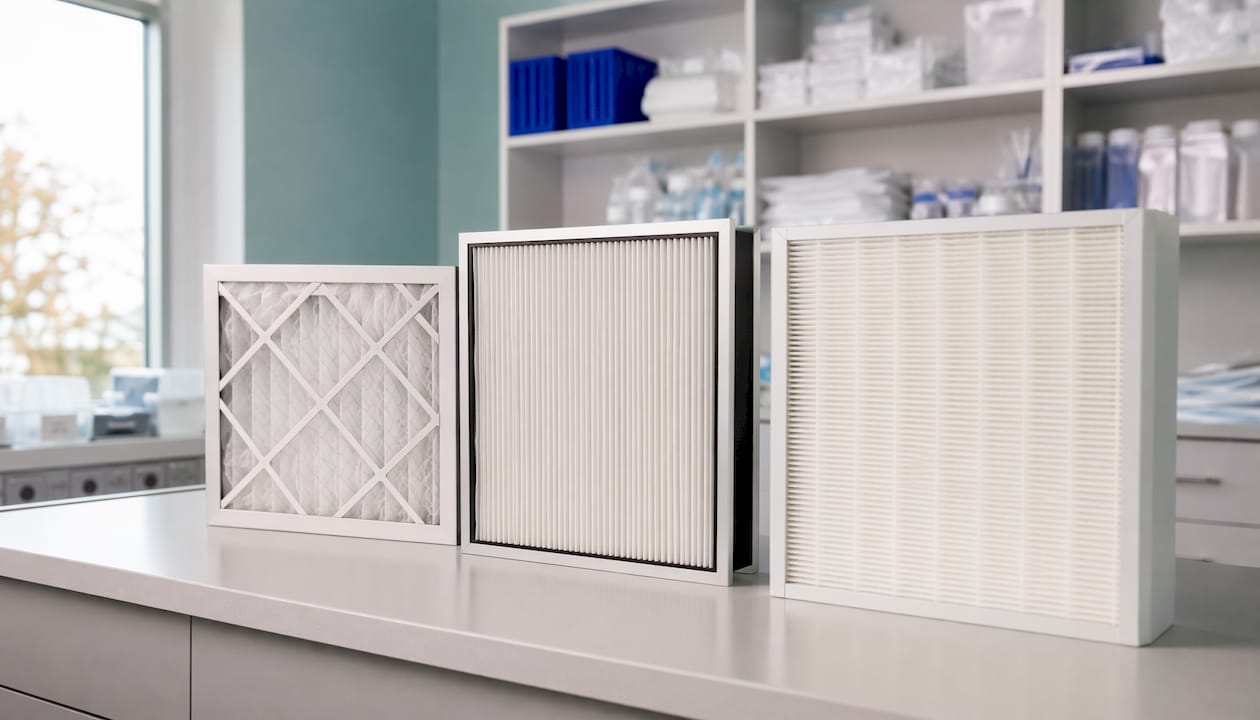
Inpatient facilities commonly design central AHUs with MERV 14 final filters; room recirculating fan-coil units typically carry only a MERV 8 pre-filter and therefore require supplementary portable HEPA units for infection-control purposes. This distinction matters in older Australian hospital stock, where fan-coil systems are widespread.
Portable HEPA units are appropriate as a supplement when central filtration cannot be upgraded quickly, for surge or temporary ward spaces, and for isolation support during outbreak response. They are not a substitute for designed directional airflow or correct room pressurisation. Central AHU HEPA is the preferred long-term solution for critical areas because it integrates with the building’s pressure management and ACH design.
Where filtration delivers the most value in your facility
High-efficiency filtration has the greatest measurable impact in spaces where airborne pathogen concentration directly affects patient outcomes.
- Operating theatres (ORs): Laminar airflow ceiling HEPA supply reduces particulate contamination at the surgical site. Orthopaedic and cardiothoracic ORs typically specify H14 HEPA in ceiling supply units designed to deliver sufficient air changes per hour.
- Airborne infection isolation rooms (AIIRs): Exhaust-path HEPA prevents contaminated air from reaching adjacent corridors. Negative pressure relative to the corridor is the primary control; HEPA on the exhaust path is the secondary barrier.
- Protective environments (PEs): Positive-pressure rooms for immunocompromised patients (haematology, transplant) rely on HEPA supply to deliver a low-particle environment. A single filter bypass event can introduce fungal spores at clinically significant concentrations.
- Pharmacy clean rooms and compounding areas: ISO 5 or ISO 7 classification requires HEPA-filtered unidirectional airflow. Carbon adsorbers are added where cytotoxic or volatile compounds are handled.
- Surge and temporary wards: Portable HEPA units provide rapid deployment when permanent HVAC cannot be reconfigured. Placement and CADR sizing are critical to achieve meaningful protection.
- Dusty Australian environments: Facilities in regions prone to dust events face accelerated pre-filter loading. Monitoring pre-filter pressure drop during high-dust periods prevents premature final-filter fouling and AHU performance loss.
HEPA air cleaners in healthcare show measurable reductions in airborne microbial counts and some infection outcomes (including aspergillus) when flow rate and air distribution are correctly managed. Performance in situ depends on both the device specification and how cleaned air is distributed through the space.
Standards and performance metrics to specify
The key metrics to request from any vendor or include in a procurement specification are: HEPA class (H13 or H14 per EN 1822/ISO 29463), filter efficiency at MPPS, CADR (m³/h), ACH for the target space, filter pressure drop at rated airflow, and the pre-filter rating protecting the HEPA stage.
| Metric | What it measures | How to use it in specification |
|---|---|---|
| HEPA class H13 (EN 1822/ISO 29463) | ≥99.95% efficiency at MPPS | Minimum class for AIIRs, PEs, ORs; require test certificate per EN 1822 |
| HEPA class H14 | ≥99.995% efficiency at MPPS | Specify for highest-risk areas (PE, pharmacy ISO 5 clean rooms) |
| MERV 14–16 (ANSI/ASHRAE 52.2) | High-efficiency particulate capture for AHU final filters | Specify for general inpatient AHU final stage where HEPA is not required |
| CADR (m³/h) | Volume of clean air produced per hour by a portable unit | Calculate: room volume (m³) × target ACH ÷ filter efficiency factor |
| ACH | Air changes per hour delivered to the space | AIIRs: minimum 12 ACH total; ORs: minimum 20 ACH; general wards: 6–10 ACH |
| Filter pressure drop (Pa) | Resistance added to the airstream | Confirm AHU fan can deliver design ACH at the increased static pressure |
Australian and international standards to reference in procurement and commissioning documents:
- AS/NZS 1668.2 — the primary Australian standard for mechanical ventilation in buildings, including healthcare. Specifies minimum ventilation rates and filtration requirements by space type.
- NHMRC Australian Guidelines for the Prevention and Control of Infection in Healthcare — the national infection-control reference. Specifies environmental requirements for AIIRs, PEs, and ORs.
- EN 1822 / ISO 29463 — the European and international test standards for HEPA and ULPA filters. Require vendors to supply test certificates showing efficiency at MPPS for each filter batch.
- ANSI/ASHRAE 52.2 — the MERV rating standard. Use when specifying AHU pre-filters and mid-range filters.
- ASHRAE 170 — ventilation standard for healthcare facilities. Provides ACH, pressure relationship, and humidity requirements by room type; widely referenced in Australian healthcare design.
How to choose and deploy filters and air-cleaning devices in your facility
The starting point is always the required ACH for the space and the designed pressure relationships. Equipment must meet those targets without disrupting the directional airflow the room relies on.
Calculating CADR for a portable unit:
- Measure room volume: length (m) × width (m) × height (m)
- Identify target ACH for the space (e.g., 12 ACH for an AIIR)
- Required airflow = room volume × ACH (e.g., 4 m × 5 m × 2.7 m × 12 = 648 m³/h)
- Select a portable unit with a CADR at or above that figure at the operating speed you intend to run continuously
A 20 m² room with a 2.7 m ceiling has a volume of 54 m³. At 12 ACH, the required CADR is 648 m³/h. Most portable HEPA units rated for clinical use publish CADR figures; confirm the figure is measured at MPPS, not at a larger particle size.
Vendor questions to ask before procurement:
- Provide the EN 1822 / ISO 29463 test certificate for the HEPA media, showing efficiency at MPPS
- State the measured CADR at MPPS at each fan speed
- Confirm filter pressure drop at rated airflow and the recommended pre-filter class
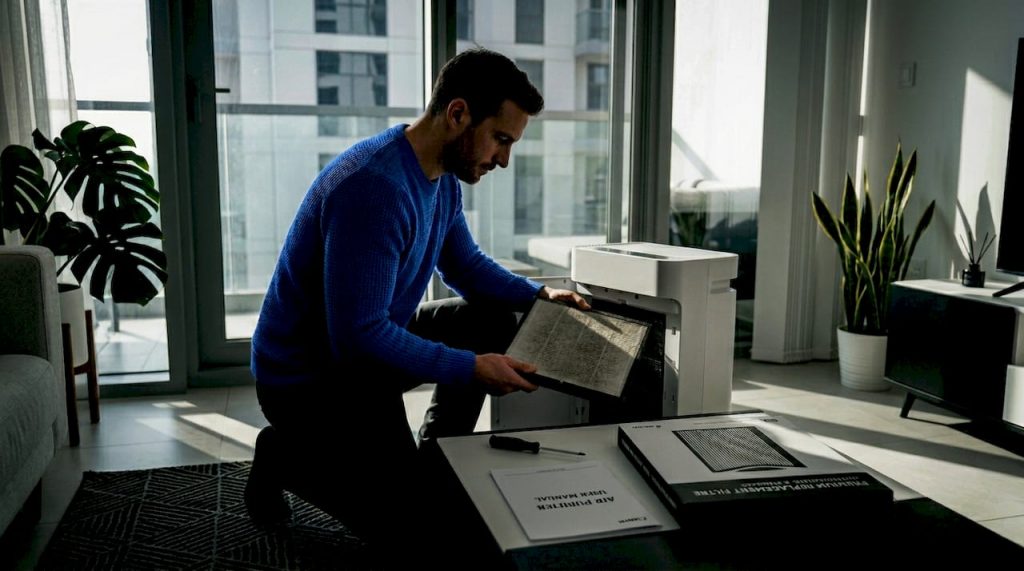
- Describe maintenance access: how filters are changed, whether the change can be performed safely in an occupied space, and what PPE is required
- Provide noise levels (dBA) at operating speeds — clinical spaces typically require ≤45 dBA at continuous operating speed
- Confirm electrical compliance with Australian standards (AS/NZS 3000) and any building integration requirements
Placement guidance for portable units:
Portable HEPA units must support, not disrupt, designed directional airflow. Incorrect placement can short-circuit room airflows and re-entrain contaminants rather than remove them. Position units to draw air from the patient zone and exhaust clean air away from the patient. Avoid placing units directly in the path of supply diffusers or exhaust grilles. For AIIRs, confirm that portable unit operation does not reduce the room’s negative pressure differential.
The NHS NETB 2023/01A guidance recommends against unproven technologies such as ionisers and photocatalytic oxidation in healthcare spaces without safety evidence — a useful benchmark when evaluating vendor claims about supplementary technologies.
Maintenance, commissioning, and recordkeeping for sustained performance
A high-efficiency filter that leaks, is clogged, or has been installed without integrity verification is effectively no filter at all. Routine inspection and scheduled replacement are non-negotiable.
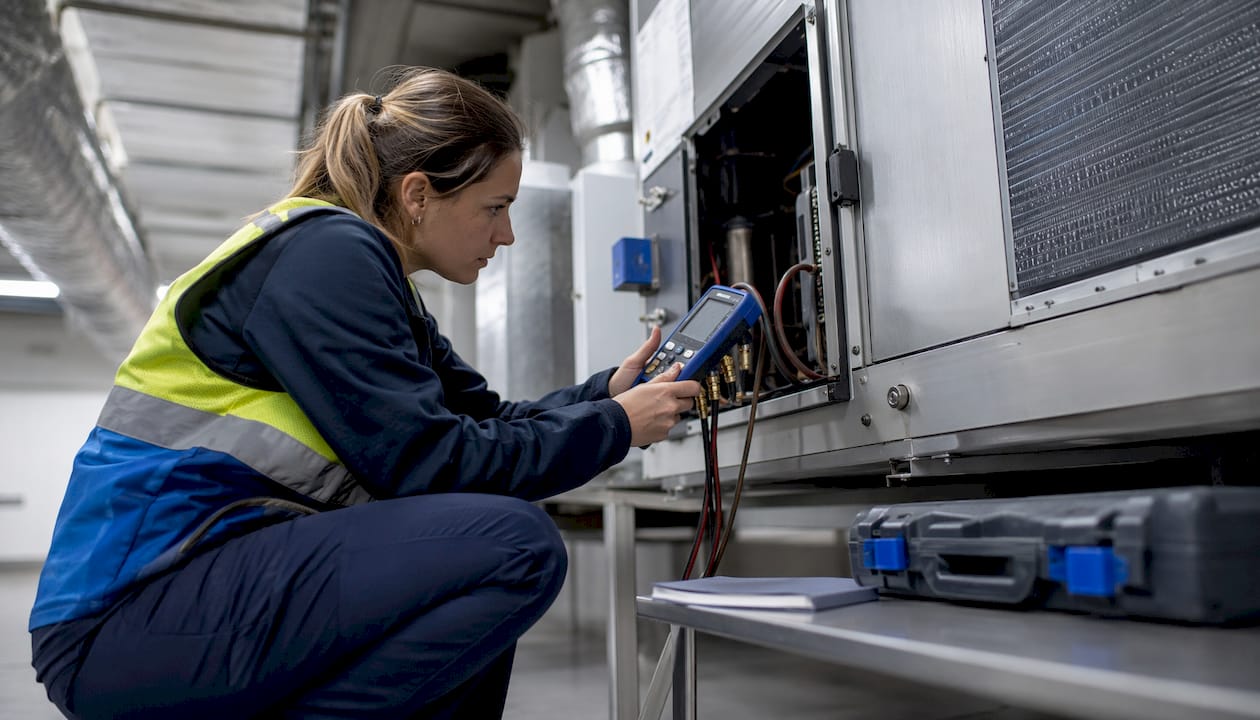
Maintenance schedule reference:
| Task | Frequency | Notes |
|---|---|---|
| Pre-filter visual inspection | Monthly (more frequently during dust events) | Replace when visibly loaded or when pressure drop exceeds threshold |
| Pre-filter replacement | Every 1–3 months depending on environment | Australian inland facilities may require monthly replacement during dust season |
| Final filter pressure-drop check | Monthly | Log readings; replace when pressure drop reaches manufacturer’s maximum |
| HEPA filter replacement | Per manufacturer schedule or when pressure drop threshold is reached | Never exceed maximum pressure drop — reduced airflow compromises ACH |
| Filter change PPE and procedure | Per each change | Staff must wear P2/N95 respirator, gloves, and eye protection; bag filters in situ before removal |
| Filter disposal | Per each change | Treat as clinical waste; double-bag and label before disposal |
| HVAC duct inspection | Annually | HVAC ductwork can accumulate microbial growth if condensation and dust are not managed; cleaning must be planned carefully to avoid dust bursts |
Commissioning and integrity testing:
- DOP/PAO challenge test (or equivalent per AS 1807.10): required for all HEPA installations in critical areas. Tests frame seals and media integrity by challenging the installed filter with a polydisperse aerosol and scanning downstream for penetration. HEPA installations must be challenge-tested to verify seals — a filter that passes the factory test can still fail in situ if the frame is not correctly sealed.
- Airflow and ACH verification: measure supply and exhaust airflow after filter installation and after any filter change. Confirm ACH meets design specification.
- Room pressure differential check: verify that designed pressure relationships (negative for AIIRs, positive for PEs) are maintained with filters installed and at operating fan speed.
- Particle counting: a spot check with a handheld particle counter after filter installation confirms correct seating and absence of bypass.
Pro Tip: Install differential pressure gauges across pre-filters and final filters in all critical AHUs. A simple trend log of pressure-drop readings gives early warning of filter loading and prevents the common failure mode of running filters beyond their effective life — which reduces ACH without triggering any visible alarm.
How filtration fits into a broader HVAC infection-control strategy
Filtration is one control layer. It must be coordinated with ACH, pressurisation, humidity management, and clinical workflows to actually reduce infection risk.
Optimising filtration alone without adjusting airflow rates or pressure relationships may not reduce infection risk as much as expected. Integrated management — combining correct ACH, pressure differentials, and high-efficiency filtration — is what delivers measurable outcomes.
Operational principles for facility teams:
- Maintain designed pressure relationships. Adding filtration must not reduce fan capacity to the point where pressure differentials are lost. Upgrading to MERV 14+ or HEPA in an existing AHU requires a fan capacity assessment first — insufficient fan power reduces ACH or upsets pressure differentials, undermining infection control.
- Preserve minimum outside air rates. ASHRAE’s Indoor Air Quality Procedure (IAQP) allows higher-efficiency filtration to offset some outdoor air volume, yielding energy savings. This trade-off requires careful assessment and is not appropriate in all healthcare spaces — outside air rates in clinical areas are often mandated by AS/NZS 1668.2 and ASHRAE 170 regardless of filtration level.
- Do not reduce ventilation because filtration has been added. Filtration removes particles; ventilation dilutes gaseous contaminants and controls CO₂. They are complementary, not interchangeable.
- Consider energy impacts. Higher-efficiency filters increase static pressure and fan energy consumption. A net-zero building strategy for healthcare facilities must account for the energy cost of upgraded filtration alongside its infection-control benefit.
Who to involve and what approvals to seek:
Filtration changes in critical areas should involve infection control, clinical leads for affected spaces, building services engineers, and clinical engineers. In Australian public hospitals, changes to ventilation systems in operating theatres and isolation rooms typically require sign-off from the relevant health authority’s infrastructure or engineering team. Document all changes, commissioning results, and filter replacement records in the facility’s building management system or CMMS.
What filtration cannot do: limits and common misconceptions
Filters reduce particle load. They do not replace ventilation, correct pressure control, PPE, or source control. Understanding these limits prevents misallocation of resources and avoids creating a false sense of security.
A portable HEPA unit placed in a standard room does not create an airborne infection isolation room. Negative pressure, a dedicated exhaust path, and correct ACH are required for AIIR function — the HEPA unit addresses particle load only.
Common misconceptions:
- “HEPA in the AHU removes all viruses.” HEPA captures particles at ≥99.95% efficiency at MPPS, but viruses travelling on respiratory aerosols are captured as part of those aerosol droplet nuclei. Viruses that reach the filter are captured; the filter does not sterilise air in the clinical sense, and HEPA alone may be complemented by UVC in high-risk applications.
- “Ionisers are a safe, effective alternative.” NHS guidance explicitly warns against ionisers and photocatalytic oxidation devices in healthcare spaces without safety evidence. Some ioniser technologies generate ozone at concentrations that are harmful to patients.
- “Adding a portable HEPA unit is enough for surge isolation.” Portable units supplement ACH and filtration but cannot establish the pressure differentials required for true isolation.
Red flags indicating poor implementation:
- Pressure drop across a final filter significantly above the manufacturer’s maximum (filter overloaded, ACH compromised)
- HEPA installations with no DOP/PAO challenge test record
- Missing or out-of-date commissioning documentation
- Evidence of bypass: visible gaps between filter frame and housing, or particle counts downstream inconsistent with filter class
- Filter changes performed in occupied clinical spaces without PPE controls and patient protection measures
A practical checklist for facility managers
Immediate actions (this week):
- Confirm the filter class installed in each AHU serving critical areas (ORs, AIIRs, PEs). Record the MERV or HEPA class and the date of last replacement.
- Check pressure-drop readings across pre-filters and final filters in all critical AHUs. Flag any readings at or above the manufacturer’s maximum for immediate replacement.
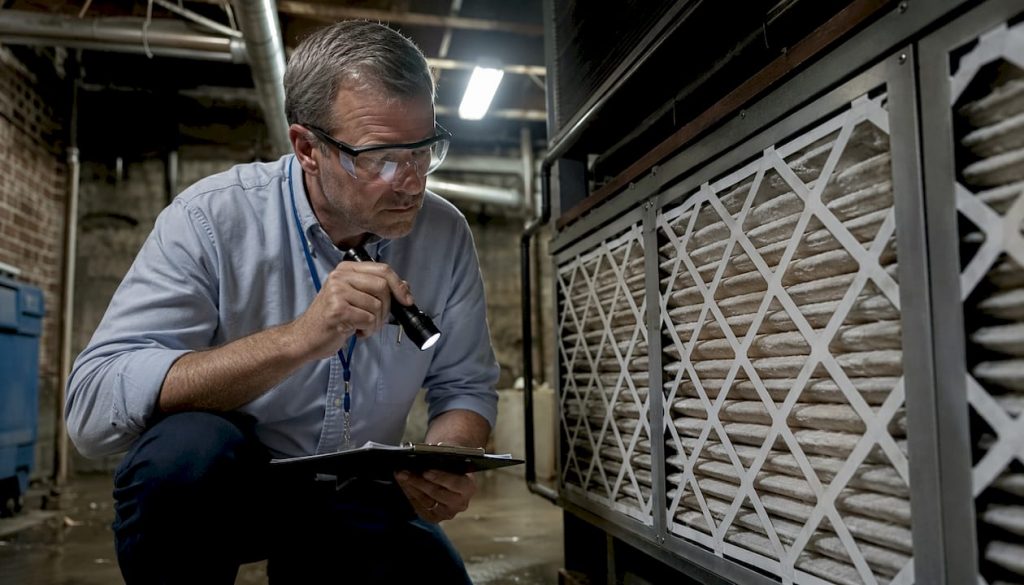
- Visually inspect accessible filter housings for bypass gaps, damaged frames, or evidence of moisture.
- Confirm room pressure differentials in all AIIRs and PEs are within specification.
Short-term actions (within one month):
- Commission portable HEPA units for any surge or temporary isolation spaces. Size units to achieve the required ACH for the space using the CADR calculation above.
- Request EN 1822/ISO 29463 test certificates from vendors for all HEPA units in service. File certificates in the building management system.
- Convene a joint review with infection control, estates, and clinical leads to identify any spaces where filtration upgrades are warranted.
- Establish a pre-filter inspection schedule for facilities in dust-prone regions, with increased frequency during high-dust periods.
Medium-term actions (one to six months):
- Assess fan capacity in AHUs where a MERV or HEPA upgrade is planned. Engage a mechanical engineer to confirm available static pressure before specifying higher-efficiency filters.
- Schedule DOP/PAO integrity tests for all HEPA installations that lack current test records.
- Integrate filter pressure-drop monitoring into the facility’s building management system or CMMS, with alert thresholds set at 80% of the manufacturer’s maximum.
- Review the clinic air safety guide for additional deployment considerations relevant to smaller clinical spaces.
Owner assignments: immediate checks — estates; short-term commissioning and documentation — estates and infection control jointly; medium-term upgrades and testing — procurement, clinical engineering, and building services.
Key takeaways
Effective healthcare air filtration requires correct filter specification, integrity-tested installation, and integration with ACH and pressure management — not just the presence of a high-efficiency filter.
| Point | Details |
|---|---|
| Specify H13/H14 HEPA for critical areas | AIIRs, ORs, and PEs require EN 1822/ISO 29463-certified H13 or H14 HEPA; always request the test certificate. |
| Size portable units by CADR and ACH | Calculate room volume × target ACH to determine the minimum CADR required; confirm the figure is measured at MPPS. |
| Test every HEPA installation | DOP/PAO challenge testing after installation is the only way to verify frame seals and media integrity in situ. |
| Filtration does not replace ventilation | Correct ACH and pressure differentials must be maintained; filtration and ventilation are complementary, not interchangeable. |
| Climatepro for portable HEPA procurement | Climatepro supplies portable air purifiers and replacement filters suited to clinical and surge-space deployment. |
The three-point action for decision-makers: specify (H13/H14 HEPA with EN 1822/ISO 29463 certification), test (DOP/PAO integrity check after installation), and maintain (scheduled replacement with pressure-drop monitoring). Reference AS/NZS 1668.2, NHMRC infection-control guidelines, and ASHRAE 170 in all procurement and commissioning documents.
An operational perspective on filtration in practice
The most common failure mode in healthcare filtration is not a poor filter choice. It is a good filter installed in a system that cannot support it. Upgrading an AHU from MERV 8 to HEPA without a fan capacity assessment is a predictable way to reduce ACH and lose the pressure differential the room depends on — the opposite of the intended outcome. The filter class on the specification sheet means nothing if the fan cannot push design airflow through the increased resistance.
A second pattern worth noting: pre-filter neglect. Pre-filters are inexpensive and easy to overlook, but a loaded pre-filter forces the final filter to do work it was not designed for, shortens its service life, and can reduce airflow enough to affect ACH in critical spaces. A simple monthly inspection programme, with replacement triggered by pressure drop rather than a fixed calendar interval, costs very little and protects a much more expensive downstream investment.
The practical tip: during any commissioning or routine maintenance visit, take a differential pressure reading across each filter stage and log it with the date. After a few months, the trend tells you more about actual filter loading than any manufacturer’s recommended replacement interval — and it gives you defensible evidence for procurement decisions.
Useful standards and guidance documents
- AS/NZS 1668.2 — Mechanical ventilation in buildings. The primary Australian standard for healthcare ventilation. Use for minimum ACH, filtration requirements, and outside air rates by space type. Essential for procurement and commissioning documents.
- NHMRC Australian Guidelines for the Prevention and Control of Infection in Healthcare — The national reference for infection-control environmental requirements. Specifies AIIR, PE, and OR ventilation and filtration standards. Use when writing infection-control SOPs and for clinical governance approvals.
- EN 1822 / ISO 29463 — European and international HEPA/ULPA filter test standards. Require vendors to supply per-batch test certificates showing efficiency at MPPS. Use in procurement specifications and to verify delivered product.
- ANSI/ASHRAE 52.2 — MERV rating standard for general ventilation filters. Use when specifying AHU pre-filters and mid-range final filters.
- ASHRAE 170 — Ventilation of health care facilities. Provides ACH, pressure relationship, humidity, and filtration requirements by room type. Widely referenced in Australian healthcare design and useful alongside AS/NZS 1668.2.
- ASHRAE Position Document on Filtration and Air Cleaning — Covers IAQP trade-offs, energy impacts of higher-efficiency filtration, and the conditions under which outdoor air reduction is appropriate. Use when assessing energy impacts of filter upgrades.
- NHS NETB 2023/01A — Application of HEPA filter devices for air cleaning in healthcare spaces. UK guidance with detailed device selection, testing, and safety criteria. Directly applicable to Australian procurement decisions and useful for evaluating supplementary technologies.
- APSIC Environmental Hygiene Guidelines (2025 update) — Asia-Pacific guidance on environmental hygiene including air quality in healthcare settings. Relevant to Australian facilities with Asia-Pacific patient populations or supply chains.
Climatepro: portable air purifiers for clinical and surge spaces
When central HVAC upgrades are not yet feasible, or when a surge ward needs rapid filtration support, a correctly specified portable HEPA unit is the practical next step. Climatepro stocks a range of portable air purifiers suited to clinical and commercial spaces, including the Honeywell Air Touch P2 for small clinic rooms and the higher-capacity Honeywell Air Touch U1 where CADR requirements are greater. Replacement filters, including pre-filter options, are available to support scheduled maintenance programmes.

Climatepro delivers across the UAE, with product specifications and filter replacement schedules available on each product page. For facility managers working through the checklist above, the air purifier range is a practical starting point for portable unit procurement. Browse the range and confirm CADR ratings against your room volume calculations before ordering.