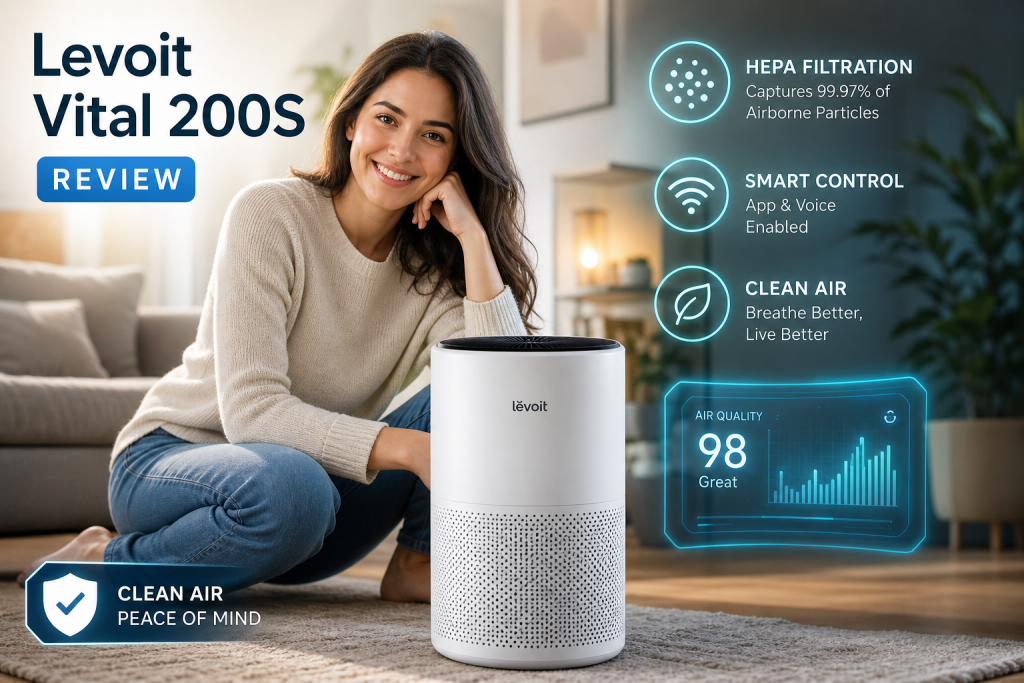
The Levoit Vital 200S keeps showing up in air purifier searches, and there’s a reason for that. It hits a price bracket where performance is genuinely competitive, the smart features work without being overcomplicated, and Levoit has built enough brand recognition that most buyers feel comfortable pulling the trigger. But most reviews either copy the spec sheet or rave about how quiet it is without telling you what actually matters before you spend your money.
This review is written for apartment dwellers in the UAE dealing with the usual suspects: fine desert dust that finds its way into sealed buildings, allergens that trigger year-round symptoms, pet hair that clogs everything, and the lingering cooking smells that come with open-plan kitchens. You’ll get the real performance numbers, an honest look at filter costs, and a clear verdict on whether the Levoit Vital 200S fits your home. If you already know you want one, ClimatePro UAE stocks both the Vital 200S and the Vital 200S-P with delivery across all seven emirates, including same-day in Dubai. If you’re not sure yet, keep reading.
What the Levoit Vital 200S actually is
The Vital 200S is Levoit’s mid-range smart air purifier. It carries a CADR of 245 CFM (416 m³/h) and is rated for rooms up to 380 sq ft (35 m²) at five air changes per hour. That’s the number you should anchor to: 35 square metres. Beyond that footprint, you’re compromising on air change frequency and real-world effectiveness. The unit ships with the device itself, a pre-installed filter, a power cord, and a quick-start guide. Dimensions are 15.6 x 8.5 x 19.8 inches (about 40 x 22 x 50 cm), weight is 6 kg, and power draw sits at 50W. It’s a standing tower design, not a desktop unit.
The filtration runs three stages: a washable pre-filter that catches hair, lint, and large dust particles; a main HEPA-style filter that handles particles down to 0.3 microns; and a third activated carbon layer that manages odors, VOCs, and smoke. Fan speeds run from 1 to 5, with an Auto Mode that adjusts based on onboard air quality sensor readings. Noise ranges from 23 dB on sleep mode to 54 dB at maximum speed.
What separates it from the standard Levoit lineup
Levoit makes a wide range of air purifiers, and the naming gets confusing fast. The Vital series sits above the Core series in both CADR and smart integration. The Core 200S, for example, has a noticeably lower CADR and smaller recommended room size. The Levoit Vital 200S adds Pet Mode, a U-shaped air inlet optimized for fur intake, and better VOC performance through a denser activated carbon stage. If you’re comparing on spec sheets alone, it offers meaningfully more coverage per dollar than anything in the Core range below it.
Vital 200S-P: what the “P” actually adds
The Vital 200S-P is the pet allergy variant, and it’s not just a marketing badge. The filter formulation is different: it’s engineered to target pet-specific allergens. According to EnergyWiseHub’s testing, the pet filter removes airborne chemicals 17% faster than the standard version. The U-shaped inlet design is shared across both models, but the P version’s filter composition gives it a genuine edge in homes where dander and fur are constant. If you have cats or dogs, this is the version worth buying. The price difference between the two is modest enough that there’s rarely a reason to choose the standard model if pets are part of your household.
Levoit Vital 200S Performance and CADR: What the Tests Show
The performance data here is solid. HouseFresh ran the Levoit Vital 200S in a 728 cubic foot test room using incense smoke and cleared all PM1 particles (finer than PM2.5) in 21 to 23 minutes at full speed. EnergyWiseHub tested it in automatic mode and recorded 75% PM2.5 reduction in 15 minutes and 99% reduction in 30 minutes. Run it on turbo with match smoke and those numbers come in at 86.6% in 15 minutes, reaching 95.9% by the 30-minute mark. For a unit in this price bracket, that’s a strong result.
In UAE apartments, the relevant threats are fine desert dust (PM2.5 and PM10), cooking smoke, VOCs from furniture and adhesives in newer builds, and allergens that cycle through poorly maintained AC systems. This unit handles all of them within its rated room size. The carbon stage is pellet-based, which performs well on cooking odors specifically, and multiple tests confirm kitchen-adjacent use as one of its stronger applications.
CADR in plain terms: what 245 CFM means for room coverage
CADR measures how quickly a purifier moves clean air through a room. At 245 CFM, the Vital 200S cycles the air in a 35 m² room five times per hour. Five air changes per hour is the standard threshold where air quality meaningfully improves for allergy sufferers and asthma patients. Drop below that and you’re still cleaning the air, just more slowly. This means the unit works as advertised in a standard UAE apartment bedroom (typically 15 to 25 m²) with headroom to spare. In a 30 m² master bedroom you’re still getting well above four air changes per hour. In a 40 m² open-plan room, the performance starts to slide.
What independent PM2.5 and smoke tests actually showed
RTINGS.com’s measurements put PM1.0 CADR at 367 m³/hr (216 CFM) at max speed, which independently validates the performance claims. In a 320 sq ft room test from a separate source, air quality improved by 96% over 60 minutes. Across HouseFresh, EnergyWiseHub, and RTINGS, the pattern holds: the Vital 200S performs consistently on smoke and fine particles. Where the data thins out is on dedicated pollen and pet dander challenges, no independent test has isolated airborne dander in a controlled setting for this model. That said, dander particles fall in the 2.5 to 10 micron range, and the unit reduces PM10 to near-zero levels in under 25 minutes. The practical implication is strong, even without direct dander testing.
The H13 HEPA label: honest take on what it means
Levoit labels this filter as H13 True HEPA. The NAD (National Advertising Division) issued a ruling challenging that claim, finding that Levoit’s testing methodology didn’t fully support the H13 designation. That’s worth knowing. What it doesn’t change is the real-world outcome: 99% PM2.5 reduction in 30 minutes is a result, not a label. The difference between a formally certified H13 and this filter, in practical terms, is narrow for the pollutants most UAE apartment residents are dealing with. Don’t let the label controversy be a deal-breaker, but don’t let the marketing overclaim sway you either. Judge it on the test numbers, which are genuinely good for the price.
Pet owners: what this unit does differently
The U-shaped air inlet on the Vital 200S-P is an engineering decision, not a cosmetic one. Standard tower purifiers pull air in through side vents, which can cause pet fur to mat against the pre-filter and restrict airflow. The U-shaped design distributes intake across a wider surface area, reducing clogging from fur and extending the interval between pre-filter cleanings. For a home with two cats or a medium-sized dog, this matters. The pre-filter on both models is washable, which keeps the main filter working longer and reduces replacement frequency.
Pet Mode uses the onboard air quality sensor to automatically ramp up fan speed when particles increase, for example, when a cat shakes out near the unit or fur gets disturbed during grooming. It’s a practical feature that removes the need for manual intervention and means the unit self-manages reasonably well in daily pet household use.
U-shaped inlet and Pet Mode: how they work together
The inlet geometry handles the physical debris; Pet Mode handles the invisible particles. Fur that would otherwise create a dense mat on a flat filter face is instead spread across the curved surface, giving the pre-filter more working area before it needs washing. The sensor in Pet Mode responds to real-time air quality changes rather than a timer. If nothing’s disturbing the air, it runs quietly on a lower speed. When air quality drops, dander, fur displacement, litter box odors, it kicks up automatically. Neither feature is revolutionary in isolation, but they work well together for the specific frustrations of pet-owning apartment residents.
Levoit Vital 200S filters for allergen control: P vs. standard
EnergyWiseHub’s testing showed the pet filter removes airborne chemicals 17% faster than the standard filter. HouseFresh ran both versions and found similar PM1 clearance times of around 24 minutes, so particle removal performance is comparable between the two. Where the pet filter earns its price is in odor and chemical management: the formulation specifically targets chemical compounds associated with pet dander and urine. If you own pets, the Vital 200S-P and its corresponding replacement filter isn’t an optional upgrade. It’s the version that does the job you’re buying it for.
What “pet dander removal” actually looks like in practice
Pet dander consists of microscopic shed skin cells, typically 2.5 to 10 microns in diameter, which puts it squarely in the PM2.5 to PM10 range the Levoit Vital 200S handles well. In practice, dander relief isn’t immediate: the unit needs to run for at least 20 to 30 minutes in a closed room before airborne dander levels drop meaningfully. For allergy sufferers who wake up with congestion, running it overnight in Auto Mode is the setup that delivers results. Keeping the unit in the bedroom rather than a central hallway makes the biggest practical difference, because it concentrates clean air where you’re breathing for 7 to 8 hours straight.
Smart features and the VeSync app
The VeSync app connects over Wi-Fi and gives you remote fan speed control, scheduling, filter life tracking, and air quality status. Setup is straightforward. Download the app, create an account, then follow the in-app Wi-Fi pairing steps. One consistent friction point is 5GHz networks: the unit only connects to 2.4GHz bands, so if your router doesn’t broadcast a separate 2.4GHz network, setup will fail. It’s a common limitation across budget-to-mid-range smart appliances and worth knowing before you start the pairing process.
Auto Mode is the feature you’ll use most. It reads the onboard sensor and adjusts fan speed continuously without any app input. For UAE apartment use, where fine dust levels can spike without obvious warning, Auto Mode is genuinely useful, you’re not checking an app to decide whether to bump up the speed. Amazon Alexa and Google Assistant both work with VeSync, so if you already have a smart home setup, voice control is available for basic functions like fan speed and on/off.
How the VeSync app and Auto Mode work day-to-day
The app is functional without being impressive. You get air quality status (displayed as a color state rather than precise PM2.5 readings), fan speed control, a scheduling interface, and filter life percentage. Real-time graphs show historical sensor readings. It doesn’t integrate with Apple Home, which is a gap for iOS-heavy households. For most users, the app becomes secondary after the first week once Auto Mode is running. The scheduling feature is useful for pre-clearing air before you return home or running on a higher speed during cooking hours. Set it once and leave it.
Alexa and Google integration: what you can and can’t control
Voice control through Alexa or Google Assistant covers the basics: turn on, turn off, set fan speed, and ask for current air quality. You can’t trigger specific modes like Pet Mode or Sleep Mode by voice, and scheduling requires the app. If your use case is a simple “Alexa, turn on the air purifier” without needing granular control, the integration works well. If you’re expecting deep smart home automation, the VeSync ecosystem is more limited than Dyson’s or a Blueair setup with HomeKit support.
Sleep mode and the display-off problem
Sleep Mode drops the fan to its quietest setting and turns the display completely dark, which is the right call for a bedroom unit. The problem is that a dark display means no way to check settings, verify the unit is running, or adjust speed without either using the app or turning on a light. For users who wake up at 3 AM and want to manually bump the speed without grabbing their phone, this is genuinely frustrating. It’s a deliberate design trade-off worth knowing about. The app solves it, but app dependency for middle-of-the-night interaction is a legitimate complaint.
Best rooms for it in a UAE apartment
The 35 m² coverage ceiling lines up almost perfectly with how UAE apartments are built. A typical bedroom in a Dubai apartment runs 15 to 25 m², a nursery is usually under 15 m², and a home office tends to fall in the 12 to 20 m² range. The Levoit Vital 200S is in its sweet spot for all three. Where it starts to struggle is in living rooms that connect to dining areas, or in any combined open-plan space, in those layouts, the CADR is working across a larger cubic volume and the air change rate drops below the level where you’d notice meaningful improvement.
UAE-specific context matters here. PM2.5-sized particles from desert aerosols infiltrate sealed buildings through HVAC systems and door gaps, and they’re not just a sandstorm-season problem. Construction particulate is a year-round issue in expanding districts. Seasonal humidity fluctuations stress indoor air quality in ways that a standalone purifier can partially address on the particle side, though for humidity control you’d need a separate dehumidifier alongside the purifier.
Bedrooms: noise levels and overnight purification
At 23 dB on Sleep Mode, the Vital 200S is genuinely quiet, most people find a light fan noise around 30 dB soothing rather than disruptive, and 23 dB sits below the ambient noise floor of most rooms. Running it overnight in a closed bedroom on Auto Mode means spending 7 to 8 hours in consistently purified air. For dust allergy sufferers, this single change often produces the most noticeable improvement because it removes overnight allergen exposure that drives morning symptoms. The 35 m² coverage is more than enough for any standard UAE apartment bedroom.
Nurseries and kids’ rooms: why Auto Mode matters here
Auto Mode removes the burden of manual monitoring, which is exactly what you need in a child’s room. Set it, close the door, and the unit responds to real-time air quality without any input from you. A nursery is also one of the smallest rooms in most apartments, which means the Vital 200S is running well within its coverage limits and delivering higher air change rates than the rated spec. The low noise floor means sleep isn’t disrupted. For parents managing infant sleep schedules, a unit that doesn’t require you to enter the room to adjust settings is a practical advantage.
Home offices: odor control and VOC reduction
VOC exposure in home offices comes from more sources than most people realize: furniture off-gassing (particularly in newer UAE apartments with MDF-heavy cabinetry), printer toner, cleaning products, and cooking smells from adjacent kitchens. The activated carbon stage in the Levoit Vital 200S handles these directly, and the pellet-based carbon design performs well on heavier odor compounds compared to carbon-coated foam alternatives. For a home office between 15 and 25 m², this unit provides good air quality without the fan noise that would interfere with calls or focused work at mid-range speeds.
Levoit Vital 200S filters and running costs
The primary replacement filter is the Vital 200S-RF-PA replacement filter. Levoit officially rates it at 12 months. In a Dubai apartment near an active construction zone or during sandstorm season, that number compresses. A more realistic estimate for UAE use is 6 to 8 months before the carbon stage loses effectiveness, even if the HEPA layer still has life left. The official pet variant filter runs $49.99 to $59.99 from Levoit directly. In the UAE, third-party compatible packs appear on Noon in 2-packs from brands like HSIAMEN at AED 459, which works out to roughly AED 230 per filter, a competitive alternative if build quality holds.
The annual running cost calculation is straightforward. One or two filter replacements per year depending on your environment, plus electricity at 50W running roughly 12 hours per day, puts total yearly cost in the $70 to $90 range under normal conditions. In a high-particulate environment with more frequent replacement, budget toward the higher end.
Filter model and lifespan: what Levoit says vs. real-world use
The 12-month guideline assumes moderate air quality, standard usage hours, and regular pre-filter cleaning. None of those conditions fully apply to a UAE apartment where outdoor air routinely contains elevated PM2.5 from desert aerosols. Regular pre-filter washing every two to four weeks extends the main filter’s life by preventing particle overload at the first stage. Skip pre-filter maintenance and the main filter saturates faster, making the 12-month figure optimistic. Build pre-filter cleaning into your schedule and you’ll consistently get closer to the official lifespan estimate.
The bonded filter design: why it frustrates long-term owners
This is the Vital 200S’s most legitimate long-term complaint. The HEPA and carbon layers are fused into a single filter unit. When the carbon depletes, which happens faster than the HEPA layer wears out, you replace the entire filter. There’s no option to swap just the carbon stage. Compared to units with separable HEPA and carbon filters (where each component can be replaced independently), the Vital 200S’s bonded design means higher per-replacement cost and more material waste. It’s a trade-off built into the product architecture that Levoit doesn’t advertise prominently. Know it going in.
Annual running cost: filter plus electricity
Factor the full cost before you commit. One filter replacement per year at approximately $55, plus electricity at 50W for 12 hours daily over 12 months, lands at roughly $70 to $90 annually. If your environment demands two filter changes per year, that figure rises to $120 to $140. Neither number is alarming compared to competitors in the same class, but the bonded design means you can’t reduce cost by managing component lifespan separately. Factor this into your comparison if you’re weighing the Levoit Vital 200S against units with separable filters.
The complaints real users have
The most frequently reported issue across Reddit threads and support forums is the red filter indicator light that stays on after a fresh filter install. It’s not a defect; it’s a reset step that gets buried in the manual. Hold the filter button for three seconds after replacing the filter and the indicator clears. This complaint appears consistently because the manual doesn’t make it obvious, and the light creates panic in new owners who just spent money on a new filter. It’s a three-second fix, but Levoit’s documentation should handle it better.
The air quality sensor deserves a specific mention. It’s an optical sensor, not a laser particle counter, which means it gives you a directional air quality state rather than precise PM2.5 readings. More importantly, it collects dust on the optical lens and can start reporting “clean” even when air quality has degraded. In a dusty UAE environment, clean the sensor every two to four weeks with a dry cotton swab. Skip this and Auto Mode becomes unreliable, because it’s reacting to a dirty sensor rather than actual air quality.
Filter indicator and the reset fix
After every filter replacement, hold the filter button for three seconds until the indicator light resets, then write that step on a sticky note and store it inside the box where you keep the replacement filter. This is the top support complaint for the Levoit Vital 200S and it’s entirely avoidable once you know the step. New owners who skip it often return units or leave negative reviews for what is essentially a documentation failure on Levoit’s part, not a product failure.
Air quality sensor accuracy: what to expect and how to maintain it
The onboard sensor reports air quality as a color state displayed on the ring around the unit. It doesn’t output actual PM2.5 numbers. This is fine for Auto Mode operation but means you can’t use it as a precise IAQ monitor. The VeSync app reflects the same sensor data, so if the sensor is dirty, the app is also giving you inaccurate readings. Clean the sensor every two to four weeks in a dusty environment. A small access point on the device allows you to reach the optical lens with a dry cotton swab, it takes 30 seconds and keeps Auto Mode functional.
Power and display issues: common causes and solutions
A percentage of units won’t power on out of the box. In most reported cases the cause is one of two things: the sealed plastic bag around the filter was not removed before running the unit (which blocks airflow entirely and can trigger a safety shutoff), or the outlet has a voltage or grounding issue. Before concluding the unit is faulty, remove the filter, check for the plastic bag, reinstall, and try a different outlet. Unplug for 30 seconds, hold the filter reset button, then reconnect. These steps resolve the majority of reported power-on failures without a warranty claim.
Verdict: who should buy the Levoit Vital 200S and who should look elsewhere
The Levoit Vital 200S earns its recommendation for a specific kind of buyer: someone with a bedroom, nursery, or home office between 20 and 35 m², dealing with pets, allergies, or both, who wants reliable smart features without a steep learning curve. The CADR holds up in independent testing. The noise at low speed is genuinely unobtrusive. Auto Mode works as advertised when the sensor stays clean. For UAE apartments dealing with desert dust, allergens, and cooking odors, this unit is a competent, well-priced choice in its class.
Where it falls short is clear: the bonded filter design adds long-term cost, the sensor needs regular cleaning to stay reliable, and it’s not suited to any room above 35 m². If your priority is a larger open-plan living area or a combined kitchen-living space, this unit won’t deliver meaningful air quality improvement on its own. The Levoit Vital 100S covers a smaller footprint at lower cost if you only need a nursery unit. The Coway Airmega 250S and Winix 5500-2 offer comparable CADR with separable filters that can reduce long-term replacement cost, though the Vital 200S matches or outperforms both on low-speed particle clearance in independent tests.
Clear reasons to buy (and the right room types for it)
Buy the Levoit Vital 200S if your room is under 35 m², you have pets or allergy symptoms, and you want smart scheduling with Alexa or Google Assistant. Choose the Vital 200S-P specifically if pets are in the household. The performance data is strong for the price and the noise floor makes it a viable overnight bedroom unit without compromise. These are the conditions where it delivers exactly what it promises.
When a different unit makes more sense
If your primary space is a living room above 40 m², look at units with higher CADR ratings. If filter cost over a three-to-five year ownership window is a deciding factor, a separable filter design gives you more control over component replacement. If you want a more rigorous certified HEPA standard with verified lab documentation, Blueair and Coway both carry stronger institutional certification, and ClimatePro UAE stocks both brands across their full product range, alongside the Vital 200S, so you can compare directly before committing. The Vital 200S is not the only answer, but for mid-sized rooms with pets or allergies, it’s a strong one.
Where to get it in the UAE with fast delivery
ClimatePro UAE carries both the Vital 200S and Vital 200S-P, with delivery available across Dubai, Abu Dhabi, Sharjah, Ajman, Ras Al Khaimah, Fujairah, and Umm Al Quwain. Same-day delivery is available in Dubai for orders placed before 3 PM. If you want to compare the Levoit Vital 200S-P against other options in the same price bracket before committing, the ClimatePro UAE catalog includes detailed product pages with filter compatibility, room size guides, and specifications. You’re not navigating a general marketplace: the store is built specifically around air quality and climate products, which makes the comparison process faster and more reliable.
Bottom line
The Levoit Vital 200S does what it claims in the right room size. The smart features are useful without being gimmicky. The filter cost is manageable when you know it going in. For UAE apartment living, where dust, allergens, and humidity are daily factors rather than occasional concerns, it earns its place as a reliable mid-range option that doesn’t require any technical expertise to set up and use.
Before you buy: measure your room against the 35 m² ceiling. Decide between the standard Levoit Vital 200S and the Vital 200S-P based on whether you have pets (if you do, go with the P). Factor the annual filter cost into your budget, particularly if you live in a high-dust area or near active construction. None of these are reasons to avoid it, they’re the decisions worth making before you order rather than after.