You search “Levoit replacement filter,” and the results throw 15 different options at you. Some say “compatible.” Some have part numbers that look right but aren’t. A few have no model information at all. If you own a Levoit air purifier, you’ve been there. A frequent problem UAE buyers run into is purchasing the wrong levoit air purifier filter because listings on general platforms don’t make model compatibility obvious. This guide fixes that. By the end, you’ll know the exact filter part number for your model, how often to replace it given UAE dust conditions, and where to get a genuine one without the guesswork.
The stakes are higher than they seem. A wrong filter doesn’t just fail to fit; it can allow unfiltered air to bypass the media entirely, running your device hard while doing almost nothing for your indoor air quality. That’s a waste of money, and in a country where outdoor air quality can spike sharply during dust events, it’s also a real health concern.
Why Levoit air purifier filter compatibility isn’t optional
Each model uses a proprietary filter design
Levoit doesn’t use a shared filter format across its product line. Each levoit air purifier filter is engineered specifically for its corresponding model’s airflow pattern, housing dimensions, and motor capacity. The Core 300 filter and the Core 400S filter look similar from a distance. They are not interchangeable. The dimensional tolerances are tight by design, because the entire filtration system depends on an airtight seal between the filter and the housing. If the filter doesn’t seat correctly, air takes the path of least resistance and bypasses the media entirely.
This matters more than most buyers realize. Air purifiers don’t filter air by magic. They work by forcing air through a dense media at controlled pressure. The moment you introduce a gap, even a small one, that pressure differential collapses and unfiltered air moves through freely. You’ll still hear the fan running. The display will still show normal readings. But you’re essentially running an expensive fan.
What happens when the fit is wrong
The practical consequences of a mismatched filter stack up quickly. Particle capture drops because air bypasses the HEPA media. The motor works harder to compensate for the pressure disruption, which shortens the device’s lifespan. The filter indicator light, which runs on a timer, won’t reflect what’s actually happening with air quality. And in a home with allergy sufferers or young children, the assumption that the purifier is working can create a false sense of security that’s worse than knowing the filter needs attention.
This is why the compatibility reference in the next section matters. It’s not fine print. It’s the most important information in this guide.
Levoit air purifier filter compatibility by model: the complete reference
Core series models
The Core series is Levoit’s most popular line in the UAE market, and it has the widest range of filter options. Here’s the compatibility breakdown for each model:
- Core 300: Core 300-P-RF (3-Stage filtration)
- Core 200S: Core 200S-P-RF (3-Stage filtration)
- Core Mini: Core Mini-P (non-HEPA filter)
- Core 400S: Core 400S-P (3-Stage) or LV-H133-RF; specialized carbon variants available
- Core 600S: LV-H133-RF or Core 600S-P
Two suffix conventions appear consistently across Levoit listings: “-P” indicates a primary replacement filter, while “-RF” stands for replacement filter. Both refer to the same type of product. When you see these on product listings, they’re telling you the same thing in different notation. One important detail that catches buyers off guard: the Core Mini uses a non-HEPA filter. It’s a smaller, simpler device with a different filtration approach. If you own a Core Mini and order a HEPA replacement from a generic listing, you’re getting the wrong product.
Vital series models
The Vital series has a narrower filter range but more specialized options. The Vital 100 uses the Vital 100-P filter, which is exclusive to this model and does not cross-reference with any other Levoit filter. The Vital 200S uses the Vital 200S-P, which comes in three distinct carbon variants:
- Pet Allergy Carbon: Targets pet dander and odor compounds specific to cats and dogs.
- Toxin Absorber Carbon: Designed for homes with higher VOC exposure, new furniture, fresh paint, or cleaning chemicals used frequently.
- Smoke Remover Carbon: Targets fine smoke particles and smoke-related odors; suited to households near construction or those who cook frequently with high-heat methods.
None of these variants is a universal upgrade over the others. Pick the one that matches your actual air quality problem.
Legacy and older models
If you’re running an older Levoit unit, the filter part numbers follow a different naming convention. The LV-PUR131 uses the LV-PUR131-RF. The LV-H132 uses the LV-H132-RF. The LV-H134 uses the LV-H134-RF. These models are still in use across UAE homes, but they’re no longer Levoit’s current lineup, which means stock availability for genuine replacement filters can be limited. If you own one of these legacy units, verify filter availability before assuming a genuine option is easy to find. The risk profile of using a third-party filter on a legacy unit is different from doing so on a current model where genuine alternatives are readily available.
What’s actually inside a genuine Levoit replacement filter
The 3-stage filtration structure explained
Most Levoit replacement filters for the Core and Vital series use a 3-stage design, and understanding what each layer does helps you evaluate what you’re actually buying. The outer layer is the pre-filter, a coarser mesh that captures large particles: visible dust, pet hair, lint, and debris. This layer takes the initial load and protects the more expensive HEPA media underneath. The middle layer is the True HEPA media, a dense fibrous sheet that captures particles down to 0.3 microns, including fine dust, pollen, mold spores, and some bacteria. The innermost layer is the activated carbon, which absorbs gaseous pollutants: cooking odors, pet odors, VOCs from household products, and similar airborne chemicals that the HEPA layer can’t address.
The three layers work as a sequence. Each one handles a different size and type of pollutant. Skipping the pre-filter cleaning step, which many people do, pushes more of the particulate load onto the HEPA layer and shortens its effective life noticeably.
HEPA rating and carbon layer variants: what the specs actually mean
Here’s something most Levoit buyers don’t know: the majority of standard Levoit replacement filters carry an H12 HEPA rating, not H13. That’s not a flaw. It’s a deliberate engineering choice that affects real-world performance. An H12 filter captures at least 99.5% of particles at the most penetrating particle size. An H13 filter captures at least 99.95%. The difference sounds small, but the more important trade-off is airflow. H13 media is denser, which restricts airflow more, meaning the unit delivers less clean air per minute even though each pass is slightly more efficient. In practice, H12 filters often deliver more total clean air per hour because the fan can move more volume through less restrictive media.
The takeaway: H12 doesn’t mean inferior. It means Levoit has balanced filtration efficiency against airflow to optimize total clean air delivery for each unit’s motor capacity. For the specialized carbon variants available on the Core 400S and Vital 200S, the base HEPA layer remains the same. What changes is the carbon formulation, different carbon treatments targeted at VOCs, odors, or smoke particles respectively. According to Levoit’s product documentation, these variants use distinct carbon materials suited to each application. These are meaningful differences, not marketing language. For an independent technical comparison of H12 versus H13 trade-offs in real-world use, see the HEPA H12 vs H13 comparison.
How UAE dust and climate affect your Levoit air purifier filter lifespan
Standard replacement timeline vs. UAE reality
Levoit’s standard recommendation is filter replacement every 6 to 8 months under normal residential conditions. In the UAE, that timeline compresses significantly. Sandstorm events during spring and autumn, year-round construction dust in rapidly developing urban areas, and the common practice of running the purifier on high speed during peak dust months all combine to saturate filters well ahead of the international guideline. In most UAE homes with regular use, plan for a levoit air purifier filter replacement roughly every 3 to 6 months, with the shorter end applying to homes near construction sites or in areas with frequent shamal wind events. Your actual interval depends on dust exposure, usage hours, and fan speed, inspect the filter regularly rather than relying on a fixed schedule.
The other factor is continuous operation. UAE households often run their air purifiers around the clock because the alternative is opening windows into outdoor air that’s frequently worse than indoor air. Continuous high-speed operation accumulates filter loading at a rate that Levoit’s standard international calibration simply doesn’t account for. The manufacturer is benchmarking against a temperate climate with intermittent use. That’s not the UAE context.
Which UAE conditions hit Levoit HEPA filters hardest
Fine desert particulate is the primary culprit. UAE desert dust contains a significant proportion of particles in the respirable range (PM2.5 and smaller), and these particles load the dense HEPA media faster than the larger particulate typical of temperate climates. Crystalline silica particles found in desert sand are also abrasive to filter fibers, gradually degrading the media’s structural integrity over time rather than simply clogging it. A filter in Dubai fills up faster than one in Stockholm and degrades faster at the fiber level, two distinct failure modes, not one.
High-humidity summer months add another variable. Activated carbon’s adsorption capacity is reduced when ambient humidity is high because water molecules compete with odor and VOC molecules for the carbon’s binding sites. This means your carbon layer saturates faster during UAE summers, even in climate-controlled homes where the air conditioning introduces humidity fluctuations. Running the purifier near an air conditioning vent can partially offset this, but it’s not a complete solution. The practical response is to factor UAE summer conditions into your replacement schedule and not wait for the indicator light to tell you when to act.
Clear signs your Levoit filter needs replacing now
Visual and performance indicators
The outer pre-filter tells the most obvious story. Pull your unit’s filter out and look at the pre-filter surface. Grey or brown discoloration across the mesh is normal accumulation. Visible caking, where dust has formed a compressed layer that doesn’t brush off easily, means the filter is past its cleaning window and approaching replacement territory. If the HEPA media underneath looks flattened or compressed rather than having its characteristic pleat structure, the media is saturated. A carbon layer that appears noticeably lighter in color or less dense than when new may be losing adsorption capacity, though use this as a supporting indicator alongside performance signals rather than a standalone diagnosis.
Performance signals are equally reliable. Reduced airflow from the top vent means the motor is straining to pull air through clogged media. Familiar household odors returning, cooking smells lingering longer or pet odors becoming noticeable again, indicate the carbon layer is spent. If the unit sounds louder than it did when new and the fan speed setting hasn’t changed, the motor is working harder to compensate for the increased resistance. Any of these signs means it’s time to replace the filter regardless of what the indicator light says.
The filter indicator light and why it’s not the only signal
Levoit’s filter indicator on most models is timer-based, not sensor-based. It counts operating hours and triggers at a preset threshold. It does not measure actual filter loading, airflow restriction, or particle capture efficiency. This means the indicator was calibrated for average use conditions in average air quality environments, neither of which describes a UAE home running the purifier continuously through sandstorm season.
Treat the indicator light as a minimum reminder. When it triggers, the filter definitely needs replacing. But in UAE conditions, the filter may need replacing well before the indicator trips, particularly during peak dust months. Visual inspection every three to four weeks takes less than two minutes and gives you far more accurate information than a timer-based light. Build it into your routine and you’ll catch filters that need replacing before they’re costing you air quality.
Genuine Levoit filters vs. third-party alternatives: the honest take
Build quality and material differences
The material differences between genuine Levoit filters and third-party alternatives are measurable and visible. Genuine filters have finer mesh on the pre-filter layer, thicker and more densely packed HEPA media, and a carbon layer that appears fully opaque. For the Core 600S specifically, third-party filters have a noticeably thinner carbon layer that is visibly see-through compared to the completely dark, opaque genuine version. For the Core 300, genuine filters weigh approximately 14.5 oz, based on direct product comparison. Aftermarket alternatives are consistently and significantly lighter, which tells you directly that less filter material is present. Less material means less surface area for particle capture and less carbon volume for odor adsorption.
Safety and off-gassing concerns with third-party filters
Genuine Levoit filters go through performance testing for fitment precision and particle capture rates. Third-party alternatives claiming “HEPA” performance rarely have independent verification for those claims. The concern isn’t hypothetical. In UAE homes with children, asthma sufferers, or allergy sensitivities, a filter with coarser, lower-density HEPA media allows fine PM2.5 particles and allergen particles to pass through that a genuine filter would capture. That’s not a minor inefficiency. It’s the difference between the device doing its job and running at reduced effectiveness in an environment where outdoor air quality already puts meaningful demands on indoor filtration.
Off-gassing from unverified synthetic materials in third-party filters is a secondary concern. Initial odor from a new filter is normal for any product. The question with unverified third-party materials is whether that off-gassing includes compounds that shouldn’t be present in breathing air. There’s no comprehensive data on this for most third-party Levoit-compatible filters, which is itself part of the problem.
When a third-party filter is acceptable and when it isn’t
For legacy Levoit models where genuine replacement filters are discontinued or out of stock, a reputable third-party alternative from a recognized manufacturer may be the only practical option. That’s a reasonable concession when the alternative is running the device with an exhausted filter or not running it at all. For current-model Levoit units actively in use in UAE homes, particularly in households with health sensitivities, the recommendation is straightforward: use genuine Levoit filters.
The price gap between genuine and third-party is real: genuine filters run from $25 to $65 USD depending on the model and variant, while third-party alternatives can be found for less. In UAE dust conditions, where you’re replacing filters more frequently than the international standard and where outdoor air quality already challenges the device, compromising filter quality to save money is a false economy. The device is doing more work here than it was designed for internationally. It needs the best filter, not a lighter one.
Where to find the right Levoit replacement filter in the UAE
ClimatePro UAE’s model-organized filter catalog
ClimatePro UAE’s filter catalog is built around a simple principle: organize by model first, not by generic category. Instead of searching a part number across a general marketplace and hoping the listing is accurate, you go to the Levoit section of the catalog, select your model, and see the compatible genuine filter immediately. No cross-referencing. No guessing whether the “compatible” label on a third-party listing actually means your model.
ClimatePro UAE carries genuine Levoit replacement filters with delivery available across all seven emirates, Dubai, Abu Dhabi, Sharjah, Ajman, Ras Al Khaimah, Fujairah, and Umm Al Quwain. Same-day delivery in Dubai may be available depending on current stock and order timing; check the site for the latest delivery options before placing your order. The catalog also includes filter compatibility notes and product specifications so you can verify the right choice before you add it to your cart.
Other purchasing options and what to watch for
Levoit’s official website is a reliable source for genuine filters. The limitation for UAE buyers is USD pricing and international shipping, which adds both cost and delivery time, check current estimated delivery timelines on Levoit’s site, as these vary by order and carrier. For a straightforward in-stock purchase, it’s a reliable option but not always the most practical one for the UAE context; see Levoit’s official replacement filters collection for model-specific listings.
General marketplace platforms like Amazon.ae and Noon carry Levoit filters, but these platforms require more careful attention. Third-party sellers frequently list “compatible” filters under genuine Levoit product pages, using the same product images and similar titles. Before purchasing from any marketplace listing, check the sold-by entity and confirm the official Levoit part number appears in the listing title, not just the description. If the sold-by entity isn’t Levoit directly or an authorized distributor, assume the product may be a third-party alternative regardless of how the listing is framed.
How to replace your Levoit filter the right way
Preparation before you open the unit
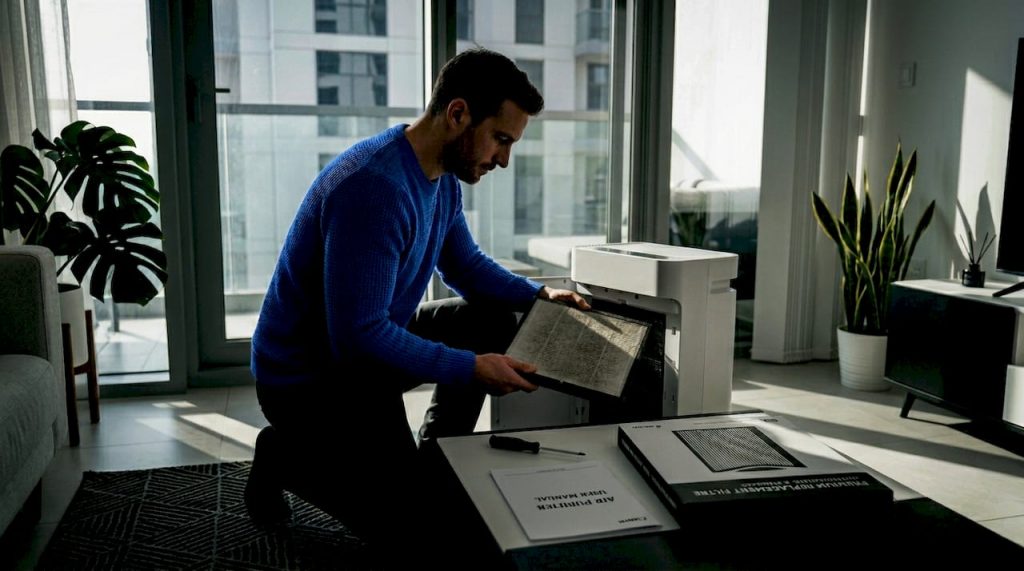
Most filter replacement guides jump straight to “open the back and pull the filter out.” A few preparatory steps make the process cleaner and protect your indoor air quality during the swap. Turn the unit off and unplug it. As an optional but practical step, some technicians recommend running the device on its lowest fan speed for about 30 seconds beforehand to help settle loose dust on the outer filter surface, this can reduce how much particulate shakes loose when you remove the old filter. Have a small plastic bag ready so you can seal the old filter immediately after removal without spreading trapped dust and allergens across the room.
The replacement process and what to check
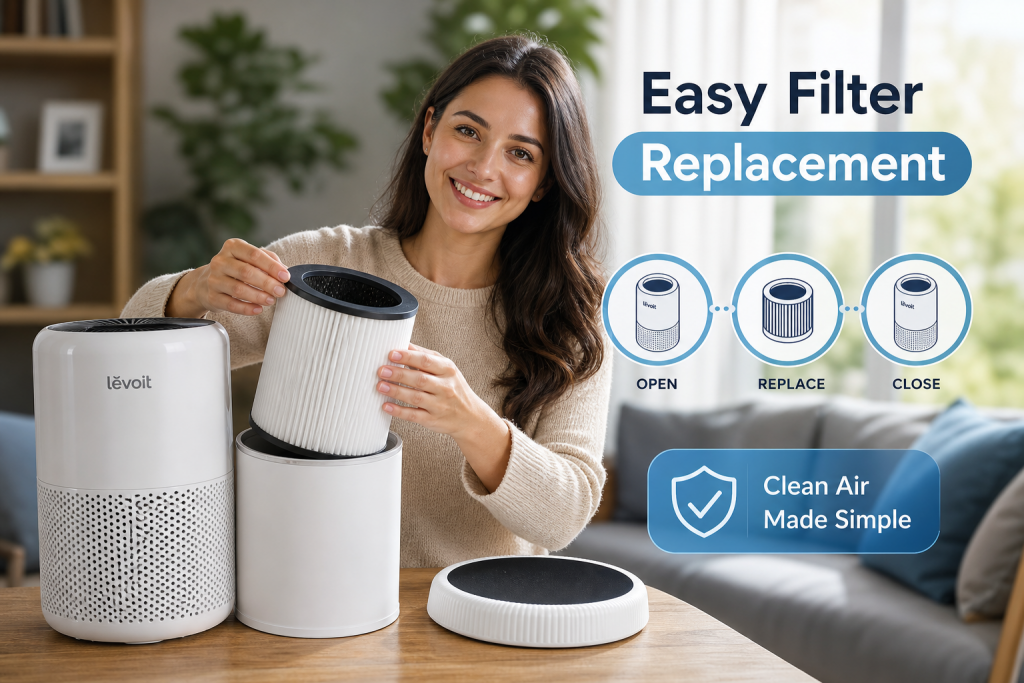
Depending on your Levoit model, the housing opens via a twist-lock base (Core series) or a back panel release. Remove the old filter as a single unit and seal it in the bag immediately. Before inserting the new levoit air purifier filter, check the interior of the housing for dust accumulation and wipe it down with a dry cloth. This prevents loose dust in the housing from loading the new filter on its first run.
Unwrap the new filter and remove the plastic protective film completely. This step is easy to miss, and running the device with the film partially attached restricts airflow significantly. Check the filter orientation before seating it. Core series filters install with the carbon layer facing a specific direction, typically toward the center of the unit. Installing it backwards doesn’t prevent the filter from seating, but it reduces odor absorption effectiveness because the airflow sequence through the layers is reversed. If your unit’s manual specifies orientation, follow it. If it doesn’t, the carbon layer generally faces inward toward the fan. For model-specific filter details and orientation diagrams, consult the manufacturer’s product page such as the LV-H126 replacement filter details.
Resetting the filter indicator light
After installing the new filter and closing the housing, plug the unit back in and power it on. Locate the filter reset button on the control panel, identifiable by a filter icon on most Core series models. Press and hold the button for approximately 3 seconds until the indicator light flashes or turns off, some models may require a slightly longer hold, so consult your model’s manual if the first attempt doesn’t respond. For the Core 400S and Core 600S, the same hold applies, with the option to reset through the VeSync app for smart model variants.
Skipping the reset is a common mistake. If you don’t reset the indicator, it continues counting from where it left off on the old filter’s timer. This means it either triggers again very soon or, if you installed the new filter well before the timer would have triggered, it won’t remind you at the right time for the next replacement. It takes only a few seconds. Do it every time.
Simple habits that make your Levoit filter last longer in UAE conditions
Monthly pre-filter cleaning routine
Levoit recommends cleaning the outer pre-filter monthly under standard conditions. In the UAE, increase that frequency to every two to three weeks during peak dust months, which run roughly from March through May and again from September through November. Use a soft brush or a vacuum cleaner with a brush attachment to remove accumulated dust from the outer mesh. This single habit meaningfully extends the time between full filter replacements because it prevents the pre-filter from loading so heavily that it pushes pressure onto the HEPA media layer beneath.
The cleaning takes about two minutes. Don’t wash the filter with water. Levoit filters are not washable; moisture damages the HEPA media and can cause mold growth inside the unit. Dry brushing or gentle vacuuming is the correct method. Do this consistently and you’ll get noticeably more effective life from each levoit air purifier filter before it needs full replacement.
Placement and fan speed adjustments that reduce filter load
Placement matters more than most people adjust for. The Levoit Core series draws air in from the sides, which means placing the unit within 10 to 15 cm of a wall restricts intake airflow. The motor compensates by working harder, which increases wear on both the device and the filter. Position the unit at least 15 to 20 cm from all walls and furniture. In the center of a room is ideal, though practically any clear position away from corners works well.
Running the device on auto mode, where the sensor modulates fan speed based on detected air quality, is significantly easier on the filter than running it on continuous high speed. During hours when the household is generating less particulate (overnight, for example), the sensor drops fan speed and the filter accumulates less loading. In UAE rooms with a door or window left open, the unit works exponentially harder because it’s effectively trying to clean outdoor air continuously. Keeping doors closed in the room where the purifier operates is a simple habit that extends filter life in a measurable way.
Get the right Levoit air purifier filter and keep it working
This guide comes down to three points. First, levoit air purifier filter compatibility is model-specific and not negotiable. The wrong filter means the device doesn’t work as intended, regardless of what the display shows. Second, in UAE dust conditions, the standard 6 to 8 month replacement guideline doesn’t apply. Plan for 3 to 6 months depending on your environment, inspect the filter regularly, and use visual and performance signals rather than the indicator light alone to decide when to replace. Third, genuine Levoit filters outperform third-party alternatives on material density, HEPA media quality, and filtration integrity, which matters more in the UAE’s high-particulate environment than it would in a less demanding climate.
If you know your Levoit model number, finding the right genuine replacement HEPA filter for Levoit at ClimatePro UAE takes less than a minute. The catalog is organized by model, not by generic category, so there’s no guessing and no cross-referencing part numbers across listings that may or may not be accurate. Check current stock and delivery options at ClimatePro UAE’s site for the most up-to-date availability across Dubai, Abu Dhabi, Sharjah, and every other emirate.
Your purifier does its job only as well as the filter inside it. In the UAE, that filter works harder than it does almost anywhere else in the world. Give it what it needs to keep up.