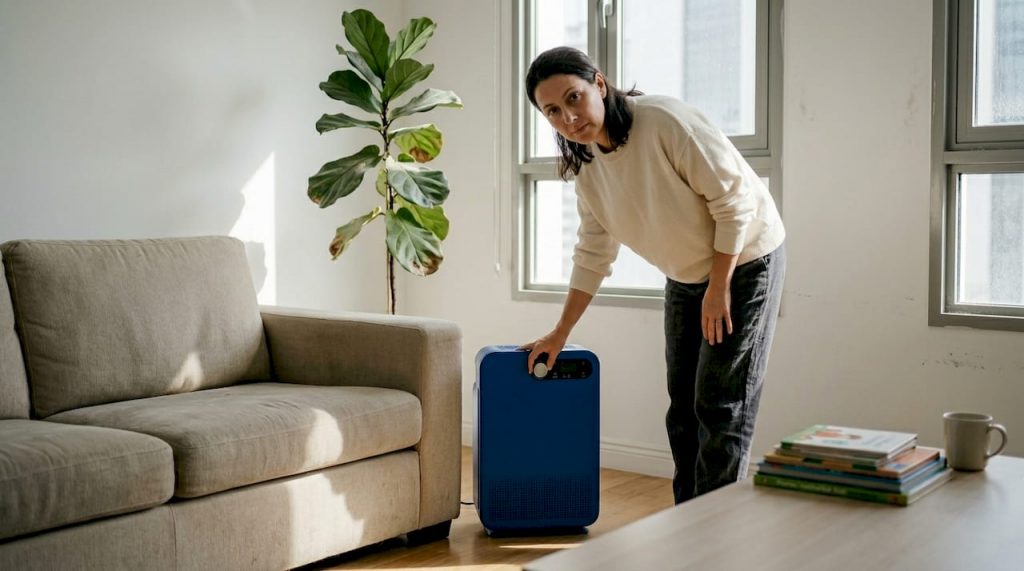
Indoor air in UAE homes carries far more invisible threats than most homeowners realise. Fine desert dust, pollen, mould spores, and pet dander accumulate year-round, even in homes that are cleaned regularly. Not all air filters deal with these particles effectively, and choosing the wrong product means breathing in pollutants that pass straight through the filter media. HEPA filtration is the evidence-backed standard for capturing the particles most likely to trigger allergies and respiratory discomfort, and understanding how it works is the first step to making a genuinely informed choice.
Table of Contents
- What is HEPA filtration?
- Which pollutants does HEPA remove—and which does it miss?
- How HEPA filtration improves air quality and allergy symptoms
- Choosing and maintaining HEPA filters for your UAE home
- Why most UAE households underestimate HEPA—and what really works
- Find the right HEPA solution for your UAE home
- Frequently asked questions
Key Takeaways
| Point | Details |
|---|---|
| HEPA is highly efficient | HEPA filters remove 99.97% of dust and allergens from indoor air at the trickiest particle size. |
| Not all air pollutants are filtered | HEPA captures particulates, but you’ll need extra filtration for gases and odours. |
| Maintenance is crucial | Clogged HEPA filters can re-release pollutants, so timely replacement is essential. |
| HEPA works best for allergy relief | Research shows HEPA filtration significantly reduces allergy symptoms and dust levels. |
| Match purifier to room and climate | Choose HEPA units with the correct CADR and replace filters regularly for best results in UAE homes. |
What is HEPA filtration?
HEPA stands for High Efficiency Particulate Air. It describes a specific class of mechanical filter held to a strict performance standard: 99.97% removal of airborne particles at 0.3 microns, a size known as the most penetrating particle size, or MPPS. Particles at this size are the hardest for any filter to capture, so the 0.3-micron benchmark is deliberately demanding.
The filter itself is made from a dense mat of randomly arranged fibres, typically fibreglass or polypropylene. Particles are captured through three mechanisms: interception (particles following airflow hit a fibre), impaction (heavier particles cannot follow airflow and collide with a fibre), and diffusion (very small particles move erratically and are caught by fibres they contact). Together, these mechanisms make HEPA highly effective across a wide range of particle sizes, including particles both larger and smaller than 0.3 microns.
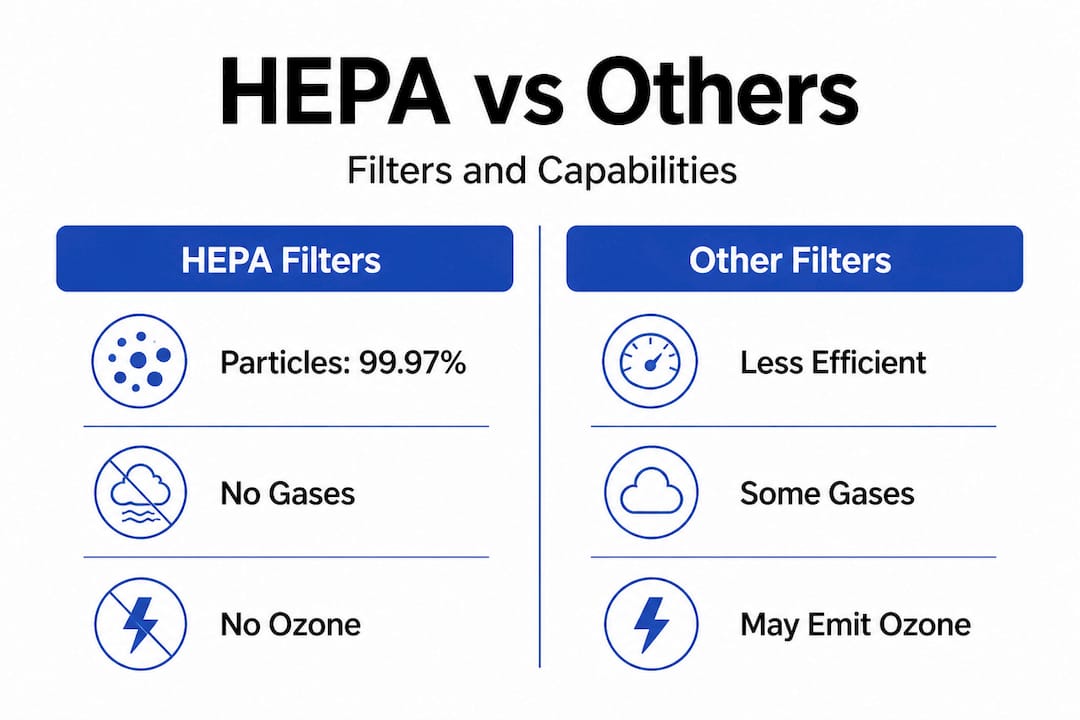
It is worth distinguishing HEPA from other common filter types. MERV (Minimum Efficiency Reporting Value) filters are the standard used in central HVAC systems. They range from MERV 1 to MERV 16, with higher ratings offering better filtration. However, even a MERV 16 filter does not match true HEPA performance. Activated carbon filters target gases and odours rather than particles, making them a complement to HEPA rather than an alternative. The table below summarises the key differences.
| Filter type | Particle removal | Gas/odour removal | Best use |
|---|---|---|---|
| HEPA | 99.97% at 0.3 microns | None | Standalone air purifiers |
| MERV 8-13 | Moderate (PM10, some PM2.5) | None | Central HVAC systems |
| MERV 14-16 | High (most PM2.5) | None | Commercial HVAC |
| Activated carbon | Minimal | Yes (VOCs, odours) | Paired with HEPA |
| Ioniser/UV | Variable, unverified | Partial | Not recommended alone |
As the EPA notes, HEPA is a purely mechanical filter and does not produce ozone or require UV assistance to function. For portable air purifiers, it consistently outperforms MERV-rated filters. However, its high resistance to airflow means it cannot simply replace a standard HVAC filter without significant system upgrades to handle the increased static pressure.
Which pollutants does HEPA remove—and which does it miss?
Understanding HEPA’s scope helps set realistic expectations. The filter excels at capturing solid and liquid particles suspended in air. In a UAE home, these include fine desert dust, pollen tracked in from outdoors, pet dander, mould spores, and many bacteria. All of these fall within the particle size range that HEPA handles reliably.
The core pollutants HEPA captures include:
- Desert dust and PM2.5: Fine particulate matter from sandstorms and vehicle exhaust, common throughout the UAE
- Pollen: Seasonal grass and tree pollen that intensifies during spring months
- Pet dander: Microscopic skin flakes from cats, dogs, and other household animals
- Mould spores: Released when humidity rises indoors, particularly in bathrooms and kitchens
- Dust mite debris: Faecal particles and body fragments that are a leading cause of allergic rhinitis
HEPA filtration captures particulates including dust, pollen, pet dander, and mould spores, but does not remove gases, volatile organic compounds (VOCs), or odours from indoor air.
What HEPA does not remove is equally important to understand. Gases such as nitrogen dioxide, formaldehyde, and VOCs released from paints, furniture, and cleaning products pass straight through a HEPA filter unchanged. Cooking odours, cigarette smoke gases, and chemical fumes are also unaffected by HEPA alone. For complete indoor air quality management, HEPA should be combined with an activated carbon stage that adsorbs gases and odours.
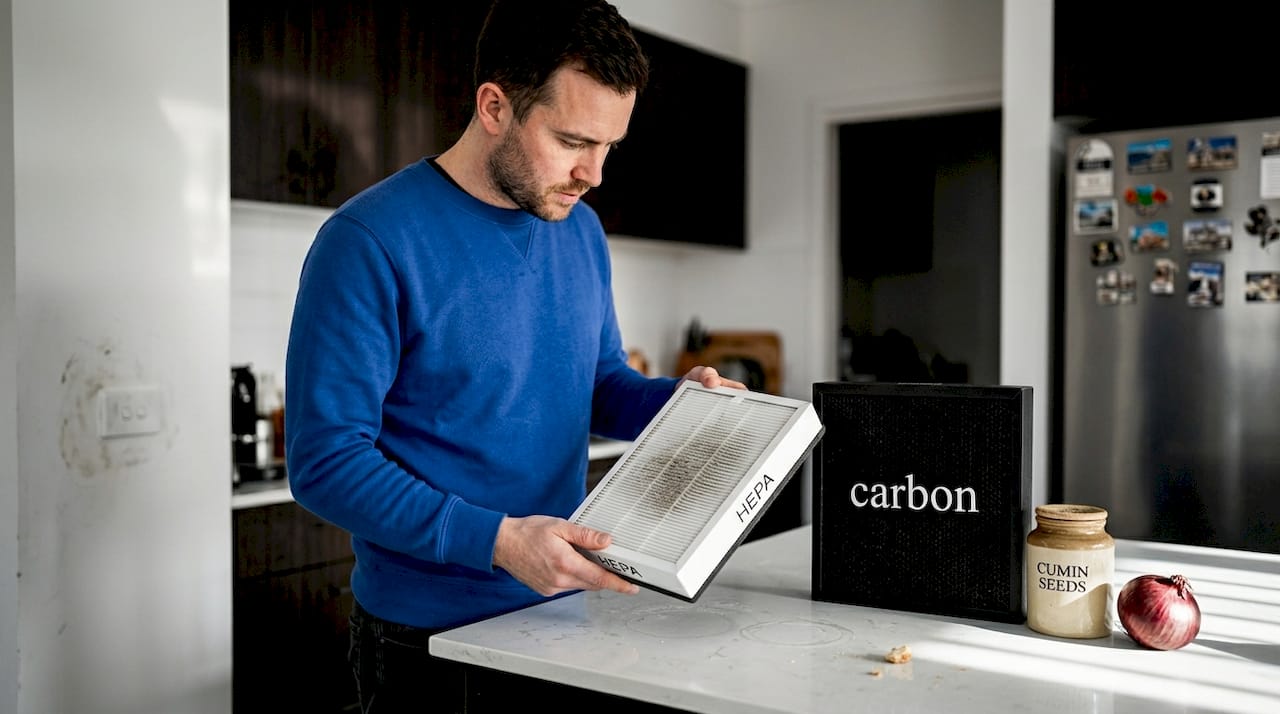
Pro Tip: If your home has both dust and odour concerns, such as cooking smells combined with pet dander, look for a purifier with both a true HEPA stage and a substantial activated carbon layer. Many units labelled “HEPA + carbon” use only a thin carbon pre-filter that provides minimal odour control. Check the activated carbon weight listed in the product specifications before purchasing. Units with central HVAC compatibility often include multi-stage filtration to address both particle and gas removal.
How HEPA filtration improves air quality and allergy symptoms
The performance data for HEPA purifiers is consistent across multiple studies. Research published in 2025 shows that HEPA air purifiers reduce PM2.5 concentrations by 40 to 93% in controlled indoor environments, and reduce measured allergen levels by 50 to 70%. These reductions translate directly into fewer and less severe allergy symptoms for household occupants. For UAE residents who experience persistent rhinitis, asthma, or eczema, the numbers represent a meaningful clinical outcome.
In the UAE specifically, the case for HEPA is even stronger than in temperate climates. Homes are sealed tightly against extreme heat for most of the year, limiting natural ventilation. This allows particulate matter to accumulate at higher concentrations indoors than outdoors. Sandstorm events introduce massive volumes of fine particles that infiltrate even well-sealed buildings. During summer months, recirculated air conditioning can redistribute settled dust back into the breathing zone. A properly sized HEPA unit running continuously addresses all of these scenarios.
To achieve the best results in a UAE home, follow these steps:
-
Calculate your room size accurately. Measure length by width in square metres. HEPA purifiers are rated by CADR (Clean Air Delivery Rate, measured in cubic feet per minute or m³/h), and the unit must be matched to your room’s volume to achieve the recommended air changes per hour.
-
Position the unit strategically. Place the purifier in the room where occupants spend the most time, typically the bedroom or living area. Avoid corners and enclosed spaces that restrict airflow into the intake.
-
Run continuously at a moderate fan speed. Running at the highest setting is not always necessary. A medium fan speed operating 24 hours per day moves more total air than bursts at maximum speed, and it is quieter for sleeping.
-
Keep windows closed during peak dust periods. During shamal winds or sandstorm events, even a brief window opening can introduce more particulate matter than the purifier can clear for several hours.
-
Monitor filter condition regularly. UAE dust loads are heavier than in most other climates. Pre-filters should be checked monthly and cleaned as needed to protect the HEPA stage from premature clogging.
Pro Tip: Use the clean air delivery rate as your primary comparison metric when selecting a unit. A CADR of 141 to 380 CFM covers most standard UAE bedroom and living room sizes. For larger open-plan spaces, look at energy-efficient purifiers with higher CADR ratings that can clean large air volumes without driving up your electricity costs significantly.
Choosing and maintaining HEPA filters for your UAE home
Selecting the right HEPA purifier requires matching the unit to the specific conditions of a UAE home. Several factors determine whether a purifier will actually perform as claimed.
Key criteria to assess before purchasing:
- True HEPA certification: Confirm the product is labelled “True HEPA” or “H13 HEPA.” Filters labelled “HEPA-style” or “HEPA-like” are not held to the same standard and may perform significantly below 99.97% efficiency.
- CADR relative to room size: A general rule is to look for a CADR (in m³/h) that is at least five times your room’s floor area in square metres. For example, a 30 m² room requires a CADR of at least 150 m³/h.
- Multi-stage filtration: Look for a pre-filter to capture large dust particles, a HEPA stage for fine particles, and ideally a carbon stage for gases and odours. UAE conditions demand all three.
- Filter availability and cost: Before purchasing any purifier, confirm that genuine HEPA filter replacement filters are available and affordable locally. Ongoing maintenance costs are often overlooked at the point of purchase.
- Noise output: A unit that is too loud will not be used overnight. Check the decibel rating at medium speed, which is the setting used most often.
- Energy consumption: Purifiers running continuously in UAE homes need to be energy-efficient. Look for units under 50 watts at medium speed to keep running costs manageable.
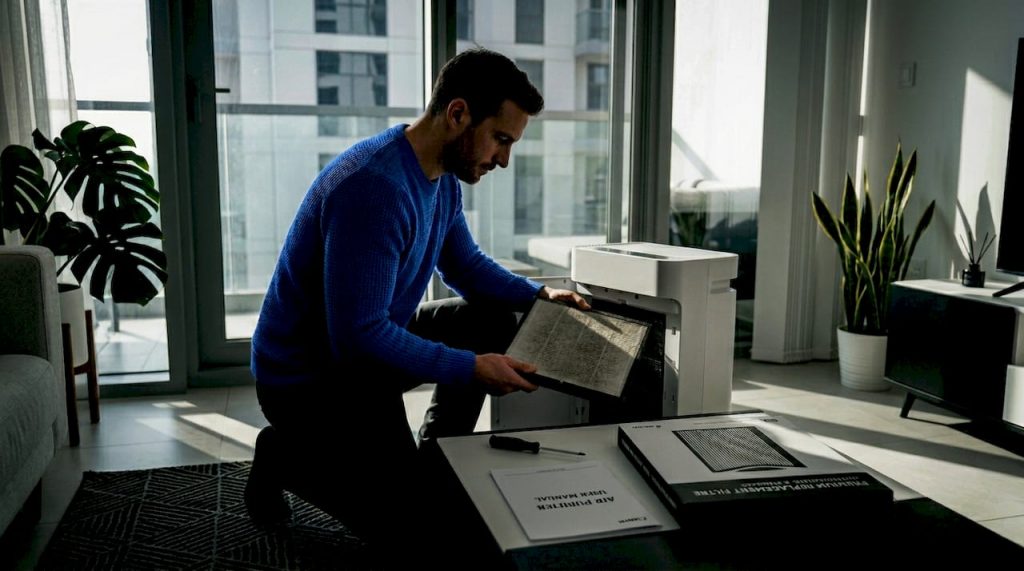
Maintenance is where many homeowners lose the benefits they paid for. Clogged HEPA filters can actually release captured pollutants back into the air when airflow forces particles through saturated filter media. In the UAE, heavy dust loads mean filters reach saturation faster than manufacturer estimates suggest, since those estimates are typically based on average global conditions.
The typical manufacturer recommendation of replacing a HEPA filter every 12 months should be treated as a maximum, not a target. In high-dust periods or households with multiple pets, six-month replacement cycles are more appropriate. Modern HEPA purifiers increasingly include filter life indicators that monitor actual airflow resistance rather than just running hours, which is a more accurate signal of when replacement is needed.
It is also important to understand the HVAC limitation. Standard residential central air conditioning systems in the UAE use low-resistance filters because the system’s fan is not designed to push air through dense HEPA media. Attempting to install a HEPA filter into a standard HVAC slot will reduce airflow to the point where the system may overheat or fail. Portable standalone HEPA purifiers are the practical and safe solution for most homes.
Pro Tip: Set a calendar reminder to inspect your pre-filter every four weeks during peak sandstorm season, which runs roughly from March through June in the UAE. A clean pre-filter significantly extends the life of the more expensive HEPA stage behind it.
Why most UAE households underestimate HEPA—and what really works
There is a persistent belief among UAE homeowners that regular cleaning and running the air conditioning is sufficient for good indoor air quality. It is not. Air conditioning recirculates and cools air but does not remove fine particles. A standard AC filter is typically rated at MERV 4 to MERV 6, meaning it catches large dust but allows PM2.5 and allergens to pass freely into the living space.
The other common error is purchasing a purifier without checking whether it contains a genuine HEPA filter. The air purifier market includes many products with misleading filter descriptions. Some units use ionisers as their primary technology, which charges particles so they fall to surfaces rather than removing them from the environment. Others use thin carbon mats labelled as multi-stage filtration. Neither approach matches the verified particle removal of a certified HEPA unit.
From working with homeowners across Dubai, Abu Dhabi, and Sharjah, we have observed that the households seeing the best outcomes do three things consistently. They size units correctly to their rooms, using the CADR as the primary guide. They replace filters on an accelerated schedule suited to UAE dust levels rather than following global average timelines. And they treat the purifier as a continuous appliance, not one to run occasionally.
The effectiveness data from well-managed HEPA units is not subtle. Allergy sufferers report measurable reductions in morning symptoms within two to four weeks of consistent use. PM2.5 readings in bedrooms running certified HEPA units at night routinely measure well below outdoor levels, even after sandstorm events. That outcome is achievable for any UAE home, but only if the right product is in place and maintained properly.
Find the right HEPA solution for your UAE home
Choosing a reliable HEPA purifier is straightforward when you know what to look for, and ClimatePro UAE stocks products tested and suited to local conditions.

Browse the full air purifier catalogue to compare certified HEPA units by CADR, room size coverage, and filter type, with delivery available across all seven UAE emirates. The Honeywell Air Touch P2 is a consistently popular choice for UAE bedrooms and medium-sized living spaces, combining true HEPA filtration with energy-efficient performance. For homeowners managing humidity alongside dust, the range of humidifiers for UAE homes complements HEPA purifiers by maintaining optimal indoor humidity levels that reduce mould spore activity and ease respiratory symptoms during the drier winter months.
Frequently asked questions
Does HEPA filter all air pollutants?
HEPA filters trap particulates like dust, pollen, pet dander, and mould spores but do not capture gases or VOCs. For complete coverage, combine a HEPA unit with an activated carbon filter stage.
What does 99.97% at 0.3 microns mean for HEPA?
This means a true HEPA filter removes 99.97% of particles at 0.3 microns, the most difficult particle size to capture. Larger and smaller particles are actually captured at even higher rates.
How often should HEPA filters be replaced?
In UAE conditions, replace HEPA filters every six to twelve months depending on dust load, as clogged filters can re-release captured pollutants and reduce unit effectiveness. Check your pre-filter monthly during sandstorm season.
Can HEPA filters be used in central air conditioning systems?
True HEPA filters are generally unsuitable for standard central HVAC systems because their high resistance to airflow limits central HVAC use without substantial system upgrades. Portable standalone purifiers are the practical alternative for most UAE households.
Recommended
- Buy Honeywell Air Touch V4 Compound Anti-Bacterial + HEPA Filter in Dubai | Best Price AED 112 | ClimatePro UAE
- Buy Air Purifiers in Dubai UAE | Best Price AED – ClimatePro
- Buy Blueair Pro Series Particle Filter in Dubai | Best Price AED 268 | ClimatePro UAE
- Buy Dyson 360 Glass HEPA + Carbon Filter in Dubai | Best Price AED 261 | ClimatePro UAE
- Inventor CF-WUHI-F Φίλτρο HEPA για Αφυγραντήρα | euragora.gr