Most portable HEPA purifiers need a filter change every 6 to 12 months, while HVAC-installed HEPA units and larger commercial systems can run 12 to 24 months or longer under performance-based monitoring. The single rule that governs both is to check differential pressure, airflow and pre-filter condition against manufacturer hour-ratings rather than relying on the calendar alone. This approach is backed by PNNL’s 10-year evaluation and widely echoed consumer guidance.
TL;DR:
- Filters in highly polluted or high particulate load environments, such as during wildfire smoke or construction, often need replacement every 3 to 6 months.
- Regularly cleaning pre-filters and managing unit runtime can significantly extend HEPA filter lifespan without sacrificing filtration quality.
- Performance-based testing, including differential pressure and efficiency checks, provides a more accurate indicator for replacement than age alone, especially in regulated settings.
- Consumers should be vigilant for physical discolouration, airflow reduction, or odour resurgence rather than relying solely on indicator lights.
- Matching genuine replacement filters to specific model numbers ensures optimal performance and avoids unnecessary early or delayed replacements.
Table of Contents
- What factors shorten or extend HEPA filter lifespan?
- How often should you replace a HEPA filter by use case?
- What signs tell you a HEPA filter needs replacing?
- How can you extend the life of a HEPA filter safely?
- What performance checks tell you it’s actually time to replace?
- What actually matters most when deciding to replace a filter?
- Where to buy genuine replacement HEPA filters and matching purifiers
- Sources
- FAQ
What factors shorten or extend HEPA filter lifespan?
Runtime is the biggest variable homeowners overlook. A purifier running continuously loads its filter faster in calendar terms than one used for fewer hours during peak pollution windows, even though the actual hours of operation might fall within the same manufacturer rating. Two identical units in two different homes can need replacement months apart purely because of usage patterns.
Particle load matters just as much. A dust storm, nearby construction, or a wildfire smoke event can saturate a HEPA filter in weeks rather than months. Households with pets, smokers, or frequent frying and grilling also push far more particulate matter through the media than a smoke-free apartment with no animals. Regional air quality events tracked in the WHO air quality database show how ambient PM spikes translate directly into faster indoor filter loading.
Humidity plays a quieter but serious role. HEPA media is engineered from pleated fibreglass or synthetic fibres that lose structural integrity when wet. A filter exposed to high humidity or accidental water contact should be replaced immediately, not dried out and reused, because moisture compromises both the fibre matrix and its capture efficiency.
Filter grade also sets the baseline. Pre-filters exist specifically to intercept the coarse dust and hair that would otherwise shorten HEPA life.
Quick reference: what shortens filter life fastest
- Continuous 24/7 runtime in high-pollution environments
- Pets shedding heavily, or a household with active smokers
- Dust storms, renovation work, or wildfire smoke exposure
- High humidity or direct water exposure to the media
- Skipping pre-filter cleaning, forcing raw particle load onto the HEPA layer
Statistic to remember: Consumer guidance places typical portable HEPA replacement between 6 and 12 months under normal household use, but that window compresses sharply once particle load or humidity moves outside typical conditions.
How often should you replace a HEPA filter by use case?
Replacement cadence depends heavily on where the filter sits and what it’s filtering. A studio apartment purifier and a hospital ward’s HVAC-installed HEPA bank are solving very different problems, and treating them the same way wastes money in one direction and risks air quality in the other.
For portable home and office purifiers, the working range is 6 to 12 months. Homes with heavy pet shedding, smokers, or ongoing construction dust nearby should plan for 3 to 6 months instead. Quieter households with good pre-filtering and moderate runtime can sometimes stretch to 14 to 16 months before performance drops meaningfully, a pattern some brands acknowledge when they quote windows of 6 to 15 months depending on model and use.
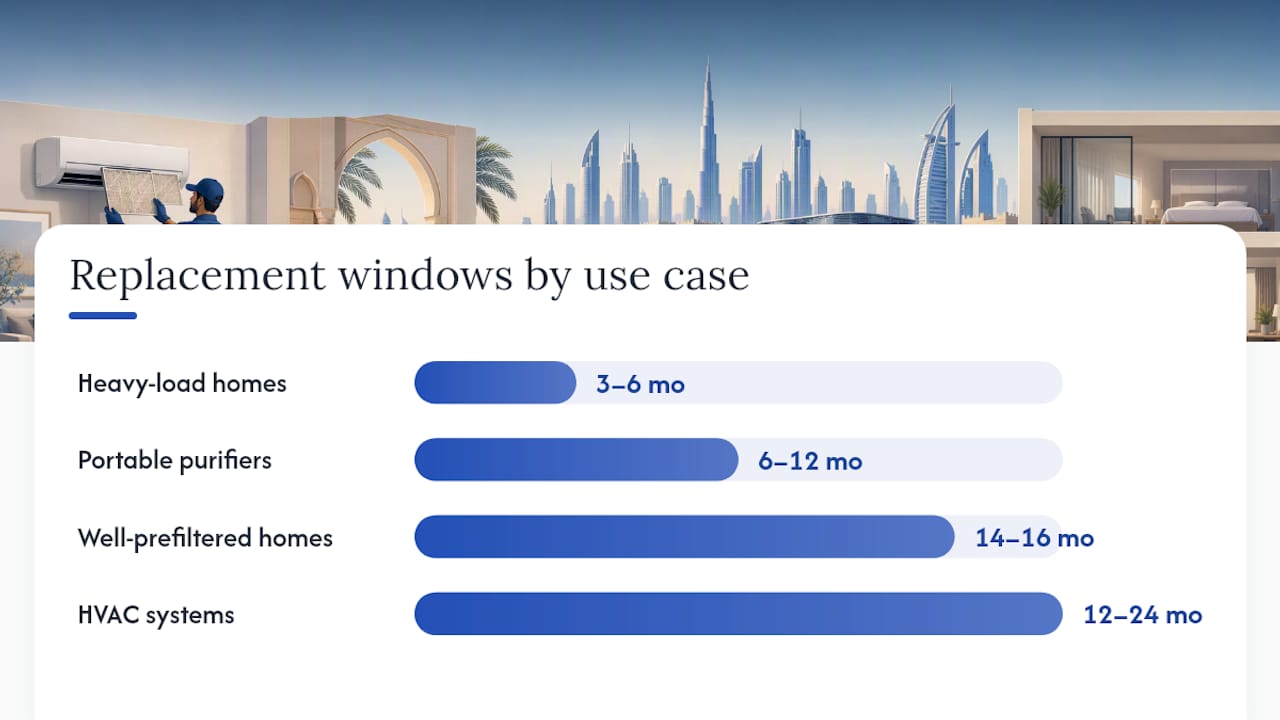
HVAC-installed HEPA filtration, common in offices and larger residential systems, typically runs 12 to 24 months. The wider range reflects differences in system design, duct sizing, and how well upstream pre-filters are maintained. A well pre-filtered system protects its HEPA stage and stretches the interval toward the upper end.
Regulated environments, cleanrooms, and nuclear facilities operate on a different logic entirely. Rather than a fixed calendar date, these settings use performance-based replacement: differential pressure thresholds, particle-efficiency testing, and operational parameters like face velocity and humidity limits determine when a filter comes out. The PNNL 10-year evaluation found filters in dry, controlled conditions often outlasting the conservative DOE age limit, which is why performance monitoring beats a strict age cutoff in these contexts.
Translating hour-ratings into months:
- A filter rated for 4,320 hours equals roughly 180 days at continuous use
- The same rating stretches to 12 months or more if the unit only runs 12 hours a day
- Manufacturer hour-ratings assume moderate particle load; heavy load shortens the effective hours
What signs tell you a HEPA filter needs replacing?
Three categories of evidence matter, and they rarely all appear at once, so it pays to check more than the indicator light.
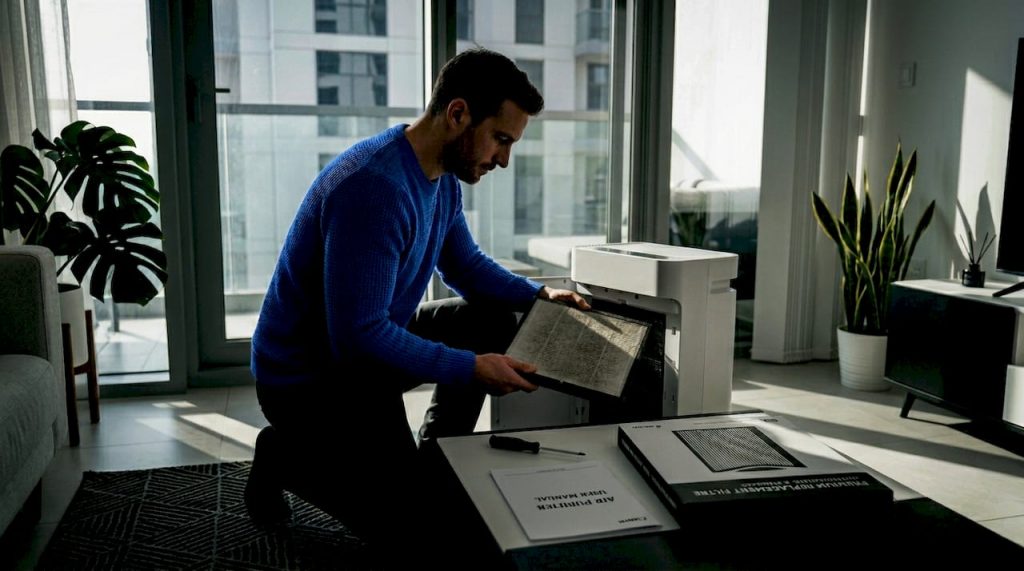
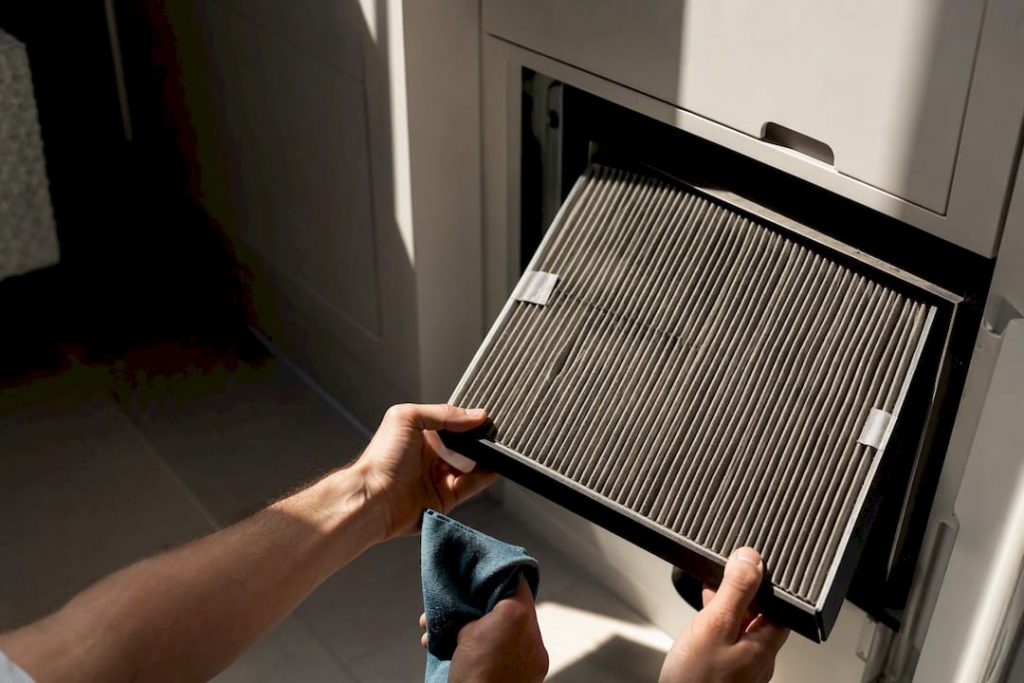
- Visual cues. Discolouration, visible dust caking on the intake side, or physical damage to the pleated media are straightforward tells. A filter that looks grey or brown when it started white has already absorbed a meaningful particle load.
- Performance cues. Rising differential pressure across the filter, noticeably reduced airflow from the outlet, or a motor working harder and louder than usual all point to a filter restricting flow more than it should.
- Health cues. The return of allergy symptoms, persistent odours, or visible smoke haze that the unit previously handled cleanly means the filter’s capture efficiency has dropped below what the room needs.
Indicator lights deserve a caveat. Many are simple runtime counters rather than genuine load sensors, a distinction CleanAirAdviser highlights clearly: a light can flash “replace” on schedule even in a low-dust home, or stay green well past saturation in a high-load one. Treat the light as a reminder to check, not as the final verdict.
Pro Tip: Hold a printed page or your phone torch behind the filter in good light. If dust patches block light unevenly across the media, that’s a stronger replacement signal than any indicator light.
How can you extend the life of a HEPA filter safely?
Pre-filter maintenance is the single most effective lever available to most households. Clean washable pre-filters every 2 to 4 weeks, and replace non-washable ones on the schedule the manufacturer specifies. This one habit reduces how much particulate load ever reaches the HEPA layer, which is the same principle facility operators use when they set performance-based replacement schedules.
Runtime management matters almost as much. Match fan speed to actual need rather than running on high continuously, and reserve boost or turbo settings for genuine high-pollution events like a dust storm or nearby cooking smoke. Position purifiers away from direct dust sources such as doorways or construction zones, and elevate intakes off the floor where floor-level dust concentration is highest.
Extending life without compromising filtration:
- Vacuum or rinse washable pre-filters every 2 to 4 weeks
- Lower fan speed for normal days, reserve boost for events
- Keep units clear of direct dust and cooking exhaust paths
- Replace carbon/odour filters on their own separate schedule
- Never wash a HEPA filter, even if it looks rinseable
Pro Tip: Washing a HEPA filter feels intuitive, but water breaks down the fibre bonding that gives the media its 99.95% capture rate. A washed HEPA filter looks clean but performs far below its rated efficiency afterwards.
After a dust storm or smoke event, check the carbon layer first if odour has returned. Carbon saturates faster than HEPA media in these conditions, and FilterBuy’s guidance notes it often needs replacement well before the HEPA stage does. Inspect the HEPA filter itself afterward for discolouration even if it isn’t due yet.
What performance checks tell you it’s actually time to replace?
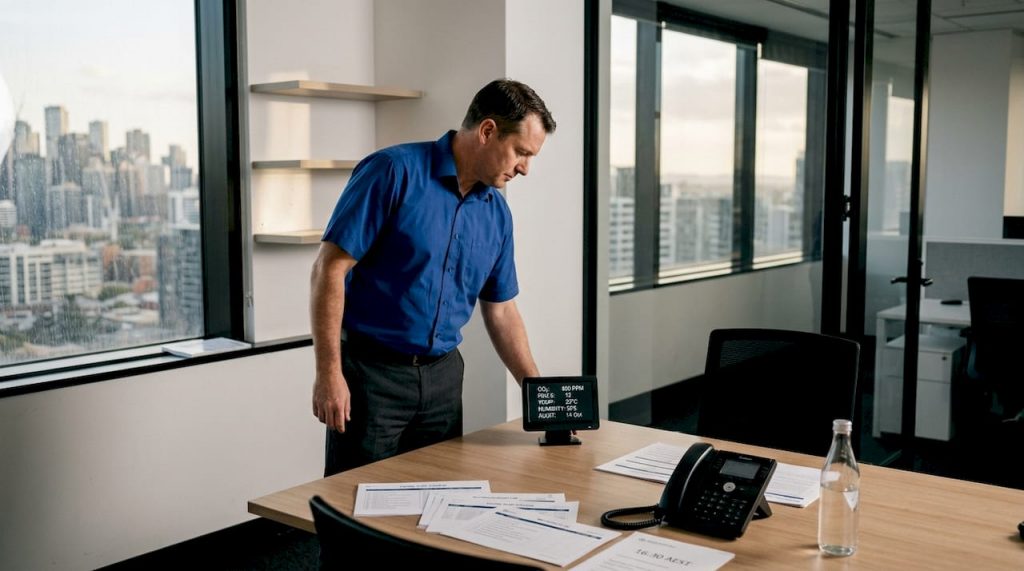
Differential pressure, or DP, measures the resistance a filter creates as air passes through it. As a filter loads with particles, that resistance climbs. Facility operators track DP against a set threshold and replace when it crosses that line, rather than guessing from a calendar date. It’s the same logic the PNNL evaluation used to justify letting filters run well past a conservative age limit in dry, controlled conditions, because DP and efficiency testing showed they still performed.
Efficiency testing is the second pillar. HEPA classification requires capturing at least 99.95% of particles at the 0.3 micron benchmark for H13, with H14 set slightly higher. A formal efficiency test checks whether a filter still meets that threshold, which matters most in clinical settings, cleanrooms, and other regulated spaces where a failed test triggers immediate replacement regardless of age.
For homes and small offices, you won’t run a lab-grade efficiency test, but you can apply the same logic at a simpler level:
- Watch for airflow that noticeably weakens compared to when the unit was new
- Note if a motor runs louder or hotter than usual, a sign of resistance climbing
- Use manufacturer hour-ratings as a baseline, then adjust based on your actual runtime and particle load
- Call a technician for formal DP or efficiency testing in commercial HVAC or clinical settings where compliance matters
Statistic to remember: the PNNL evaluation found low failure rates across 10 years in dry, controlled facilities, reinforcing that performance-based checks, not age alone, should drive replacement decisions in regulated environments. Homeowners can borrow the same principle by watching for the energy penalty a clogged filter creates as fan motors work harder to push air through rising resistance.
What actually matters most when deciding to replace a filter?
Calendar-only replacement is the easy answer and the wrong one for anyone who wants both clean air and reasonable spending. The homeowner who swaps filters religiously every six months regardless of conditions is often replacing a perfectly functional filter early, while the one who waits for a light to flash is often running a saturated filter for months past its useful capacity. Neither extreme serves the room.
The better approach borrows directly from how facility operators think: check pre-filter condition and airflow first, use the calendar as a rough guide rather than a rule, and treat manufacturer hour-ratings as a starting estimate that your specific runtime and particle load will adjust up or down. That habit costs nothing and catches both premature and overdue replacements that a fixed schedule misses.
The trade-off worth naming honestly: early replacement wastes money but never harms air quality, while late replacement risks both reduced filtration and, in HVAC systems, strain on the motor pushing air through a clogged filter. When in doubt, replace early. It’s the cheaper mistake.
— Nevel
Where to buy genuine replacement HEPA filters and matching purifiers
Once you’ve worked out your replacement window, sourcing the right filter matters as much as timing it correctly. Genuine replacement HEPA filters and matching purifier models, including Blueair filter lines and Honeywell Air Touch units, are available, so you’re not guessing whether a generic filter actually fits your unit.

Match the exact SKU to your model number before ordering. A Blueair Classic 500/600 Series filter won’t fit a 200 series housing, and a Blueair Blue 3610 pre-filter serves a different role entirely from the main HEPA cartridge. If you’re running a Honeywell Air Touch P2 or a Honeywell Air Touch P1, check the model plate against the listed compatibility before adding to cart. Browse the full air purifier and filter range to compare current models, or reach out through the site if you’re unsure which filter matches your unit. Getting the right filter, on the right schedule, is a five-minute check that saves months of reduced air quality.
Sources
For the technical detail behind facility-grade replacement thresholds, the PNNL 10-year HEPA lifetime evaluation remains the most rigorous public source. For home and office guidance, CleanAirAdviser, Alen, and FilterBuy each summarise practical replacement windows. Manufacturer documentation for your specific model always takes priority when it conflicts with general guidance.
- Final status: HEPA filter 10‑year lifetime evaluation — PNNL
- How often to replace air purifier filter (2026 guide) — CleanAirAdviser
- How long do HEPA air purifier filters last? — FilterBuy
FAQ
How long should a HEPA filter last?
Portable purifiers typically last 6 to 12 months under normal household use, while HVAC-installed HEPA systems can run 12 to 24 months depending on design and pre-filtering.
How do I know if my HEPA filter needs replacing?
Watch for rising differential pressure, reduced airflow, visible discolouration, or the return of odours and allergy symptoms rather than relying solely on an indicator light, which is often runtime-based, not load-sensing.
How often should I replace my HEPA filter?
Most homes fall in the 6 to 12 month range, but heavy pet shedding, smoking, or nearby construction dust can push that down to 3 to 6 months, while low-load households can sometimes stretch past a year.
How long does HEPA last in regulated facilities?
Cleanrooms and nuclear facilities use performance-based replacement rather than a fixed age. The PNNL evaluation found filters in dry, controlled conditions often outlasting the conservative 10-year DOE age limit when differential pressure and efficiency testing confirm they still perform.