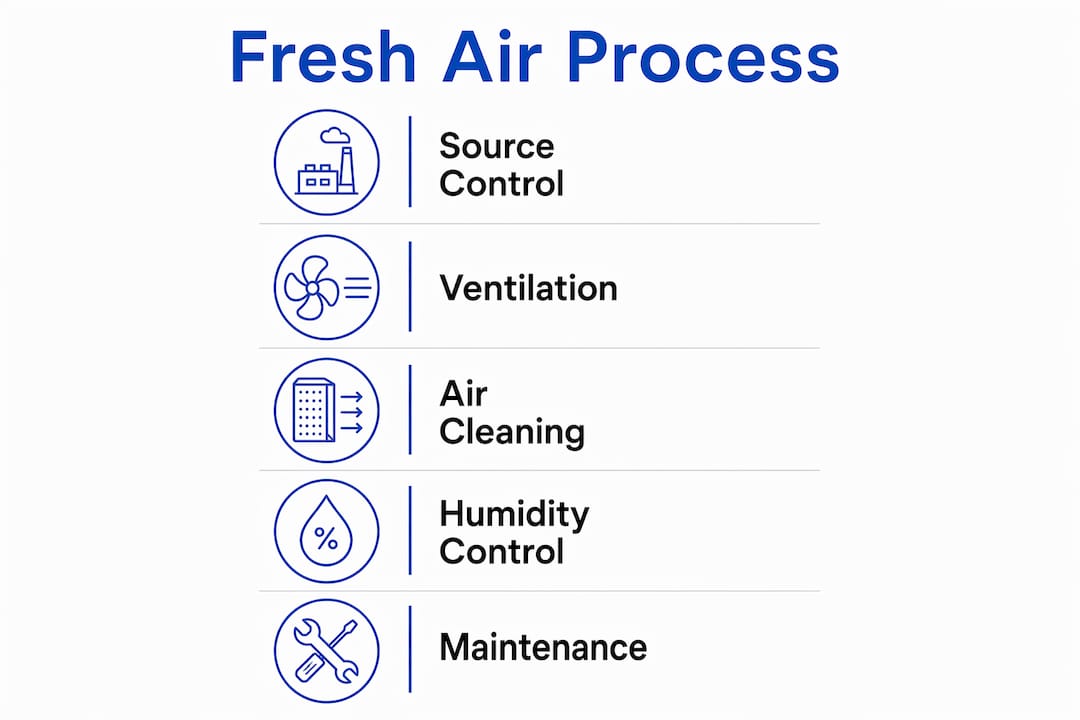
The fresh air process for homes combines three deliberate strategies: source control (eliminating or reducing pollutant origins), controlled ventilation (exchanging stale indoor air with filtered outdoor air), and targeted air cleaning. The single best next step is a quick source-control sweep followed by measuring indoor CO2 and relative humidity, which tells you exactly where to focus effort before spending anything on equipment.
- Source control: fix or remove the pollutant at its origin — gas cooktops, chemical cleaners, damp materials
- Ventilation: use mechanical systems or natural airflow to dilute and remove contaminants
- Air cleaning: portable or in-duct filtration to capture residual particles
EPA guidance consistently identifies source control as the most cost-effective first step, with ventilation and filtration as complementary layers. ASHRAE 62.2 provides the technical benchmark for calculating how much mechanical ventilation a home actually needs. Climatepro’s product pages and blog are practical starting points for matching devices to your specific rooms and conditions.
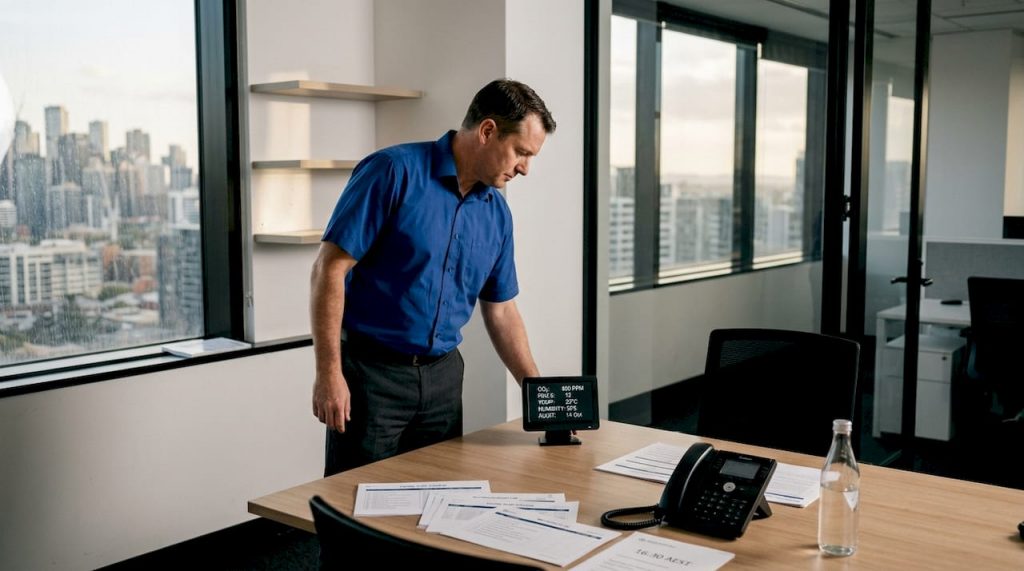
Pro Tip: Measure CO2 and relative humidity before buying any device. A CO2 reading above 1,000 ppm in an occupied room signals inadequate ventilation; a relative humidity reading above 60% signals a moisture problem. Both direct you to different solutions.
Table of Contents
- Why source control, ventilation and air cleaning must work together
- Which whole-house ventilation system suits your Australian home?
- Room-by-room checklist for better air exchange
- How to manage humidity across Australian seasons
- Choosing and maintaining a room air cleaner
- What does a fresh-air system cost to install and maintain?
- How to verify your ventilation is actually working
- When should you call a ventilation professional?
- Key takeaways
- A practical perspective on where homeowners go wrong
- Climatepro: air quality devices matched to your home
- Useful sources and further reading
Why source control, ventilation and air cleaning must work together
Relying on a single strategy rarely delivers sustained indoor air quality improvement. Source control removes the problem at its origin, which is always cheaper than diluting or filtering it away. Ventilation dilutes what remains and removes moisture, CO2 and volatile organic compounds (VOCs). Air cleaning captures fine particles that ventilation alone cannot eliminate.
ASHRAE 62.2 sets ventilation rates based on floor area and occupancy, giving homeowners a defensible method for sizing mechanical ventilation rather than guessing.
Humidity is a modifier that affects all three pillars. The EPA recommends keeping indoor relative humidity between 30% and 50%; sustained levels above 60% raise the risk of mould and bacterial growth. In practice, high humidity can accelerate off-gassing from building materials and reduce the effectiveness of HEPA filters by clogging them faster.
Outdoor air quality adds another layer of complexity for Australian homeowners. During bushfire smoke events, opening windows to ventilate can introduce PM2.5 at levels far above safe thresholds. The correct response is to temporarily close the building, run HEPA air cleaners on recirculation, and resume ventilation once outdoor air quality recovers.
Pro Tip: During a bushfire smoke event, set your HVAC to recirculate rather than draw outdoor air. A HEPA H13 unit running in the main living area provides a meaningful buffer while outdoor conditions are poor.
Which whole-house ventilation system suits your Australian home?
Whole-house mechanical ventilation falls into four categories, each with different implications for pressure, moisture and energy use.
| System type | How it works | Pressure effect | Best suited to |
|---|---|---|---|
| Exhaust-only | Fans exhaust stale air; outdoor air enters through gaps | Negative (depressurises) | Dry, cool climates; older leaky homes |
| Supply-only | Fan draws outdoor air in via HVAC return | Positive (pressurises) | Dry climates; homes with combustion appliances |
| Balanced (no recovery) | Equal supply and exhaust fans, no heat exchange | Neutral | Mild climates; retrofit situations |
| HRV / ERV | Balanced with heat (HRV) or heat + moisture (ERV) recovery | Neutral | Energy-efficient and well-sealed homes |
Exhaust-only systems are the simplest and cheapest, but in hot, humid Australian climates they can depressurise a home and draw moist air into wall cavities, creating hidden condensation and mould. Coastal Queensland, the Northern Territory and tropical Western Australia are high-risk zones for this outcome.
ERVs transfer both heat and moisture; HRVs transfer sensible heat only. Where latent loads are high, as they are across much of coastal and tropical Australia, an ERV is generally the better choice because it moderates incoming humidity rather than simply exchanging it. In cooler, drier climates such as inland Victoria or the ACT, an HRV is often sufficient and slightly more efficient at heat recovery.
Airtightness is a prerequisite. Installing a balanced ventilation system in a leaky home wastes energy and delivers unpredictable airflow. Sealing the building envelope before commissioning ventilation is the correct sequence. For guidance on integrating ERV or HRV with home energy management, pairing ventilation controls with a broader energy system is increasingly practical.
Pro Tip: Ask your installer for the home’s estimated air changes per hour before specifying a system. A very leaky home may need sealing work before balanced ventilation delivers its full benefit.
Room-by-room checklist for better air exchange
- Kitchen: Use a rangehood vented directly outdoors, not recirculating. Run it during cooking and for a short time after to clear residual combustion products and moisture. Gas cooktops produce NO2 and CO; a correctly rated rangehood is the single most impactful spot ventilation upgrade in most homes.
- Bathrooms: Run the exhaust fan during every shower and for some time after. Continuous-run low-wattage fans are more effective than intermittent use. Check that the fan is ducted to the outside, not into the roof cavity.
- Laundry: Exhaust the dryer outdoors and run a spot fan or dehumidifier when hand-washing or air-drying indoors. Drying clothes inside without ventilation can raise room humidity by a significant margin.
- Bedrooms: People spend roughly a third of their lives in bedrooms, making air quality here particularly important. A trickle vent or a small balanced supply point works well. A portable HEPA air cleaner positioned near the bed provides effective particle reduction during sleep.
- Living areas: These rooms benefit most from whole-house supply ventilation or a higher-CADR portable unit. Position the air cleaner away from walls and furniture to allow unrestricted airflow.
- Apartments and older homes: Whole-house ducted systems are often impractical. Prioritise spot exhaust fans in wet areas, portable HEPA units in bedrooms and living rooms, and apartment ventilation strategies that work within existing building constraints.
How to manage humidity across Australian seasons
Keeping indoor relative humidity between 30% and 50% protects both occupants and the building structure. Sustained levels above 60% raise the risk of mould and bacterial growth; below 30%, respiratory mucous membranes dry out and static electricity increases.
| Condition | Recommended action | Typical Australian context |
|---|---|---|
| RH consistently above 60% | Run a dehumidifier; increase exhaust ventilation | Coastal QLD, NT, tropical WA in wet season |
| RH 50%–60% | Increase ventilation; check for moisture sources | Most capital cities in summer |
| RH 30%–50% | Maintain current strategy | Target band for all climates |
| RH below 30% | Add a humidifier; check heating system type | Inland areas, Canberra in winter |
In summer across humid coastal zones, the priority is dehumidification and exhaust ventilation. In winter in drier inland areas, reverse-cycle heating can strip humidity below comfortable levels, making a humidifier a practical addition. An ERV helps moderate both extremes by transferring moisture between incoming and outgoing air streams, reducing the swing between seasons.
Pro Tip: Place a standalone RH sensor in the bathroom and laundry as well as the main bedroom. These rooms drive most of a home’s moisture load, and monitoring them separately reveals problems that a single living-room sensor will miss.
Choosing and maintaining a room air cleaner
Portable HEPA air cleaners reduce particulate levels effectively but do not remove most gases or VOCs. HEPA H13 grade captures particles down to 0.1 microns at 99.95% efficiency, which covers PM2.5, dust mite allergens, mould spores and most airborne bacteria. Standard HEPA (H11 or H12) captures less at the fine end of the particle range.
Sizing a unit:
- Measure the room area in square metres
- Multiply by ceiling height to get volume
- Choose a unit whose CADR (Clean Air Delivery Rate) delivers at least 4–5 air changes per hour for bedrooms, or 3 for living areas
- Place the unit away from walls, not tucked into a corner, to allow full airflow circulation
| Room type | Recommended air changes per hour | Placement priority |
|---|---|---|
| Bedroom | 4–5 | Near the bed, not directly facing it |
| Living area | 3–4 | Central, away from walls |
| Home office | 4 | Near the occupant’s breathing zone |
Maintenance schedule:
- Pre-filter: clean or replace every 2–4 weeks depending on dust load
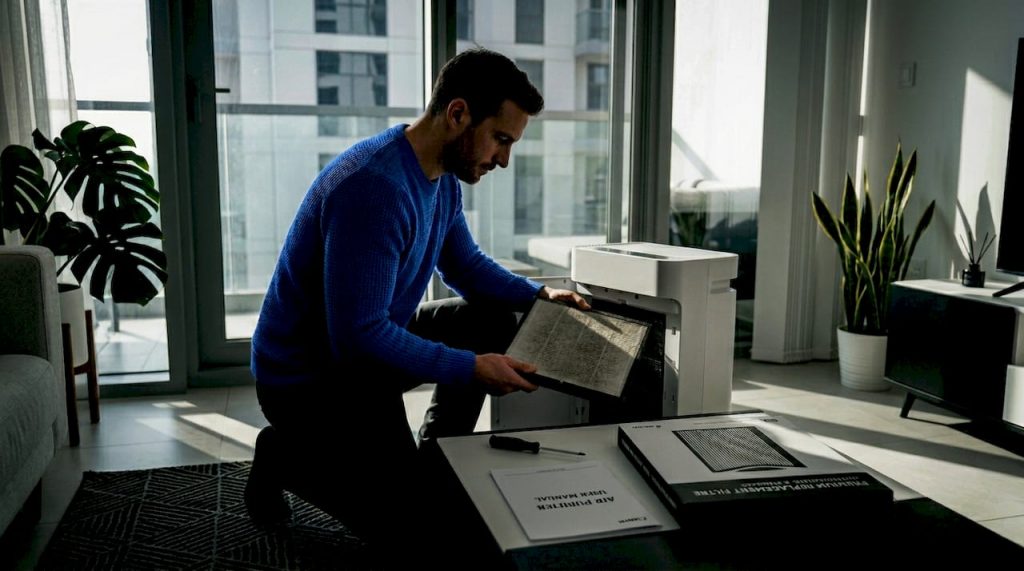
- HEPA H13 filter: replace every 6–12 months; sooner in high-dust or high-smoke environments
- Activated carbon layer: replace every 3–6 months if odour or VOC control is a priority
- Check CADR performance annually; a unit running on a clogged filter delivers a fraction of its rated output and strains the motor
Neglected filters reduce filter efficiency and increase energy consumption. Keeping a replacement filter on hand avoids gaps in protection.
What does a fresh-air system cost to install and maintain?
Realistic budget guidance: Spot ventilation upgrades (rangehood replacement, bathroom exhaust fans) typically cost a few hundred dollars installed. Whole-house balanced HRV or ERV systems for an average Australian home range from several thousand dollars for equipment and installation, depending on home size, duct complexity and system specification. Portable HEPA air cleaners sit at a wide range of price points. Ongoing costs include filter replacements every 3–6 months and annual core cleaning for HRV/ERV units to maintain 70–80% recovery efficiency.
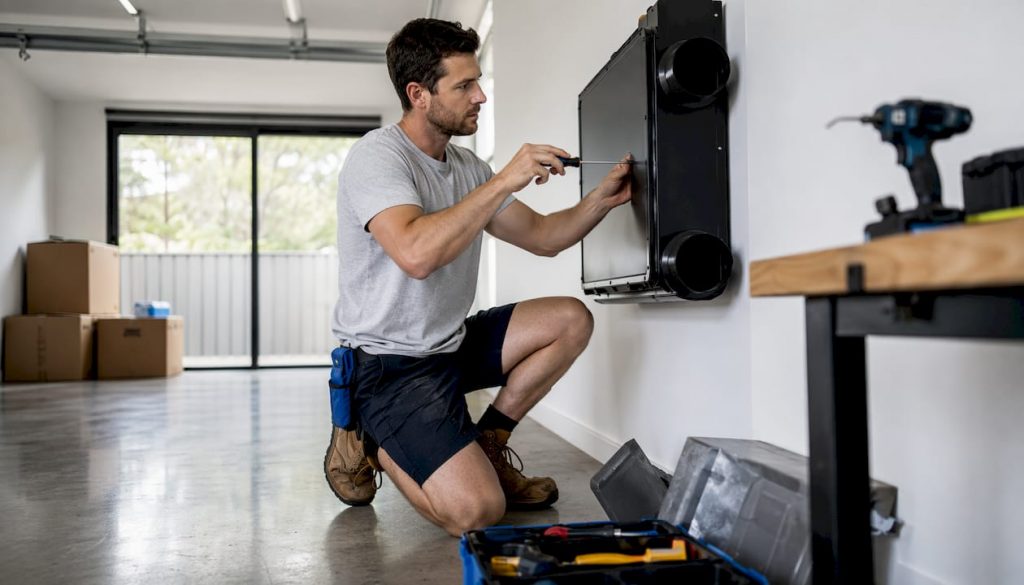
A practical installation sequence: assess the home’s airtightness and pollutant sources first, seal obvious gaps, install ventilation, then commission with airflow measurement. Professional commissioning using a balometer or manometer balances airflow to within ±5–10%, preventing short-circuiting where supply and exhaust points are too close together. Skipping commissioning is the most common reason a correctly specified system underperforms.
How to verify your ventilation is actually working
- CO2 monitoring: CO2 is a reliable proxy for ventilation adequacy. Outdoor CO2 sits around 420 ppm. Well-ventilated occupied rooms typically stay below 800–1,000 ppm. Sustained readings above 1,000 ppm indicate insufficient fresh air exchange.
- Relative humidity sensors: Place sensors in bathrooms, laundry and bedrooms. Target the 30%–50% band for relative humidity; sustained readings above 60% in any room after ventilation is running signal a moisture source or inadequate exhaust capacity.
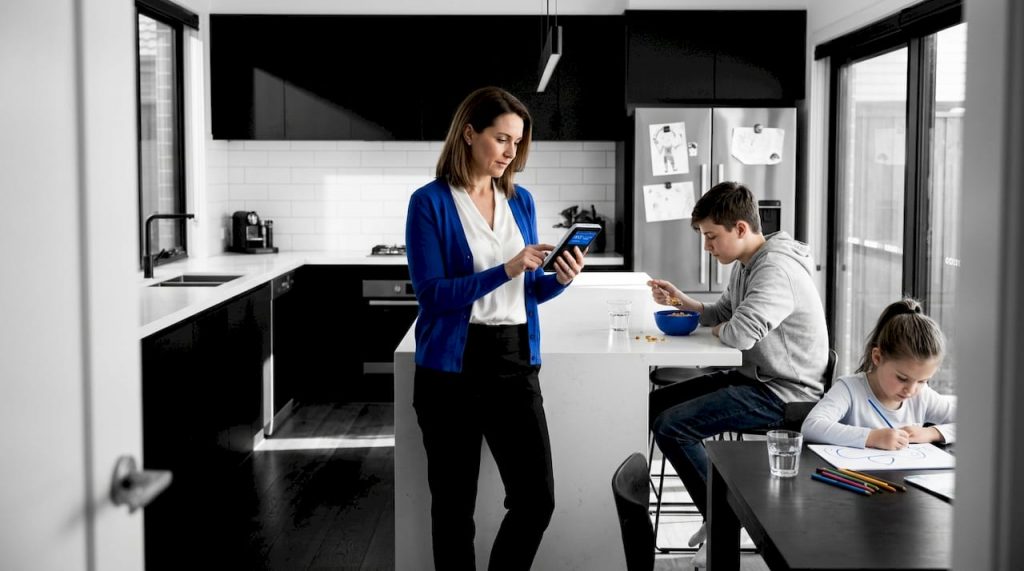
- IAQ monitors: Multi-parameter units measuring PM2.5, VOCs and CO2 simultaneously help identify spikes tied to specific activities (cooking, cleaning, sleeping). Interpret spikes relative to your home’s baseline rather than against a single threshold.
- ASHRAE 62.2 as a benchmark: Use the standard’s ventilation-rate formula (based on floor area and number of bedrooms) to verify whether your mechanical system is delivering the calculated minimum. Where possible, have an installer confirm actual airflow with measurement tools rather than relying on fan specifications alone.
When should you call a ventilation professional?
Call a professional when:
- Mould returns after cleaning and basic ventilation improvements
- Humidity remains above 60% despite running exhaust fans and a dehumidifier
- You cannot achieve balanced airflow or the home feels stuffy in all rooms regardless of fan operation
- You are installing a whole-house HRV or ERV in a home with existing HVAC ductwork
Questions to ask at quote stage:
- Will you conduct an airtightness test before specifying the system?
- How will you balance supply and exhaust airflow, and what tools do you use?
- What is the estimated air changes per hour after installation?
- Will the ERV or HRV integrate with the existing HVAC system?
- Who supplies replacement filters and cores, and what is the recommended service interval?
- What warranty covers the unit and the installation labour?
A professional who cannot answer the airflow-balancing and commissioning questions clearly is worth reconsidering. Proper balanced ventilation design is a technical process, not a straightforward fan installation.
Key takeaways
The most effective fresh-air process for homes combines source control first, correctly sized ventilation second, and targeted air cleaning third, with humidity kept between 30% and 50% throughout.
| Point | Details |
|---|---|
| Source control comes first | Fix pollutant origins before buying devices — it delivers the highest IAQ gain per dollar. |
| Humidity target: 30%–50% | Sustained relative humidity above 60% raises mould risk; monitor wet rooms separately with dedicated sensors. |
| ERV suits humid Australian climates | ERVs transfer both heat and moisture, making them the better choice for coastal and tropical zones. |
| Size air cleaners by CADR | Target 4–5 air changes per hour for bedrooms; replace HEPA H13 filters every 6–12 months. |
| Climatepro for devices and filters | Climatepro stocks HEPA air purifiers, dehumidifiers, humidifiers and replacement filters suited to residential IAQ needs. |
A practical perspective on where homeowners go wrong
Most homeowners reach for a purifier before they have identified what they are actually trying to remove. That sequence is understandable but often wasteful. A gas cooktop without an outdoor-vented rangehood, a bathroom fan ducted into the roof cavity, or a laundry with no exhaust will keep generating pollutants and moisture faster than any portable unit can address them. The device becomes a band-aid over a process problem.
The other common gap is commissioning. A well-specified HRV or ERV installed without airflow measurement can short-circuit, meaning supply and exhaust points are close enough that fresh air exits before mixing with room air. The system runs, the energy bill arrives, and the indoor CO2 barely moves. Spending a few hundred dollars on professional commissioning after installation is one of the highest-return steps in the whole process.
Seasonal planning matters too. Australian homes face genuinely different challenges in summer humidity and winter dryness depending on their climate zone. A strategy that works in July in Melbourne needs adjustment by January. Revisiting CO2 and RH readings at the start of each season takes ten minutes and tells you whether your current setup is still adequate.
Climatepro: air quality devices matched to your home
Climatepro stocks a curated range of HEPA air purifiers, dehumidifiers and humidifiers selected for residential and small commercial spaces. Whether you need a compact bedroom unit, a higher-capacity living-area purifier, or a dehumidifier for a humid coastal home, the range covers the main use cases this article addresses.

For readers ready to act on the room-by-room checklist above, the Honeywell Air Touch P2 is a practical bedroom starting point, while the Honeywell Air Touch U1 suits larger living areas. Replacement filters are stocked alongside units so maintenance gaps are not a barrier. Browse the full range at Climatepro and use the product guides to match a unit to your room size and specific concern, whether that is dust, allergens, pet odours or humidity control.
Useful sources and further reading
- EPA: What can I do to improve indoor air quality in my home? — source control, ventilation and filtration hierarchy
- EPA: Improving indoor air quality — source control as the primary strategy
- US Department of Energy: Guide to Home Ventilation — spot and whole-house ventilation types
- HVI: Mechanical Ventilation Types — ASHRAE 62.2 ventilation rate calculations
- Building America Solution Center: Whole-House Ventilation Strategies — system selection and commissioning guidance
- Climatepro blog: Energy recovery ventilation explained — HRV and ERV operation and selection
- Climatepro blog: Humidity control workflow — step-by-step seasonal humidity management
- Climatepro blog: Apartment ventilation guide — airtightness and ventilation for apartments