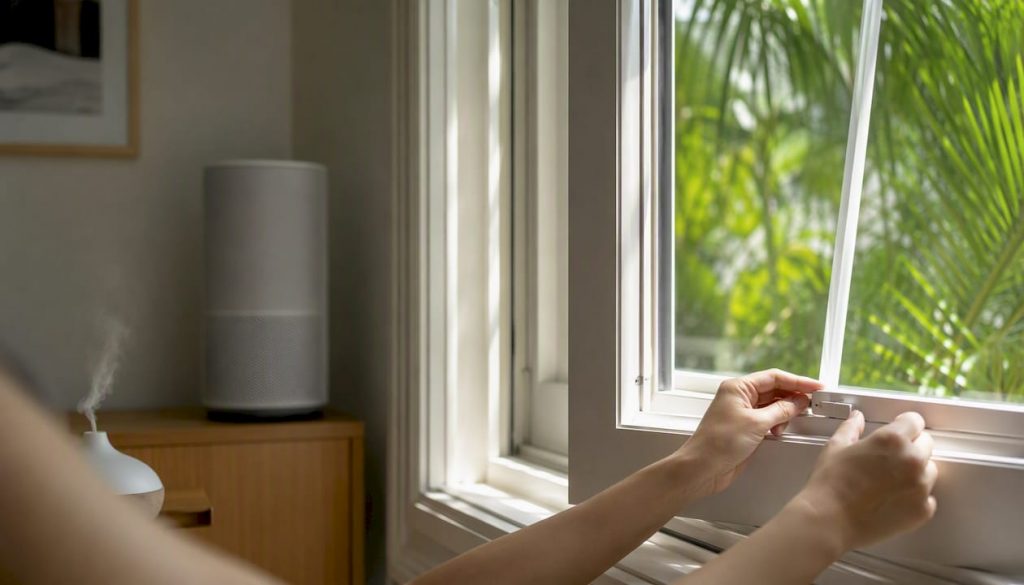
The fastest, lowest-impact way to improve home air quality is a three-layer approach: stop the source, boost ventilation, then add targeted filtration only where necessary. This sequence, supported by the EPA and confirmed by a comprehensive MDPI review, keeps energy use and waste to a minimum while delivering measurable results. Eco-friendly air cleaning methods work best when applied in order, not all at once.
Start today with these three steps:
- Open windows on opposite sides of the home for 10–15 minutes to flush stale air.
- Identify and remove or reduce the main pollutant source (cleaning sprays, gas cooking without rangehood, indoor smoking).
- Run a HEPA H13 portable purifier in the room where occupants spend the most time, sized correctly to that room’s volume.
Key takeaways
The most effective eco-friendly air cleaning strategy for Australian homes combines source control, ventilation, and HEPA H13 filtration applied in that order, with filtration reserved for smoke events, allergy conditions, or airtight dwellings.
| Point | Details |
|---|---|
| Layer your approach | Apply source control first, ventilation second, and HEPA filtration only where the first two are insufficient. |
| Size filtration correctly | Use the formula Room volume (m³) × Target ACH = Required CADR (m³/h) to avoid over- or under-sizing a unit. |
| Avoid ozone devices | EPA guidance is unambiguous: ozone generators are unsafe for occupied indoor spaces and should not be used at home. |
| Plants supplement, not replace | Cordyline fruticosa removed up to 87.5% of VOCs in controlled lab conditions; real-world particulate removal requires mechanical filtration. |
| Climatepro for targeted filtration | Climatepro’s HEPA H13 purifiers and dehumidifiers suit the filtration layer for Australian homes, with genuine replacement filters available. |
Table of Contents
- What are the core eco-friendly air cleaning strategies?
- How do ventilation options compare for Australian homes?
- How do you size and use filtration responsibly?
- Do indoor plants actually clean the air?
- Are UV, ionisers and ozone generators safe to use at home?
- How do you keep air cleaning genuinely eco-friendly?
- What should you look for when buying and maintaining a purifier?
- What changes during bushfire smoke, coastal conditions and high humidity?
- What does the evidence actually show?
- A practitioner’s view on real-world air quality decisions
- Climatepro’s range for Australian-style air quality needs
- Sources
What are the core eco-friendly air cleaning strategies?
Indoor air quality experts organise sustainable air purification into three layers, each with a different environmental cost and a different ceiling of effectiveness.
Source control is the most efficient layer. Switching from solvent-based cleaning products to low-VOC alternatives, using an exhaust rangehood when cooking, sealing combustion appliances, and banning indoor smoking eliminates pollutants before they disperse. No energy, no filters, no waste. For most well-ventilated Australian homes, source control alone reduces VOC concentrations significantly.
Ventilation is the second layer. Diluting and removing pollutants with outdoor air costs far less energy than running a purifier continuously, and it handles CO2, moisture, and odours that mechanical filters cannot. Ventilation is preferred over filtration wherever outdoor air quality is acceptable, which in most Australian suburbs it is on most days.
Filtration becomes necessary when outdoor air quality is poor (bushfire smoke, high pollen), when occupants have asthma or allergies, or when a home is too airtight to ventilate adequately. A portable HEPA cleaner sized correctly to the room adds a targeted, controllable layer without committing to whole-house ducted systems.
- Source control: zero energy, zero consumables, highest return on effort.
- Ventilation: low energy, no consumables, handles gases and CO2.
- Filtration: moderate energy, filter consumables, best for particles and smoke.
Pro Tip: For homes with allergy sufferers or infants, apply all three layers simultaneously in sleeping areas. Source control and ventilation reduce the total pollutant load; filtration catches the residual fine particles that ventilation cannot remove.
How do ventilation options compare for Australian homes?
Natural ventilation is the lowest-impact choice and works well in most Australian climates for much of the year. Cross-ventilation, achieved by opening windows on opposite sides of the home, creates airflow that dilutes CO2 and removes moisture-laden air without any electricity. The practical limit is outdoor air quality: during bushfire season or high-pollen days, opening windows imports more pollutants than it removes.
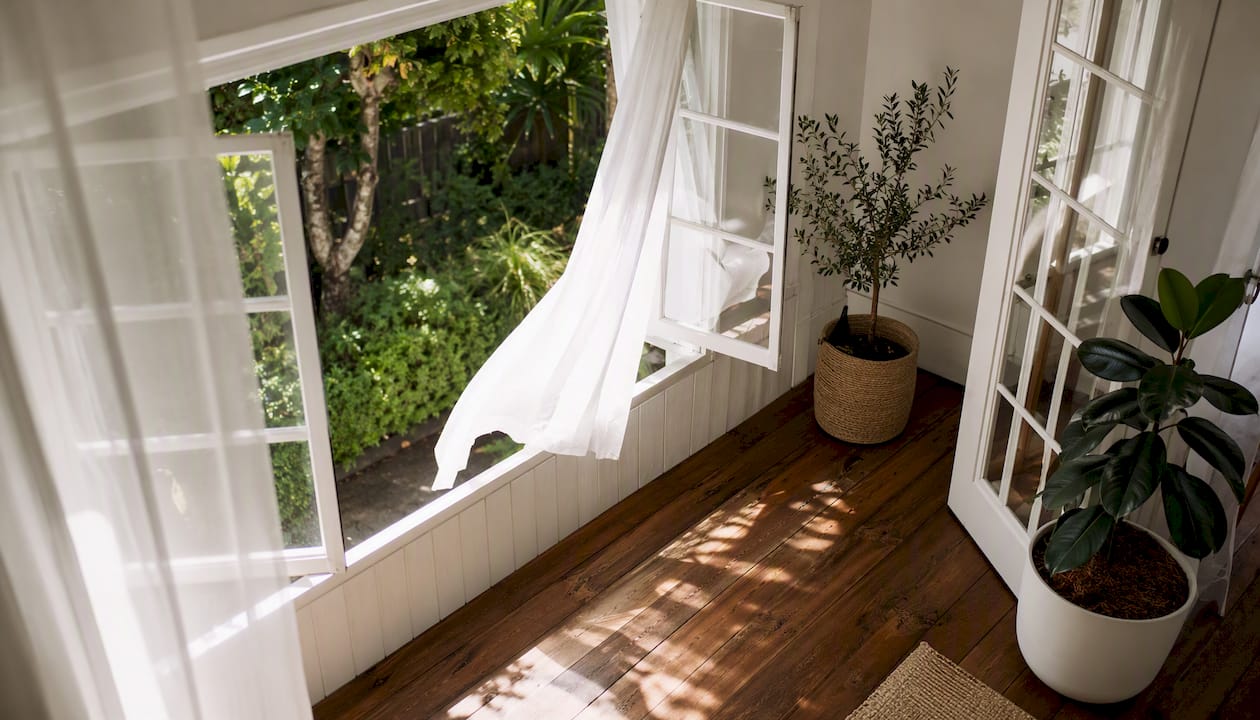
Mechanical ventilation fills the gap. Exhaust fans in bathrooms and kitchens remove moisture and combustion by-products at the source. Supply ventilation systems push filtered outdoor air into living areas, maintaining positive pressure that reduces infiltration of uncontrolled outdoor air. Apartment ventilation in tightly sealed newer buildings often depends entirely on mechanical systems because natural airflow is insufficient.
When does a home need mechanical ventilation?
- The home was built or retrofitted to high airtightness standards (common in newer builds after the NCC 2022 energy provisions).
- Indoor relative humidity consistently exceeds 60%, indicating inadequate moisture removal.
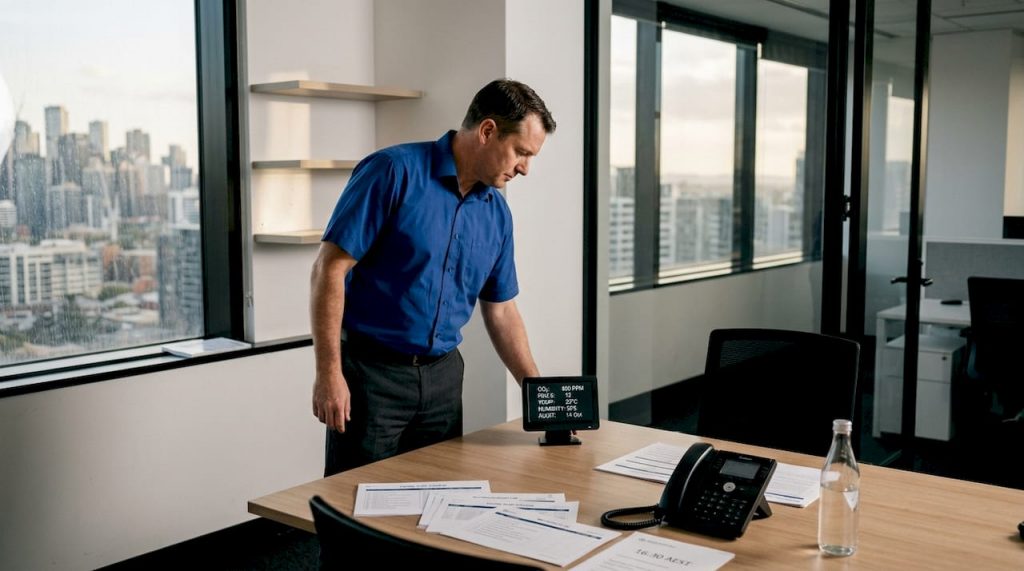
- CO2 levels in occupied rooms regularly exceed 1,000 ppm (measurable with a low-cost sensor like the Aranet4 or CO2Meter).
- Occupant density is high relative to floor area (shared houses, home offices with multiple people).
Energy recovery ventilators (ERV) and heat recovery ventilators (HRV) are the energy-wise answer for airtight homes. ERVs also transfer moisture, making them better suited to humid climates like coastal Queensland or Darwin. HRVs suit drier, cooler climates like Canberra or alpine Victoria. ERV benefits for homeowners are well documented for airtight dwellings.
- To reduce heating/cooling losses when ventilating: ventilate during mild parts of the day, use trickle vents rather than fully open windows, and consider a programmable timer on exhaust fans.
How do you size and use filtration responsibly?
Mechanical filtration is a tool, not a default. When it is needed, choosing the right filter class and sizing the device correctly determines both effectiveness and environmental cost.
HEPA H13/H14 and why filter class matters
For fine particles, smoke, and allergens, these classes are the relevant standard. EPA guidance confirms that HEPA filters capture a high fraction of airborne particles, including those carrying viruses and fine smoke particulates. Lower-rated filters (MERV 8–11) handle coarser dust but allow fine particles through.
ASHRAE’s position document on filtration recommends MERV 13 or higher for HVAC systems and supports HEPA-class portable units for targeted room cleaning, particularly where vulnerable occupants are present.
ACH, CADR and room sizing
ACH (Air Changes per Hour) measures how many times a purifier processes the room’s total air volume each hour. For general use, 4–5 ACH is the target; for allergy or smoke situations, 5–6 ACH is preferable.
CADR (Clean Air Delivery Rate) is the volume of clean air a unit delivers per minute (m³/min or CFM). The sizing formula is straightforward:
Required CADR (m³/h) = Room volume (m³) × Target ACH
A Cambridge study on portable air cleaners confirmed that correctly sized portable HEPA units reduce airborne aerosol concentrations in occupied spaces when run at appropriate fan speeds.
Reducing filter waste
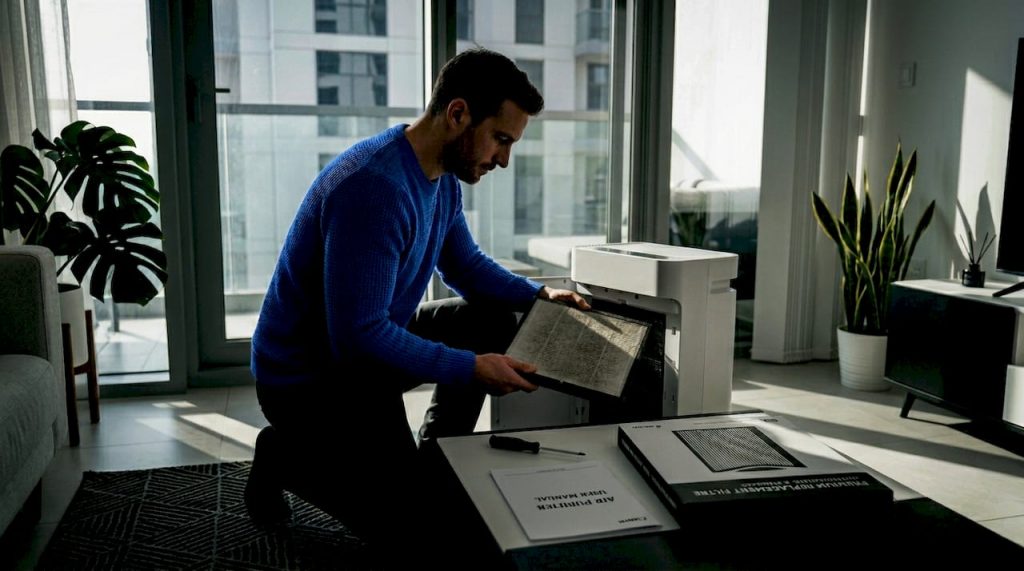
- Choose units with washable prefilters to extend HEPA life and reduce replacement frequency.
- Check whether the manufacturer offers a filter take-back or recycling programme before purchasing.
- Run the purifier on auto or low speed during normal conditions; reserve high speed for smoke events. This extends filter life and cuts electricity use.
- HEPA filtration details and filter maintenance schedules are worth reviewing before committing to a unit.
Do indoor plants actually clean the air?
Plants are a genuine but limited tool in a natural air cleaning strategy. The evidence supports their use for VOC removal; it does not support relying on them for particulate control.
A controlled Scientific Reports study found that Cordyline fruticosa has been shown to remove a high proportion of measured VOCs in controlled lab conditions, and Syngonium podophyllum demonstrated strong removal of PM2.5 and PM10 in controlled lab conditions. These are striking figures, but the conditions matter: sealed chambers, controlled pollutant concentrations, and plant densities far higher than a typical living room.
Statistic callout: Cordyline fruticosa achieved up to 87.5% VOC removal in controlled lab conditions (Scientific Reports, 2025). Real-world removal in a ventilated living room will be substantially lower.
A Nature review on botanical air cleaning concludes that plants are effective as a supplemental VOC-removal layer but insufficient alone for heavy particulate control. The practical implication: plants help with VOCs from furniture, paints, and cleaning products, but they will not protect an allergy sufferer from fine dust or smoke particles.
Scale reality check. To achieve measurable VOC reduction in a 30 m² living room, research suggests you would need a plant density far beyond what most households maintain. A small algae bioreactor is a more space-efficient biological option: a pilot algae-based air purifier study reduced CO2 and improved PM2.5 and TVOC removal in a sealed test room while producing oxygen, though these systems remain experimental for home use.
- Best plants for VOC removal: Cordyline fruticosa, Syngonium podophyllum, peace lily (Spathiphyllum), and golden pothos.
- Plants do not replace mechanical filtration for particles, smoke, or allergens.
- Algae bioreactors are a promising supplement but are not yet practical off-the-shelf products for most Australian homes.
Pro Tip: Avoid overwatering indoor plants. Wet soil is a mould growth medium, and mould spores are a significant indoor allergen. Allow the top 2–3 cm of soil to dry between waterings, and use pots with drainage holes.
Are UV, ionisers and ozone generators safe to use at home?
Advanced air cleaning technologies vary widely in safety and real-world effectiveness. Understanding the distinctions prevents costly or harmful choices.
UVGI and photocatalytic oxidation
Ultraviolet germicidal irradiation (UVGI) inactivates airborne pathogens by disrupting their DNA. It works well in ducted HVAC systems and hospital settings where air passes through the UV field at controlled speeds. In portable home units, the exposure time is often too short for reliable inactivation, and the MDPI review notes that context-dependent performance is a consistent finding across advanced technologies. Photocatalytic oxidation can generate formaldehyde and other by-products; ACS Environmental Science Letters research cautions that lab-to-home translation of these methods requires careful evaluation of secondary pollutants.
Ozone generators: avoid in occupied spaces
The EPA states clearly that ozone generators should not be used in occupied indoor spaces. Ozone at concentrations sufficient to inactivate pollutants also irritates the respiratory tract and can react with indoor chemicals to form formaldehyde and ultrafine particles.
This is not a nuanced trade-off. Ozone generators marketed as air purifiers are unsafe for homes where people or pets are present.
Electrostatic precipitators and ionisers
Electrostatic precipitators collect particles on charged plates and can be effective, but poorly designed units emit trace ozone. Always look for independent low-ozone or ozone-free certification before purchasing. Ionisers that release negative ions into the room can cause particles to deposit on surfaces rather than removing them from the air entirely, and some models produce measurable ozone. The EPA advisory on air cleaners recommends checking for ozone certification on any ion-based device.
Myth buster: Ionisers do not clean all pollutants. They have no effect on gases, VOCs, or CO2, and their particle removal depends on surface deposition rather than capture. A HEPA filter physically traps particles; an ioniser moves them.
How do you keep air cleaning genuinely eco-friendly?
Buying a purifier does not automatically make your air quality strategy sustainable. Energy use, filter disposal, and device longevity all carry environmental costs.
High-impact choices to avoid:
- Running a purifier on maximum fan speed continuously when pollutant levels are low.
- Purchasing units with proprietary filters that have no recycling or take-back option.
- Using ozone generators or devices with no independent emissions certification.
- Replacing HEPA filters before they are actually saturated (most last 6–12 months with a prefilter in place).
Lower-impact behaviours:
- Schedule filtration runs to coincide with cooking, cleaning, or high-occupancy periods rather than running 24/7.
- Use a washable prefilter to capture coarse dust before it reaches the HEPA layer, extending HEPA life.
- Select units with an auto or sleep mode that reduces fan speed when sensors detect clean air.
- Choose energy-efficient purifiers with a low wattage-to-CADR ratio; a well-designed unit delivers 150–200 m³/h CADR at under 30W on medium speed.
Lifecycle considerations. Check whether the manufacturer publishes filter recyclability data. Some brands offer postal return programmes for used filters. Avoid units where the filter and housing are bonded together, making separation for recycling impossible. Sustainable filter options vary in MERV rating; washable filters suit low-demand situations but may not protect occupants with asthma or heavy smoke exposure.
What should you look for when buying and maintaining a purifier?
A structured approach to purchasing and maintenance reduces both waste and ongoing cost.
Buyer checklist
- Confirm the CADR rating matches your room volume at your target ACH (use the formula: room volume × ACH = required CADR in m³/h).
- Verify the filter is rated HEPA H13 or H14, not just “HEPA-type” or “HEPA-like.”
- Check the unit’s wattage at medium speed; aim for under 50W for rooms up to 60 m³.
- Assess noise at the speed you will use most; below 45 dB(A) is comfortable for sleeping areas.
- Confirm replacement filters are available locally or via reliable shipping, and check their price before committing to the unit.
- Look for a washable prefilter and check whether the manufacturer has a filter recycling programme.
Maintenance schedule
- Weekly: Wipe down the unit’s exterior and check the prefilter; wash if visibly loaded with dust.
- Every 3 months: Inspect the HEPA filter; replace if discoloured or if airflow has noticeably dropped.
- Every 6–12 months: Replace the HEPA filter under normal use conditions; replace sooner after extended smoke events.
- At replacement: Contact the manufacturer about filter return schemes; some councils in Australia accept HEPA filters in e-waste collections.
Indicative costs (AUD, for guidance only): A mid-range portable HEPA H13 unit suitable for a bedroom costs roughly $200–$500. Replacement filters typically run $50–$150 per year depending on the model and usage. Electricity adds approximately $20–$60 per year at medium speed, based on average Australian residential tariffs.
- Long-life washable prefilters reduce annual filter spend and landfill contribution.
- Subscription filter replacement programmes offered by some brands simplify maintenance and sometimes include recycling.
What changes during bushfire smoke, coastal conditions and high humidity?
Australian conditions create specific air quality challenges that require adjustments to the standard layered approach.
Bushfire smoke
Bushfire smoke carries extremely fine PM2.5 particles that penetrate deep into the lungs. During a smoke event, the priority shifts entirely to filtration and sealing. Ventilation becomes counterproductive when outdoor PM2.5 exceeds safe thresholds (above 25 µg/m³ on a 24-hour average, per Australian air quality standards).
- Seal gaps around doors and windows with draught excluders or tape during severe smoke events.
- Run a HEPA H13 portable purifier continuously in the main living area and bedroom.
- Monitor PM2.5 with a low-cost sensor (Laser Egg, IQAir AirVisual, or similar) to know when outdoor air is safe to ventilate again.
- Avoid using rangehoods or exhaust fans that draw outdoor air in during smoke events.
Pro Tip: Keep a roll of masking tape and a set of draught excluders stored with your emergency kit.
Coastal and humid climates
Salt-laden air in coastal areas accelerates corrosion on metal components in ventilation systems and purifiers. Choose units with corrosion-resistant housings and check filter media for salt tolerance. A dehumidifier that maintains indoor humidity between 40–55% reduces biological pollutant loads without any filtration at all.
Newer, well-sealed homes
Post-NCC 2022 homes are significantly more airtight than older Australian housing stock. Without mechanical ventilation, CO2 and moisture accumulate rapidly. An ERV or HRV with a MERV 13 or HEPA-class intake filter handles both fresh air supply and particle filtration in a single system, making it the most space-efficient and energy-efficient solution for this building type.
What does the evidence actually show?
The research on indoor air cleaning is substantial but uneven. Some methods have strong, replicated evidence; others have promising pilot data that has not yet translated to real-world home conditions.
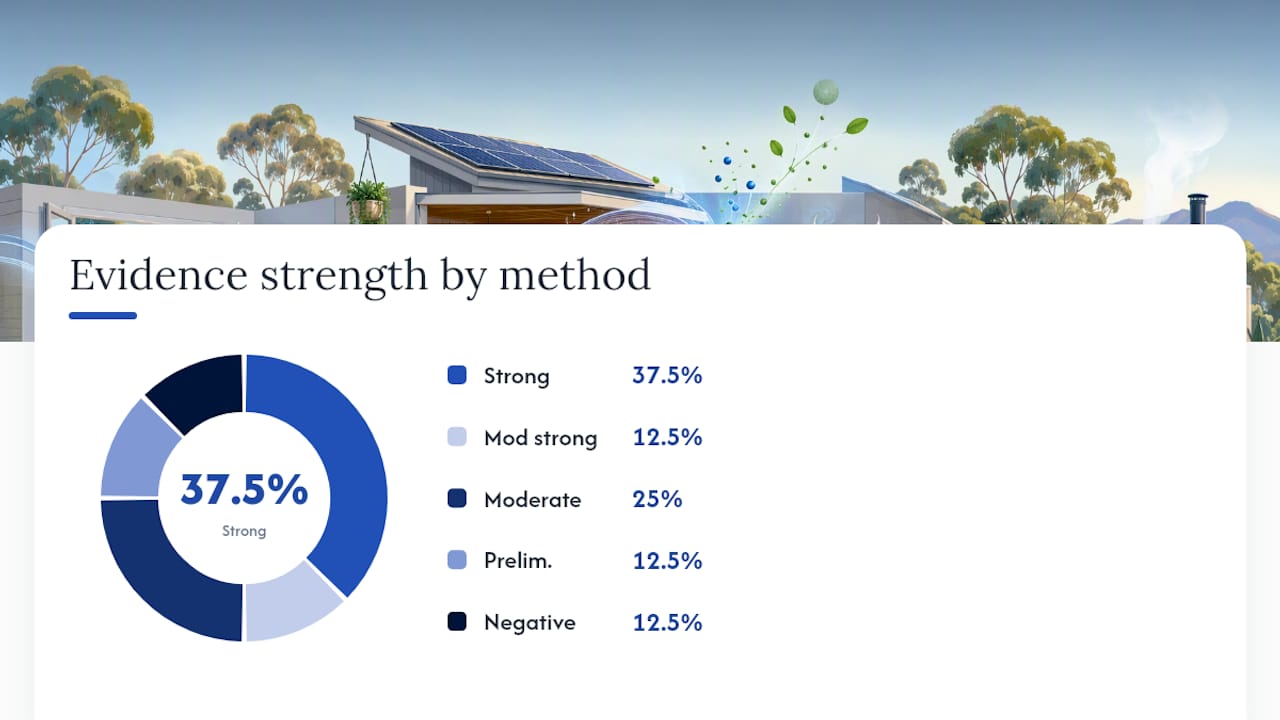
| Method | Evidence strength | Best use case | Key limitation |
|---|---|---|---|
| HEPA H13/H14 filtration | Strong (multiple studies, EPA/ASHRAE guidance) | Particles, smoke, allergens | Energy and filter waste if oversized |
| Source control | Strong (EPA, ASHRAE) | All pollutant types | Requires behaviour change |
| Natural ventilation | Strong | CO2, moisture, VOCs | Ineffective during smoke or high pollen |
| ERV/HRV | Moderate-strong | Airtight homes, energy recovery | Higher upfront cost |
| Indoor plants (VOCs) | Moderate (controlled studies) | Supplemental VOC reduction | Scale required for real-world effect |
| UVGI (in-duct) | Moderate | Pathogen inactivation in HVAC | Limited efficacy in portable units |
| Algae bioreactors | Preliminary | CO2 and TVOC supplement | Not yet practical for most homes |
| Ozone generators | Negative (EPA) | None recommended for homes | Direct health risk |
The Scientific Reports phytoremediation study provides the strongest plant-specific data, with Cordyline fruticosa achieving up to 87.5% VOC removal in controlled conditions. The algae pilot study is promising but remains experimental. The MDPI comprehensive review is the clearest statement of the current consensus: no single method is universally optimal, and layered approaches combining source control, ventilation, and targeted filtration are what major agencies recommend.
- EPA and ASHRAE both endorse HEPA-class filtration for particulate control and warn against ozone-generating devices.
- University of Melbourne guidance provides practical ACH and CADR targets for Australian homeowners.
- Single studies on plants and algae are encouraging but should not displace proven mechanical methods for vulnerable occupants.
A practitioner’s view on real-world air quality decisions
When assessing a typical family home, the most common finding is that the biggest air quality problem is also the easiest to fix: a gas cooktop used without an exhaust rangehood, or cleaning products stored and used in an unventilated laundry. Addressing those two sources costs nothing and often eliminates the need for a purifier entirely in low-risk households.
The most common mistake is purchasing a purifier before addressing sources and ventilation. A HEPA unit running in a room where a gas heater is burning without flue ventilation will capture some particles but will not touch the NO2 and CO that are the actual health risks. Sequence matters: source first, ventilation second, filtration third.
For homes with children, allergy sufferers, or elderly occupants, the calculus shifts. Filtration is not optional in those cases during smoke season or high-pollen periods. The goal is not to avoid mechanical filtration on principle; it is to use it precisely, size it correctly, and maintain it properly so the environmental cost is proportionate to the health benefit.
Climatepro’s range for Australian-style air quality needs
Climatepro stocks a curated range of HEPA H13 air purifiers, dehumidifiers, and replacement filters selected for performance, energy efficiency, and filter availability. For homeowners who have worked through source control and ventilation and now need targeted filtration, the Honeywell Air Touch P2 delivers H13-grade filtration with a washable prefilter, keeping ongoing filter costs and waste manageable. For larger open-plan spaces, the Honeywell Air Touch U1 covers higher CADR requirements without a disproportionate energy footprint.

Browse the full air purifier range to match a unit to your room size, filter class, and noise requirements, with genuine replacement filters available alongside each model.
Sources
- MDPI review: indoor air purification techniques and their contexts
- University of Melbourne: guide to air cleaners
Recommended
- Fresh air process for homes: a homeowner’s how-to — Blog | ClimatePro UAE
- How to improve indoor air quality at home in Australia — Blog | ClimatePro UAE
- List of air purification methods for healthier homes — Blog | ClimatePro UAE
- Energy efficient air cleaning workflow for homes — Blog | ClimatePro UAE