The fastest way to cut household dust is to combine source control, correctly sized HEPA filtration, and targeted humidity and ventilation management. A built-environment study of Dubai residences confirms that HEPA purifiers work best when integrated with sealing and source control. Running a purifier with windows open during a sandstorm delivers a fraction of the benefit. The same research shows that behaviour changes alone, such as sealing windows during dust events and running purifiers during high-emission activities, produce measurable reductions in indoor particulate matter.
Six actions you can take today:
- Close and seal windows when outdoor dust or PM levels are elevated
- Run your HEPA air purifier on its highest CADR setting while cooking, vacuuming, or during sandstorms
- Place heavy-duty mats at every entry point and adopt a no-shoes-indoors policy
- Wet-dust hard surfaces rather than dry-wiping, which resuspends particles
- Launder bedding weekly at 60°C to reduce dust mite load
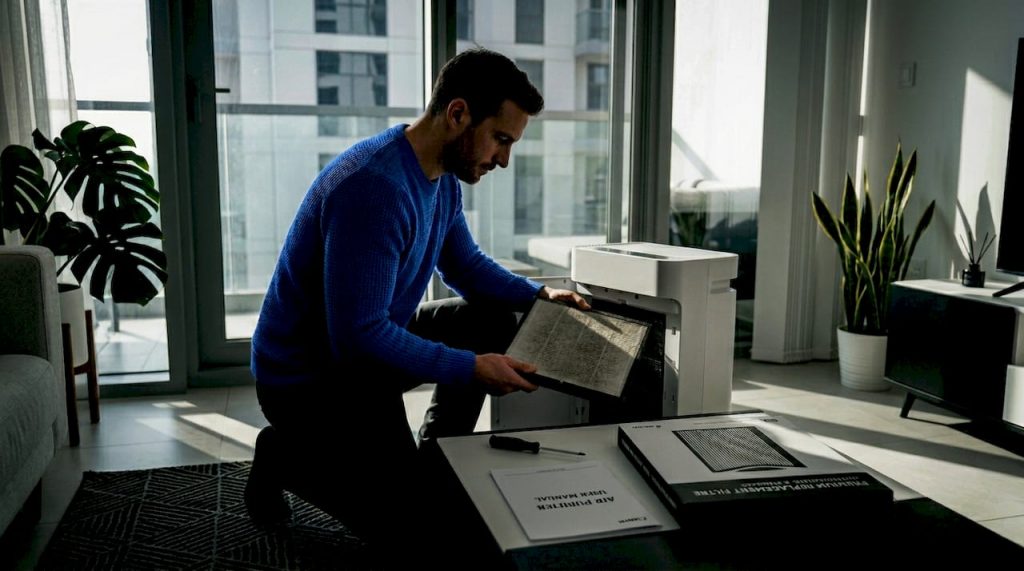
- Check your purifier filter — a clogged filter reduces effectiveness significantly
HEPA H13 and H14 filters, which remove 99.95–99.97% of particles at 0.3 µm, and WHO-aligned indoor air quality guidance on source control and ventilation, form the two core trust signals behind this plan.
Key takeaways
Combining source control, correctly sized True HEPA H13 filtration, and a consistent maintenance schedule is the most effective approach to reducing household dust in UAE homes.
| Point | Details |
|---|---|
| HEPA standard matters | Choose H13 or H14 certified filters (99.95–99.995% at 0.3 µm); reject unverified “HEPA-like” claims. |
| Size by CADR | Match purifier CADR to room volume; aim for at least two air changes per hour, five for allergy sufferers. |
| Humidity target: 30–50% RH | Measure with a hygrometer and use a humidifier or dehumidifier seasonally to stay in range. |
| Seal before you filter | Closing gaps and sealing window frames during dust events reduces infiltration before filtration begins. |
| Climatepro for UAE homes | Climatepro stocks HEPA H13 purifiers, replacement filters, humidifiers, and dehumidifiers with delivery across all emirates. |
Table of Contents
- What does a practical dust control schedule look like?
- Where does household dust come from, and why does particle size matter?
- Room-by-room dust control: where to focus first
- How do HEPA purifiers, HVAC filters, and CADR work together?
- Cleaning techniques that actually reduce dust exposure
- When should you use a humidifier vs a dehumidifier?
- How does ventilation affect indoor dust levels?
- Common mistakes that keep dust problems going
- How to choose and combine dust control measures
- What to realistically expect after following this plan
- Climatepro: HEPA purifiers, filters, and humidity solutions for UAE homes
- Sources
What does a practical dust control schedule look like?
Daily
- Run your air purifier continuously, or at minimum during cooking, cleaning, and peak outdoor dust hours
- Keep windows closed when outdoor PM is high; check a local air quality index if unsure
Weekly
- Vacuum all floors and upholstered furniture with a sealed True HEPA vacuum
- Wet-dust shelves, skirting boards, and ceiling fans using a damp microfibre cloth
- Launder bedding, pillowcases, and any pet bedding
Monthly
- Inspect and clean or replace pre-filters on your air purifier
- Clean AC drip pans and check that HVAC filters are not visibly clogged
- Check door and window seals for gaps; reseal with weatherstripping where needed
Pro Tip: During a sandstorm or high outdoor PM event, close all windows immediately, switch your purifier to maximum speed, and avoid vacuuming until the outdoor event passes — vacuuming during peak infiltration stirs settled particles back into the air just as fresh ones are entering.
Where does household dust come from, and why does particle size matter?
Indoor dust is rarely a single substance. In UAE homes it typically combines fine desert sand and silica blown in through gaps and ventilation, skin cells and fibres shed by occupants, pet dander and hair, cooking aerosols and combustion particles, and particles released from soft furnishings, carpets, and clothing.
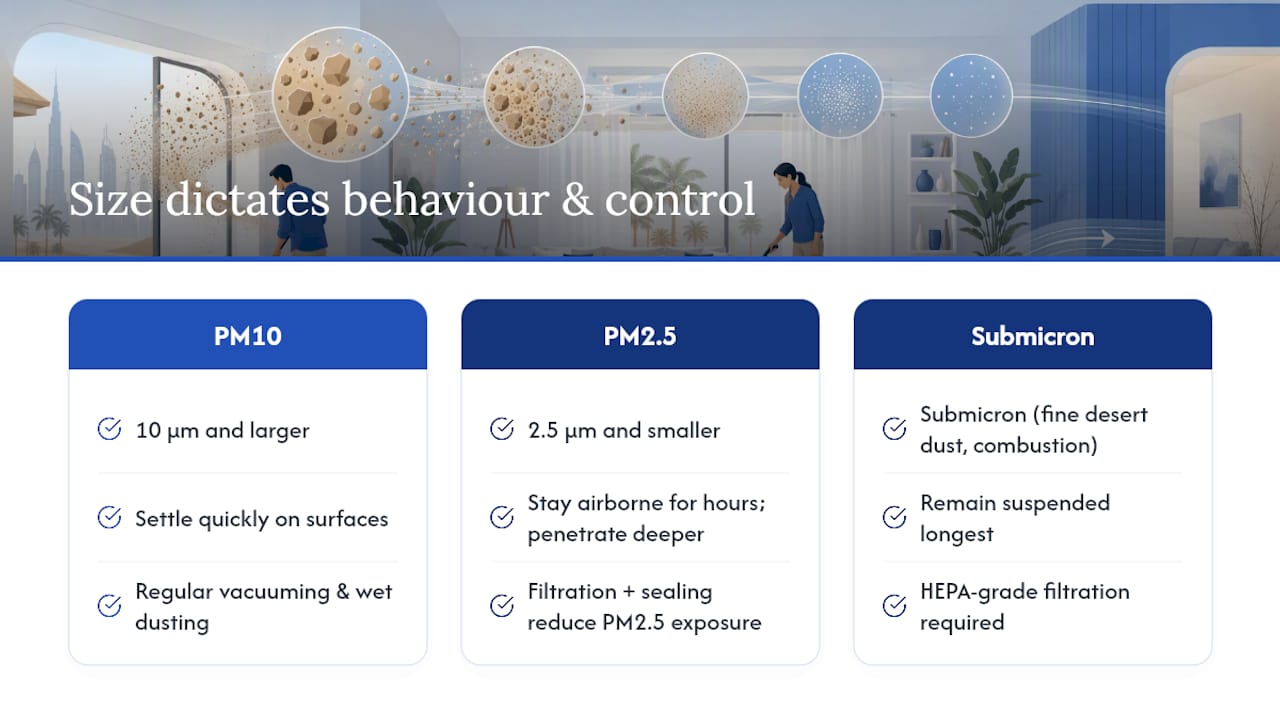
Particle size determines both health risk and the removal method needed. PM10 particles (10 µm and larger) settle quickly on surfaces and are removed by regular vacuuming and wet dusting. PM2.5 particles (2.5 µm and smaller) stay airborne for hours and penetrate deeper into the respiratory tract. Submicron particles, including fine desert dust and combustion byproducts, remain suspended longest and require HEPA-grade filtration to capture reliably.
Particle infiltration matters: The Dubai infiltration study found that outdoor particulate matter enters residential buildings through gaps in building envelopes, around window frames, and through HVAC systems — making sealing and filtration the two most effective structural controls.
Mechanical filtration and a well-sealed building envelope together reduce PM2.5 exposure more effectively than either measure alone, a finding consistent with environmental health reviews on ventilation and IAQ.
Room-by-room dust control: where to focus first
Bedroom
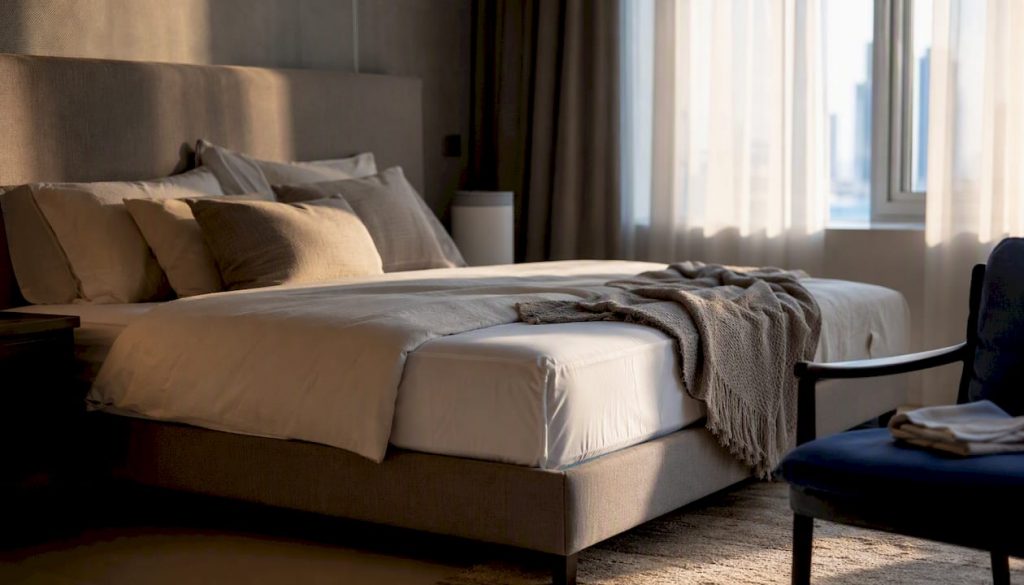
The bedroom deserves the most attention because occupants spend six to eight hours there breathing at rest. Fit a dust-mite-proof mattress protector and pillow covers, wash bedding weekly at 60°C, and position your purifier near the bed rather than across the room. For a standard UAE bedroom of roughly 15–20 m², a purifier with a CADR of at least 150–200 m³/h is appropriate.
Living room
Open-plan living areas accumulate dust from foot traffic, soft furnishings, and cooking aerosols. Vacuum upholstered furniture weekly, not just floors. A higher-capacity purifier placed centrally, away from walls, circulates air more evenly across larger volumes.
Kitchen
Cooking generates fine oil aerosols and combustion particles that spread quickly. Use the range hood on its highest setting whenever the hob is on, and run your purifier on high during and for 30 minutes after cooking. Avoid aerosol sprays near cooking surfaces.
Entryways
Entry points are where outdoor dust enters in the largest quantities. A double-mat system — a coarse outdoor mat plus a finer indoor mat — captures the majority of tracked-in particles. A dedicated shoe rack just inside the door reinforces a no-shoes policy without requiring constant reminders.
Pro Tip: In a small apartment where one purifier must cover multiple zones, place it in the room where you spend the most time sleeping or sitting, not in the hallway. Hallway placement looks logical but delivers the least benefit where it counts.
How do HEPA purifiers, HVAC filters, and CADR work together?
HEPA standards: what H13 and H14 actually mean
True HEPA filters are tested to defined efficiency levels. H13 removes at least 99.95% of particles at 0.3 µm; H14 reaches 99.995%. Many products marketed as “HEPA-like” or “HEPA-style” carry no certifying test data. Industry guidance from Camfil is direct on this point: always request factory test documentation or look for a certified class label before purchasing.
Sizing by CADR and room volume
CADR (Clean Air Delivery Rate) measures the volume of clean air a purifier delivers per hour. A practical sizing rule: multiply your room area in m² by ceiling height (typically 2.7 m in UAE apartments) to get room volume, then choose a purifier whose CADR covers that volume at least twice per hour, and ideally five times per hour for allergy sufferers.
Johns Hopkins Medicine guidance notes that HEPA units must run during high-emission activities and be correctly sized to deliver their rated benefit — an undersized unit running continuously still underperforms a correctly sized unit running on schedule.
Filter stages and what each does
| Filter stage | Primary function | Replacement signal |
|---|---|---|
| Pre-filter | Captures large particles, hair, and fibres; protects HEPA | Visibly grey or clogged |
| Activated carbon | Adsorbs odours, VOCs, and gases | Reduced odour control (typically several months) |
| True HEPA (H13/H14) | Removes fine particles ≥0.3 µm at 99.95–99.995% | Per manufacturer schedule, typically 12 months residential |
HVAC filter choices
Standard AC filters in UAE apartments use low-MERV media that captures large debris but passes fine particles. Upgrading to a higher-MERV filter (MERV 11–13) improves fine particle capture without the pressure-drop penalty of a full HEPA insert. Full HEPA inserts in ducted systems require professional assessment to confirm the system’s fan can handle the added resistance.
Cleaning techniques that actually reduce dust exposure
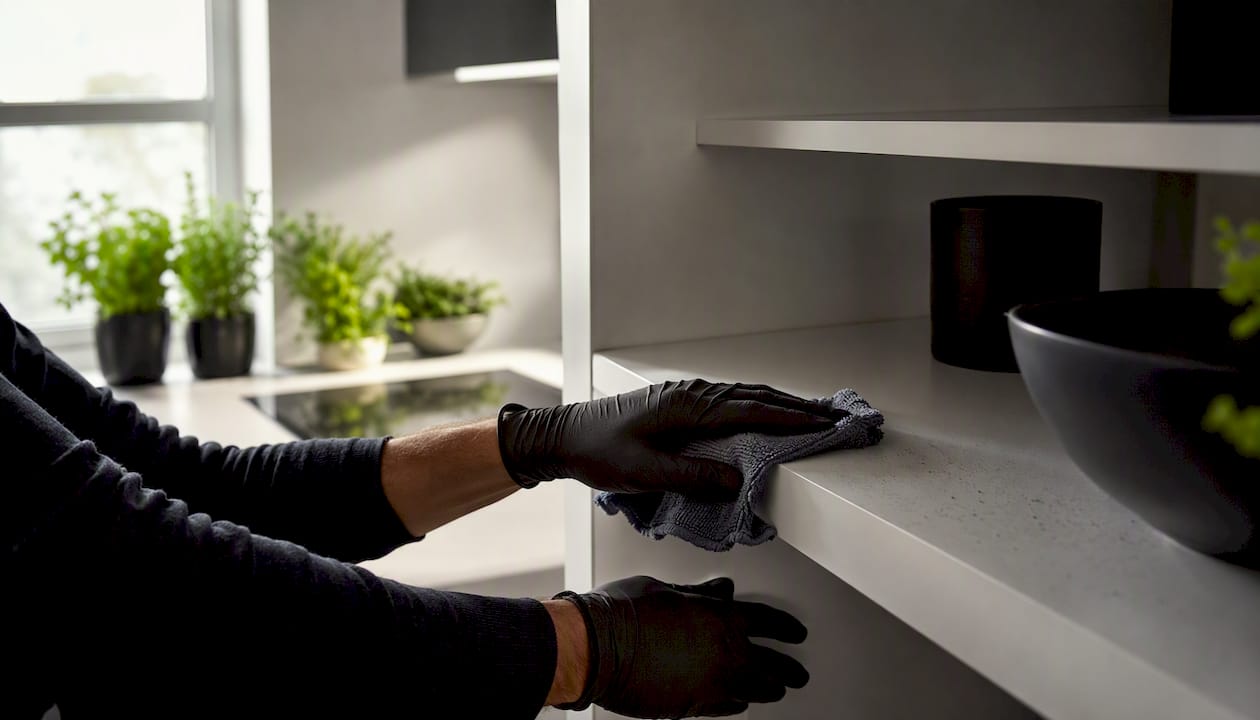
Dry dusting with a feather duster or dry cloth moves particles from surfaces into the air, where they remain suspended for hours. Microfibre cloths used damp trap particles electrostatically and remove them from the surface entirely. Start at the highest point in the room — ceiling fans, top shelves — and work downward so dislodged particles fall onto surfaces not yet cleaned.
Vacuuming technique matters as much as frequency. A vacuum without a sealed system exhausts fine particles back into the room through gaps around the motor and bag. Sealed True HEPA vacuums contain the full airstream through the filter before exhaust. Vacuum at a slow, deliberate pace — roughly one metre per two seconds — to allow suction to lift embedded particles rather than just skim the surface.
Pro Tip: Keep your air purifier running on high during and for at least 20 minutes after vacuuming. The cleaning process resuspends fine particles, and the purifier captures them before they resettle.
Recommended cadence for busy households or pet owners:
- Vacuum hard floors twice weekly; carpets three times weekly
- Launder curtains and cushion covers monthly
- Groom pets outdoors or in a bathroom with the door closed, then vacuum the space immediately after
When should you use a humidifier vs a dehumidifier?
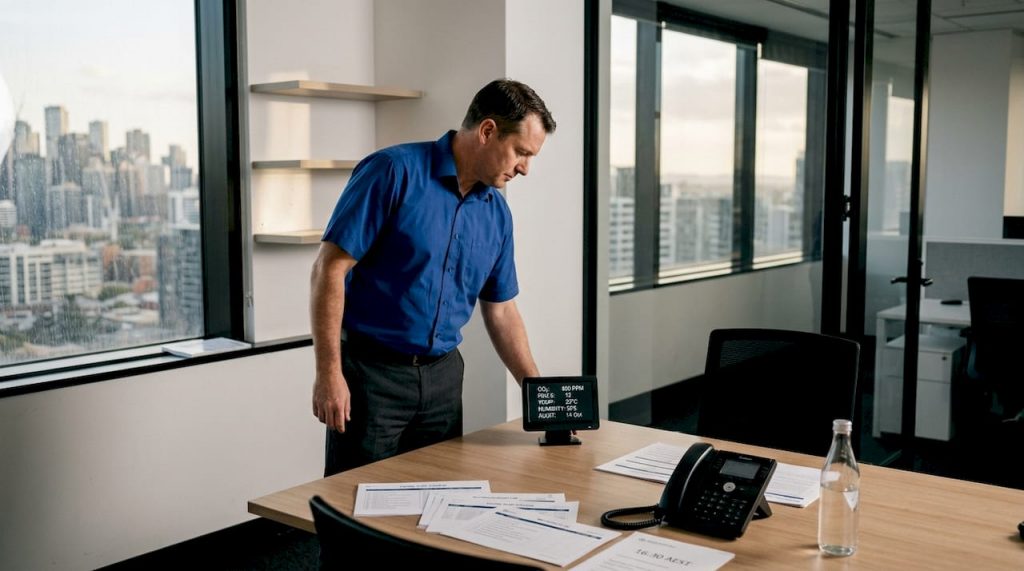
The answer depends on a single measurement: your indoor relative humidity (RH). Aim for 30–50% RH. Below 30%, fine particles and allergens stay airborne longer, and dry air irritates mucous membranes. Above 50%, dust mite populations grow rapidly and mould risk increases. Research on indoor humidity and IAQ supports this 30–50% target as the range that minimises both extremes.
A humidifier restores moisture in that scenario. During humid summer months, or in ground-floor apartments with poor vapour barriers, indoor RH can climb above 60% even with AC running — a dehumidifier is the correct tool there.
Device maintenance is non-negotiable. Humidifiers with stagnant water tanks grow bacteria and mould within days; clean the tank every two to three days and use distilled water to prevent mineral deposits. Dehumidifier collection buckets need emptying and rinsing regularly for the same reason.
Pro Tip: A basic hygrometer costs under AED 30 and removes all guesswork. Read it at the same time each morning for a week before deciding which device your home needs. The humidity control workflow guide on Climatepro’s blog walks through the seasonal decision process step by step.
How does ventilation affect indoor dust levels?
Ventilation dilutes indoor pollutants but introduces outdoor particles when outdoor air quality is poor. The trade-off is straightforward: open windows when outdoor PM is low and indoor pollutants from cooking or cleaning need clearing; close and seal when outdoor PM is elevated.
A Dubai apartment case study found that mechanical exhaust combined with controlled ventilation reduced indoor VOC and formaldehyde concentrations substantially over several weeks — a result that natural ventilation alone did not achieve. Mechanical kitchen and bathroom exhausts remove moisture and cooking aerosols without requiring windows to be opened.
HVAC maintenance checklist:
- Inspect and replace AC filters every 1–3 months during high-PM periods
- Clean AC drip pans quarterly to prevent mould and biofilm growth
- Check duct connections and gaskets for gaps that allow unfiltered air to bypass the filter
- Schedule a professional duct inspection annually, or before seasonal dust peaks
Pro Tip: Book HVAC servicing in February or March, before the UAE’s peak summer dust season. Filters and drip pans cleaned ahead of the high-load period perform significantly better through the hottest months.
Common mistakes that keep dust problems going
- Using a “HEPA-like” purifier — no certified test data means no guaranteed particle removal. Always verify the H13 or H14 class label.
- Running the purifier only when dust is visible — by the time dust is visible, fine particles have already been circulating for hours. Run continuously or on a timer.
- Opening windows during sandstorms — outdoor PM during a dust event can be orders of magnitude higher than indoor levels. Seal first, ventilate later.
- Skipping pre-filter cleaning — a clogged pre-filter forces the HEPA layer to work harder and shortens its life. Clean pre-filters monthly.
- Vacuuming with a non-sealed machine — check for a “sealed system” label; if absent, the vacuum is likely exhausting fine particles back into the room.
- Ignoring dirty HVAC components — field studies associate dirty filters, debris in intakes, and dirty ductwork with higher rates of respiratory symptoms.
Monitoring progress is simple: note how quickly a white surface accumulates visible dust before and after implementing the plan, and track any reduction in allergy symptoms over four to six weeks.
How to choose and combine dust control measures
A three-step decision workflow covers most households:
- Assess and seal — identify the main infiltration points (window gaps, door frames, HVAC intakes) and address them with weatherstripping or professional sealing before spending on equipment.
- Size and run filtration — select a True HEPA H13 purifier matched to your room’s CADR requirement and run it continuously or during high-emission activities. Pair with a sealed HEPA vacuum for surface cleaning.
- Maintain on schedule — replace HEPA filters per manufacturer guidance (typically every 12 months in residential use), clean pre-filters monthly, and service HVAC units quarterly.
Buying priorities by budget:
- Essentials: a correctly sized HEPA H13 purifier, a sealed HEPA vacuum, and a hygrometer
- Upgrades: a second purifier for the bedroom, a humidifier or dehumidifier matched to measured RH, and higher-MERV HVAC filters
Climatepro stocks HEPA H13 purifiers, replacement filters, humidifiers, and dehumidifiers with air cleaner maintenance guidance to support the full maintenance schedule.
What to realistically expect after following this plan
Airborne dust levels respond quickly to correct filtration. With a properly sized HEPA purifier running continuously, visible airborne haze typically clears within hours and measured fine particle counts drop within the first day or two. Settled dust on surfaces takes longer — consistent wet dusting and vacuuming over two to four weeks produces a noticeable reduction in how quickly surfaces re-accumulate dust.
Filtration and housekeeping together reduce exposure substantially, but they do not create a sterile environment. Dust sources are continuous: occupants shed skin cells, outdoor particles infiltrate through every opening, and cooking generates fresh aerosols daily. The maintenance schedule in this guide is designed to keep those sources manageable rather than eliminate them entirely. Follow the checklist, replace filters on time, and the results compound over months.
Climatepro: HEPA purifiers, filters, and humidity solutions for UAE homes
Climatepro is the direct path from this guide to the products it recommends. The online store carries True HEPA H13 air purifiers sized for UAE apartments and villas, genuine replacement filters, and a full range of humidifiers and dehumidifiers — all with delivery across Dubai, Abu Dhabi, Sharjah, and every other emirate.

For homeowners ready to act on the CADR sizing table above, the Honeywell Air Touch P2 suits standard bedrooms and mid-sized rooms, while the Honeywell Air Touch U1 covers larger open-plan spaces. Browse the full air purifier range to match CADR to your specific room volume, or contact Climatepro directly for a product recommendation.
Sources
- Navigating dust storms and urban living: an analysis of particulate matter infiltration in Dubai’s residences
- WHO/Environmental health reviews and guidance (IAQ and ventilation topics)
- Air filters, dehumidifiers, and humidifiers | Johns Hopkins Medicine
- HEPA Filters Explained — How Do HEPA Filters Work? – Air Filters for Clean Air