
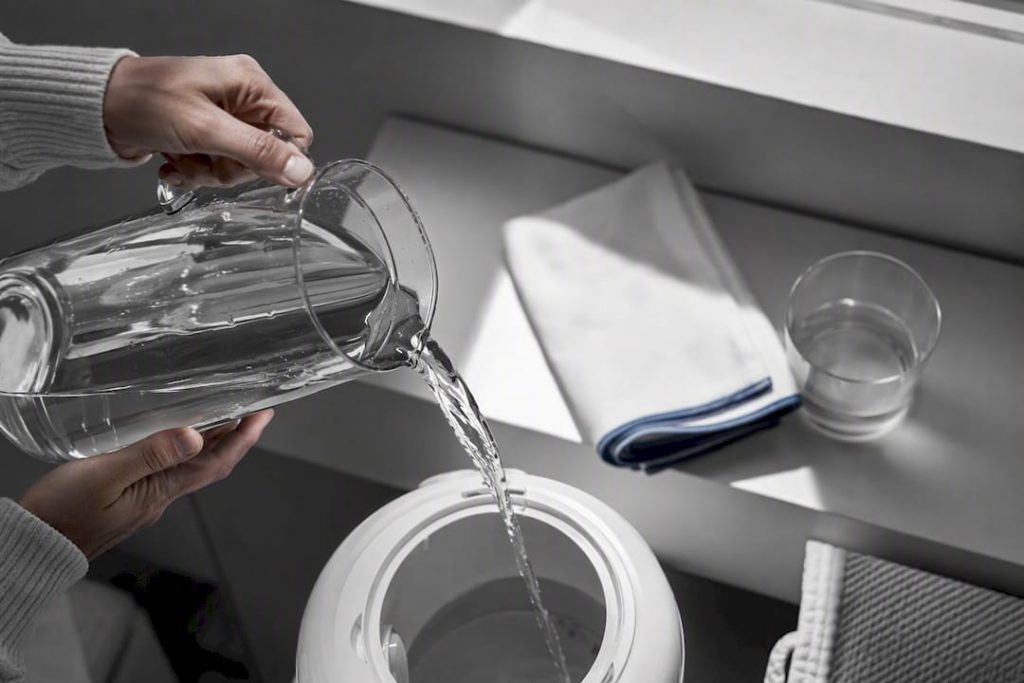
Distilled water is the safer default for most humidifiers, and it’s non-negotiable for nursery use. Manufacturer guidance and the EPA recommend it because it carries no dissolved minerals, so there’s no white dust and far less scale to manage. It won’t stop bacteria or mould from growing on its own. Regular cleaning still does that job.
TL;DR:
- Ultrasonic and impeller humidifiers benefit most from distilled water due to their susceptibility to mineral buildup and white dust dispersion.
- Using tap water in these units causes rapid scale formation, reduced output, and visible residues within a day or two.
- Demineralised or reverse osmosis water are acceptable alternatives, providing low TDS levels that significantly decrease mineral dispersal compared to tap water.
- Microbial growth in humidifier tanks remains a concern regardless of water type, requiring thorough cleaning routines to prevent mold and bacteria.
- Regular maintenance, including daily emptying and weekly vinegar soakings, is essential for hygiene and extended appliance lifespan, independent of water purity.
Table of Contents
- Why distilled water for humidifiers matters: minerals, white dust, and scale
- Does your humidifier type actually need distilled water?
- Reverse osmosis, demineralised, and bottled water: what actually works
- Where to get distilled water and what it costs
- Cleaning your humidifier: the step distilled water doesn’t replace
- How ClimatePro helps you get this right
- Distilled water alone won’t fix a dirty tank
- Sources
Why distilled water for humidifiers matters: minerals, white dust, and scale
Tap water isn’t pure water. It carries dissolved solids, mostly calcium and magnesium, measured as total dissolved solids (TDS) in parts per million. The harder your local water supply, the higher that number climbs, and the more material your humidifier has to deal with every time it runs.
In an ultrasonic or impeller humidifier, a vibrating disc shatters water into a fine mist without heating it. Any minerals dissolved in that water don’t stay behind. They ride out with the droplets and land on furniture, screens, and windowsills as a fine pale residue. That’s the white dust homeowners often mistake for mould or dust buildup. It’s actually calcium and magnesium settling out of the air once the water evaporates around it.
Inside the tank, the same minerals build up on the transducer plate and reservoir walls as scale. This layer degrades the transducer’s output over time, so the unit works harder to produce the same amount of mist, and it creates a rough surface where bacteria and biofilm attach more easily. The EPA’s humidifier guidance specifically recommends low mineral water to prevent both the scale build up and the dispersal of minerals into indoor air, as detailed in the role of filtration in indoor air quality.
Signs your water is too hard for your device usually show up fast:
- A fine white or grey film on surfaces near the humidifier within a day or two of use
- Visible chalky residue inside the tank or on the mist outlet
- Reduced mist output despite a full tank
- A musty smell developing faster than usual between cleans
Distilled water typically measures near zero TDS, often in the 0 to 5 ppm range, according to Purific’s breakdown of humidifier water options. Standard tap water, depending on your region, contains significantly higher mineral content compared to distilled water. That gap is the entire reason distillation matters for this particular appliance.
Does your humidifier type actually need distilled water?
Not every humidifier reacts to tap water the same way, and knowing which category yours falls into changes how strict you need to be.
Ultrasonic and impeller humidifiers are the most sensitive to mineral content. Because they aerosolise the entire water sample, whatever is dissolved in that water ends up in the room, not just in the tank. These are the units where distilled water for humidifiers makes the biggest practical difference, both for reduced white dust and for output that doesn’t fade as scale accumulates.
Evaporative or wick humidifiers work differently. A wick or filter draws water up and air passes over it, so minerals largely stay trapped in the wick rather than dispersing into the room. Tap water is more tolerable here, but the wick still hardens with scale and needs replacing more often, so you’re trading air quality for a shorter part life and more frequent buying.
Warm mist and steam humidifiers boil water before releasing vapour, which kills most microorganisms in the process. Mineral scale still forms on the heating element, though, and that buildup shortens the appliance’s working life just as it does in kettles.
A few practical rules of thumb:
- Check the manual first. Many manufacturers state distilled or demineralised water as a warranty condition, not a suggestion, a point Wirecutter’s testing on distilled water use also flags.
- If you see white dust within a day of running an ultrasonic unit, that’s your device telling you the water is too hard.
- Demineralisation cartridges, sold as add ons for some models, soften water on the way into the tank and reduce (though rarely eliminate) the mineral load.
Pro Tip: If you’re not sure which category your humidifier falls into, run it for a few hours with tap water on a dark tabletop nearby. If a pale film appears, switch to distilled water immediately rather than waiting for scale to build up inside the tank.
Reverse osmosis, demineralised, and bottled water: what actually works
Distilled water isn’t always sitting in the cupboard when you need it, and that’s fine. A few substitutes come close enough to matter.
Reverse osmosis (RO) water pushes tap water through a semi permeable membrane that filters out most dissolved solids. It typically lands around 5 to 50 ppm TDS, higher than distilled but still low enough to sharply cut white dust and scale compared with untreated tap water. Demineralised water, produced through deionisation, sits in a similar low range. Both are described as workable alternatives in Purific’s water comparison guide.
What doesn’t work, despite persistent advice online:
- Standard pitcher filters (activated carbon designs) improve taste and remove chlorine but do almost nothing for dissolved minerals. TDS barely moves.
- Boiled water kills organisms but does nothing to the mineral content. Minerals don’t evaporate with steam in a domestic kettle scenario; they concentrate as the water reduces, so boiled tap water can be just as hard as it started, sometimes harder.
- Bottled “spring” or “mineral” water is actively worse, since it’s often higher in dissolved solids than tap water by design.
For households running a humidifier daily through winter, an EPA-cited insight on cost trade-offs suggests distilled water can end up cheaper over a season than replacing scaled cartridges or scrubbing scale out of a unit weekly. RO water from a home filtration system is a reasonable middle ground if you’re already set up for it. If you’re buying bottled water regardless, check the label for TDS or “purified by distillation” wording rather than assuming any bottled water will do.
Where to get distilled water and what it costs
Sourcing distilled water for a humidifier isn’t complicated, but the cheapest option depends on how often you’re running the device.
- Supermarkets and grocery delivery. Distilled water is sold cheaply in most supermarkets, usually alongside iron and drinking water. Check the label says “distilled” specifically, not just “purified” or “drinking water,” since those terms aren’t interchangeable and don’t guarantee the same near zero TDS.
- Countertop distillers. These units boil tap water and condense the steam back into a container, leaving minerals behind. The upfront cost is higher than a bottle of water, but the per litre cost drops significantly over months of regular use, making a distiller worthwhile for households running a humidifier through an entire dry season.
- Home RO systems. If you already have an RO unit installed for drinking water, that output works as a practical substitute when true distilled water isn’t on hand. It won’t match distillation’s near zero TDS, but it’s a meaningful step-down from tap water.
For nursery use, storage matters as much as sourcing. Keep distilled water in a sealed, clean container away from direct sunlight, and don’t decant it into a container that previously held anything else without a thorough wash first. Once opened, treat it the same way you’d treat any water sitting near a baby’s room: use it within a few days rather than letting it sit for weeks.
Cleaning your humidifier: the step distilled water doesn’t replace
Distilled water solves the mineral problem. It does nothing for microbial growth, and that’s the part too many households skip.
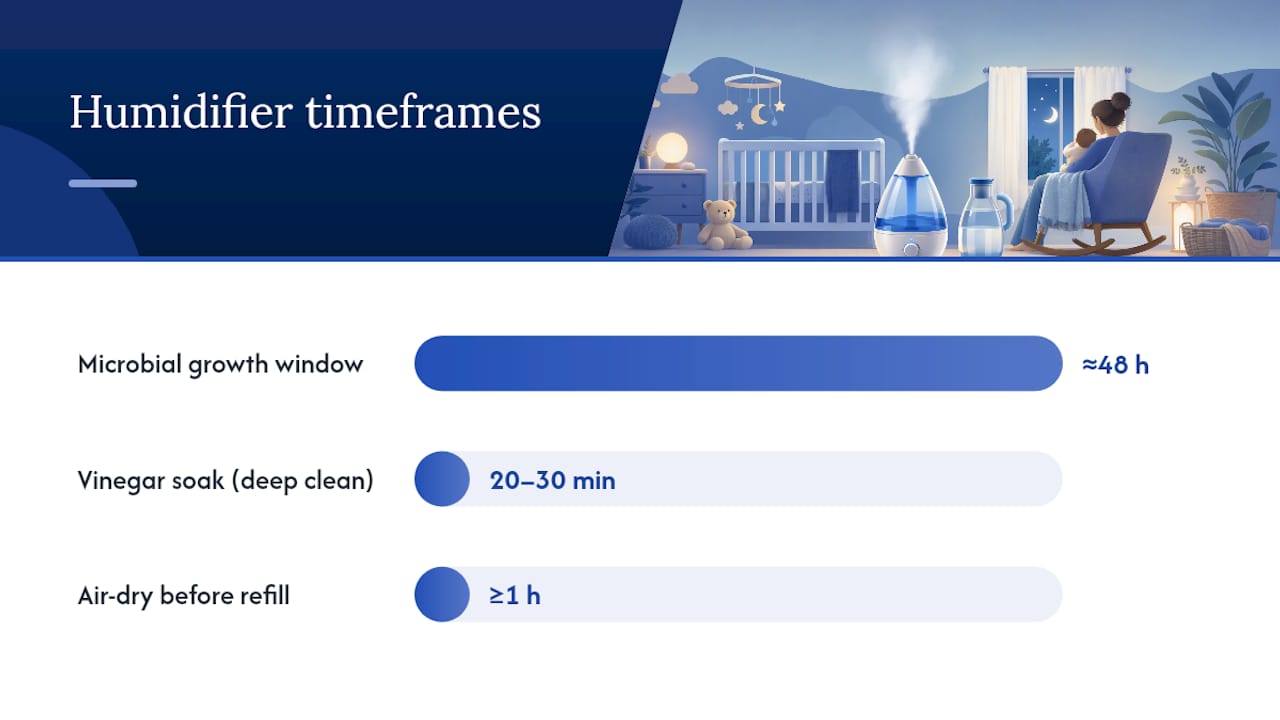
Water left sitting in a warm, damp tank is exactly the environment mould and bacteria need. Purific’s guidance on humidifier maintenance notes that stagnant water of any kind, distilled or not, can develop mould or bacterial growth within roughly 48 hours. Distilled water buys you less scale and less scrubbing. It buys you nothing on the biological side.
A workable maintenance routine looks like this:
- Empty and dry daily. Tip out any leftover water at the end of each day rather than topping up a partially full tank. Wipe the reservoir dry with a clean cloth.
- Deep clean weekly. Fill the tank with a mix of white vinegar and water (roughly one part vinegar to two parts water), let it sit for 20 to 30 minutes, then scrub with a soft brush focusing on the base and any transducer surface.
- Rinse thoroughly. Vinegar residue left behind is just as capable of aerosolising as mineral scale, so rinse until you can’t smell it anymore.
- Disinfect periodically. A diluted bleach solution, used strictly according to the manufacturer’s instructions and always followed by a full rinse and air dry, handles biofilm that vinegar alone won’t shift.
- Dry fully before storing or refilling. Air drying for at least an hour prevents the very moisture that microbial growth depends on.
- Replace wicks and cartridges on schedule. Evaporative wicks and demineralisation cartridges have a working life, usually stated in the manual, and running them past that point undoes any benefit from switching to distilled water in the first place.
Pro Tip: Set a recurring weekly reminder on your phone for the vinegar soak. It’s the single most skipped step in humidifier care, and it’s also the one that prevents the musty smell most people blame on the water itself rather than the tank.
The CDC’s guidance on preventing waterborne germs at home specifically flags cool mist humidifiers as the preferred choice for children’s rooms, partly because they avoid burn risk and partly because keeping the water clean is more straightforward to monitor than with a steam unit. Clean water in, and clean maintenance out, matters more for infants than for anyone else in the house.
How ClimatePro helps you get this right
Picking a humidifier that’s genuinely easy to clean matters as much as picking the right water. Look for models with wide tank openings you can actually get a brush into, and where relevant, tanks with demineralisation cartridge slots that reduce how often you need to source distilled water at all.
Some suppliers stock humidifiers designed for practical maintenance, alongside replacement filters and spare parts for when a wick or cartridge reaches the end of its life. If you’re setting up a nursery, our guide on the role of humidifiers in nurseries and our breakdown of why nursery air quality matters for a baby’s health cover the setup decisions that come before water choice. For the mechanics behind mineral aerosolisation, our ultrasonic humidification guide goes deeper into how these units disperse mist and why that matters for cleaning frequency.
Delivery runs across multiple locations in the UAE, with support on hand if you need help matching a replacement cartridge to your existing unit.
Distilled water alone won’t fix a dirty tank
The advice on distilled water for humidifiers gets treated as a complete solution far more often than it should. It isn’t. It solves exactly one problem, mineral dispersal, and leaves the bigger one, microbial growth, entirely untouched. A pristine tank filled with distilled water that hasn’t been cleaned in three weeks is arguably worse than a well maintained tank running filtered tap water, because the false sense of security stops people from checking it.
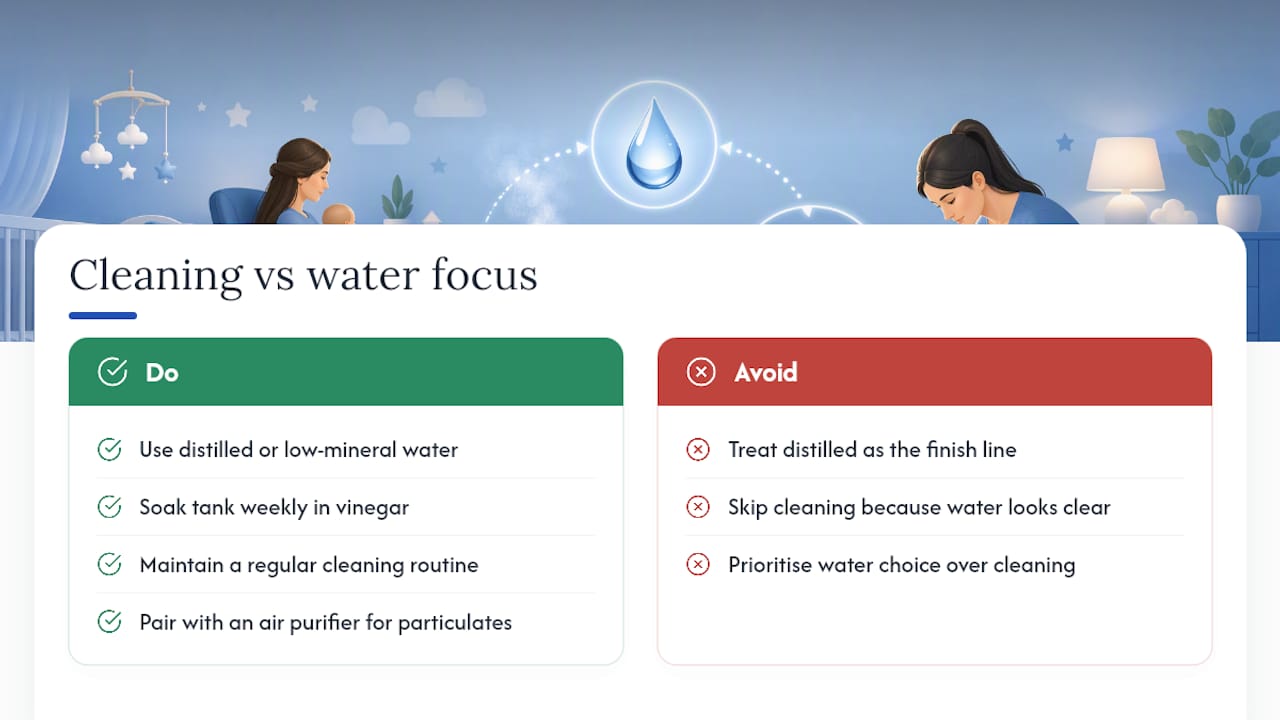
Where conventional advice falls short is treating “use distilled water” as the finish line rather than the starting point. The mineral side of the problem is largely cosmetic and mechanical: white dust on furniture, scale slowing down a transducer. The biological side is the one that actually affects health, and it doesn’t care what’s dissolved in your water.
If you’re deciding where to put your effort, prioritise the weekly vinegar soak over agonising between distilled, RO, or demineralised water. Any low mineral option will handle the scale problem reasonably well. Only a genuine cleaning routine handles the other one, and skipping it because the water looked clean is the mistake that costs people the most in the long run.
— Nevel
Even with the best sourcing habits, a humidifier is only one part of managing indoor air, particularly if dust, allergens, or pet odours are also a concern in the room where it’s running. Pairing a well maintained humidifier with an air purifier such as the Honeywell Air Touch P2 or the more compact Honeywell Air Touch P1 can address particulate concerns that water choice alone doesn’t touch. Browse the full humidifier range at Climatepro to compare tank designs, cartridge compatibility, and spare parts availability before you buy, and check the air purifier catalogue if you’re setting up a nursery or bedroom that needs both humidity control and cleaner air in one room.
Sources
- EPA — Humidifier factsheet
- CDC — Preventing waterborne germs at home
- Purific — Distilled water for humidifiers: what you need to know