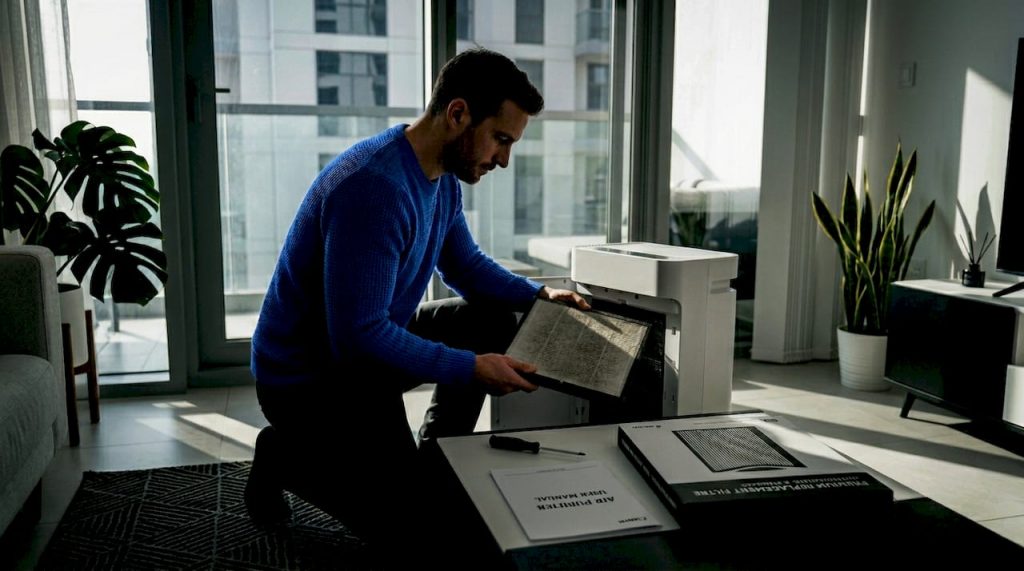
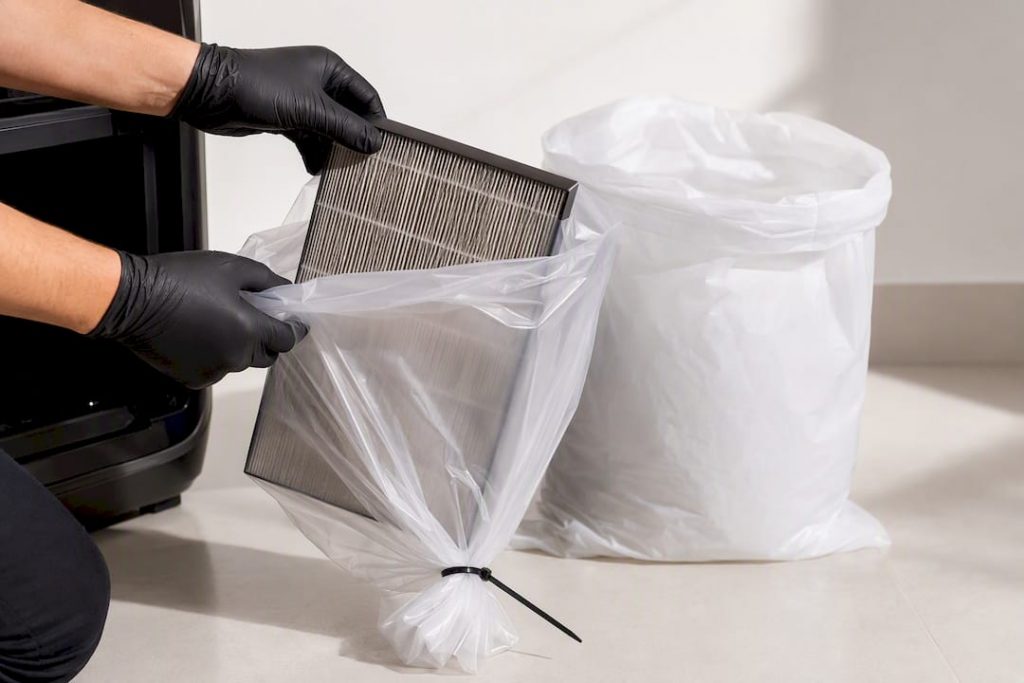
Seal the used filter in a plastic bag, ideally double-bagged, before it goes anywhere near a bin. Wear gloves and a mask while you handle it, since trapped dust, allergens, and mould spores can escape into the air the moment the filter is disturbed. For most households, the sealed bag then goes into general waste, unless local council rules say otherwise or the filter has been exposed to chemicals, mould, or biological contamination that calls for specialist handling.
TL;DR:
- Always double-bag and seal a used HEPA filter immediately in heavy-duty bags to prevent the release of trapped dust, allergens, and mould spores during disposal.
- Wear gloves, a mask, and eye protection when handling used filters, and avoid shaking, tapping, or vacuuming the filter to minimize airborne particulate spread.
- Discard most household HEPA filters in general waste unless local regulations specify otherwise or contamination suggests a special waste stream.
- Filters from laboratories or industrial settings with biological or chemical contamination require certified hazardous waste handling and documentation instead of standard disposal.
- HEPA filter media itself is rarely recyclable due to its composite materials, but packaging and reusable pre-filters can be separated and recycled where permitted.
Table of Contents
- How do you dispose of a HEPA filter step by step?
- What PPE do you need when changing a filter?
- Where do household HEPA filters actually go?
- When is a filter not ordinary household waste?
- How do you prepare, bag, and label a filter correctly?
- Can HEPA filters be recycled?
- A safety-first approach beats a clever one
- Where to buy genuine replacement filters and get disposal advice
- Sources
- FAQ
How do you dispose of a HEPA filter step by step?
Disposing of a used filter safely is less about equipment and more about sequence. Skip a step and you risk releasing exactly the particulate matter the filter spent months trapping.
- Turn off and unplug the purifier. Never remove a filter while the unit is running or still connected to power.
- Slide the filter out slowly. Avoid tapping, knocking, or shaking it against the housing. That single habit is the most common way people undo months of clean filtration in one motion.
- Place it straight into a heavy-duty bin liner or zip-seal bag. Do this immediately, before you set the filter down anywhere else.
- Double-bag and seal tightly. Tie the inner bag, then place it inside a second bag and seal that one too.
- Label the bag if it shows mould, staining, or odour suggesting chemical exposure. A marker note (“used air filter, mould present”) helps waste handlers take appropriate care.
- Bin it in general household waste if your local council permits this. If you’re not sure, a quick call or website check with your local waste authority settles it.
Pro Tip: Keep a spare heavy-duty bag near the purifier before you start. Fumbling for one after the filter is already out is when most dust escapes into the room.
This sequence works for the vast majority of household air purifiers. Filters from clinics, labs, or industrial settings typically require a different disposal process to ensure safety and compliance.
What PPE do you need when changing a filter?
The dust sitting inside a used HEPA filter isn’t ordinary household grime. It’s a concentrated month’s worth (or more) of dust mites, pollen, mould spores, pet dander, and in some homes, tobacco residue or fine particulate from nearby traffic. Handling it without protection defeats the purpose of running an air purifier in the first place.
Recommended protective gear:
- Disposable gloves, changed or washed after use
- A P2 or N95 equivalent mask, particularly if anyone in the household has allergies or asthma
- Eye protection, useful for allergy sufferers who react even to airborne dust
- Good ventilation in the room, achieved by opening a window before you start
Do the change away from children and pets, and in a room with airflow rather than a sealed closet. Experts commonly recommend gloves and a dust mask, double-bagging, and washing hands afterwards as the baseline household precaution, and it’s a routine worth keeping every time, not just when the filter looks visibly dirty.
The mistake to avoid above all others: never shake, tap, or vacuum a used HEPA filter. Vacuuming seems like the tidy option, but running a vacuum nozzle over trapped particulate matter forces fine dust back into the air rather than removing it, and a standard vacuum without HEPA-grade exhaust filtration can simply redistribute what the filter caught. The same goes for tapping it against a bin to “empty” it. HEPA media is designed to hold particles, not release them on demand.
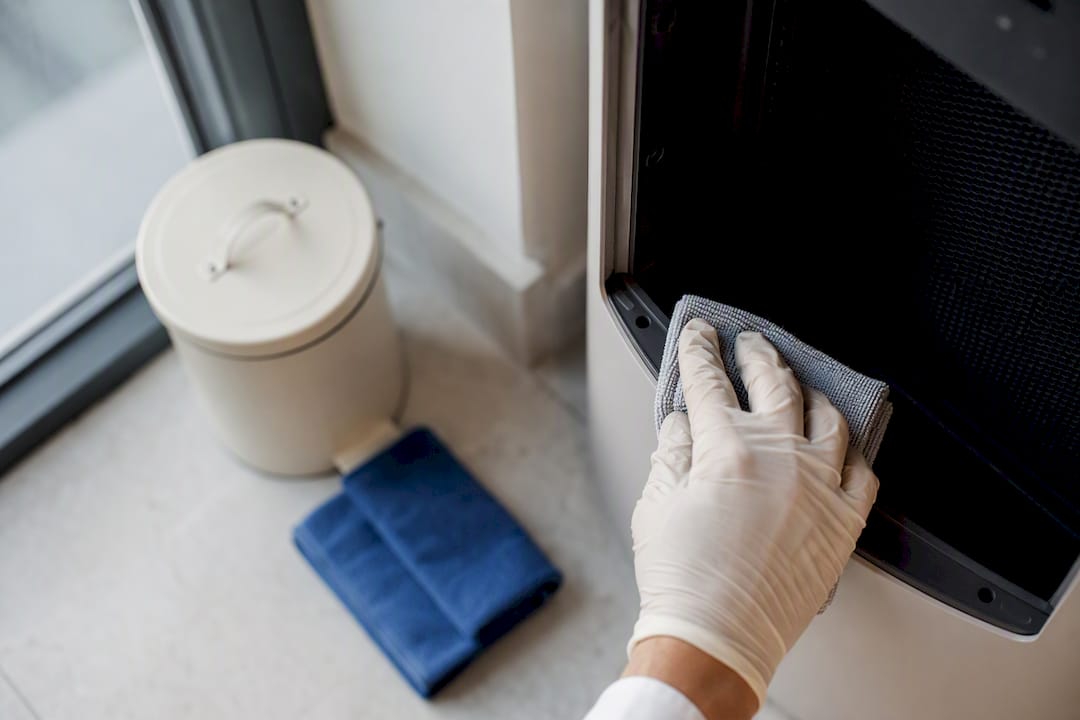
Once the filter is bagged, wipe down the surfaces around the purifier and wash your hands thoroughly. Dust settles on nearby surfaces during any filter change, even a careful one.
Where do household HEPA filters actually go?
Most household HEPA filters end up in general waste, and that’s usually the correct call. Government guidance, including Victoria’s own advice on air purifier maintenance and cleaning, states that used filters are typically not recyclable and can go in general waste where local rules allow. The key qualifier is “where local rules allow.” Waste regulations vary by council and by country, so a quick check with your local waste authority is worth the two minutes it takes, particularly if you’re disposing of several filters at once from a large household or small office.
Here’s the decision path that covers most situations:
- Ordinary dust, pollen, and pet hair buildup: seal and bin as general waste.
- Visible mould growth or a strong musty smell: bag separately, label clearly, and check with your council on whether it needs to go to a specific waste stream.
- Any chemical exposure (paint fumes, pesticide use nearby, industrial residue): treat as special waste, not general rubbish.
- Packaging around the new filter (cardboard box, plastic wrap): separate this from the filter itself and recycle it through your normal household recycling.
Recycling the HEPA filter media itself is rarely available to households. Consumer guidance from sources like AirPurifiersAdvisor confirms that sealing and binning is the standard route precisely because the composite construction of HEPA media makes it unsuitable for most municipal recycling streams. The pleated fibre, adhesive, and frame are bonded together in a way that current household recycling infrastructure isn’t built to separate.
If you’re disposing of filters from a commercial premises, such as a clinic waiting room or hotel lobby unit, larger volumes may trigger different rules even for non-contaminated filters. Many councils cap how much general waste a commercial address can put out, so check whether your quantity needs a scheduled collection or trade waste account rather than the standard household bin.
When is a filter not ordinary household waste?
Some filters carry contamination that changes everything about how they should leave the building. This distinction matters most in clinical, laboratory, and industrial settings, but it’s worth knowing even as a homeowner, particularly if you’ve had recent illness in the house, used strong chemical treatments, or run an air purifier during renovation work involving asbestos-adjacent materials or lead paint removal.
Situations that call for a different protocol include:
- Biological agents: filters from labs, clinics, or biosafety cabinets used around infectious samples
- Chemotherapy or pharmaceutical residues: filters from oncology wards or compounding pharmacies
- Industrial chemical exposure: filters from workshops, spray booths, or facilities handling solvents
Filters used in laboratories or hazardous environments often need specialised protocols including autoclaving or handling by certified hazardous waste services before they can leave the premises at all. Some institutions go further still. Biological safety cabinet filters, for instance, typically require documented disposal forms and may need gas decontamination or other pre-treatment before removal, a process that has nothing in common with pulling a filter out of a bedroom purifier.
For commercial and industrial operators, the documentation matters as much as the physical handling. Industry guidance warns that companies should record waste codes and involve certified waste disposal contractors whenever contamination is a possibility, since regulators can and do audit these trails.
If you manage a clinic, nursery, hotel, or workshop and you’re not certain which category your filter falls into, the safest move is to contact your facility’s safety officer or a licensed hazardous waste contractor before you touch it. Guessing wrong here isn’t a minor slip. It’s the difference between a bin bag and a biohazard incident.
How do you prepare, bag, and label a filter correctly?
Good containment technique comes down to having the right supplies ready before you start, and moving through the swap without pausing halfway.
Gather these before you begin:
- Thick bin liners or heavy-duty zip bags, rated for garden waste rather than thin kitchen bags
- Adhesive tape to reinforce the seal
- A permanent marker for labelling
- Disposable gloves and a mask, put on before you open the purifier casing
Then work through the swap itself:
- Unplug the unit and open the filter compartment.
- Grip the filter frame, not the pleated media, and lift it straight out in one slow motion.
- Lower it directly into the open bag held close to the unit, minimising the distance it travels through open air.
- Twist and tape the inner bag, then place it inside the second bag and seal that too.
- Write the date and any contamination notes on the outer bag with the marker.
- If you can’t dispose of it immediately, store the sealed bag somewhere dry and out of reach of children or pets rather than leaving it near the purifier.
Pro Tip: If you’re changing filters in more than one purifier on the same day, bag each filter separately rather than combining them. It keeps contamination notes accurate and stops you second-guessing which bag came from which room.
Finish with a proper clean up: wipe down the surfaces where the filter sat, run a HEPA-equipped vacuum over the immediate area if you have one, and wash your hands before touching anything else. For a fuller walkthrough of the swap itself, Climatepro’s guide to air filter replacement covers the mechanical side of removing and fitting filters across common purifier models.
Can HEPA filters be recycled?
The honest answer is rarely, and understanding why helps set realistic expectations. HEPA media is a composite of glass or synthetic microfibres bonded with adhesive and set into a plastic or cardboard frame, which is exactly what makes it good at trapping fine particles and bad at being sorted by standard recycling equipment. Manufacturer guidance, including Coway’s own support advice, confirms that bagging and binning through general waste remains the recommended route because the filter media itself isn’t widely recyclable.
What you can recycle is everything around the filter. Separating the cardboard box, paper inserts, and plastic wrap from a new filter’s packaging before you throw away the old one is a simple step that meaningfully reduces landfill volume across a household that changes filters every few months.
It’s also worth knowing the difference between the two parts many purifiers use. A washable pre-filter, often a mesh or foam layer that catches larger particles before air reaches the HEPA element, can usually be rinsed and reused for a long time, unlike the disposable HEPA filter itself. Mixing these two up is common, and treating a reusable pre-filter as disposable wastes money as much as it wastes material.
- Check the manufacturer’s website for a take-back or mail-back scheme before assuming there’s none.
- Ask your retailer about return programmes, particularly for larger commercial-grade units.
- For high-volume disposal, such as a hotel or clinic replacing dozens of filters at once, a professional waste disposal service is worth the cost over ad hoc binning.
Climatepro’s guide to HEPA filtration and UAE indoor air quality covers how filter design affects both performance and end-of-life handling, useful background if you’re choosing a replacement model.
A safety-first approach beats a clever one
Conservative handling isn’t the exciting answer, but it’s the correct one. The instinct to find a recycling loophole for HEPA media is understandable. Nobody enjoys binning something that clearly cost money and clearly did its job. The trade-off, though, tips firmly toward containment rather than reprocessing until safe, scalable methods for sterilising and separating used filter media exist at scale. Until then, sealed and binned is not a compromise. It’s the responsible choice.
What strikes me most, working through the guidance available across manufacturers and government waste authorities, is how small the gap is between doing this safely and doing it poorly. It’s not a matter of expensive equipment or specialist training for the average household. It’s double-bagging instead of single-bagging. It’s a slow lift instead of a shake. It’s a five-minute check with the local council instead of an assumption. Those margins matter more than they get credit for, because waste workers handling a torn, unsealed bag face the same exposure risk as the person who removed the filter in the first place.
Experience with HEPA H13 filtration units across various settings has shaped the practical detail in this guide, but the underlying principle holds regardless of brand or region: treat a used filter as something that needs containing, not just discarding.
— Nevel
Where to buy genuine replacement filters and get disposal advice
Once a filter’s been bagged and binned, the next question is usually which replacement to buy, and getting the right model matters just as much as getting the disposal right. Genuine HEPA replacement filters matched to specific purifier models are available to ensure proper sealing and performance.

Browsing the air purifier and filter range shows current stock across brands used widely in UAE homes and clinics, including replacement filters for models like the Blueair Classic 500/600 Series and the Blueair ComfortPure 3-in-1 T20i. If you’re upgrading rather than just swapping a filter, the Honeywell Air Touch P2 is a common choice for bedrooms and small offices across Dubai and Abu Dhabi. Climatepro’s team can also answer questions about disposal for your specific model or advise on whether your pre-filter is washable rather than disposable, so you’re not throwing out a part that didn’t need replacing. Head to the air purifier category page to check compatibility before your next filter change.
Sources
- Carbon and Hepa Filter Replacement and Disposal: Safety First — Air Science
- How to dispose of air purifier filter — AirPurifiersAdvisor
- How do I dispose of my used filters? — Coway support
FAQ
How do you dispose of air purifier filters?
Seal the used filter in a bin liner or zip bag, double-bag it for extra containment, and place it in general household waste if your local council permits this. Check with your local waste authority first if the filter shows mould, chemical exposure, or other contamination.
Can HEPA filters be vacuumed and reused?
No. Vacuuming a used HEPA filter forces trapped particles back into the air rather than removing them, and standard vacuums can redistribute fine dust the filter was designed to hold. HEPA filters are disposable and should be replaced, not cleaned and reinstalled.
What should you do with a HEPA filter once it’s removed?
Bag it immediately using the slow lift and double bag method, label it if there’s mould or chemical exposure, and place it in general waste unless local rules or contamination require special disposal. Wash your hands and wipe down surrounding surfaces afterwards.
Do HEPA filters really need to be replaced?
Yes, HEPA filters lose effectiveness as they trap particulate matter over time, and a clogged filter reduces airflow and cleaning performance. Manufacturer guidance for most household purifiers recommends replacement on a set schedule, detailed further in Climatepro’s guide to HEPA filtration and air quality.
Are HEPA filters recyclable?
Rarely. The composite construction of HEPA media makes it unsuitable for most standard recycling streams, so sealing and binning through general waste remains the standard advice from manufacturers and government waste authorities alike. Packaging around the filter, such as cardboard and plastic wrap, can usually be recycled separately.