CADR stands for clean air delivery rate, expressed in cubic feet per minute (CFM), and it tells you how quickly a purifier cleans particles from the air. Every purifier carries three CADR numbers, for smoke, dust and pollen. The Association of Home Appliance Manufacturers (AHAM) recommends the “2/3 rule”: pick a smoke CADR that’s at least two thirds of your room’s area in square feet, and you’ll have a purifier sized for that space.
TL;DR:
- A smoke CADR of at least 165 to 200 CFM is recommended for typical rooms of 250 to 300 square feet, following the 2/3 rule.
- Smoke CADR is more relevant than dust or pollen for filtering fine particles like wildfire smoke or vehicle exhaust.
- Running a purifier at maximum fan speed on a new filter yields the best possible CADR, but real-world effectiveness drops at lower speeds and with loaded filters.
- CADR does not account for gases, odours, or VOCs, which require specific activated carbon filtration beyond particle removal.
- For accurate sizing, consider adding a 1.5 times margin if the room has high ceilings, open layout, or persistent pollution sources.
Table of Contents
- What does CADR measure and how is it tested?
- Why smoke, dust and pollen CADR each matter differently
- How to size a purifier using CADR and the 2/3 rule
- Where CADR falls short of the full picture
- Getting closer to your unit’s rated CADR at home
- ClimatePro’s sizing checklist for choosing by CADR
- When CADR should decide your purchase, and when it shouldn’t
- Let ClimatePro match the right purifier to your room
- Standards and guidance behind CADR claims
- Sources
- FAQ
What does CADR measure and how is it tested?
CADR isn’t a filter rating. It’s a whole-machine performance number that combines two things: how much air the unit moves and how well it strips particles out of that air on each pass.
The test is run under ANSI/AHAM AC-1, the industry standard behind every AHAM Verifide label. A purifier runs inside a sealed test chamber. Technicians inject a known concentration of test particles, either smoke, dust or pollen, and measure how fast the concentration drops with the unit running versus how fast it drops on its own through natural settling. The difference between those two decay rates, multiplied by the chamber’s volume, gives you the CADR figure in CFM.
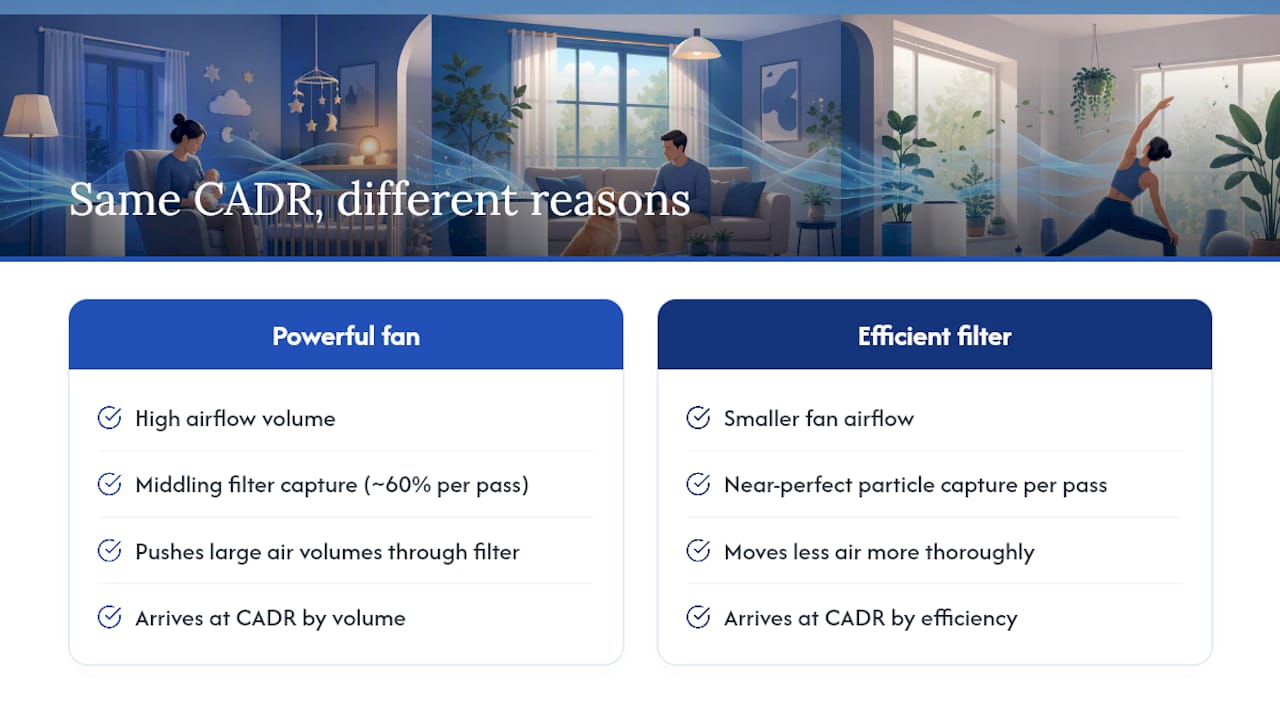
That’s why two purifiers can carry a similar CADR number for completely different reasons. A unit with a powerful fan but a middling filter might push huge volumes of air through a filter that only catches, say, 60% of particles per pass. Another unit with a smaller fan and a near-perfect filter might land on the same CADR by moving less air more thoroughly. The number tells you the outcome, not the mechanism, so it’s not a proxy for filter quality on its own.
A few testing details matter more than most buyers realise. CADR is measured with the fan on its highest setting, using a brand new filter straight out of the box. Both of those conditions flatter the number. Run the same unit on low speed, or six months into a filter’s life with dust loading it down, and the real CADR will sit below the figure on the box. This isn’t a flaw in the standard, since the test needs a fixed, repeatable condition. It just means the label describes a best case, not a daily average.
It’s also worth being clear about what CADR does and doesn’t cover. The test measures particle removal only. It says nothing about gases, smoke odour, or volatile organic compounds (VOCs), because those aren’t filtered the same way particles are. The EPA’s guide to air cleaners in the home is explicit on this point: CADR is a useful comparative metric for portable air cleaners, but it applies to particulate matter, not the gaseous pollutants that a HEPA filter simply passes through untouched.
The 1,008 cubic foot AHAM test chamber is also a fixed, empty box under controlled airflow, nothing like a furnished bedroom with a ceiling fan, a doorway draft and a rug soaking up particles at ground level. CADR gives you a reliable way to compare purifiers against each other under identical conditions. It’s a weaker guide to exactly how many CFM you’ll get in your actual living room. Reputable manufacturers report both a “rated” and “measured” CADR for this reason, and ENERGY STAR’s room air cleaner specification requires manufacturers to disclose both figures along with measured operating power, which is a good habit to check for when you’re comparing spec sheets.
Why smoke, dust and pollen CADR each matter differently
Every AHAM-tested purifier reports three separate CADR numbers because “particles” isn’t one category. It’s a range of sizes from under a micron to over ten microns, and no single filter behaves identically across that whole range.
The smoke CADR covers particles from 0.09 to 1.0 micron. This band includes wildfire smoke, cooking fumes, vehicle exhaust that drifts in through windows, and fine combustion particles generally. It’s the hardest band to filter well because particles this small can slip past a mediocre filter media, and it’s also the band most closely associated with the fine particulate matter (PM2.5) that health agencies track for respiratory risk.
The dust CADR sits in the 0.5 to 3 micron range, covering settled household dust, some mould spores and skin flakes. The pollen CADR covers the largest band, 5 to 11 microns, which takes in tree and grass pollen along with larger pet dander clusters.
Here’s the practical wrinkle: larger particles are also easier for gravity to deal with on its own. In the test chamber, pollen and dust particles settle out of the air faster than smoke particles do, even with the purifier switched off. That natural settling narrows the measurable gap between “purifier running” and “purifier off” for the larger bands, which tends to compress dust and pollen CADR scores relative to how effectively the filter media actually captures those particles. It’s a quirk of the test method, not a sign the purifier is bad at catching dust.
For most households, that’s exactly why smoke CADR carries the most weight in a buying decision. If you’re managing allergies, dust or pet dander, dust and pollen CADR are worth checking, but they’ll typically already be higher than the smoke figure on the same unit, so they’re rarely the limiting factor. If you’re dealing with wildfire haze, a smoky kitchen, or general fine-particle pollution, the smoke CADR is the number that decides whether the purifier can keep up. A rule of thumb that holds for most buyers: size to the smoke CADR, and the dust and pollen numbers will generally look after themselves.
How to size a purifier using CADR and the 2/3 rule
AHAM’s sizing guidance boils down to one clean rule: your smoke CADR should be at least two thirds of your room’s floor area in square feet, for a standard room with an 8-foot ceiling. Here’s how to apply it.
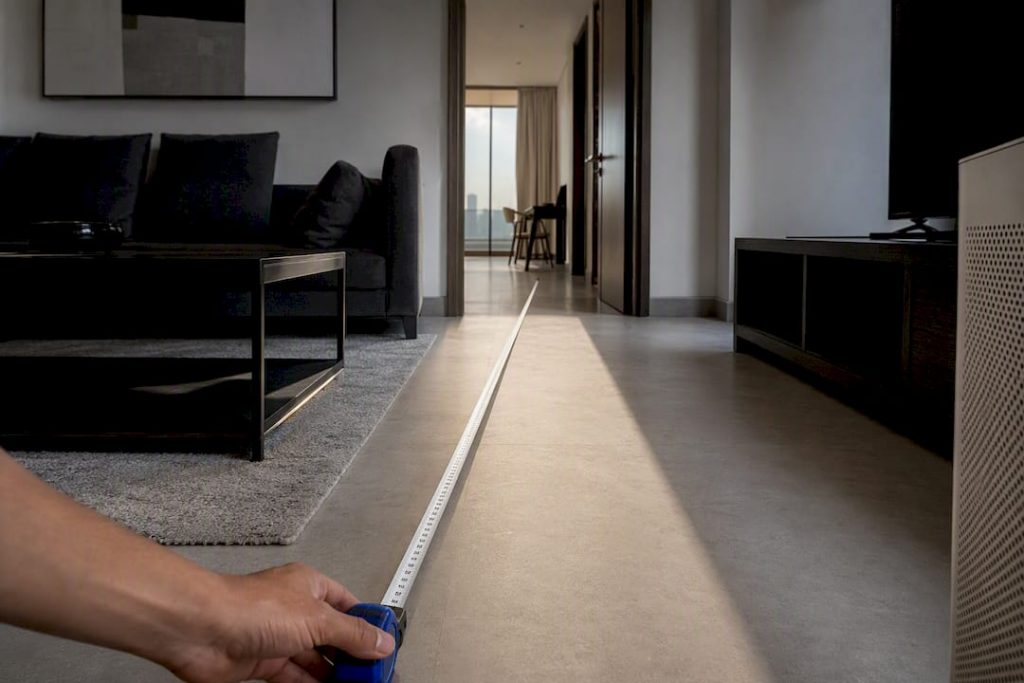
- Measure your room’s floor area in square feet. A 12 by 12 foot bedroom is 144 square feet; a 20 by 15 foot living room is 300 square feet.
- Multiply that area by two thirds (0.67). A bedroom with a floor area of about 144 square feet should have a smoke CADR of approximately two thirds of that area in CFM. A living room around 300 square feet should scale similarly following the 2/3 rule.
- Compare that target against the smoke CADR listed on the product, not the dust or pollen figure, and choose a unit that meets or exceeds it.
- Round up rather than down if the room has higher ceilings, an open-plan layout, or a persistent particle source like a smoker, a gas stove or nearby traffic.
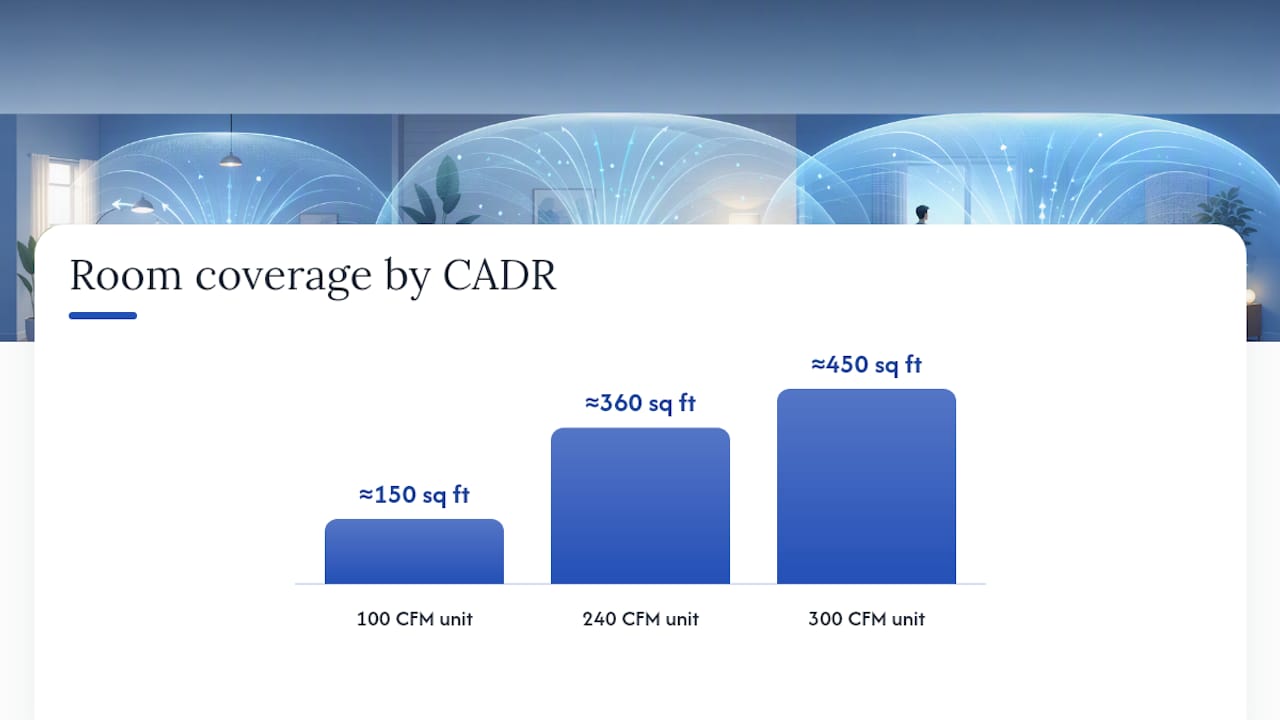
Working through a few common room sizes makes the numbers less abstract. A typical bedroom around 150 square feet needs roughly 100 CFM smoke CADR, comfortably covered by many compact HEPA units. A living room around 250 to 300 square feet pushes that target to 165 to 200 CFM, where a mid-sized purifier like the Honeywell Air Touch P2 sits well within range. An open-plan living and dining area of 450 square feet or more starts asking for 300 CFM or higher, which is where a larger-capacity unit such as the Honeywell Air Touch U1 earns its higher CADR rating.
So is 240 or 300 CADR good? Run it through the rule rather than judging the number in isolation. A 240 CFM smoke CADR comfortably covers a room up to about 360 square feet using the 2/3 rule, which makes it a strong fit for a large bedroom or a mid-sized living room, but undersized for an open-plan area twice that footprint. A 300 CFM smoke CADR stretches to around 450 square feet, putting it in solid territory for most combined living and dining spaces. Neither figure is universally “good” or “bad”; it depends entirely on the square footage you’re asking it to clean.
CADR also converts into air changes per hour (ACH), a second way of thinking about cleaning speed that some readers find more intuitive. The formula is CADR (CFM) × 60, divided by room volume in cubic feet. For an 8-foot-high, 150 square foot bedroom (1,200 cubic feet), a 100 CFM smoke CADR delivers 6,000 divided by 1,200, or 5 ACH. That sits inside the 4 to 6 ACH range generally considered solid for allergy and dust control. Wildfire smoke events or households with heavy indoor sources often call for closer to 6 to 8 ACH, which means sizing up beyond the bare 2/3 minimum rather than treating it as a ceiling.
Where CADR falls short of the full picture
The AHAM number is a genuinely useful comparison tool, but treating it as gospel leads to a few predictable disappointments.
The chamber test’s bias toward smoke over larger particles, covered earlier, means a purifier’s pollen or dust CADR can understate how well it actually captures those particles in daily use. That’s a quirk of methodology, not a defect in the product.
Fan speed is the bigger practical gap. CADR is always measured at maximum fan speed, and Consumer Reports’ air purifier buying guide points out that plenty of owners never actually run their units at that setting because it’s loud. Drop to a medium or low speed for the sake of a quiet bedroom overnight, and your effective CADR drops with it, sometimes by half or more. The box number assumes a fan setting many people avoid.
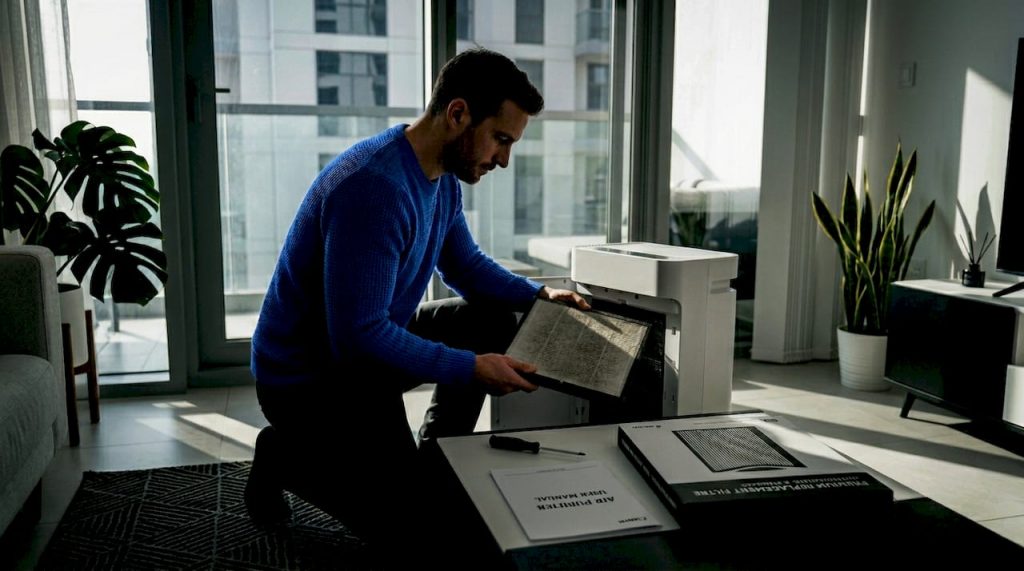
Filter condition matters just as much. CADR is tested on a fresh filter straight out of packaging. A filter loaded with six months of dust, or a cheap non-standard replacement swapped in to save money, won’t perform to the same standard, even in an otherwise identical unit. Genuine replacement filters, changed on schedule, are what keep real-world performance closer to the rated figure.
Then there’s the boundary CADR simply doesn’t cross. It measures particles only, never gases. A high smoke CADR says nothing about a purifier’s ability to handle cooking odours, VOCs from paint or furniture, or general “stuffy room” smells. Odour and gas control comes down to activated carbon media or similar adsorption technology sitting alongside the HEPA filter, and a unit’s CADR rating won’t tell you whether that carbon stage exists or how much of it there is.
Getting closer to your unit’s rated CADR at home
A few placement and habit changes close most of the gap between the number on the box and what you actually feel in the room.
- Place the unit centrally in the room rather than tucked into a corner, since corners restrict airflow into and out of the machine.
- Keep at least 30 to 50 centimetres of clear space around the intake and outlet, away from curtains, furniture or walls.
- For rooms over roughly 400 to 500 square feet, consider two smaller units positioned at opposite ends rather than one large unit working alone. Two moderate CADR units distributed through a space generally circulate and mix air more evenly than a single large unit pushed to its limit from one corner.
- Run the unit on a higher speed during and after events that spike particles, cooking, guests, wildfire smoke, then drop it to a lower, quieter setting overnight.
- If noise is the deciding factor at bedtime, a short high-speed pulse of 20 to 30 minutes before sleep, followed by low speed overnight, often beats running low speed continuously.
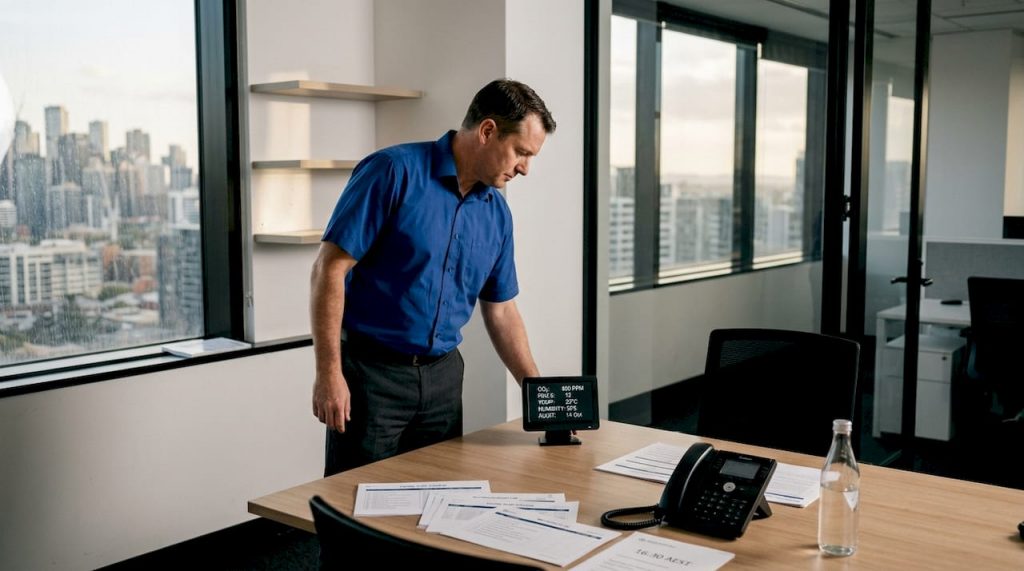
Pro Tip: Before you buy, check the decibel rating at the fan speed you’ll actually use overnight, not the speed the CADR was tested at. A purifier that’s rated for a 300 square foot room on high but sounds like a hairdryer at that setting probably will not be run that way, which quietly erodes the CADR you paid for. Compare the noise level at the speed matching your real ACH target from ClimatePro’s placement guide.
ClimatePro’s sizing checklist for choosing by CADR
We put the 2/3 rule into a straightforward checklist so you’re not doing chamber-test maths before buying a purifier.
First, measure your room’s floor area in square feet. Second, look for a smoke CADR at or above two thirds of that figure. Third, add margin: if the ceiling runs higher than 8 feet, the layout is open-plan, or there’s a persistent source (smokers, gas cooking, heavy traffic pollution), aim for 1.5 times the room area instead of the bare two thirds.
This is exactly the calculation we walk customers through when they’re deciding between models, and it’s covered in more depth in our guide to matching CADR to your room using AHAM’s 2/3 rule and our breakdown of how to size an air purifier by room size rather than square footage guesswork. If you’re unsure how many units a larger or open-plan home actually needs, our note on how many air purifiers you actually need at home covers the distributed-unit approach in more detail.
When CADR should decide your purchase, and when it shouldn’t
CADR deserves to be the deciding factor when your main concern is particles: seasonal allergies, pet dander, wildfire smoke drifting indoors, or general dust in a home with poor natural ventilation. In those cases, undersizing on smoke CADR is the single most common mistake buyers make, and it’s the one the 2/3 rule directly fixes.
Where CADR should take a back seat is odour and gas control. A high CADR unit with a thin carbon layer will do very little for cooking smells or VOCs, so that’s a separate spec to check, not something the CADR number implies. Energy consumption and noise at your actual run speed matter more than CADR once you’ve shortlisted a few units that already clear your sizing target.
My take for most households: size to smoke CADR first using the 2/3 rule, then filter your shortlist by carbon capacity, noise at realistic speeds, and running cost, in that order.
— Nevel
Let ClimatePro match the right purifier to your room
Sizing by CADR is straightforward once you have the numbers, but choosing between models with the right smoke CADR, filter type and noise profile for your actual room takes a bit more digging. The market offers HEPA H13 purifiers across the CADR range needed for anything from a single bedroom to an open-plan living space, with genuine replacement filters available to maintain performance, and delivery services commonly cover major cities and emirates in the UAE.

If you’ve worked out your room’s square footage and want a unit that clears the 2/3 rule comfortably, the Honeywell Air Touch P2 is a solid mid-room option, while larger or open-plan spaces are better served by the higher-capacity Honeywell Air Touch U1. Browse the full range on our air purifiers category page, or get in touch for personalised sizing support if your space doesn’t fit a standard rule-of-thumb calculation.
Standards and guidance behind CADR claims
Four sources anchor everything a CADR label claims. AHAM Verifide runs the ANSI/AHAM AC-1 test and lists certified products, so a Verifide mark confirms the number was independently tested rather than self-reported. ENERGY STAR’s room air cleaner specification ties PM2.5 CADR bins to minimum efficiency thresholds. The EPA’s residential air cleaner guide explains what CADR does and doesn’t cover, and Consumer Reports’ buying guide flags the noise-versus-speed trade-off buyers routinely overlook.
Sources
- Air Filtration Standards – AHAM Verifide
- ENERGY STAR Version 3.0 room air cleaners final draft specification (Nov 2024)
- Air purifier buying guide – Consumer Reports (2026)
FAQ
What is a good CADR rating?
A good CADR rating is one that meets or exceeds two thirds of your room’s floor area in square feet for the smoke figure, per AHAM’s 2/3 rule, so “good” depends entirely on the room, not a fixed number.
Is 240 CADR good?
A 240 CFM smoke CADR comfortably covers a room up to roughly 360 square feet using the 2/3 rule, making it a good fit for a large bedroom or mid-sized living room, but undersized for bigger open-plan spaces.
Is 300 CADR good?
A 300 CFM smoke CADR suits rooms up to around 450 square feet, which puts it in solid range for most combined living and dining areas, though very large or open-plan homes may still need a higher rating or a second unit.
Does CADR measure gas and odour removal?
No. CADR only measures particle removal for smoke, dust and pollen; gas, VOC and odour control depends on activated carbon or similar media, which the EPA notes sits outside what CADR testing covers.
Why does my purifier feel weaker than its CADR rating suggests?
CADR is tested at maximum fan speed on a brand new filter, so running on a lower, quieter setting or using an ageing filter, as Consumer Reports points out, will bring real-world performance below the rated figure.