Yes, many mouldy books can be saved. Isolate affected volumes immediately, get relative humidity below 55%, and act within 48 hours if items are wet. Freeze anything you cannot dry in that window, except leather, vellum, and photographs. Put on PPE, including an N95 respirator and nitrile gloves, before you touch anything.
TL;DR:
- Maintaining relative humidity below 55% is crucial; tools like hygrometers cost less than a hardcover book and help monitor conditions accurately.
- Isolating affected books immediately, wearing PPE, and reducing room humidity within 48 hours are key actions to prevent mold growth and limit damage.
- Active mold appears fuzzy and moist, while inactive stains are dry and powdery; testing for texture, smell, and location helps identify the current threat.
- Regular dust removal, strategic shelving away from cold surfaces, and quarantine of new books help prevent mold from establishing over time.
- Using a dehumidifier and HEPA air purifier together, along with routine RH checks, creates an environment where mold cannot thrive and protects collections long-term.
Table of Contents
- Books mould prevention checklist you can apply today
- Why does mould grow on books in the first place?
- How do you tell active mould from old mould damage?
- What to do in the first hours of an active outbreak
- How do you clean inactive mould off a book safely?
- Setting up long-term humidity control for books
- What should you monitor to catch problems early?
- When should you call a conservator instead of handling it yourself?
- Which devices actually support books mould prevention?
- Practical products for controlling humidity and airborne spores
- What’s the one habit that actually prevents mould in books?
- Sources
Books mould prevention checklist you can apply today
Effective books mould prevention comes down to controlling three variables: humidity, airflow, and dust. None of them require specialist equipment to manage day to day.
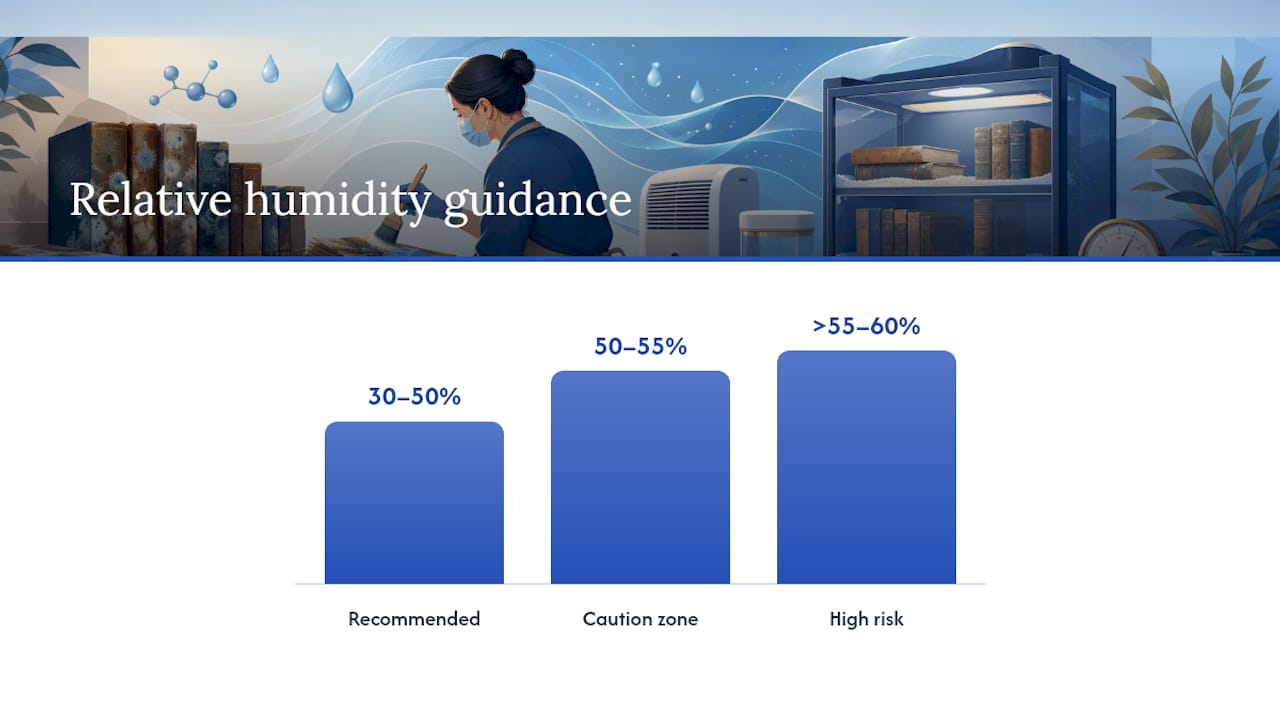
Start with the number that matters most. Relative humidity above 60% for sustained periods creates conditions where mould can establish itself on paper and binding materials. A hygrometer costing less than a hardcover book tells you where you actually stand, rather than guessing based on how the room feels.
Here’s a practical checklist for ongoing humidity control for books and shelving hygiene:
- Keep relative humidity in a moderate range using a dehumidifier or air conditioning, and check the reading regularly with a hygrometer.
- Position shelving away from exterior walls and out of basements or closets, where cold surfaces and poor airflow encourage condensation.
- Leave a few centimetres of space between books and the back of the shelf so air can circulate behind the collection.
- Run a HEPA vacuum with a brush attachment or an electrostatic cloth over shelves and book tops on a monthly schedule to remove dust before spores get a foothold.
- Quarantine every incoming book, whether it’s a donation, a secondhand purchase, or a return from storage, and inspect it before shelving it with the rest of your collection.
- Check dehumidifier drainage and HVAC filters on a set schedule, and investigate any musty smell or sign of booklice straight away.
Pro Tip: Booklice are a strong early warning sign. They thrive in the same humidity range that mould does, so spotting them on a shelf is often your cue to check RH before you ever see visible growth.
Why does mould grow on books in the first place?
Mould needs three things to establish itself: moisture, an organic food source, and still air. Paper, cloth bindings, animal-hide glues, and even the starch in some cotton endpapers are all organic material mould spores can feed on once moisture pushes conditions past the threshold. Spores are already present in ordinary household dust, so the trigger is almost always a change in the environment, not the sudden arrival of contamination from outside.
Several conditions make that trigger far more likely:
- Condensation on windows, exterior walls, or cold pipes near shelving, which raises local humidity well above the room average.
- Temperature swings, particularly in uninsulated storage rooms or garages, which cause moisture to condense on cool surfaces overnight.
- Stagnant air, common in closed cabinets, dense stacks, or rooms with no ventilation, which lets humid pockets build up unnoticed.
- Risky locations, including basements, rooms with carpets (which trap moisture and dust), and corrugated cardboard boxes, which absorb and hold humidity.
Leather bindings, animal-glue spines, and older cloth-cased books with starch-based adhesives are generally more vulnerable than modern books using synthetic binding glues, simply because mould has more to feed on.
How do you tell active mould from old mould damage?
Not every dark spot on a book is a current problem, and treating inactive staining as an active outbreak wastes effort and risks unnecessary damage to the page. Work through these checks in order.
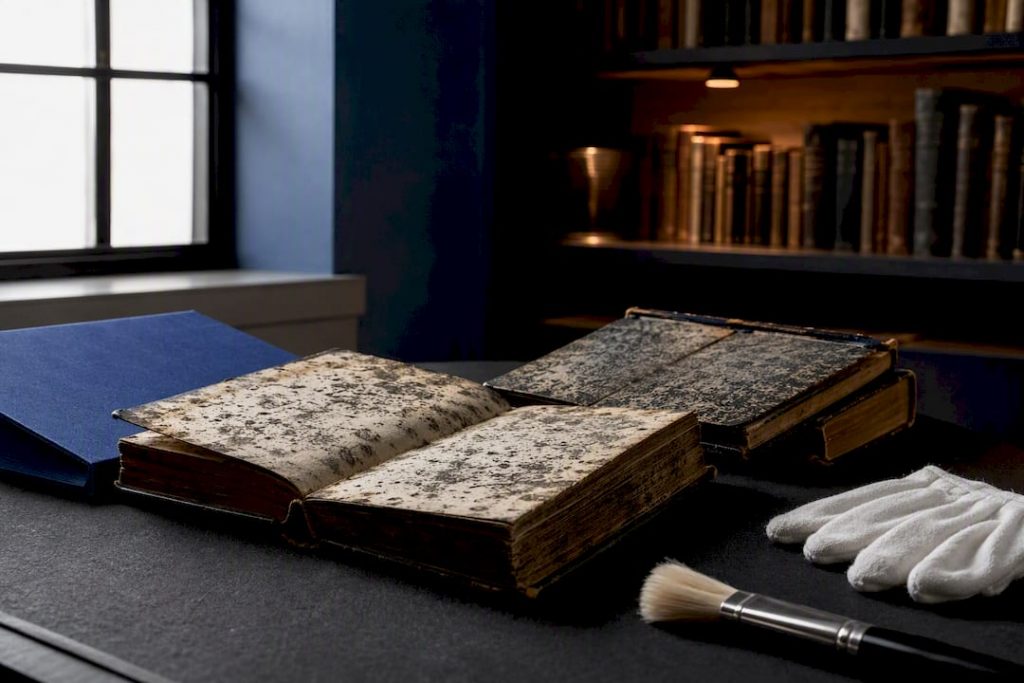
- Look at the texture. Active mould is usually fuzzy, raised, or slightly fibrous, and it can appear white, green, black, or orange. Inactive mould damage is flat, dry, and powdery, and it often looks like a stain rather than a growth.
- Check the hotspots. The gutter margin near the spine, the underside of the top edge, and the inside of the front and back boards are where moisture collects first, since airflow barely reaches those spots.
- Smell the book. A strong musty odour usually indicates active growth or very recent moisture exposure, even where nothing is visible yet.
- Touch it carefully while wearing gloves. Active mould can smear or leave a chalky residue on a gloved finger. Dry, inactive staining will not transfer.
- Photograph and log every affected item before you do anything else, noting the date, the shelf location, and a description of what you see. This record becomes essential if you later need to consult a conservator or file an insurance claim.
If you are unsure whether growth is active, treat it as active. The health and handling precautions cost little, and the alternative risks spreading spores through your collection.
What to do in the first hours of an active outbreak
An active outbreak calls for a set order of operations, not a scramble. Speed matters here: mould typically begins germinating on wet materials within 48 hours, so every step below is built around that window.
- Move affected items to a separate, ventilated area. Isolate them from the rest of your collection immediately, ideally somewhere with an exterior door or window rather than a sealed room.
- Put on PPE before you touch anything. Cornell University’s preservation guidance treats all mould as potentially toxic, recommending an N95 respirator, nitrile gloves, and a protective apron whenever handling infected material.
- Label and separate items by severity, but do not seal them in plastic bags unless you intend to freeze them straight away. A sealed bag without freezing traps humidity and creates a microclimate that accelerates growth rather than stopping it.
- Get the room’s relative humidity below 55% using a dehumidifier or the building’s HVAC system, and add a fan to keep air moving across shelves and floors. Mop up any standing water and address the source of a leak before you consider the job finished.
- Freeze anything you cannot fully dry within 48 hours. Wrap items in freezer paper or place them in ventilated boxes rather than sealed bags, and leave them in a domestic or chest freezer for at least 24 hours. Do not freeze leather, vellum, parchment, or photographic materials, since freezing can cause separate, often irreversible damage to those formats.
- Defrost slowly before cleaning. Move frozen items to a cool, dry, well-ventilated space and let them come to room temperature gradually before any cleaning begins.
Pro Tip: A household freezer works fine for most paper-based books in a genuine emergency. Set aside freezer space as part of your household emergency plan before you need it, rather than discovering at 11pm that there’s no room next to the frozen vegetables.
How do you clean inactive mould off a book safely?
Confirm the mould is dry, flat, and powdery before you clean anything. Active, fuzzy growth needs stabilising first using the steps above, not cleaning.
Once you’re confident it’s inactive, work outdoors or near an open window and keep wearing your PPE.
- Use a HEPA vacuum with a brush attachment on low suction to lift loose spores and residue from the page surface and gutter margin.
- A dry-cleaning sponge (a soft, crumbly conservation-grade sponge) works well for surface residue on paper that a vacuum brush can’t reach.
- For limited, stubborn spots only, a cloth barely dampened with 70% isopropyl alcohol can help, but keep moisture to an absolute minimum and never soak the page.
- Never use household bleach on book materials. It degrades paper fibres and can cause discolouration that’s impossible to reverse.
- Never run a standard household vacuum over a mouldy book. Without HEPA filtration, it can exhaust spores straight back into the room rather than capturing them, worsening the contamination you’re trying to remove.
- Skip the household freezer for anything you weren’t advised to freeze by a conservator, particularly photographs, film, or anything with a wax or gelatine-based coating.
HEPA-rated equipment isn’t a nice-to-have here. HEPA filters capture at least 99.97% of particles as small as 0.3 micrometres, and mould spores typically range from 1 to 200 micrometres, well within what a properly rated filter traps rather than redistributes.
Once you’ve finished, let items dry fully in open air, check them again after a few days for any sign of reactivation, and keep a written record of the treatment date and method for future reference.
Setting up long-term humidity control for books
Stabilising an outbreak solves today’s problem. Preventing the next one means building an environment where mould simply can’t get a foothold, and that starts with consistency rather than chasing a perfect number.
Climate targets that actually hold up
Aim for relative humidity in the 30–50% range, with temperature held as steady as your building allows. What matters more than hitting an exact figure is avoiding sustained periods above roughly 55–60%, since mould risk climbs sharply past that point, and swings in temperature that cause condensation on cold surfaces are often more damaging than a slightly elevated but stable RH reading.
Choosing and placing equipment
A dehumidifier sized for the room, not the whole house, does most of the work in a dedicated library or storage space. Undersized units run constantly without ever pulling RH down; oversized units short-cycle and leave humidity uneven across the room. Check the drainage tank or hose regularly, since a full tank simply stops removing moisture until it’s emptied. On the HVAC side, replace filters on the manufacturer’s schedule, and consider upgrading to HEPA filtration in any room that has had a mould problem before, since it addresses the airborne spore side of the equation that a dehumidifier alone doesn’t touch.
Storage materials that help rather than hurt
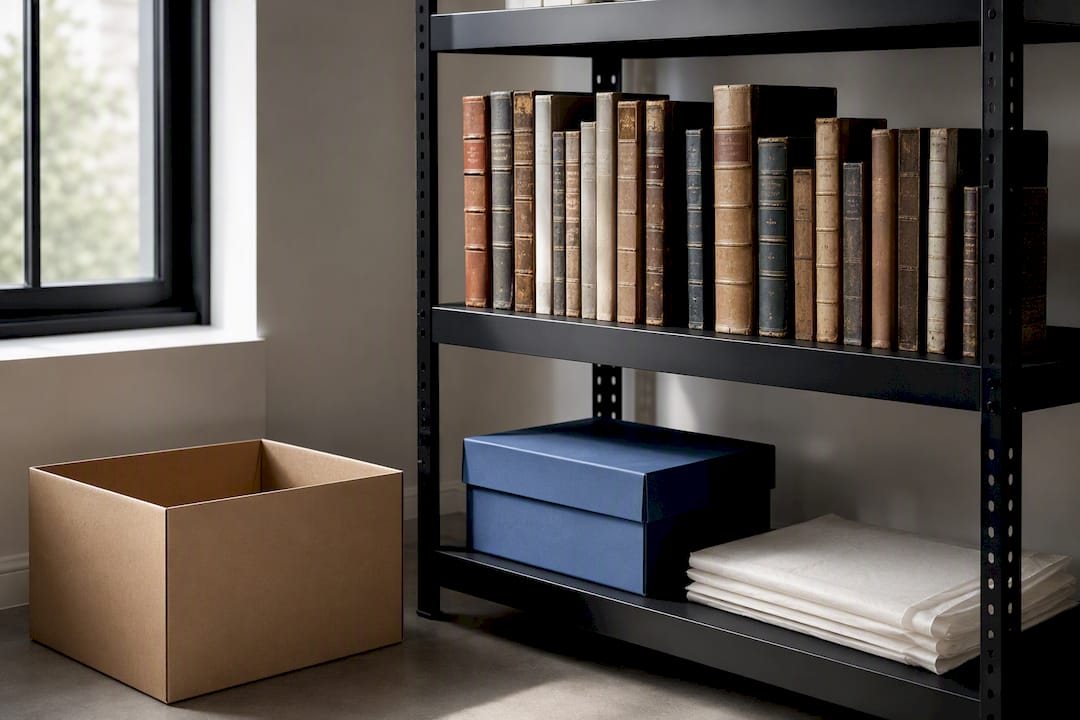
Metal shelving beats wood in damp-prone areas, since wood can hold and release moisture and, in some cases, host mould itself. Space books with a little breathing room rather than packing shelves tight, and use archival boxes with interleaving tissue for your most vulnerable or valuable volumes. Avoid storing books in corrugated cardboard boxes anywhere with elevated humidity, since cardboard absorbs moisture readily and holds it against the very items you’re trying to protect.
Housekeeping and acquisitions
Put a dusting schedule on the calendar rather than leaving it to memory, and quarantine every new donation or purchase before it joins the shelves. This single habit, more than any piece of equipment, is what keeps a contained problem from becoming a collection-wide one. Our mould prevention checklist for homeowners covers the monthly routine in more detail if you want a template to adapt.
Pro Tip: Label archival boxes with the date they were last inspected. It takes seconds and turns “I think I checked that box” into a hard fact next time you’re doing rounds.
What should you monitor to catch problems early?
A basic analogue thermo-hygrometer is enough for a single room and costs very little. For a larger library or multiple storage areas, a networked datalogger that records RH and temperature over time is worth the extra outlay, since it shows trends rather than a single snapshot, and trends are what actually predict trouble.
Place sensors away from doors, vents, and direct sunlight so the reading reflects the room generally, not one draughty corner.
- Check readings weekly at minimum, and daily during humid seasons or after any weather event.
- If RH sits above 55% for more than a day or two, treat it as an action trigger, not something to watch a little longer.
- Empty dehumidifier tanks and check drainage lines on a fixed schedule rather than waiting for an overflow to remind you.
- Keep a simple log, even a spreadsheet, of RH readings and maintenance dates. Our humidity control workflow guide walks through building one from scratch.
When should you call a conservator instead of handling it yourself?
Some situations move beyond safe DIY territory. Call a conservator or professional salvage service when an outbreak spans many volumes at once, when high-value or fragile items are affected, or when the collection includes photographs, film, or other sensitive media that freezing or alcohol wiping could damage further.
Health matters too. If anyone in the household or building is immunocompromised, has asthma, or has a mould allergy, bring in a professional rather than handling extensive growth yourself. Institutional collections should also consider insurance and liability implications before undertaking large-scale treatment in-house.
Bring your photographs, RH logs, and any acquisition or storage notes to that first conversation. It gives the conservator a genuine head start on assessment.
Which devices actually support books mould prevention?
Device choice follows directly from the two problems you’re managing: ambient moisture and airborne spores. A dehumidifier sized to the room pulls RH down and holds it there, but check the drainage tank regularly, since a full tank means the unit has effectively stopped working. A HEPA air purifier handles the airborne side, capturing spores stirred up during cleaning or shelving that a dehumidifier can’t touch, and the two work best as a pair rather than either alone. A basic hygrometer or a networked datalogger tells you whether either device is actually doing its job, rather than assuming it is.
Practical products for controlling humidity and airborne spores
Beyond the checklist, most of what protects a collection long term comes down to two devices working together: something that pulls moisture out of the air, and something that filters spores out of it. Climatepro stocks both categories, sized for everything from a single bookshelf room to a full home library.

For a dedicated book room or a converted closet library, a compact unit like the Xiaomi Smart Dehumidifier Lite is enough to keep RH in the target range without dominating the room. Match capacity to your actual square metreage rather than buying the largest unit available. Browse the full dehumidifier range if you’re comparing sizes for a bigger space.
On the airborne side, the Honeywell Air Touch P1 and Honeywell Air Touch P2 both use HEPA filtration suited to a home library, while the Air Touch U1 covers larger rooms. Check the full air purifier catalogue for options across different room sizes. Whichever unit you choose, look at ease of filter replacement before you buy. A HEPA filter you’ll actually swap on schedule beats a higher-spec one that’s a hassle to service. If you’re not sure which capacity suits your room, Climatepro’s product pages list coverage area and filter type for each model so you can match the unit to your space before ordering.
What’s the one habit that actually prevents mould in books?
The mistake seen most often isn’t ignorance of the science. It’s hesitation. People notice a musty smell or a faint discolouration and decide to keep an eye on it for a week, and that week is exactly the window in which containable mould becomes a spreading problem.
The second mistake is sealing a mouldy book in a plastic bag “to be safe,” without freezing it. That single action does more harm than leaving the book exposed to air, because it traps the very moisture the mould needs.
If there’s one habit worth adopting, it’s this: photograph and date every shelf inspection, even when nothing looks wrong. A log with nothing alarming in it is still useful, because it’s what lets you spot the first change before it becomes an outbreak.
— Nevel
Sources
- 3.8 Emergency salvage of mouldy books and paper — NEDCC
- Mould — Library preservation and conservation tutorial, Cornell University
- Preservation services and damage response — University of Illinois Library