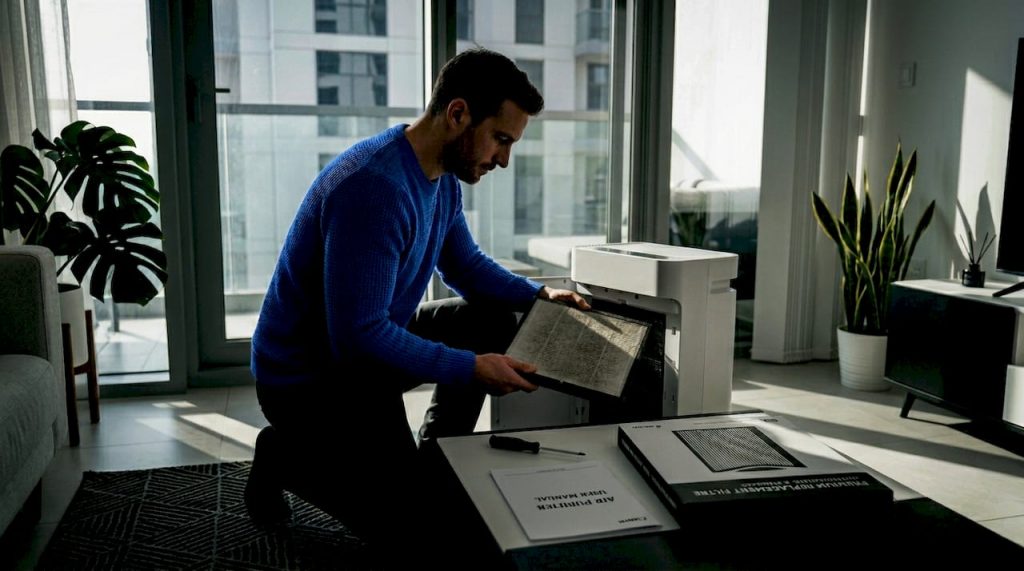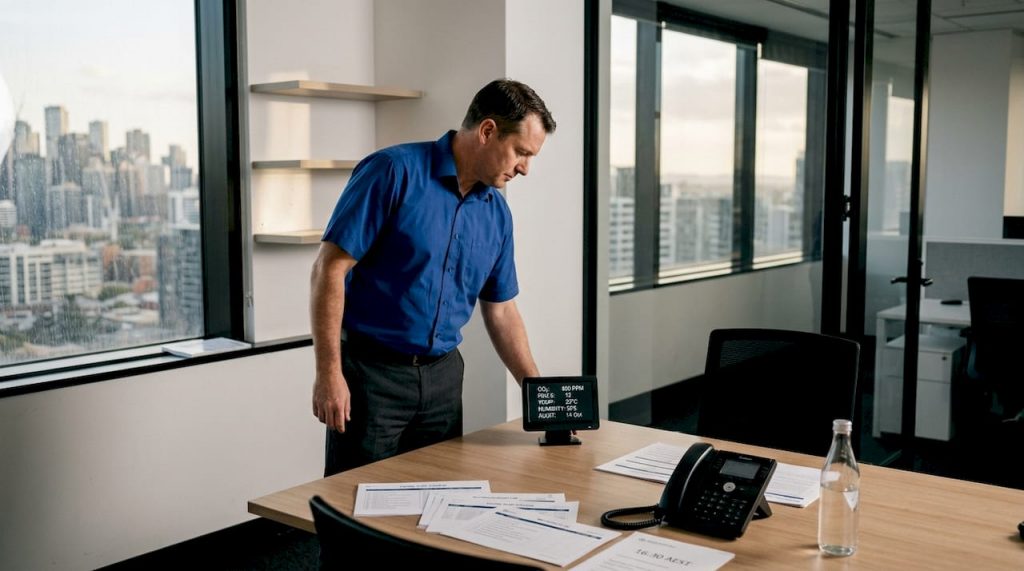
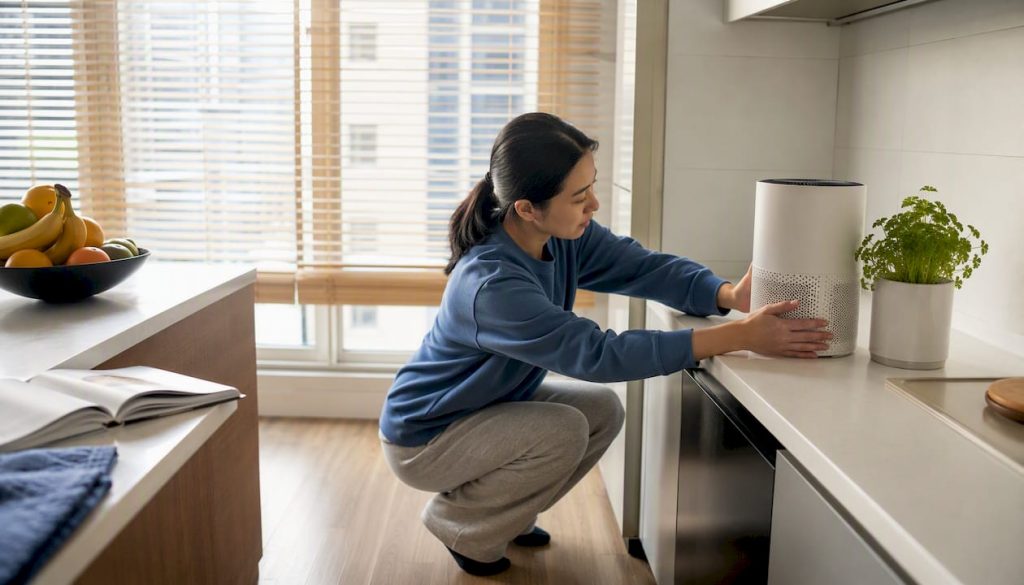
For most Australian apartments, a mid-range True HEPA purifier with a CADR of 200–300 m³/h and a dedicated activated carbon stage covers the majority of needs, from bushfire smoke events to everyday cooking odours and allergens. The picks below are matched to specific apartment types so you can choose by room size and use case rather than wading through a full product catalogue.
Quick shortlist:
- Studio or small bedroom (under 25 m²): Levoit Core 300S or Levoit Vital 100S — compact footprint, H13 HEPA, sleep mode near 24 dB
- One-bedroom open plan (35–45 m²): Levoit Core 400S or Coway Airmega Mighty (AP-1512HH) — balanced CADR, quiet sleep mode, app integration
- Smoke, VOCs or persistent odours: Austin Air HealthMate or Levoit Vital 200S with carbon stage
- Budget or bushfire emergency: AirFanta 3Pro or CleanAirKits Luggable XL Ultra
TL;DR trust signals: Look for verified CADR (AHAM-tested), True HEPA H13 or H14 certification, and a measured sleep-mode noise level under 30 dB. Instrumented studies show that a notable portion of indoor air in apartments can originate from adjacent units within a few hours, which is why continuous auto-mode operation matters more in flats than in detached homes.
Table of Contents
- How the best apartment air purifiers compare at a glance
- How to size a purifier correctly for your apartment
- Matching the right purifier to your apartment situation
- Filter types, running costs and what to expect in Australia
- How reputable reviewers test purifiers and how you can verify claims
- Where to buy in Australia and what to check before you purchase
- Key takeaways
- The case for treating apartment air quality as a continuous priority
- Climatepro’s range for Australian apartment residents
- Further reading and sources for Australian apartment buyers
How the best apartment air purifiers compare at a glance
| Model | Best for | CADR / coverage | Price band | Filter type & replacement | Noise (low/high) | Smart features | AU availability |
|---|---|---|---|---|---|---|---|
| ClimatePro Honeywell Air Touch P2 | General apartment use, quiet bedrooms | Mid CADR, ~25–35 m² | $$ | True HEPA + carbon; filters via ClimatePro | Low/moderate | Auto mode | ClimatePro; authorised warranty |
| Levoit Vital 200S | Small–medium apartments, smart auto | Strong CADR for class, ~30 m² | $ | H13 HEPA + carbon; 6–8 months | ~24 dB / moderate | App, auto, AQI sensor | Major AU retailers |
| Levoit Core 400S | One-bed open plan, living + sleeping | ~380 m³/h, ~40 m² | $$ | H13 HEPA + carbon; 6–8 months | ~24 dB / moderate | App, auto, AQI sensor | Major AU retailers |
| Levoit Vital 100S | Tiny studios, bedside use | ~130 m³/h, ~15 m² | $ | H13 HEPA + carbon; 6–8 months | ~24 dB sleep | Basic auto | Major AU retailers |
| Levoit Core 300S | Studios ~19 m², budget HEPA | ~190 m³/h, ~19 m² | $ | H13 HEPA + carbon; 6–8 months | ~24 dB sleep | Basic | Major AU retailers |
| Coway Airmega Mighty (AP-1512HH) / Mighty2 (AP-1512N) | Smaller apartments, reliable particle removal | ~246 m³/h, ~25 m² | $$ | True HEPA + carbon; 12 months HEPA | ~24 dB / moderate | Auto, AQI indicator | JB Hi-Fi, Harvey Norman |
| Coway Airmega Mighty (AP-1512HH) | 25–35 m² open plan | Higher CADR, compact | $$ | True HEPA + carbon | Low/moderate | Auto | Select AU retailers |
| Coway Airmega 100 | Small rooms, entry level | ~130 m³/h, ~20 m² | $ | True HEPA + carbon | Low | Basic auto | Select AU retailers |
| Coway Airmega 350 | Larger open-plan apartments | High CADR, ~45 m² | $$$ | True HEPA + carbon | Low/moderate | App, auto | Select AU retailers |
| Coway Airmega ProX | Large or multi-zone apartments | Very high CADR | $$$$ | True HEPA + carbon | Low/moderate | App, auto | Specialist retailers |
| Blueair Blue Pure 511 | Budget studio, quiet operation | ~190 m³/h, ~19 m² | $ | HEPASilent + fabric pre-filter | Very low / low | Basic | AU online retailers |
| Blueair Blue Pure 211i Max | Large open living, smoke purge | ~500 m³/h, ~40 m² | $$$ | HEPASilent + carbon | Low/moderate | App, auto | AU online retailers |
| Blueair Blue Signature Large | Mid-large apartments, quiet | High CADR | $$$ | HEPASilent + carbon | Very low | Basic | AU online retailers |
| Austin Air HealthMate | Daily indoor smoking, heavy VOC | High CADR + deep carbon | $$$$ | HEPA + 6 kg carbon bed; 5 years | Moderate | None | Specialist AU retailers |
| Breville Protect Max | Design-conscious apartments | Mid-high CADR | $$$ | True HEPA + carbon | Low/moderate | Auto | Harvey Norman, JB Hi-Fi |
| Winix Zero+ Pro | Mixed particle + light odour | Mid-high CADR | $$ | True HEPA + washable carbon pre-filter | Low/moderate | App, auto, sensor | AU online retailers |
| Dyson Purifier series | Data displays, multi-function living | Mid-high CADR | $$$$ | HEPA H13 + carbon | Low/moderate | App, real-time PM/VOC | JB Hi-Fi, Dyson AU |
| Philips / Bosch Air 200 | Mainstream brand, spare parts | ~300 m³/h, ~30 m² | $$ | True HEPA + carbon | Low/moderate | Auto | Harvey Norman, JB Hi-Fi |
| AirFanta 3Pro / CleanAirKits Luggable XL Ultra / Triple Exhalaron | Budget or emergency smoke purge | Very high CADR, low cost | $ | HEPA panel; varies | Moderate/loud | None | Online (DIY/specialist) |
Spec notes by category:
- ClimatePro Honeywell Air Touch P2: Replacement filters are stocked locally through Honeywell’s range at Climatepro, which removes the filter-supply uncertainty common with grey-market imports. Authorised warranty applies.
- Levoit Core 300S: Compact testing shows it cleans a ~19 m² studio in 12–15 minutes on medium or auto mode, with sleep mode at approximately 24 dB. Ideal for renters who need a small, quiet unit.
- Coway Airmega Mighty (AP-1512HH) / Mighty2 (AP-1512N): Consistently recommended in independent apartment tests for their CADR-to-price ratio and low running costs. The Mighty2 adds a refreshed design with the same core performance.
- Austin Air HealthMate: The standout for persistent tobacco smoke. Its deep-bed activated carbon approach (approximately 6 kg of carbon and zeolite) addresses VOCs and odours that standard HEPA-only units cannot capture. Five-year filter life reduces replacement frequency.
- AirFanta 3Pro / CleanAirKits Luggable XL Ultra / Triple Exhalaron: High CADR at low upfront cost, but DIY Corsi-Rosenthal-style builds typically run at 45–55 dB on higher speeds, making them unsuitable for bedroom use. Best reserved for daytime operation or acute bushfire smoke events.
- Winix Zero+ Pro: The washable carbon pre-filter reduces annual filter spend compared with fully disposable multi-stage units.
- Dyson Purifier series: Real-time PM2.5 and VOC displays are genuinely useful for identifying pollution spikes from neighbours or cooking, though the price premium is significant.
How to size a purifier correctly for your apartment
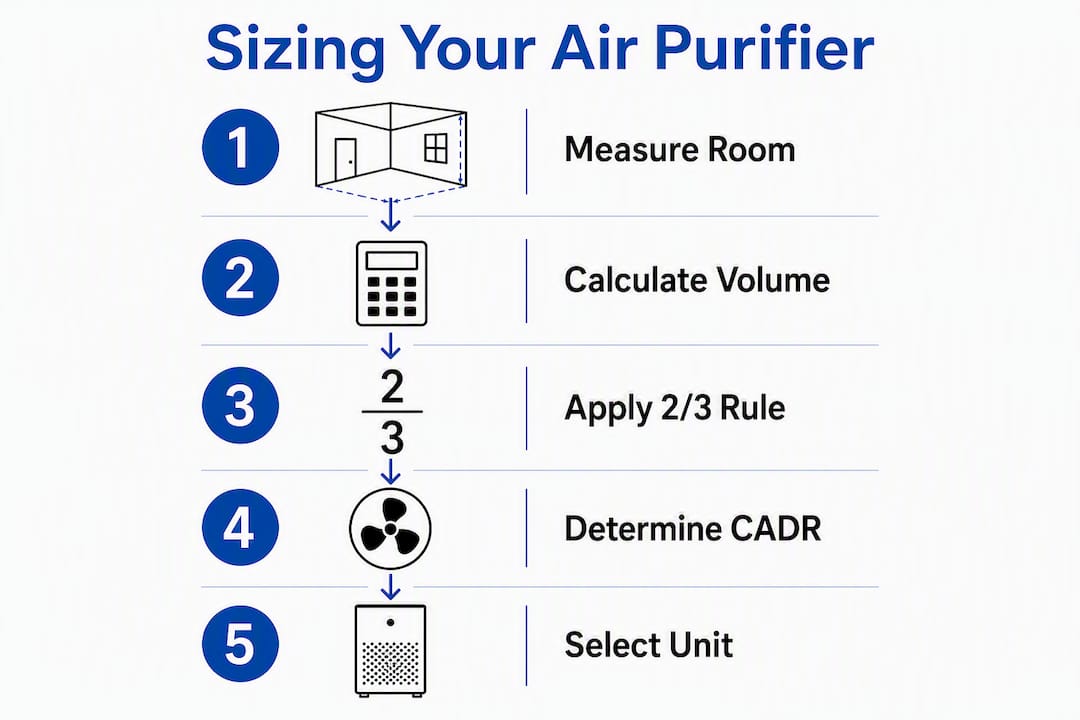
Getting the size right is the single most important decision. An undersized unit running flat out still won’t deliver adequate air changes, and an oversized unit in a tiny studio wastes money.
The 2/3 rule and ACH formula
The 2/3 rule for apartments states that a purifier’s CADR (in m³/h) should be at least two-thirds of the room’s square footage to ensure adequate air exchanges per hour (ACH) in multi‑unit buildings. This accounts for infiltration from adjacent units and aims to preserve effective ACH in apartments. In practice, apartments need a higher target than detached homes because of inter-unit air transfer. Aim for 4–6 air changes per hour (ACH) for allergy and smoke management.
The formula is straightforward:
Required CADR (m³/h) = room volume (m³) × target ACH
Room volume = floor area (m²) × ceiling height (m). Most Australian apartments have 2.4–2.7 m ceilings.
Worked examples
-
Studio, ~25 m², 2.4 m ceiling: Volume = 60 m³. At 5 ACH target: required CADR = 300 m³/h. The Levoit Core 400S (~380 m³/h) or Coway Airmega Mighty (~246 m³/h on medium) both cover this, with the Core 400S providing headroom for smoke events.
-
One-bedroom open plan, ~40 m², 2.4 m ceiling: Volume = 96 m³. At 5 ACH: required CADR = 480 m³/h. The Blueair Blue Pure 211i Max (~500 m³/h) or a pair of mid-range units (one in the living area, one in the bedroom) both work.
-
Bedroom only, ~12 m², 2.4 m ceiling: Volume = 28.8 m³. At 4 ACH: required CADR = ~115 m³/h. The Levoit Vital 100S (~130 m³/h) covers this with room to spare at low speed.
Placement and runtime
Place the unit where pollution enters, not necessarily in the geometric centre of the room. Near a shared wall, corridor doorway, or kitchen is more effective for intercepting infiltration. For bushfire smoke, position near the most likely infiltration point (window gaps, under-door gaps). Running on auto mode 24/7 is the most practical approach for apartments because auto-mode sensors respond to transient spikes from neighbour cooking or drifting smoke without requiring manual adjustment.
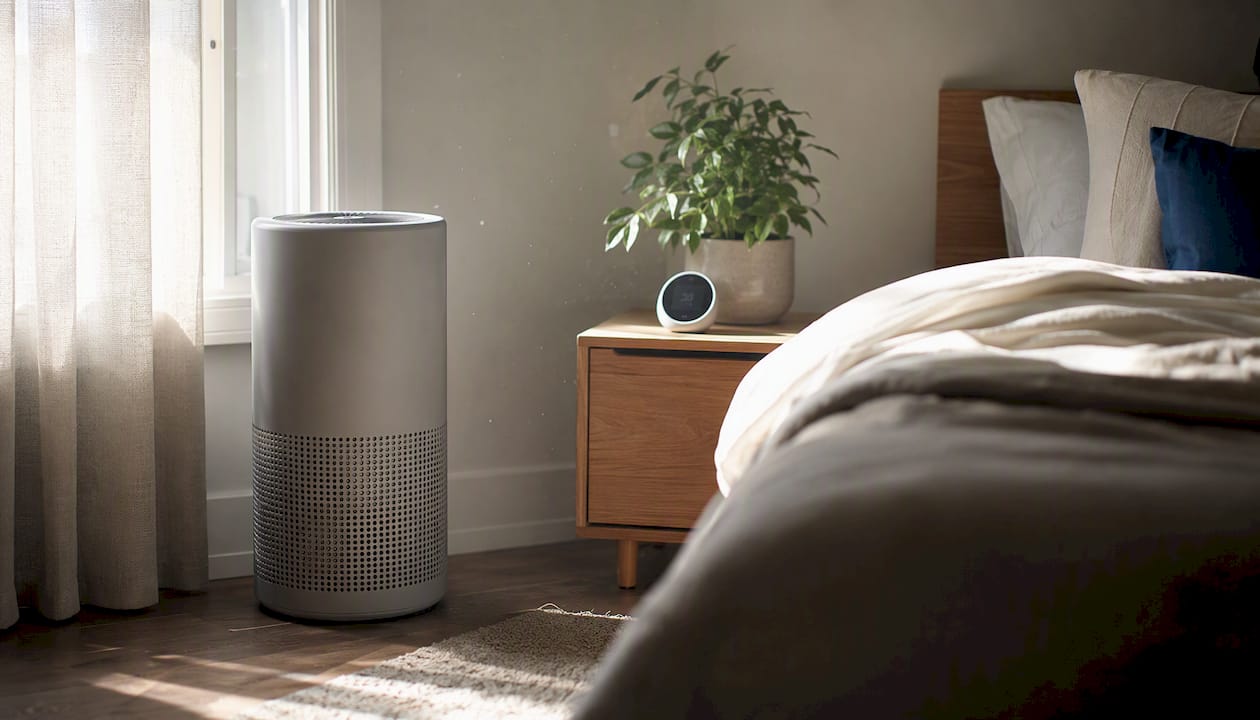
Pro Tip: Measure the actual noise level of any unit you’re considering at its lowest speed setting, not just the manufacturer’s claim. Units with a verified sleep mode under 30 dB are far more likely to run overnight consistently. If a unit is louder than ~30 dB at night, residents often switch it off, removing protection during the hours when infiltration from neighbouring units continues uninterrupted.
Matching the right purifier to your apartment situation
Bushfire smoke and outdoor smoke infiltration
During bushfire events, fine PM2.5 particles are the primary hazard. A high CADR unit running on high speed for a rapid purge, then dropping to auto, is the most effective response. The Blueair Blue Pure 211i Max and Coway Airmega 350 both deliver the throughput needed for larger open-plan apartments. For a budget emergency response, the AirFanta 3Pro or a CleanAirKits Luggable XL Ultra provides very high CADR at low cost, though noise levels limit overnight use.
Allergies and dust
Consistent 24/7 HEPA-grade filtration matters more than peak CADR for allergy management. The Coway Airmega Mighty (AP-1512HH) and Levoit Core 400S both carry H13 HEPA and have proven track records in apartment allergy testing. Auto mode with a reliable particle sensor keeps the fan speed proportional to actual particle load, which reduces noise and energy use during low-pollution periods.
Pets and odours
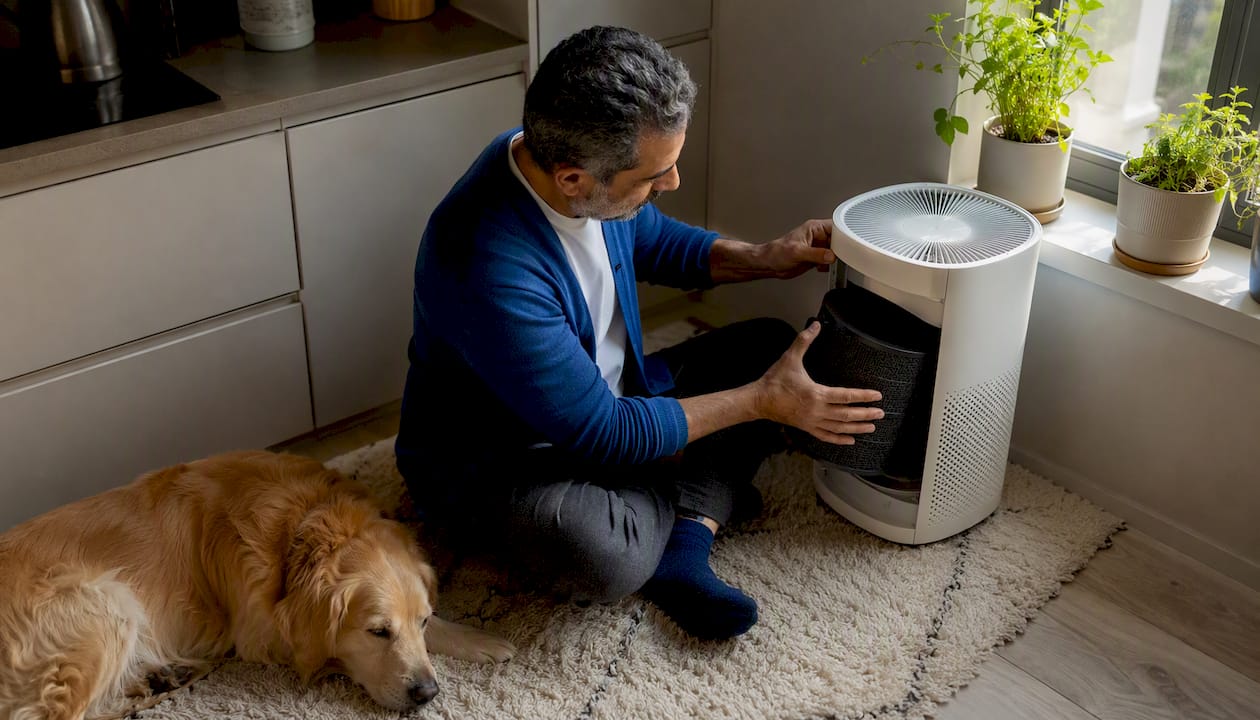
Pet dander is a particle problem; pet odour is a VOC problem. A unit with both a True HEPA stage and a meaningful activated carbon stage handles both. The Winix Zero+ Pro’s washable pre-filter captures pet hair before it loads the main filter, extending HEPA life. For heavier odour loads, the Breville Protect Max or Levoit Vital 200S both carry a carbon stage adequate for typical pet odour in a one-bedroom apartment.
Daily indoor smoking
Standard HEPA-only units are not sufficient for daily indoor smoking. Deep-bed activated carbon with a substantial carbon mass is required to neutralise VOCs and persistent odour. The Austin Air HealthMate, with approximately 6 kg of activated carbon and zeolite, is the most appropriate choice for this scenario. For intermittent neighbour smoke infiltration, a mid-range unit with a carbon stage (Levoit Core 400S, Coway Airmega Mighty) is adequate.
Quiet bedroom use
The Levoit Vital 100S and Levoit Core 300S both measure approximately 24 dB in sleep mode, making them practical for bedside placement. The Blueair Blue Pure 511 is also notably quiet at low speed. For a one-bedroom apartment where a single unit must cover both living and sleeping zones, the Levoit Core 400S offers a quiet sleep mode alongside sufficient CADR for the larger combined area.
Tiny studios
In a studio under 20 m², a compact unit is preferable to a large tower. The Levoit Core 300S covers approximately 19 m² and fits on a shelf or bedside table. The Coway Airmega 100 is another compact option at a similar price point. Both run quietly enough for overnight use without dominating the room.
Multiple units vs one large unit: In a two-bedroom apartment, two mid-range units (one per room) typically outperform a single large unit in the living area. The bedroom unit runs quietly at low speed overnight; the living-area unit handles cooking and daytime pollution. The combined filter replacement cost is comparable to a single premium unit, and portability is a practical advantage in a rental.
Filter types, running costs and what to expect in Australia
HEPA grades and carbon approaches
True HEPA (H13) captures 99.97% of particles at 0.3 microns. H14 captures 99.995% and appears in medical-grade units like the Coway Airmega ProX. For most apartments, H13 is the appropriate standard. “HEPA-like” or “HEPA-style” labels without a grade designation are not equivalent and should be treated sceptically.
Activated carbon comes in three forms relevant to apartment buyers:
- Thin fabric or granule layer: Found in most mid-range units (Levoit, Coway, Blueair). Adequate for cooking odours and light VOC loads; not sufficient for daily smoking.
- Pelletised carbon stage: A thicker, denser carbon bed found in units like the Winix Zero+ Pro. Better for moderate odour loads and mixed particle/VOC environments.
- Deep-bed carbon: The Austin Air HealthMate approach. Approximately 6 kg of carbon and zeolite handles persistent VOC and tobacco smoke loads that lighter stages cannot address.
Typical replacement intervals and annual cost bands (Australia)
| Filter type | Typical replacement interval | Estimated annual cost (AUD) |
|---|---|---|
| H13 HEPA (mid-range unit) | 6–12 months | $60–$120 |
| Activated carbon stage (mid-range) | 6–12 months (often combined with HEPA) | Included above or $30–$60 separate |
| Deep-bed carbon (Austin Air HealthMate) | ~5 years | ~$60–$80 amortised per year |
| Washable pre-filter (Winix Zero+) | Rinse every 2–4 weeks | $0 (washable) |
| HEPASilent filter (Blueair) | 6 months | $80–$100 |
Worked running cost example
A mid-range unit like the Levoit Core 400S running on auto 24/7 typically draws 8–45 W depending on fan speed. At an average Australian electricity rate of approximately $0.30/kWh and an average draw of ~15 W, annual electricity cost is roughly $40. Add one filter replacement per year at approximately $80–$100, and total annual running cost sits around $120–$140. That figure is comparable across most mid-range HEPA units in this class.
Pro Tip: Running a purifier on auto mode rather than a fixed high speed reduces both energy consumption and filter wear. Washable pre-filters (as on the Winix Zero+ Pro) extend the life of the main HEPA stage by capturing larger particles before they reach it. Buying OEM replacement filters directly from an authorised local retailer avoids compatibility issues and ensures the filter media meets the original specification.
For further context on energy-efficient purifier selection, Climatepro’s guide covers the relationship between wattage, fan speed settings, and long-term running costs in detail.
How reputable reviewers test purifiers and how you can verify claims
Independent testing is the only reliable basis for comparing CADR and noise claims. Manufacturer-stated figures are a starting point, not a guarantee.
-
AHAM-verified CADR: The Association of Home Appliance Manufacturers (AHAM) CADR protocol tests smoke, dust, and pollen removal in a standardised chamber. Look for the AHAM Verifide mark or an explicit statement that CADR was measured to AHAM standards. Units without this verification may carry inflated figures.
-
Instrumented PM2.5 smoke chamber tests: Reputable reviewers use calibrated particle counters (such as the IQAir AirVisual Pro or TSI SidePak) to measure particle reduction over time in a sealed room. This is more informative than CADR alone because it reflects real-world performance at different fan speeds.
-
Measured noise (dB): Manufacturer noise claims are often measured at one metre in an anechoic chamber. Independent reviewers measure at a realistic distance (0.5–1 m) in a normal room. A unit claiming 25 dB may measure 28–32 dB in a typical bedroom. Always check independent measured values, not spec-sheet claims.
-
Measured wattage: A plug-in energy meter (such as a Belkin Conserve Insight or similar) confirms actual draw at each fan speed. This is relevant for running cost calculations and for checking whether a unit’s energy consumption matches its CADR output.
-
Filter replacement cost verification: Confirm the replacement filter SKU is available in Australia before purchasing. Some models sold here use filters that must be imported, adding cost and lead time.
-
“HEPA-like” red flag: Any unit described as “HEPA-like”, “HEPA-style”, or “99% HEPA” without a stated grade (H13, H14, or MERV 17+) does not meet True HEPA standards. The US EPA’s HEPA guidance is clear that True HEPA must capture 99.97% of particles at 0.3 microns; anything less is a different product category.
Where to buy in Australia and what to check before you purchase
Retailer checklist
Before committing to a purchase, confirm:
- Local stock: The unit ships from within Australia, not from an overseas warehouse with extended lead times.
- Australian warranty: The warranty is honoured by an Australian entity, not only by the overseas manufacturer. Grey-market imports often carry no local warranty.
- Authorised distributor status: Buying from an authorised distributor protects against counterfeit filters and ensures the unit meets Australian electrical safety standards.
- Spare filter availability: Confirm the replacement filter SKU is in stock locally and has a realistic reorder lead time. A unit with a six-month filter life that requires a four-week import is a practical problem.
- Delivery time: For bushfire season preparedness, same-week delivery matters.
Buying channels in Australia
Specialist IAQ retailers and authorised online stores offer the most reliable combination of local stock, genuine filters, and warranty support. Climatepro stocks the Honeywell Air Touch P2 with authorised warranty and replacement filters available directly, which removes the filter-supply uncertainty common with marketplace sellers.
Major electronics retailers (JB Hi-Fi, Harvey Norman) carry Coway, Dyson, Breville, Philips, and Blueair lines with Australian warranty. Stock depth varies by model and location.
Online marketplaces (Amazon AU, eBay AU) offer the widest model range but require careful verification of seller status. Authorised seller badges and Australian warranty statements should be confirmed before purchase, not assumed.
Practical buying tips for apartment residents: Register your warranty immediately after purchase. Keep the receipt and box for the first 12 months. Note the filter replacement date on the unit or in a calendar app. For Blueair units, replacement filters are available through Climatepro’s filter catalogue, which is useful if local retail stock is depleted during peak demand periods such as bushfire season.
Air purifiers work best as part of a broader indoor air quality approach. Ventilation and source control remain the primary tools for long-term exposure reduction; purifiers are a highly effective supplement, particularly in apartments where central HVAC cannot be modified.
Key takeaways
For most Australian apartments, a True HEPA H13 purifier with a CADR matched to 4–6 ACH for the room volume, a carbon stage for odours, and a verified sleep-mode noise under 30 dB covers the majority of everyday and seasonal air quality needs.
| Point | Details |
|---|---|
| Use the 2/3 rule and ACH formula | Target CADR = room volume (m³) × 4–6 ACH; adjust upward for apartments with shared walls or smoke risk. |
| Sleep noise under 30 dB is non-optional | Units louder than ~30 dB at night get switched off, removing overnight protection when inter-unit infiltration continues. |
| Carbon stage matters for odours and smoke | Thin carbon layers suit cooking odours; deep-bed carbon (Austin Air HealthMate) is required for daily indoor smoking or heavy VOC loads. |
| Verify CADR and filter availability before buying | Confirm AHAM-verified CADR and that replacement filter SKUs are in stock in Australia before purchasing. |
| Climatepro for local stock and warranty | Climatepro stocks the Honeywell Air Touch P2 and Blueair replacement filters with authorised Australian warranty and local filter supply. |
The case for treating apartment air quality as a continuous priority
Most apartment residents reach for an air purifier during a bushfire event or a bout of allergies, then switch it off when the immediate problem passes. That reactive pattern misses the more persistent issue: Instrumented studies show that 10–30% of indoor air in apartments can be from adjacent units within two hours, meaning portable purifiers are often the most effective control in rented flats where central HVAC can’t be changed. Neighbour cooking, cleaning products, and cigarette smoke from a shared corridor all contribute to baseline particle and VOC loads that accumulate quietly.
The practical implication is that auto mode running continuously is more effective than high-speed operation during visible events. A mid-range unit on auto draws modest power, responds to transient spikes without manual input, and maintains a consistent baseline that a reactive approach cannot replicate. The units that perform best in apartments are not necessarily those with the highest peak CADR; they are the ones residents actually leave running.
There is also a tendency to over-invest in a single large unit for the living area while leaving the bedroom unprotected overnight. Given that adults spend roughly a third of their lives in the bedroom, a second compact unit at bedside, even a modest Levoit Vital 100S or Coway Airmega 100, often delivers more health benefit per dollar than upgrading the living-area unit to a higher tier.
Climatepro’s range for Australian apartment residents
Apartment residents who want local stock, genuine replacement filters, and authorised warranty support without the uncertainty of marketplace imports have a direct option through Climatepro. The Honeywell Air Touch P2 is stocked with replacement filters available locally, covering the general apartment use case with a practical mid-range CADR and quiet operation. For buyers who need a higher-CADR option or a different form factor, the full Climatepro air purifier catalogue includes Blueair replacement filters and a range of units suited to studios through to larger open-plan apartments.

Filter availability during peak demand periods, such as bushfire season, is where local stock makes a practical difference. Climatepro’s catalogue includes Blueair Classic and Blue series replacement filters, stocked for immediate dispatch. Browse the full range and confirm local availability before the next smoke event, not during it.
Further reading and sources for Australian apartment buyers
- Guide to Air Cleaners in the Home — US EPA: The authoritative consumer reference for portable air cleaner selection, covering CADR, filter types, and the relationship between purifiers and ventilation. Directly applicable to Australian apartment buyers.
- What is a HEPA filter? — US EPA: Defines True HEPA standards and clarifies the difference between certified HEPA and “HEPA-like” marketing claims. Use this to verify product descriptions.
- Air purification in apartments — AirPureLife: Covers the 2/3 rule, inter-unit air transfer data, placement strategy, and sleep noise thresholds. One of the most practically focused sources for apartment-specific sizing.
- Apartment air quality — Clear Air Living: Explains auto-mode sensor value, kitchen placement strategy, and the case for continuous filtration in apartments.
- Best air purifier for cigarette smoke — Everyday Home Comfort: Covers when deep-bed carbon is necessary versus when a standard carbon stage suffices, with specific guidance on VOC and tobacco smoke scenarios.
- Best air purifier for small apartments — Urban Micro Tips: Instrumented compact unit testing including the Levoit Core 300S studio coverage data and ACH formula guidance.
- Simple steps for improving indoor air quality — Harvard T.H. Chan School of Public Health: Expert framing of purifiers as a supplement to ventilation and source control, not a replacement.
- Climatepro: air purifier buying tips: Practical checklist covering the 2/3 rule, CADR matching, and filter selection for apartment buyers.
- Climatepro: room-by-room air tips: Room-specific placement guidance relevant to studio and open-plan apartment layouts.
- Energy Star certified room air cleaners: Searchable database of Energy Star certified purifiers, useful for verifying energy consumption claims before purchase.
Recommended
- Air purifier buying tips: how to choose the right one — Blog | ClimatePro UAE
- Dyson air purifier for bedroom: a clear guide — Blog | ClimatePro UAE
- Guide to allergy proofing apartments: practical steps for renters — Blog | ClimatePro UAE
- Advantages of air purifiers: what families need to know — Blog | ClimatePro UAE