Proper ventilation measurably improves health, comfort and building longevity by diluting indoor pollutants, controlling humidity and maintaining thermal conditions. ASHRAE guidance recommends keeping indoor CO2 no more than 700 ppm above outdoor levels (roughly 1,200 ppm total) to support concentration and reduce absenteeism. Peer-reviewed building science reviews confirm that ventilation rates between 10–25 litres per second (l/s) per person are associated with fewer sick-building symptoms and better perceived air quality. Climatepro’s range of air purifiers, humidifiers and dehumidifiers complements these ventilation strategies for homes and workplaces across the UAE.
The primary benefit categories this guide covers:
- Health: reduced airborne infection risk, lower VOC and allergen concentrations, fewer respiratory symptoms
- Comfort: odour removal, reduced stuffiness, better temperature and humidity regulation
- Building integrity: condensation control, mould prevention, protection of materials and insulation
- Productivity: improved cognitive function, lower absenteeism, better task performance
- Energy: strategies to balance adequate airflow with running costs
Key takeaways
Proper ventilation is the single most effective building-level intervention for reducing indoor pollutants, controlling humidity and sustaining occupant health and performance.
| Point | Details |
|---|---|
| Target CO2 below 1,200 ppm | ASHRAE guidance sets 700 ppm above outdoor levels as the threshold for maintaining concentration and reducing absenteeism. |
| Aim for 10–25 l/s per person | Ventilation rates in this range are associated with reduced sick-building symptoms and improved perceived air quality. |
| Pair ventilation with source control | Ventilation dilutes contaminants; removing the source first makes ventilation significantly more effective. |
| Supplement with HEPA and humidity devices | Air purifiers, dehumidifiers and humidifiers address dimensions ventilation alone does not fully resolve. |
| Climatepro for complementary devices | Climatepro stocks HEPA air purifiers, humidifiers and dehumidifiers suited to homes and workplaces across the UAE. |
This article is general information, not a substitute for advice from a qualified doctor. Consult a qualified healthcare professional about your own circumstances before acting on anything here.
Table of Contents
- What is ventilation and what is it supposed to do?
- What are the main benefits of proper ventilation?
- What performance targets should you aim for?
- Natural, mechanical or hybrid: which approach suits your building?
- How can you tell if ventilation is inadequate?
- How to improve ventilation at home and at work
- How do air purifiers, humidifiers and dehumidifiers fit in?
- Maintenance tasks and common mistakes
- When should you call a ventilation professional?
- An editorial perspective on ventilation priorities
- Climatepro’s range for cleaner, better-controlled indoor air
- Sources
What is ventilation and what is it supposed to do?
Ventilation is the deliberate exchange of indoor and outdoor air to dilute or remove contaminants and manage humidity and thermal conditions inside a building. It is a distinct service from source control (eliminating the pollutant at its origin) and air cleaning (filtering recirculated air). All three work together; none substitutes for the others.
The American Lung Association notes that after source control, ventilating with cleaner outdoor air is the next most effective step for reducing indoor contaminants. Outdoor air typically carries far fewer pollutants than indoor air, though that advantage disappears when outdoor pollution is high and intake air is unfiltered.
Common ventilation strategies include:
- Natural ventilation: openable windows, doors and passive stack vents driven by wind and temperature differences
- Mechanical ventilation: supply fans, extract fans, or balanced supply-and-extract systems including mechanical ventilation with heat recovery (MVHR) and energy recovery ventilators (ERV)
- Hybrid systems: natural ventilation backed by mechanical assistance when conditions require it
What are the main benefits of proper ventilation?
Health
Adequate airflow dilutes airborne pathogens, volatile organic compounds (VOCs), radon, combustion by-products and second-hand smoke residues. Building science reviews link higher ventilation rates to reductions in sick-building symptoms and lower rates of respiratory illness. Allergy sufferers benefit directly: lower particulate and mould-spore concentrations reduce the frequency and severity of symptoms.

Comfort and odour control
Stale air, persistent cooking smells and bathroom odours are reliable signs of insufficient air exchange. Proper airflow removes moisture-laden and odour-carrying air before it accumulates, making spaces feel fresher without relying on masking agents.

Building integrity
Moisture is the primary driver of mould growth, condensation damage and insulation degradation. Controlled ventilation removes water vapour generated by cooking, bathing and occupants before it reaches dew point on cold surfaces. This protects wall cavities, window frames and structural timbers over the long term.
Productivity and cognitive performance
Stale indoor air and elevated CO2 are associated with measurable reductions in cognitive function and decision-making performance. Research summarised by Harvard Business Review shows that office workers in poorly ventilated spaces score lower on tests of concentration and higher-order thinking.
IAQ Science research from Lawrence Berkeley National Laboratory further shows that higher ventilation rates correlate with reduced absenteeism in both schools and workplaces. For facility managers, that translates directly to fewer sick days and more consistent output.
What performance targets should you aim for?
Measurable targets give ventilation a concrete standard rather than a vague aspiration. The table below summarises the most commonly referenced benchmarks.
ASHRAE guidance sets the 700 ppm above outdoor air (approximately 1,200 ppm total) threshold as the point at which concentration and comfort begin to decline. Rates below 10 l/s per person are consistently linked to worse perceived air quality; rates in the 10–25 l/s range are associated with meaningful improvements. Healthcare and high-occupancy spaces warrant the upper end of that range or beyond.
The U.S. Department of Energy’s ventilation assessment guide frames ventilation as a core building service, comparable to heating and cooling, and recommends demand-controlled ventilation (DCV) and heat recovery as practical ways to meet these targets without excessive energy use.
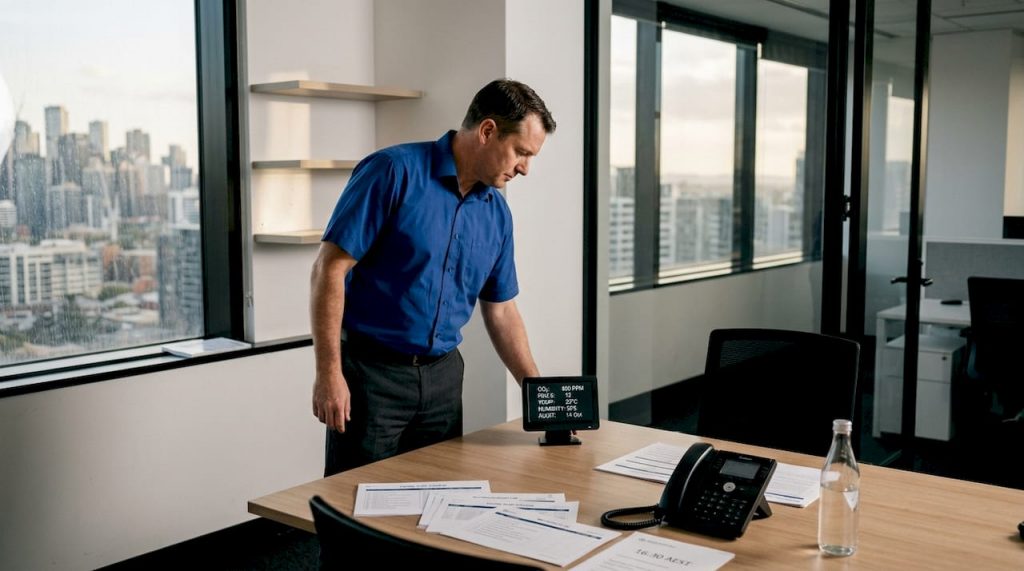
Pro Tip: A low-cost CO2 monitor placed at seated height in the centre of a room gives you a real-time proxy for ventilation adequacy. A reading that climbs above 1,000 ppm within an hour of occupancy and stays there is a clear signal the space needs more fresh air. Time-stamped logging helps distinguish occupancy-driven spikes from a persistent background problem.
For a technical breakdown of air changes per hour and how to calculate them, the air changes per hour guide on the Climatepro blog is a useful reference.
Natural, mechanical or hybrid: which approach suits your building?
Each ventilation strategy involves genuine trade-offs. The right choice depends on climate, building type, occupancy patterns and budget.
| Criterion | Natural ventilation | Mechanical (supply/extract, MVHR/ERV) | Hybrid / DCV |
|---|---|---|---|
| Control | Weather-dependent, intermittent | Consistent, programmable | Adaptive; CO2-sensor driven |
| Filtration | None | Yes (with appropriate filters) | Yes (mechanical component) |
| Energy impact | Near zero running cost | Fan energy; MVHR recovers most heat | Optimised; runs only when needed |
| Upfront cost | Low | Moderate to high | Moderate to high |
| Maintenance | Minimal | Filter changes, duct cleaning, servicing | As per mechanical component |
Natural ventilation carries no running cost, but it is unreliable in extreme climates and provides no filtration. Opening windows in a high-traffic urban area can introduce outdoor particulates and pollutants, which is why the American Lung Association recommends pre-filtration or mechanical ventilation with filtration where outdoor air quality is poor.
Mechanical systems, particularly MVHR and ERV units, deliver consistent rates and recover heat or energy from exhaust air before it leaves the building. The U.S. Department of Energy highlights DCV with CO2 sensors as a practical energy-smart solution for spaces with variable occupancy, such as conference rooms and classrooms, where running a system at full capacity during unoccupied hours wastes energy without benefit.
For apartment-specific design considerations, the apartment ventilation guide covers airtightness, mechanical options and common retrofit approaches.
How can you tell if ventilation is inadequate?
Poor ventilation rarely announces itself clearly. The signs accumulate gradually, which is why many people attribute symptoms to other causes.
Physical and environmental signs:
- Persistent condensation on windows or cold walls, especially in winter
- Mould spots in corners, behind furniture or on ceiling edges
- Lingering cooking, bathroom or musty odours that do not clear within an hour
- Relative humidity consistently above 60% (measure with a hygrometer)
- CO2 readings above 1,000–1,200 ppm during normal occupancy
Occupant symptoms:
- Frequent headaches, fatigue or difficulty concentrating during the working day
- Dry or irritated eyes and throat, particularly in air-conditioned spaces
- Increased allergy or asthma flare-ups with no obvious external trigger
Simple checks you can run today:
- Place a CO2 monitor in the room for 24 hours and note peak readings
- Open windows and doors for 15 minutes and observe whether symptoms ease
- Inspect extract fans and grilles for dust build-up or blockages
- Check that bathroom and kitchen fans are actually exhausting air outside, not into a ceiling cavity
Pro Tip: Use a CO2 monitor with time-stamped data logging rather than a spot-reading device. A log that shows CO2 rising steadily from 400 ppm to 1,400 ppm over two hours of occupancy, then dropping when windows are opened, gives you clear evidence of the problem and its solution. A flat high reading that does not respond to window opening points to a different source.
The room-by-room air tips guide on the Climatepro blog provides practical checks for each area of the home.
How to improve ventilation at home and at work
Immediate, no-cost actions
- Run kitchen extract fans during cooking and for 15 minutes afterwards.
- Run bathroom fans during and for 20 minutes after showering.
- Open windows on opposite sides of a space for 10–15 minutes of cross-ventilation, morning and evening.
- Clear any furniture, boxes or curtains blocking supply or extract grilles.
- Check that trickle vents in window frames are open and unobstructed.
Room-level upgrades (low to moderate cost)
- Replace undersized or noisy bathroom and kitchen extract fans with correctly rated units that exhaust directly outside.
- Fit window trickle vents where they are absent.
- Add a portable HEPA air purifier to rooms with persistent particulate issues. These reduce particles and allergens but do not replace ventilation for CO2 control.
System-level investments
- Install MVHR or ERV for whole-building balanced ventilation with heat recovery.
- Retrofit DCV with CO2 sensors in offices, classrooms or meeting rooms with variable occupancy.
- Upgrade air handling units (AHUs) in commercial buildings to include filtration and heat recovery.
The cost and impact of each measure vary considerably.
| Measure | Approximate cost range | Primary benefit | Limitation |
|---|---|---|---|
| Cross-ventilation (windows) | Free | CO2 dilution, odour removal | Weather-dependent, no filtration |
| Extract fan upgrade | Low | Moisture and odour removal | Point-source only |
| Trickle vents | Low | Background fresh air supply | Limited rate control |
| Portable HEPA purifier | Moderate | Particulate and allergen reduction | Does not address CO2 |
| MVHR / ERV system | High | Balanced ventilation, heat recovery | Requires installation and maintenance |
| DCV with CO2 sensors | Moderate to high | Energy-efficient demand response | Requires commissioning |
Warning: poorly designed ventilation can worsen indoor air quality. Bringing in unfiltered outdoor air in a polluted environment, or exhausting humid air into a roof cavity instead of outside, creates new problems. Any mechanical system should be designed and commissioned by a qualified professional.
For guidance on combining ventilation with energy-efficient air cleaning, the energy-efficient air cleaning workflow article covers practical sequencing.
How do air purifiers, humidifiers and dehumidifiers fit in?
Supplementary devices address specific air quality dimensions that ventilation alone may not resolve, but they work alongside ventilation rather than in place of it.
- HEPA air purifiers capture fine particles, allergens, dust and some biological contaminants. They do not remove CO2, and they do not control humidity. In a poorly ventilated room, a purifier can reduce particulate levels while CO2 continues to rise, which is why monitoring both metrics matters.
- Dehumidifiers remove excess moisture from indoor air and are particularly useful in humid climates or rooms prone to condensation. They need adequate airflow to distribute drier air through the space; running one in a sealed room with no air movement creates localised dry zones.
- Humidifiers add moisture where ventilation or dry climates strip it out. Overly dry air (below 30–40% relative humidity) irritates mucous membranes and increases susceptibility to airborne infections.
Pro Tip: Pair a HEPA purifier with a CO2 monitor. If particulate readings drop but CO2 stays elevated, the purifier is doing its job on particles while ventilation remains the unresolved issue. Treating both metrics separately prevents the common mistake of assuming clean-looking air is well-ventilated air.
When outdoor pollution is high, the most effective approach is mechanical ventilation with filtration at the intake, rather than relying on window opening. This is particularly relevant in urban environments where traffic emissions or dust are persistent. The Institute for Health Metrics and Evaluation documents the health burden of outdoor air pollution, which underscores why unfiltered natural ventilation is not always the right default.
Maintenance tasks and common mistakes
Ventilation systems deliver their benefits only when they are maintained. Neglect undoes the investment quickly.
Maintenance essentials:
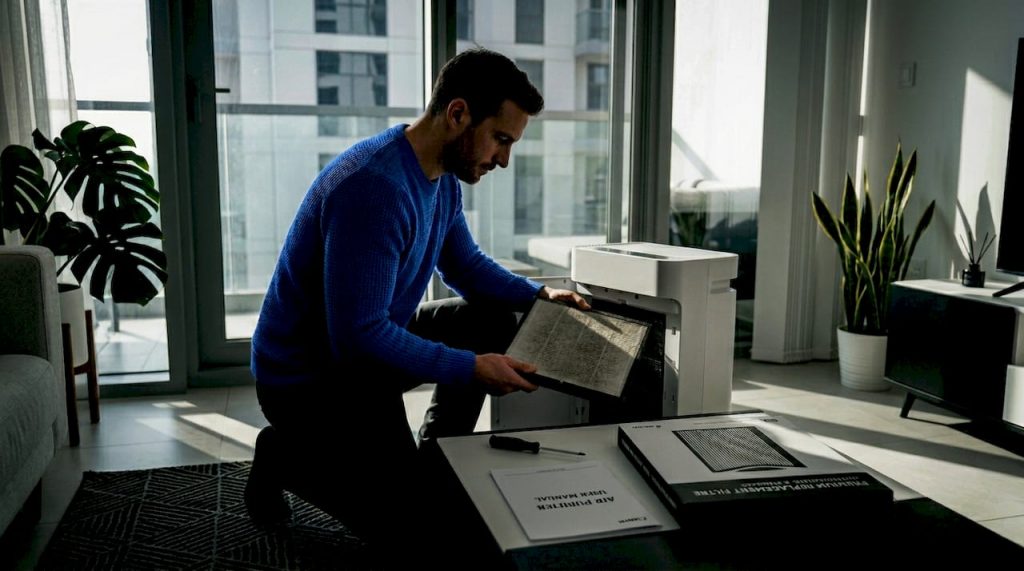
- Change or clean filters on a schedule aligned with the manufacturer’s guidance and local air quality conditions. Clogged filters restrict airflow and can become a source of contamination.
- Clear extract ducting annually; grease and lint accumulate in kitchen and bathroom ducts.
- Keep supply and exhaust grilles free of dust, furniture and stored items.
- Service MVHR and ERV units per manufacturer guidance, including heat-exchanger cleaning and condensate drain checks.
- Inspect outdoor intakes seasonally for debris, bird nesting or blockage.
Common mistakes:
- Sealing a home for energy efficiency without adding controlled mechanical ventilation. Airtightness increases the need for ventilation; it does not reduce it.
- Venting kitchen or bathroom fans into roof cavities or wall spaces instead of directly outside. This transfers moisture into the building fabric.
- Disabling ventilation systems to save running costs during mild weather, then wondering why mould appears.
- Relying solely on air purifiers and assuming the ventilation problem is solved.
A seasonal check routine, including filter inspection in spring and autumn, keeps systems performing year-round. The healthy home environment checklist provides a structured seasonal reference.
When should you call a ventilation professional?
Some ventilation problems are beyond what a homeowner or facilities team can resolve without specialist assessment.
Call a professional when:
- Mould returns persistently after cleaning, suggesting a moisture source that ventilation alone is not addressing
- CO2 levels remain above 1,200 ppm after basic fixes such as opening windows and clearing grilles
- You are planning an MVHR or ERV installation, which requires duct design, balancing and commissioning
- You suspect moisture migration through walls or floors, which can indicate building envelope issues beyond ventilation
- A commercial building requires compliance with ASHRAE 62.1 or local building code ventilation standards
What a professional typically does:
- Measures ventilation rates using tracer gas or blower-door tests
- Logs CO2 and relative humidity over 24–48 hours to establish a baseline
- Inspects ductwork for leaks, blockages and incorrect exhaust routing
- Balances supply and extract flows across rooms
- Provides a written report with upgrade recommendations and cost estimates
When requesting quotes, ask specifically for compliance with ASHRAE 62.1 (commercial) or 62.2 (residential) standards, or the equivalent local building code. This gives you a documented benchmark against which to assess the work.
An editorial perspective on ventilation priorities
Most conversations about indoor air quality focus on what to add: a purifier here, a dehumidifier there. The more productive question is what the building is failing to remove. Ventilation is fundamentally an exhaust service. Its job is to get contaminated air out before it accumulates to the point where it affects health or comfort.
The productivity evidence is particularly underappreciated. Research on stale office air shows cognitive performance declining at CO2 levels that many offices routinely reach by mid-morning. That is not a comfort issue; it is a performance issue with a measurable cost. Yet most organisations invest heavily in ergonomics and lighting while treating ventilation as a background utility.
The energy trade-off is real but often overstated. DCV goes further by running systems only when occupancy demands it. The argument that good ventilation is too expensive to run does not hold up against the evidence on absenteeism, productivity and building maintenance costs.
At Climatepro, the practical experience of supplying filtration, humidification and dehumidification solutions reinforces one consistent finding: devices work best when ventilation is already doing its job. A HEPA purifier in a well-ventilated room is a genuine upgrade. The same purifier in a sealed, CO2-saturated room is treating symptoms while the underlying problem persists.
Climatepro’s range for cleaner, better-controlled indoor air
Ventilation addresses the air exchange side of indoor air quality. For the particulate, humidity and allergen dimensions that ventilation alone does not fully resolve, Climatepro stocks a curated range of air purifiers, humidifiers and dehumidifiers suited to homes, offices, clinics and commercial spaces across the UAE.

Units such as the Honeywell Air Touch P2 feature HEPA H13 filtration and are sized for room-specific use, making them a practical complement to an existing ventilation strategy rather than a replacement for one. Replacement filters are stocked for all major models, so maintaining filtration performance is straightforward. Browse the full range at Climatepro and find the right product for your space.
Sources
- Ventilation, Indoor air quality and health — peer‑reviewed building science review (NCBI/NLM)
- Ventilation assessment and action guide (U.S. Department of Energy)
- Ventilation | American Lung Association
- Research: Stale office air is making you less productive | HBR
Recommended
- Why ventilate apartments: health, air quality & comfort — Blog | ClimatePro UAE
- Healthy home environment checklist: 2026 guide — Blog | ClimatePro UAE
- Office air quality improvement: top 10 strategies — Blog | ClimatePro UAE
- Apartment ventilation guide: design, airtightness, and airflow — Blog | ClimatePro UAE