
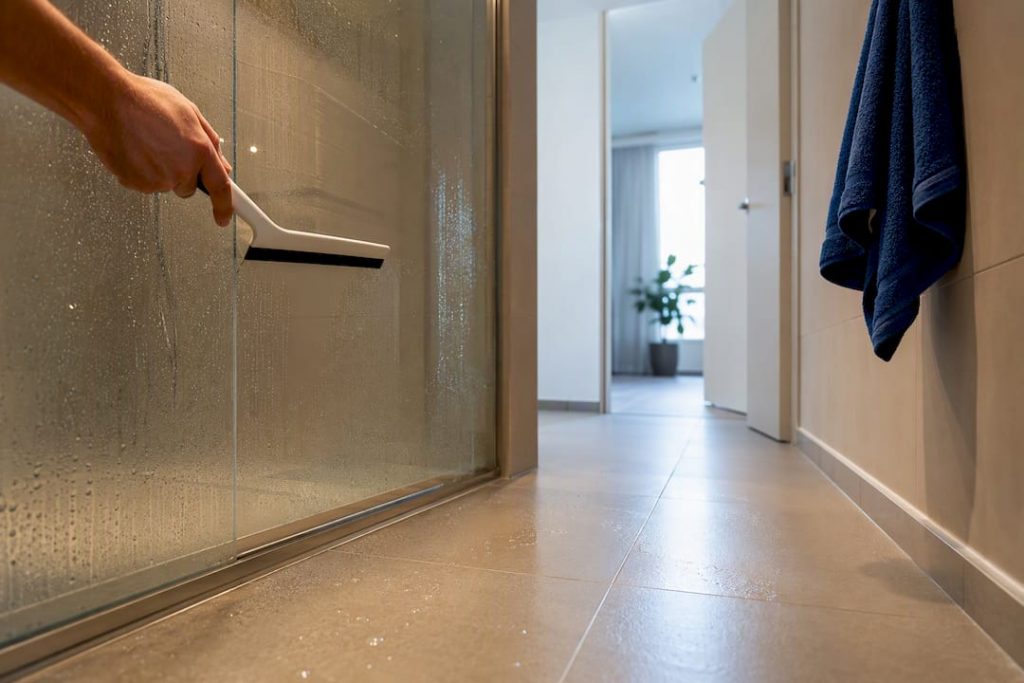
Run a correctly sized, ducted exhaust fan during showers and for at least 10 minutes after, combine it with a squeegee habit and an open door, and check results with a hygrometer. If relative humidity in the bathroom still sits above 60% once those habits and the fan are working properly, that is the point to add a dehumidifier or a smarter sensor-based control.
TL;DR:
- A properly sized exhaust fan rated around 8 air changes per hour is essential for effective humidity removal, especially in larger or poorly ventilated bathrooms.
- Maintaining relative humidity below 60% is critical to prevent mold growth, which often occurs on cold surfaces where condensation persists after steaming.
- Using a hygrometer to log humidity levels helps identify if a fan or ducting issue exists before investing in dehumidifiers or automation devices.
- Simple habits like squeegeeing surfaces and leaving doors or curtains open after showers significantly reduce moisture load on the ventilation system.
- When humidity remains high despite good practices and a working fan, adding a dehumidifier or advanced sensors becomes necessary for control.
Table of Contents
- Why bathroom humidity matters for health and your home
- How to measure humidity and check your fan is working
- Immediate, low-cost steps to cut humidity after a shower
- Exhaust fan sizing, ducting and installation that works
- Sensors and automation: humidistats, condensation sensors and smart controls
- When to add a dehumidifier or rethink your ventilation strategy
- Routine maintenance and the hidden causes worth checking first
- Step-by-step humidity control workflow from ClimatePro UAE
- An easy homeowner routine that prevents most problems
- How ClimatePro can help you control bathroom humidity
- Sources
- FAQ
Why bathroom humidity matters for health and your home
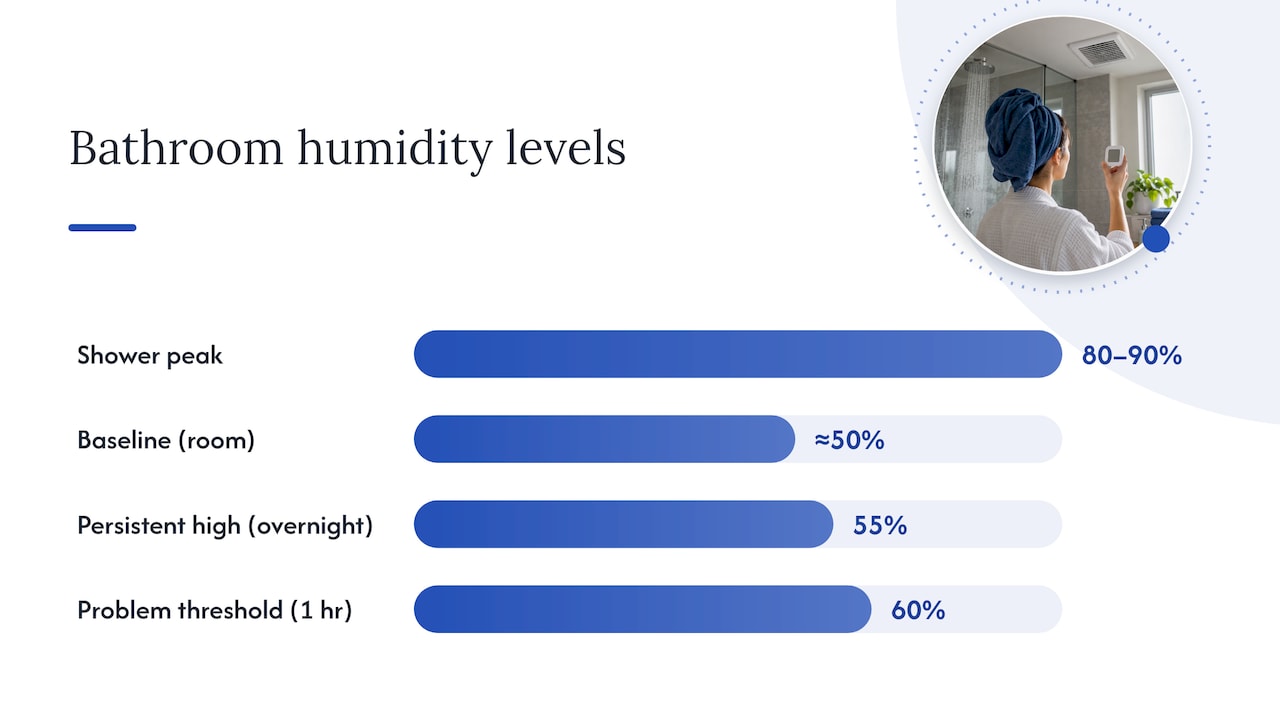
Indoor relative humidity between 30% and 50% keeps mould growth in check and supports better air quality, according to Building America’s ventilation guidance. Once RH climbs past 60%, the risk of mould increases, and bathrooms are the room most likely to cross that line because of steam, wet surfaces and limited airflow.
Sustained bathroom RH above 60% raises mould risk, according to Building America, which is why ventilation sizing targets are built around keeping bathrooms below that threshold rather than just clearing visible steam.
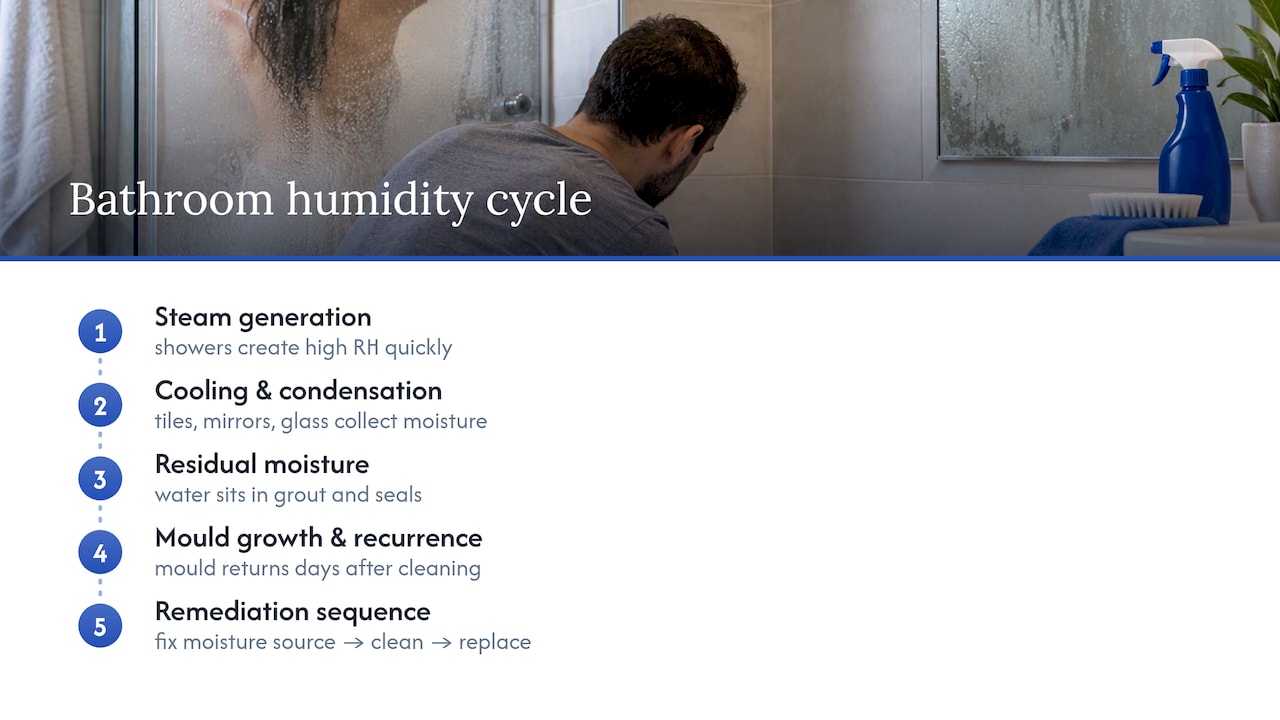
Cold surfaces make the problem worse. Tiles, mirrors and window glass cool faster than the surrounding air, so moisture condenses on them even after the steam has cleared. That condensation sits in grout lines and silicone seals, feeding mould colonies that reappear within days of being cleaned. Wiping mould off a tile without addressing the moisture source is treating the symptom, not the cause, and remediation guidance is consistent on this point: find and fix the moisture source first, then clean, then replace anything that will not come clean.
Left unmanaged, the damage moves beyond cosmetic staining. Grout deteriorates, paint blisters, and timber trims can swell or rot where moisture is trapped behind them. None of this happens overnight, but in a bathroom used daily, the cycle of steam, condensation and incomplete drying repeats often enough that small problems become structural ones within a season or two.
How to measure humidity and check your fan is working
A hygrometer takes the guesswork out of bathroom humidity control. Look for one with a digital display, reasonable accuracy, and a min/max logging function so you can see peak readings during a shower and how quickly the room recovers afterwards. Mount it on a wall away from the direct shower plume, at roughly breathing height, so it reads the general room air rather than one damp patch.
- Hygrometer placement: choose an interior wall away from the shower spray and away from the door draught.
- Peak versus baseline: a spike to 80-90% during a hot shower is expected; what matters is how fast it drops back towards 50%.
- Fan suction check: hold a small piece of tissue against the fan grille while it runs. If the tissue does not hold firmly against the grille, suction is weak, a method commonly used as a quick field check for exhaust fan performance.
- Exterior termination check: step outside and confirm the exterior hood flap opens and air is actually leaving the building, not just moving into a ceiling void.
Pro Tip: Log your hygrometer reading at the same time each morning for a week before making any equipment changes. That baseline tells you whether you have a ventilation problem or a habit problem.
A short spike during a shower is normal and not a fault. A sustained reading above 60% an hour after the fan has run, or a room that never drops below 55% even overnight, points to a fan, ducting or habit issue that needs attention rather than a one-off product purchase.
Immediate, low-cost steps to cut humidity after a shower
Most bathroom humidity problems are fixed with habits, not hardware. These steps cost nothing beyond a few minutes and a cheap squeegee, and they reduce the load your exhaust fan has to clear.
- Squeegee shower walls and glass straight after use. This single habit removes a large share of the standing moisture the fan would otherwise need to evaporate and vent, and it is consistently recommended as a first line of defence against recurring bathroom mould.
- Leave the shower curtain spread out or the glass door ajar so trapped water can evaporate into the room rather than sitting in folds or corners.
- Run the exhaust fan during the shower and for 10 to 30 minutes afterwards using a delay-off timer, which installation guidance recommends as a minimum runoff period to clear residual moisture.
- Where there is no window and the fan alone cannot keep up, a small dehumidifier or a doorway fan pointed into the hallway gives the room somewhere for the remaining moisture to go.
- Hang towels somewhere they can dry fully, ideally outside the bathroom, since a damp towel left on a hook is a slow, continuous moisture source.
- Wipe down the sink and benchtop and give the room a weekly check for damp patches around the base of the toilet, under the vanity and along the shower frame.
Pro Tip: Pair the squeegee with the fan switch, physically or mentally. If flicking one becomes the trigger for the other, the habit sticks without needing an automated system.
These steps work because they attack the two variables that create the mould-friendly environment: standing water and stagnant air. A fan running against a shower door covered in beaded water is doing more work than it needs to, and a room with the door shut all day has nowhere for humidity to escape even with a fan running for ten minutes. Build the routine around drying surfaces first and moving air second, and most homes never need to think about supplementary equipment at all.
Exhaust fan sizing, ducting and installation that works
An underpowered or badly ducted fan is the most common reason humidity control fails even when the habits above are followed. The Home Ventilating Institute’s rule of thumb is about 8 air changes per hour for intermittent spot ventilation in a bathroom, a figure detailed in Building America’s ventilation guide.
A bathroom of typical size needs a fan rated appropriately to provide sufficient air changes per hour, commonly around 8 ACH, according to Building America, a useful benchmark for checking whether an existing fan is actually adequate for the room it serves.
The nameplate CFM on a fan box is usually measured at a very low static pressure, so it rarely reflects what the fan delivers once it is connected to real ducting. The same guidance recommends comparing fans using ratings taken at 0.25 inches water gauge, since that better represents installed conditions, and budgeting for further derating when the duct run is long or has multiple bends.
Ducting mistakes are just as common as undersized fans:
- Keep duct runs as short and straight as possible, since every extra elbow adds resistance the fan has to overcome.
- Never downsize the duct partway along its run, a common shortcut that chokes airflow badly.
- Insulate any duct passing through an unconditioned attic or roof space to stop condensation forming inside it.
- Always terminate to the exterior through a wall or roof cap, never into an attic or soffit, because installation guidance from the U.S. Department of Energy warns that venting into these spaces can cause hidden mould and rot.
- Check the backdraft damper at the exterior hood periodically. A stuck or painted-shut damper can block airflow even when the fan itself sounds fine.
Sensors and automation: humidistats, condensation sensors and smart controls
Once the fan and habits are sorted, sensors and automation add convenience rather than solving a problem ventilation alone cannot. Two main control types are worth knowing.
- Humidistats measure relative humidity directly and switch the fan on once a set threshold is reached, which is reliable but can lag slightly behind fast-rising steam.
- Condensation or dew-point sensors anticipate moisture forming on cold surfaces and can trigger a fan before visible condensation appears, a feature built into some current bathroom fan controls.
- Timers alone are simple and cheap but run regardless of actual humidity, which wastes energy on quick showers and under-ventilates long ones.
- False triggers are the main drawback of humidity-based controls, since a sudden temperature drop or an open window can register as a humidity change even when moisture levels have not actually risen.
Sensor placement matters as much as the sensor type. Mount it on a wall or ceiling away from the direct shower plume, at a height similar to where you would naturally breathe, so it reads the general room condition rather than a blast of steam that will clear in seconds regardless of what the fan does.
Pro Tip: A timer combined with a humidity override tends to outperform either control on its own: the timer guarantees a minimum runoff period, while the humidity sensor extends the fan’s run time on unusually steamy days without needing you to adjust anything manually.
When to add a dehumidifier or rethink your ventilation strategy
If the fan is correctly sized, the ducting is sound, and the daily habits are in place, but the hygrometer still shows sustained readings above 60%, a dehumidifier or a broader ventilation review is the next step rather than a bigger fan.
- A portable dehumidifier suits a single problem bathroom, particularly one with no window and limited fan capacity.
- Check whether the unit uses a gravity drain or an internal pump. A pump drain lets you site it away from a floor drain, but it adds a component that needs occasional maintenance.
- Weigh noise and running cost against convenience. A small unit left running overnight is quieter than most exhaust fans but adds to the household’s electricity use.
- Whole-house or HVAC-integrated dehumidification is worth considering when humidity problems are not confined to one bathroom but recur across several rooms, which usually points to a building-wide ventilation issue rather than a single fan fault. Our guide to energy recovery ventilation covers when a balanced, whole-home approach makes more sense than treating each room separately.
Routine maintenance and the hidden causes worth checking first
A lot of “persistent” humidity problems trace back to maintenance items rather than undersized equipment.
- Clean fan grilles and blades every few months, since dust buildup quietly reduces airflow long before the fan sounds like it is struggling.
- Inspect ductwork annually for loose screws, sagging sections or crushed flex duct at the fan-to-duct collar, all of which restrict flow.
- Check caulk and grout for gaps where water can seep behind tiles, and inspect the toilet’s wax ring if you notice damp flooring near its base.
- Biofilm in slow-draining pipes is a common, overlooked odour and moisture source, and diagnosing drains, wax rings and grout is worth doing before assuming the fan is at fault.
Pro Tip: Recurring ceiling mould, soft or discoloured drywall, or a musty smell that does not track back to an obvious surface are signs to call a tradesperson rather than keep cleaning and hoping it resolves.
Step-by-step humidity control workflow from ClimatePro UAE
Our step-by-step humidity control workflow starts the same way this guide does: measure first with a hygrometer, then apply ventilation and drying fixes for a week before changing anything else.
- Log daily RH readings and note whether the fan clears a shower spike within 20 to 30 minutes.
- If RH stays above 60% after a week of consistent habits, check the fan’s suction and ducting before buying new equipment.
- In air-conditioned interiors, avoid overcooling the bathroom, since reduced air conditioner runtime can leave indoor air feeling more humid, a pattern covered in our Dubai apartment humidity guide.
An easy homeowner routine that prevents most problems
The routine that solves this for most people is unglamorous: squeegee every shower, run the fan during and after, and keep a hygrometer somewhere visible so you notice drift before it becomes mould. If readings stay high after a week of doing that consistently, check the fan and ducting before spending money on anything new.
— Nevel
How ClimatePro can help you control bathroom humidity
Once you know your bathroom needs more than habits and a working fan, ClimatePro’s dehumidifiers category covers compact units suited to smaller, enclosed bathrooms, and our accessories range includes fans, ducting parts, timers and humidity sensors for the control side of the setup.

Support and replacement parts are handled locally within the UAE, avoiding the need for overseas shipments.
| Step | What to do | Where to start |
|---|---|---|
| Measure | Place a hygrometer and log readings for a week | Household check, no purchase needed |
| Fix habits and airflow | Squeegee, fan delay-off, open door or window | No purchase needed |
| Add equipment if needed | Choose a dehumidifier or humidity sensor for the room | Dehumidifiers, Accessories |
Browse the full catalogue to compare options, or check current stock before you commit to a specific unit.
Sources
- Say goodbye to mould: keep a squeegee in your shower
- Ventilation guide (Building America)
- Install exhaust fan flex duct (Bath Fan Only)
- Bathroom Mold: How to Remove & Prevent It
FAQ
Is a 60% humidity level in a bathroom bad?
Yes, sustained readings above 60% raise the risk of mould growth, according to ventilation guidance that recommends keeping indoor humidity closer to the 30 to 50% range. A brief spike during a shower is normal as long as it drops back down within 20 to 30 minutes.
What should bathroom humidity be set to?
Aim to keep relative humidity between 30% and 50% most of the time, which aligns with the indoor humidity range Building America associates with lower mould risk. Short-term spikes above that during showers are expected and are not a problem on their own.
Where is the best place to install a humidity sensor in a bathroom?
Mount it on a wall or ceiling away from the direct shower spray, at roughly breathing height, so it reads general room conditions rather than a burst of steam. Placing it too close to the shower head causes the sensor to react to moisture that would clear on its own within minutes.
How can I reduce bathroom humidity after a shower?
Squeegee the walls and glass immediately, leave the door or curtain open to help the room dry, and run the exhaust fan for at least 10 minutes after you finish. These habits, combined with a properly sized and ducted fan, resolve most bathroom humidity problems without any extra equipment.