Ionisers are generally not recommended for occupied indoor spaces if they generate ozone or lack published emissions data, according to the EPA and the California Air Resources Board. Peer-reviewed research backs that caution with mixed physiological findings. If anyone in the room develops a cough, chest tightness, or worsening asthma while a device is running, or its marketing mentions ozone or “activated oxygen,” switch it off and seek medical advice.
TL;DR:
- Ionisers often produce ozone or lack emissions data, making them unsuitable for occupied indoor spaces, especially for vulnerable individuals.
- They mainly relocate particles onto surfaces rather than remove them, and some devices can generate secondary pollutants like formaldehyde through chemical reactions.
- Ozone exposure from ionisers can irritate lungs and worsen symptoms in people with asthma, COPD, or respiratory sensitivities.
- HEPA filters physically trap at least 99.95% of particles at 0.3 microns, outperforming ionisers in allergy control, smoke removal, and air quality.
- Check for UL 867 certification, CARB listing, and manufacturer ozone emission disclosures before purchasing to ensure indoor safety standards are met.
Table of Contents
- How ioniser and ozone air cleaners actually work
- What ozone and ioniser use actually do to your lungs
- The secondary chemistry problem: byproducts you can’t see
- HEPA filtration vs ionisers: what actually clears the air
- Safety standards worth checking before you buy
- Practical safety steps if you own or are considering one
- Where Climatepro fits into this evidence
- Why we back HEPA-first air cleaning for occupied rooms
- A non‑ozone way to clear your air
- Sources
- FAQ
How ioniser and ozone air cleaners actually work
Most ionisers use corona discharge or needlepoint ionisation to fire a stream of electrons into the air. Those electrons attach to airborne particles, giving them a positive or negative charge. Charged particles then stick to nearby surfaces such as walls, curtains, and furniture, or clump together and drop out of the air faster than they would otherwise.
That is a fundamentally different process to filtration. A filter physically traps and removes particles from the airstream; an ioniser just relocates them onto your furniture, where they can be stirred back into the air by foot traffic or a vacuum cleaner.
- Unipolar ionisers release only one type of charge, which can build up static and occasionally increase particle deposition on the device itself.
- Bipolar ionisers release both positive and negative ions, aiming for a more balanced charge and less residual buildup.
- Some devices are ozone generators by design, marketed to “purify” or “deodorise” air; others produce ozone unintentionally as a byproduct of the ionisation process itself.
Either way, the EPA notes that ionisers do not remove gases or odours, and any ozone they generate is a separate health concern layered on top of that limited particle performance.
What ozone and ioniser use actually do to your lungs
Ozone is a lung irritant at ground level, regardless of whether it comes from a device or outdoor smog. Even short exposures can trigger measurable respiratory symptoms, and the people most at risk are children, older adults, and anyone with asthma or COPD.
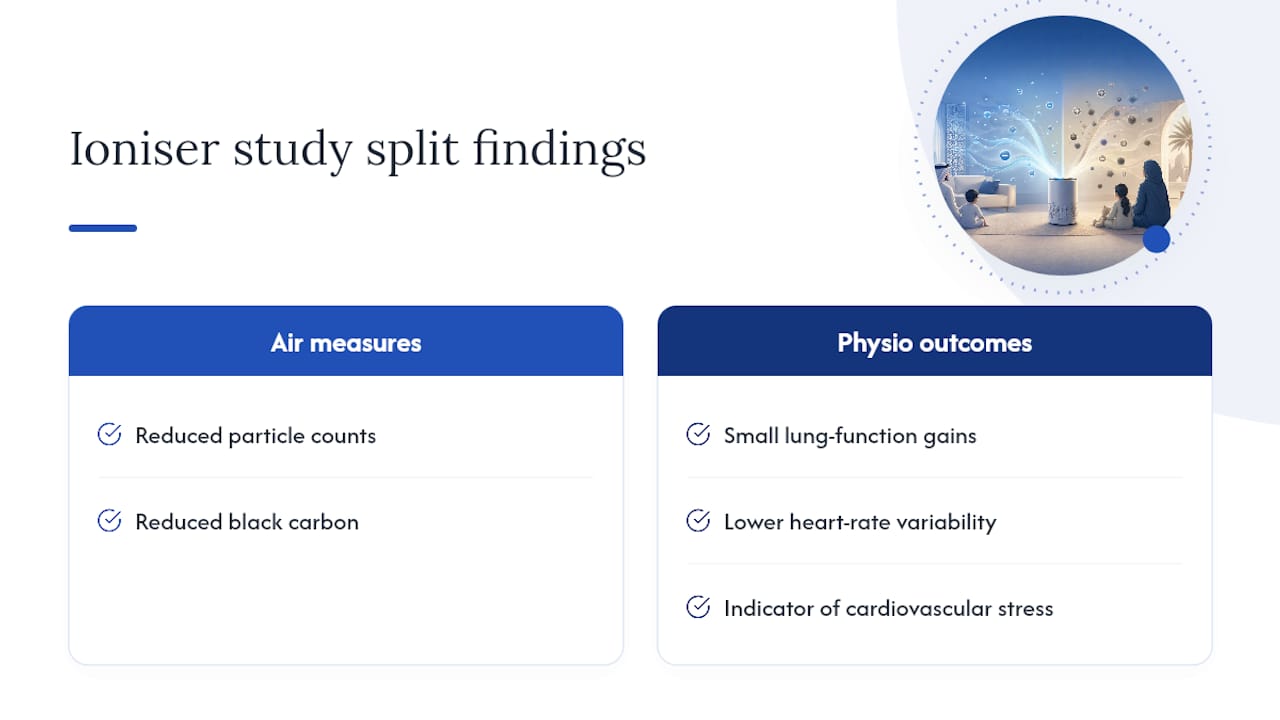
A randomised crossover study in school children found that ionisers reduced some particle and black carbon measurements, but also produced mixed physiological signals: small gains in lung function sat alongside a drop in heart-rate variability, a marker tied to cardiovascular stress. That result matters because it shows particle counts and health outcomes don’t always move in the same direction. A device can visibly cut dust in the air while still placing measurable strain on the body through ozone or altered indoor chemistry. Fewer particles in a room is not, on its own, evidence of a health benefit.
The secondary chemistry problem: byproducts you can’t see
Ozone doesn’t just sit in the air and irritate lungs on its own. It reacts with volatile organic compounds already present indoors, things like paint fumes, cleaning products, and furnishings, to form secondary pollutants that weren’t there before the device was switched on.
A peer-reviewed review of electronic air cleaners found this chemistry can generate formaldehyde and ultrafine particles, both of which carry their own respiratory risks. Ultrafine particles are small enough to penetrate deep into lung tissue, while formaldehyde is a recognised irritant linked to eye, nose, and throat symptoms.
- Ozone plus VOCs can produce formaldehyde as a reaction byproduct.
- The same reactions can generate ultrafine particles too small for many sensors to register.
- These byproducts can raise total exposure risk even in rooms where visible dust or PM2.5 counts have dropped.
Regulators including CARB flag this secondary chemistry as a core reason ozone-generating devices aren’t recommended for occupied spaces, separate from the ozone itself.
HEPA filtration vs ionisers: what actually clears the air
Mechanical filtration and ionisation solve different problems, and only one of them removes contaminants rather than relocating them. A true HEPA H13 filter captures at least 99.95% of particles at 0.3 microns, including dust, pollen, pet dander, and most bacteria and virus-carrying particles, by physically trapping them in filter media.
- HEPA filtration removes particles from circulation; ionisers mostly redistribute them onto surfaces.
- For bedrooms, allergy control, and smoke-affected rooms, HEPA units consistently outperform ionisers on measurable air quality.
- Ionisers can occasionally help with fast particle knockdown in a large, unoccupied space, but the ozone and byproduct trade-off usually outweighs that benefit in a home.
- Combined ioniser and filtration systems exist, but they still carry the ozone question unless the ioniser component is certified to low-emission standards.
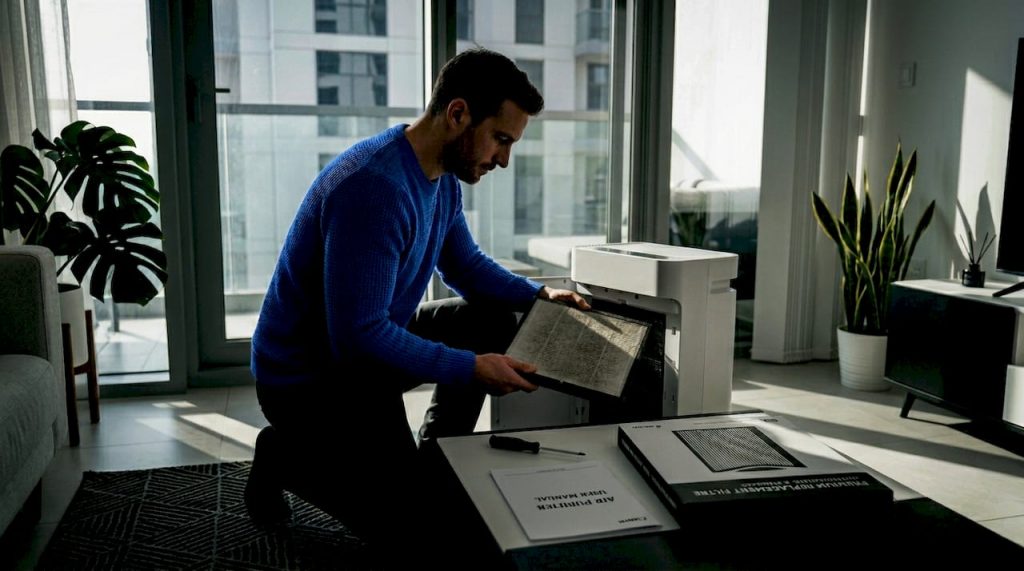
Pro Tip: If you already own a combination unit, check whether the ionisation function can be switched off independently. Many models let you run the HEPA filter alone, which removes the ozone risk entirely while keeping the filtration benefit.
For a side-by-side look at maintenance and running costs, Climatepro’s energy-efficient air cleaning workflow breaks down where electronic cleaners and mechanical filters diverge on upkeep.
Safety standards worth checking before you buy
Three things separate a reasonably tested device from an unregulated one:
- UL 867 certification — this is the test standard used to measure ozone emissions from electronic air cleaners; regulators reference it, and CARB’s own white paper on air cleaner emissions explains how the measured output translates into allowable limits.
- CARB certification listing — CARB maintains a public list of air cleaners tested against its ozone limits; a device absent from that list has not been through the process.
- Manufacturer emissions disclosure — a legitimate device states its tested ozone output in parts per billion, not vague marketing language.
Be wary of copy that leans on phrases like “activated oxygen,” “negative ion therapy,” or “ozone freshness” without a linked test result. Absence of an emissions figure is itself a red flag.
Practical safety steps if you own or are considering one
Stop using the device and speak with a doctor if anyone in the household develops a new cough, chest tightness, or an uptick in asthma symptoms after it’s switched on. Those are the classic early signs of ozone irritation, and they tend to ease once exposure stops.
- Ventilate the room, opening a window or running an exhaust fan reduces ozone concentration fast.
- If you use the device mainly for odour control, run it only in unoccupied rooms and air the space out before anyone re-enters.
- An ozone meter is a cheap way to confirm actual output rather than relying on a marketing claim.
- Size any air cleaner to the room; an undersized unit run at maximum output for hours is a common way ozone and byproduct exposure creeps up.
Pro Tip: Dust settled by an ioniser doesn’t disappear, it sits on surfaces until disturbed. Wipe down furniture and vacuum with a sealed HEPA vacuum weekly if you’re running one of these devices, otherwise that redistributed dust ends up back in the air.
Where Climatepro fits into this evidence
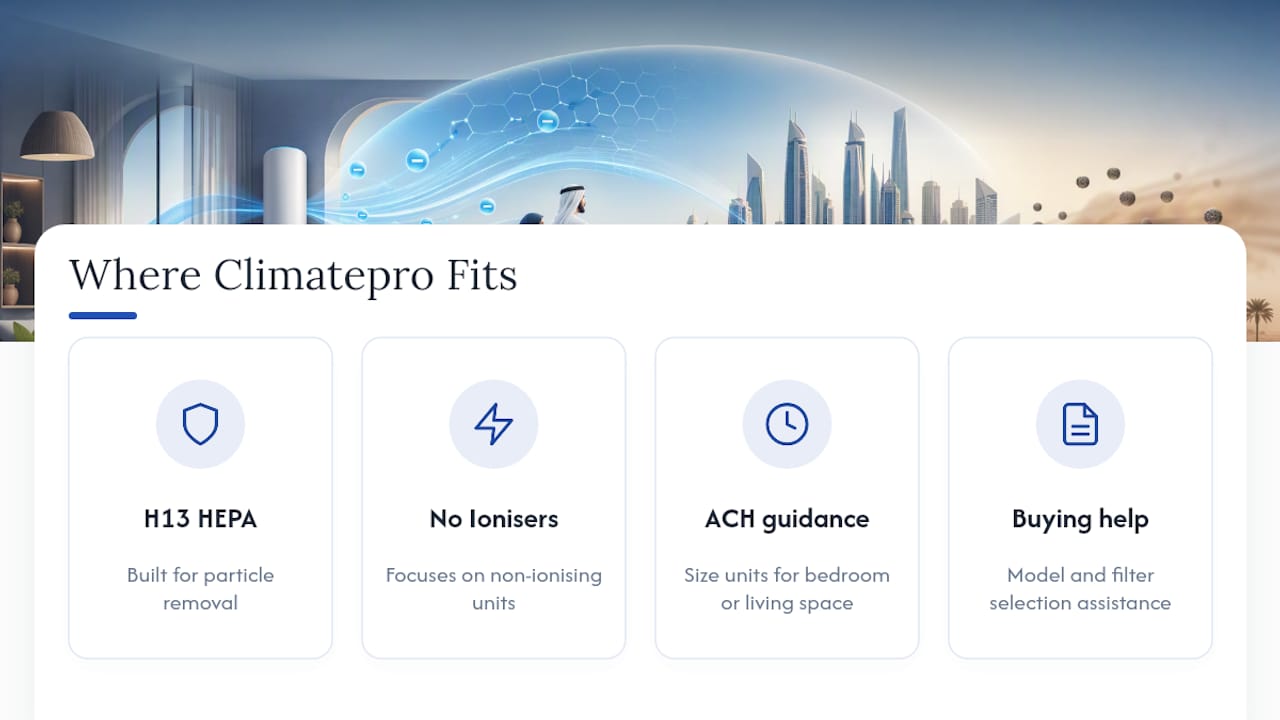
Climatepro focuses on H13 HEPA purifiers built for genuine particle removal rather than ionisation, with ACH (air changes per hour) guidance to help you size a unit correctly for a bedroom or living space. For readers who want the mechanics explained in more depth, our breakdown of how air ionisation actually works covers the technology beyond what fits here. If you’re unsure which model or filter suits your room, that’s the kind of question customers often need help with before they buy.
Why we back HEPA-first air cleaning for occupied rooms
The evidence on ionisers isn’t ambiguous once you separate marketing claims from tested output. Regulators point at ozone; peer-reviewed studies point at secondary chemistry and inconsistent physiological outcomes. That’s why HEPA filtration is recommended as the default choice for bedrooms, nurseries, and anywhere people spend real time. If you need help matching an air change rate to your room size, assistance is available.
— Nevel
A non‑ozone way to clear your air
If you’ve read this far because a device in your home smells faintly metallic after it’s been running, or you’re simply choosing between an ioniser and a proper purifier, the decision comes down to what each one actually removes. HEPA filtration physically traps particles rather than charging and relocating them, which is the reason Climatepro stocks H13 HEPA units instead of ozone-based devices.

Our Honeywell Air Touch P2 is a solid mid-size room option, while the compact Honeywell Air Touch P1 suits smaller bedrooms and home offices. Larger living spaces are better matched to the Honeywell Air Touch U1, and if you need something for the car, the Honeywell Move Pure 5 covers that without any ozone output at all. Browse the full range in our air purifier catalogue and pick by room size rather than brand name, that’s the single biggest factor in whether a purifier actually does its job. If you’re not sure which model fits your space, get in touch and we’ll help you match a unit and filter schedule to your room before you check out.
This article is general information, not a substitute for advice from a qualified doctor. Consult a qualified healthcare professional about your own circumstances before acting on anything here.
Sources
- What are ionizers and other ozone generating air cleaners? | US EPA
- Study on ioniser air purification and cardiorespiratory effects in school children (PMC8579920)
- Hazardous ozone‑generating air purifiers | California Air Resources Board
FAQ
Is it okay to be in a room with an ioniser running?
It depends on the device. If it produces ozone or has no published emissions data, the EPA and CARB both advise against occupied use, particularly for children, older adults, and anyone with asthma or COPD.
Which is better, an ioniser or an air purifier?
A HEPA air purifier removes particles from circulation through filtration, while an ioniser mostly redistributes them onto surfaces and can generate ozone in the process. For allergy control, smoke, and bedrooms, HEPA filtration is the more reliable option.
What are the negative effects of an air ioniser?
The main risks are ozone exposure, which irritates the lungs and airways, and secondary byproducts like formaldehyde and ultrafine particles formed when ozone reacts with indoor VOCs, as detailed in a peer-reviewed review of electronic air cleaners.
What does ionised air do to your body?
Charged ions can cause particles to settle out of the air faster, but a school-based study found this came with mixed physiological effects, including reduced heart-rate variability alongside small lung-function gains.
Are ionisers safe for people with asthma?
Generally, no. Ozone is a known lung irritant, and medical evidence summarised by Acibadem Hospitals Group found no consistent clinical benefit for asthma management, while the ozone risk remains a genuine concern.