

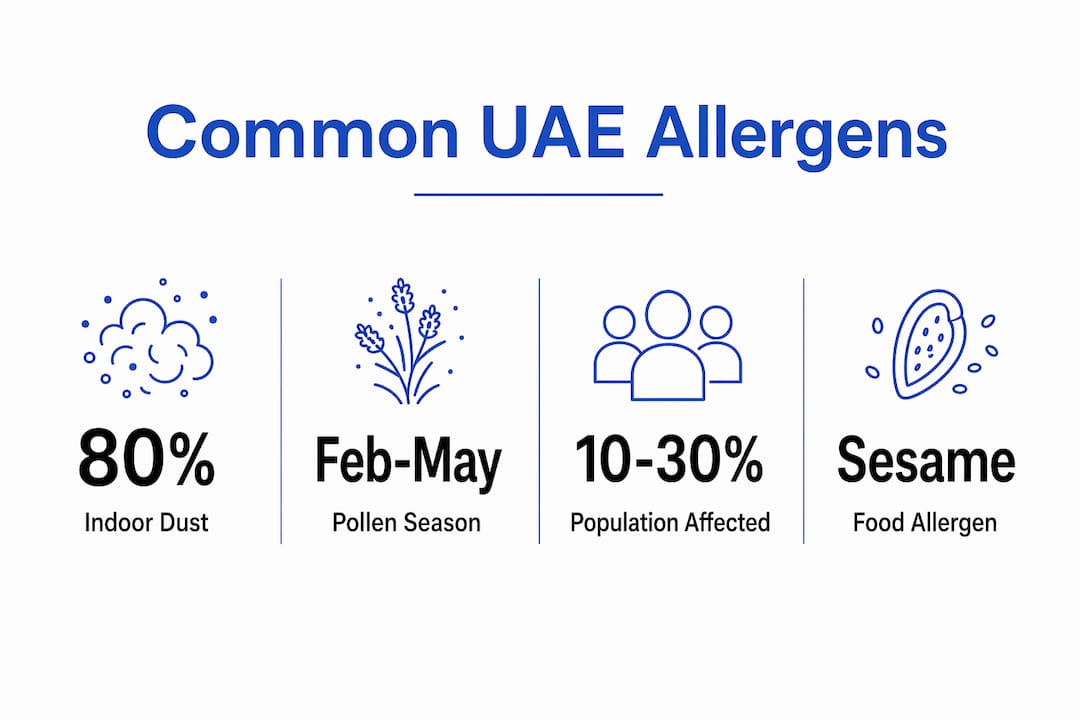
Allergens in the UAE are substances that trigger immune reactions in sensitised individuals, and the country’s unique climate, architecture, and multicultural food culture create an unusually broad range of allergy triggers. Indoor sources like dust mites and mould thrive in air-conditioned spaces, outdoor pollens from Acacia and Mesquite trees peak between february and may, and food allergens span both global staples and regionally specific ingredients like sesame and chickpeas. Allergy testing methods such as skin prick tests and serum IgE panels are widely available in Dubai and Abu Dhabi, making diagnosis more accessible than many residents realise.
What are allergens in the UAE and why are they different here?
Allergens are proteins or chemical compounds that cause the immune system to overreact, producing symptoms ranging from sneezing and itchy eyes to anaphylaxis. In the UAE, the allergen profile differs from most countries because of three compounding factors: a hot, humid coastal climate, near-constant air conditioning, and a highly mobile expatriate population.
Many residents develop new sensitivities after relocating to the UAE because they encounter native trees like Ghaf and Mesquite, plus mould strains inside AC units, that simply do not exist in their home countries. This means someone who had no allergies in Europe or South Asia may develop allergic rhinitis or asthma within months of arriving. The standard international allergy test panel often misses these regional triggers, which is why regionally tailored testing produces better diagnostic outcomes for the UAE’s multicultural population.

Recognising the specific allergen types present in the UAE is the first step toward managing symptoms effectively. The sections below cover indoor allergens, outdoor allergens, and food allergens in detail.
What are the most common indoor allergens in the UAE?
Indoor allergens dominate the UAE’s allergy burden because residents spend the majority of their time in sealed, air-conditioned spaces. This creates year-round exposure rather than seasonal spikes, which is why so many people mistake their symptoms for a persistent cold or sinus infection.
The key indoor allergy triggers in UAE homes and offices include:
- Dust mites. Up to 80% of allergic patients in the Gulf region are sensitised to dust mites, making them the single most prevalent indoor allergen. Mattresses, pillows, carpets, and AC ducts are the primary reservoirs. Optimal indoor humidity between 30–50% inhibits dust mite growth, but many UAE homes run above that threshold.
- Mould spores. Mould grows inside AC ducts, bathroom grout, and any surface exposed to condensation. After rain events, indoor humidity rises sharply and creates a 24–48 hour window ideal for mould proliferation. Keeping humidity below 60% is the minimum standard for mould control.
- Pet dander. Cat allergen Fel d 1 is especially persistent, remaining airborne for hours and transferring to clothing and furniture. This means you can react to cat allergen in a home or office that has never housed a cat.
- Cockroach allergens. Cockroach proteins in droppings and shed skin are a recognised trigger for asthma and rhinitis in urban UAE apartments, particularly in older buildings.
Allergy experts note that constant AC use recirculates these particles continuously, producing chronic year-round symptoms that residents often dismiss as seasonal colds. That misidentification delays treatment and allows sensitisation to worsen over time.
Pro Tip: Clean or replace AC filters every 4–6 weeks and use a HEPA-rated air purifier in bedrooms to reduce overnight dust mite and mould spore exposure. Bedroom air quality matters most because that is where you spend 7–8 hours breathing unfiltered air.
Which outdoor allergens affect the UAE and when do they peak?
Outdoor allergens in the UAE follow a more predictable seasonal pattern than indoor ones, though the desert environment adds a layer of complexity that most allergy guides overlook.
The four main outdoor allergen and irritant categories are:
- Tree and grass pollen. Ornamental and native trees including Acacia, Mesquite, and Cypress are the primary pollen sources. Pollen seasons peak from february to may, coinciding with cooler temperatures that encourage outdoor activity. Grass pollens from Bermuda grass, widely used in UAE parks and golf courses, extend the season into early summer.
- Weed pollen. Weeds including Chenopodium (goosefoot) and Amaranthus produce fine pollen that travels long distances. These are less discussed but contribute significantly to rhinitis symptoms in spring.
- Sand and dust storms. Desert dust and sand are not allergens themselves. They act as mechanical irritants and carry pollen and mould spores deep into the respiratory tract, amplifying the effect of existing allergens during storm events. This is why allergy symptoms often spike sharply during and after a haboob.
- Post-rain mould. Rainfall in the UAE is infrequent but intense. When it occurs, outdoor mould spore counts rise rapidly as spores release from soil and vegetation. Combined with the indoor humidity spike described above, rain events represent the highest-risk period for mould-sensitive residents.
Monitoring daily pollen counts through resources like the UAE Ministry of Climate Change and Environment advisories helps residents plan outdoor activity during peak season. Limiting morning outdoor exercise between 5 am and 10 am, when pollen counts are highest, reduces cumulative exposure significantly.
What food allergens are common in the UAE?
Food allergens in the UAE reflect both global standards and the country’s multicultural food culture. The internationally recognised Big 8 allergens, which are milk, eggs, peanuts, tree nuts, fish, shellfish, wheat, and soy, account for the majority of serious food allergy reactions worldwide and are equally relevant here.
| Allergen Category | Common Sources in UAE Diet | Reaction Severity |
|---|---|---|
| Milk and eggs | Dairy products, baked goods, Arabic sweets | Mild to severe |
| Peanuts and tree nuts | Snack foods, Indian and Middle Eastern dishes | Potentially severe |
| Fish and shellfish | Seafood restaurants, Asian cuisine | Potentially severe |
| Wheat | Bread, pasta, Arabic flatbreads | Mild to moderate |
| Sesame seeds | Tahini, hummus, Arabic bread, Asian sauces | Mild to severe |
| Chickpeas | Hummus, falafel, Indian curries | Mild to moderate |
Food allergens common in the UAE extend beyond the Big 8 to include sesame and chickpeas, which feature prominently in Arabic, Indian, and Levantine cuisines. Sesame allergy in particular is underdiagnosed because it is not always listed prominently on food labels in the region. Symptoms of food allergies range from hives and digestive upset to anaphylaxis, and the severity can increase with repeated exposure.
Regionally tailored allergy testing panels that include sesame, chickpeas, and common spices provide more accurate diagnosis than generic international panels for residents eating a UAE-typical diet.
Pro Tip: If you suspect a food allergy, keep a detailed food diary for two weeks before your allergy appointment. Recording meals, symptoms, and timing gives the specialist far more useful data than memory alone.
How do allergens affect health in the UAE and how can you manage them?
Allergic rhinitis affects 10–30% of the UAE population, triggered by dust, pollen, mould, and pet dander. That figure means roughly one in five residents is managing nasal congestion, sneezing, itchy eyes, or post-nasal drip on a regular basis. Asthma is a related condition that shares many of the same triggers and is worsened by the same indoor and outdoor allergen sources.
The most common misdiagnosis in the UAE is treating allergic rhinitis as a recurring cold or sinus infection. Antibiotics do not address allergic inflammation, so symptoms persist or worsen without the correct treatment. If you have had more than three “colds” in a year, or if symptoms appear consistently in certain environments, allergy testing is the appropriate next step.
Practical strategies for reducing allergen exposure at home include:
- Humidity control. Maintain indoor humidity between 30–50% using a dehumidifier, particularly after rain events. Healthcare professionals recommend humidity control alongside HEPA filtration as the two most effective home-based allergen management strategies.
- Air purification. HEPA-rated air purifiers capture dust mite particles, mould spores, and pet dander. Place units in bedrooms and living areas where exposure time is highest.
- Regular cleaning. Wash bedding weekly in hot water above 60°C to kill dust mites. Vacuum with a HEPA-filtered vacuum cleaner rather than a standard bag model.
- Seasonal precautions. During february to may pollen peaks, keep windows closed during morning hours and shower after returning indoors to remove pollen from hair and skin.
- Professional diagnosis. Skin prick tests and serum IgE blood tests identify specific sensitisations. Knowing your exact triggers allows targeted avoidance rather than broad, impractical lifestyle restrictions.
For residents wanting to understand the full range of indoor air quality improvements available, combining humidity control with air purification addresses the two largest indoor allergen drivers simultaneously.
Key takeaways
Managing allergens in the UAE requires addressing both indoor and outdoor sources, with dust mites, mould, and pollen representing the highest-risk triggers for most residents.
| Point | Details |
|---|---|
| Dust mites are the top indoor allergen | Up to 80% of Gulf allergy patients are sensitised; target mattresses, AC ducts, and carpets first. |
| Pollen peaks from february to may | Acacia, Mesquite, and Cypress trees drive the season; limit morning outdoor exposure during this period. |
| Food allergens extend beyond the Big 8 | Sesame and chickpeas are significant regional triggers often missed by standard international test panels. |
| Humidity control is non-negotiable | Keep indoor humidity between 30–50% to inhibit dust mite and mould growth year-round. |
| Persistent symptoms warrant allergy testing | Skin prick and IgE tests identify specific triggers and prevent years of misdiagnosis. |
Living with UAE allergens: what i have observed over time
Having spent considerable time reviewing indoor air quality data and allergy patterns across the Gulf, the pattern I find most striking is how consistently residents underestimate their indoor environment as the primary source of their symptoms. The outdoor allergen story is easier to tell because it has seasons and visible events like sandstorms. The indoor story is quieter and more insidious.
AC systems in the UAE run for 10–12 months of the year. Without regular filter maintenance, they become distribution systems for dust mite particles, mould spores, and pet dander rather than clean air sources. I have seen residents invest in expensive allergy medications while continuing to sleep in rooms with uncleaned AC filters and humidity levels above 65%. The medication manages symptoms; it does not address the source.
The other observation worth sharing is about expatriates specifically. Moving to the UAE resets your allergen exposure profile entirely. Ghaf tree pollen, Mesquite, and the specific mould strains in Gulf-climate AC units are genuinely novel to most newcomers. Developing new allergies in your 30s or 40s is not unusual here. It is a direct consequence of encountering a new allergen environment without prior sensitisation. Early testing after arrival, rather than waiting for symptoms to become chronic, is the most practical approach I can recommend.
For apartment residents specifically, the air quality strategies for UAE apartments that address both filtration and humidity control are worth reviewing before the summer humidity season begins.
— Nevel
Reduce indoor allergens with the right air purification
Climatepro stocks a range of air purifiers and humidity control devices suited to UAE homes, offices, and clinics. The Honeywell Air Touch P2 captures dust mite particles, mould spores, and pet dander with its HEPA filtration system, making it a practical choice for bedrooms and living areas. For larger spaces or higher allergen loads, the Honeywell Air Touch U1 offers greater coverage. Pairing an air purifier with a dehumidifier addresses both airborne particles and the humidity conditions that allow mould and dust mites to thrive.

Browse the full air purifier catalogue at Climatepro for models suited to every room size and budget, with delivery across Dubai, Abu Dhabi, Sharjah, and all seven emirates.
FAQ
What are the most common allergens in the UAE?
Dust mites, mould spores, pollen from Acacia and Mesquite trees, pet dander, and food allergens including sesame and chickpeas are the most prevalent allergy triggers in the UAE. Indoor allergens dominate due to year-round air conditioning use.
When is pollen season in the UAE?
Pollen season in the UAE peaks from february to may, driven primarily by ornamental and native trees including Acacia, Mesquite, and Cypress. Bermuda grass pollen can extend symptoms into early summer.
Can you develop new allergies after moving to the UAE?
Yes. Many expatriates develop new sensitivities to local trees like Ghaf and Mesquite, and to mould strains found in UAE AC units, because these allergens are not present in most other countries.
How do i know if my symptoms are allergies or a cold?
Allergy symptoms typically persist for weeks or months, worsen in specific environments, and do not respond to antibiotics. A skin prick test or serum IgE blood test confirms specific allergen sensitisations and rules out infection.
Does humidity affect allergen levels in UAE homes?
Indoor humidity above 60% actively promotes dust mite reproduction and mould growth. Keeping humidity between 30–50% using a dehumidifier is one of the most effective ways to reduce indoor allergen concentrations in UAE homes.
Recommended
- HEPA filtration: Improve your UAE home’s air quality — Blog | ClimatePro UAE
- UAE air pollution: Impacts, monitoring, and solutions — Blog | ClimatePro UAE
- Home air quality improvement guide for UAE homeowners — Blog | ClimatePro UAE
- Understand air cleaning technologies for healthier UAE homes — Blog | ClimatePro UAE