The most reliable way for apartment residents to know whether their indoor air is healthy is to use a multi-parameter monitor that measures PM2.5 and CO2, and preferably VOCs as well. Consumer Reports recommends CO2, PM2.5, and VOCs as the core metrics for home monitoring. Sensor type matters: CO2 readings are only trustworthy from NDIR sensors, PM2.5 from laser optical particle counters (OPC), and TVOC is a general trend index, not a chemical identifier.
Top picks for apartments at a glance:
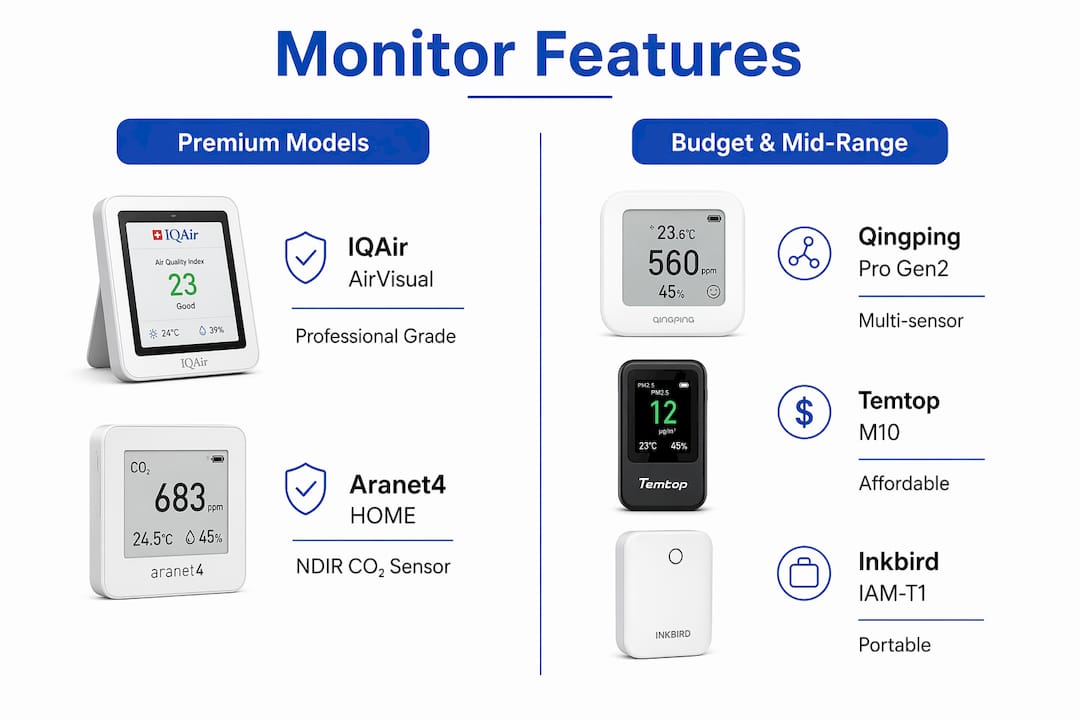
- Aranet4 HOME — Best for CO2 monitoring; NDIR sensor, long battery life, no subscription, AU$250–300 range
- Qingping Air Monitor Pro Gen2 — Best all-rounder; NDIR CO2, OPC PM2.5, HCHO, VOC, temp/humidity, AU$180–250
- AirGradient One — Best for data transparency; open-source firmware, NDIR CO2, OPC PM2.5, strong community support, AU$150–220
- IQAir AirVisual Pro — Best for accuracy and data logging; professional-grade sensors, cloud logging, AU$350–450
- Temtop M10 — Best budget pick; PM2.5, CO2, HCHO, VOC, AU$60–100
- Inkbird IAM-T1 — Best pocket/portable option; PM2.5, temp/humidity, AU$50–80
Note on PurpleAir (Zen / PA-II): PurpleAir units are widely used for outdoor and semi-outdoor monitoring and community AQI mapping. They measure PM2.5 via dual laser particle counters but lack CO2 or VOC sensors, making them less suited as a primary indoor apartment monitor. They are a strong supplementary tool for tracking outdoor infiltration.
Table of Contents
- Which air quality monitors for apartments are worth buying?
- How are monitors evaluated for accuracy?
- What does each sensor actually measure?
- How to choose an indoor air quality monitor for your apartment
- How to place and use a monitor in your apartment
- Where to buy in Australia and what to expect to pay
- Key takeaways
- An indoor air reviewer’s perspective
- When your monitor reveals a PM2.5 problem, a HEPA purifier is the practical answer
- Authoritative sources and further reading
Which air quality monitors for apartments are worth buying?
Aranet4 HOME
The Aranet4 HOME is the benchmark for CO2 monitoring in apartments. It uses a true NDIR sensor, which is the only sensor technology that delivers stable, calibration-grade CO2 readings over time. Battery life runs to several months on a single set of AAs, and the e-ink display is readable at a glance without needing an app open. There is no subscription, no cloud dependency, and data exports via Bluetooth to the Aranet app.
Best for: Renters focused on ventilation management and CO2 control.
Sensors: CO2 (NDIR), temperature, humidity, atmospheric pressure.
Pros: Highly accurate CO2; excellent battery life.
Cons: No PM2.5 or VOC sensor; higher price for CO2-only coverage.
Typical AU$ range: AU$250–300.
Qingping Air Monitor Pro Gen2
The Qingping Pro Gen2 covers the widest sensor range of any mid-price unit available in Australia. It combines NDIR CO2, an OPC laser sensor for PM2.5, electrochemical formaldehyde (HCHO), TVOC, and temperature/humidity in a compact desktop form. The companion app logs historical data and the unit works with Apple HomeKit and Mi Home. For most apartment renters wanting a single device, this is the most practical choice.
Best for: Renters who want one device covering all major pollutants.
Sensors: CO2 (NDIR), PM2.5 (OPC), HCHO (electrochemical), TVOC, temp/humidity.
Pros: Broad sensor coverage; good app ecosystem; compact.
Cons: TVOC is an index only; HCHO accuracy varies at very low concentrations.
Typical AU$ range: AU$180–250.
AirGradient One
AirGradient One stands out because its firmware is open-source and its sensor data can be pushed to Home Assistant, Grafana, or the AirGradient cloud. It uses a Sensirion SCD41 NDIR CO2 sensor and a Plantower OPC for PM2.5, both of which are well-regarded in independent testing. The unit is mains-powered and designed for fixed placement, which suits a living room or home office. Its community-tested accuracy data is publicly available, a transparency that most consumer brands do not offer.

Best for: Data-focused renters and smart-home users who want local data control.
Sensors: CO2 (NDIR), PM2.5 (OPC), TVOC, temp/humidity.
Pros: Open-source; strong independent testing record; local data logging.
Cons: Mains-powered only; requires some setup for advanced features.
Typical AU$ range: AU$150–220.
IQAir AirVisual Pro
The AirVisual Pro sits at the premium end of the consumer market. It uses professional-grade laser particle counting for PM2.5 and an NDIR sensor for CO2, with cloud logging that stores years of historical data. The large colour display shows real-time AQI, CO2, PM2.5, TVOC, temp, and humidity simultaneously. IQAir has an established presence in Australia and the unit ships with a compatible plug.
Best for: Renters with health sensitivities or those who want the most detailed historical record.
Sensors: PM2.5 (laser OPC), CO2 (NDIR), TVOC, temp/humidity.
Pros: Premium sensor accuracy; extensive data logging; strong brand support.
Cons: Higher price; cloud-dependent for full data history.
Typical AU$ range: AU$350–450.
Temtop M10
The Temtop M10 is the most practical budget entry for apartment renters who want more than a single-pollutant device. It covers PM2.5, CO2, HCHO, and TVOC on a clear LCD display with no app required. Accuracy at this price point is adequate for trend detection rather than precision measurement, and consumer-grade monitors at this level are best used for spotting changes rather than absolute values.
Best for: Budget-conscious renters wanting a multi-parameter starting point.
Sensors: PM2.5, CO2, HCHO, TVOC, temp/humidity.
Pros: Affordable; no app needed; covers key pollutants.
Cons: CO2 sensor type not always specified as NDIR; accuracy degrades faster than premium units.
Typical AU$ range: AU$60–100.
Inkbird IAM-T1
The Inkbird IAM-T1 is a pocket-sized unit that measures PM2.5, temperature, and humidity. It is battery-powered and light enough to carry between rooms, making it useful for checking hotspots without buying multiple monitors. It does not measure CO2 or VOC, so it works best as a secondary device alongside a more capable unit.
Best for: Portable spot-checking; secondary device for kitchen or bedroom comparisons.
Sensors: PM2.5, temp/humidity.
Pros: Compact; battery-powered; low cost.
Cons: No CO2 or VOC; limited to PM2.5 trend data.
Typical AU$ range: AU$50–80.
Side-by-side comparison
| Dimension | Aranet4 HOME | Qingping Pro Gen2 | AirGradient One | IQAir AirVisual Pro | Temtop M10 | Inkbird IAM-T1 |
|---|---|---|---|---|---|---|
| Best for | CO2/ventilation | All-round apartment use | Data/smart home | Health-sensitive users | Budget starter | Portable spot-check |
| Sensors measured | CO2, temp, humidity, pressure | CO2, PM2.5, HCHO, TVOC, temp/humidity | CO2, PM2.5, TVOC, temp/humidity | PM2.5, CO2, TVOC, temp/humidity | PM2.5, CO2, HCHO, TVOC, temp/humidity | PM2.5, temp/humidity |
| Sensor tech & accuracy | NDIR CO2 (±50 ppm) | NDIR CO2, OPC PM2.5, electrochemical HCHO | NDIR CO2 (SCD41), OPC PM2.5 | Laser OPC PM2.5, NDIR CO2 | Optical PM2.5, CO2 (type varies) | Optical PM2.5 |
| Connectivity & data logging | Bluetooth, Aranet app | Wi-Fi, HomeKit, Mi Home app | Wi-Fi, local API, cloud optional | Wi-Fi, IQAir cloud, extensive logging | USB, basic app | Bluetooth, basic app |
| Typical AU$ range | AU$250–300 | AU$180–250 | AU$150–220 | AU$350–450 | AU$60–100 | AU$50–80 |
| Portability / power | Battery (AA, months) | Mains | Mains | Mains | USB rechargeable | Battery |
| Calibration / stability | Factory NDIR; stable long-term | Annual drift typical; NDIR stable | Open calibration data; community-verified | Factory calibrated; strong long-term record | Periodic recalibration advised | Basic; replace after 1–2 years |
| Ease of use & alerts | E-ink display; simple alerts | Colour display; app alerts | Display + app; advanced for smart home | Large colour display; AQI alerts | LCD; standalone display | Small display; basic |
Availability note for Australian buyers: The Aranet4 HOME, Qingping Pro Gen2, and IQAir AirVisual Pro are available through Australian online retailers and specialist IAQ stores. AirGradient ships directly from its website with international shipping. Temtop and Inkbird units are widely available on Australian marketplaces. Check that the unit ships with an AU plug or includes an adapter, and confirm the warranty covers Australian returns.
Pro Tip: If you suspect a specific room has a problem (kitchen after cooking, bedroom overnight), a dedicated radon test kit or a professional IAQ assessment is worth considering for issues that a consumer monitor cannot identify, such as radon infiltration from below-grade foundations or specific chemical contamination. Consumer monitors do not detect radon.
How are monitors evaluated for accuracy?
Accuracy in consumer air quality monitors depends primarily on sensor technology and calibration, not price alone. For CO2, NDIR sensors are the standard for reliable readings; devices that estimate CO2 from VOC readings (labelled eCO2) are unreliable for ventilation decisions. For PM2.5, laser optical particle counters (OPC) outperform basic infrared sensors, particularly at low concentrations. VOC sensors in consumer devices use metal oxide semiconductor (MOS) technology, which responds to a broad range of gases and reports a single TVOC index.
The most reliable way to check a monitor’s real-world accuracy is co-location: place the unit next to a known-accurate reference device for 24–48 hours and compare readings. University lab tests and independent reviews (such as those published by Consumer Reports or academic IAQ researchers) provide the next best signal. When evaluating a product listing, look for explicit sensor type disclosure (NDIR, OPC, electrochemical), a published specification sheet, and any mention of factory calibration or a calibration service.
Trust signals to prioritise when assessing a monitor:
- Sensor type named explicitly (NDIR, OPC, electrochemical) rather than generic “high-precision sensor”
- Published accuracy specification (e.g., ±50 ppm for CO2, ±10% for PM2.5)
- Independent test results from a university lab, Consumer Reports, or a recognised IAQ reviewer
- Calibration statement or available recalibration service
- Data export capability so readings can be verified against other sources
The EPA’s guidance on low-cost air pollution monitors notes that consumer devices are appropriate for identifying trends and informing behaviour changes, not for regulatory-grade measurement. That framing is the right one for apartment use: the goal is to know when to open a window, run a purifier, or investigate a source, not to produce laboratory data.
What does each sensor actually measure?
PM2.5 and CO2 are the two most actionable pollutants for apartment residents. TVOC is a useful alarm for off-gassing or cleaning products. Humidity affects mould risk and comfort. Here is what each sensor covers and why it matters in a flat.
Pollutant reference thresholds
| Pollutant | Guidance value | Action level | Common apartment sources |
|---|---|---|---|
| PM2.5 | WHO long-term: 5 µg/m³ (annual mean) | Above 35 µg/m³ (24-hr): reduce exposure | Cooking, candles, incense, outdoor infiltration, smoking |
| CO2 | Outdoor baseline: typical outdoor level | Above moderate levels: ventilate; above high levels: urgent | Occupants breathing, gas stoves, poor ventilation |
| TVOC | No universal standard; below 300 µg/m³ typical background | Elevated readings: investigate source | New furniture, paints, cleaning products, air fresheners |
| Formaldehyde (HCHO) | WHO: 0.1 mg/m³ (30-min average) | Any persistent reading above 0.1 mg/m³: ventilate | New furniture, MDF, flooring, adhesives |
| Relative humidity | 40–60% RH comfortable and low mould risk | Low humidity: add moisture; high humidity: mould risk | Cooking, showers, drying laundry indoors, HVAC |
| Temperature | 18–24°C typical comfort range | Outside range: affects pollutant behaviour and comfort | Heating, cooling, solar gain |
Radon note: Radon is a radioactive gas that seeps from soil and building materials. No consumer multi-parameter monitor measures radon. If your apartment is on a lower floor or ground level, a dedicated radon test kit (available from specialist suppliers in Australia) is the only reliable option.
Key limitations to keep in mind:
- TVOC sensors report a single index, not specific chemicals. A spike tells you something changed; it does not identify the compound.
- HEPA purifiers reduce PM2.5 effectively but do not lower CO2. High CO2 requires ventilation, not filtration.
- Humidity readings from low-cost sensors can drift by ±5% RH or more; treat them as directional.
How to choose an indoor air quality monitor for your apartment
Prioritise sensors you will actually act on. PM2.5 and CO2 cover the two most common and most actionable apartment pollutants. Everything else is useful context.
Buying checklist
- Sensors and sensor technology: Confirm CO2 is NDIR (not eCO2). Confirm PM2.5 uses an optical particle counter. Ask the retailer or check the spec sheet if the listing is unclear.
- Connectivity and data logging: Decide whether you need Wi-Fi logging, a local display only, or smart-home integration (HomeKit, Google Home, Home Assistant). Cloud logging is convenient but check the privacy policy.
- Display and alerts: A clear standalone display means you can read the unit without a phone. Push alerts for threshold breaches are useful for overnight CO2 spikes.
- Calibration and warranty: Look for a stated calibration interval or factory calibration certificate. Consumer monitors typically need recalibration or replacement after 1–2 years for VOC sensors; NDIR CO2 sensors are more stable.
- Power and portability: Mains-powered units suit fixed placement in a living room or bedroom. Battery-powered units allow spot-checking in different rooms.
- Price and value: Consumer-grade monitors range from around AU$50 to AU$300 and above. Budget units are adequate for trend detection; mid-range units with NDIR and OPC sensors offer the best balance for most renters.
- Privacy and data policy: If the unit logs to a cloud server, check what data is stored, for how long, and whether it is shared with third parties.
Questions to ask before buying
- What sensor type is used for CO2: NDIR or eCO2?
- Does the PM2.5 sensor use a laser OPC or a basic infrared sensor?
- Can I export raw data as a CSV or access it via a local API?
- What is the stated accuracy for CO2 and PM2.5?
Red flags
- CO2 listed as “eCO2” with no mention of NDIR
- Sensor types not disclosed in the product listing or spec sheet
- No calibration information or stated sensor lifespan
- No local display and no data export option
- Aggressively low price with vague specifications and no independent reviews
Sensor lifespan varies by type. NDIR CO2 sensors typically remain accurate for 5–10 years with minimal drift. MOS VOC sensors and electrochemical HCHO sensors degrade faster, often within 2–3 years, and may need replacement or recalibration. Factor this into the total cost of ownership when comparing budget and mid-range units.
How to place and use a monitor in your apartment
Place the monitor in the primary living area or bedroom at breathing height, roughly 0.9–1.8 metres from the floor. Avoid positioning it near open windows, doors, or air vents, as these locations produce readings that do not reflect the air you are actually breathing.
Monitoring works best as a habit rather than a one-time check. Review data after activities that commonly affect indoor air: cooking, cleaning with chemical products, having guests over, or during days when outdoor smoke or pollution is elevated. Check trends weekly to identify recurring sources rather than isolated spikes.
Readings action map
| Reading | Pollutant | Immediate action |
|---|---|---|
| PM2.5 above 35 µg/m³ | Particulate matter | Run HEPA purifier; identify source (cooking, candles, outdoor infiltration) |
| Elevated CO2 levels | Carbon dioxide | Open windows or increase mechanical ventilation |
| High CO2 levels | Carbon dioxide | Ventilate immediately; check occupancy and appliance use |
| TVOC spike (sudden rise) | Total VOC | Identify source (cleaning products, new items); ventilate |
| HCHO above 0.1 mg/m³ | Formaldehyde | Ventilate; check new furniture or flooring; consider source removal |
| High humidity levels | Moisture | Run dehumidifier or increase ventilation; check for mould sources |
| Low humidity levels | Dryness | Run humidifier; check heating system |
Apartment-specific considerations: When outdoor AQI is poor (during wildfire smoke events, for example), closing windows and running a HEPA purifier is more effective than ventilating. Use AirNow or the Australian Bureau of Meteorology’s air quality alerts to decide when outdoor air is worse than indoor air before opening windows. For CO2 management when outdoor air is poor, short bursts of mechanical ventilation are preferable to sustained natural ventilation.
Running the kitchen exhaust fan during and after cooking is one of the most effective single actions for reducing PM2.5 spikes. Gas stoves in particular generate both PM2.5 and NO2; an exhaust fan vented to the outside (not a recirculating filter) is the correct response. For persistent PM2.5 issues, a HEPA purifier running continuously in the affected room is the practical solution, as the EPA identifies source control, ventilation, and air cleaners as the three core strategies for improving indoor air quality.
Pro Tip: Move a small portable unit (such as the Inkbird IAM-T1) between the kitchen and bedroom at different times of day to identify which room has the higher PM2.5 baseline. This avoids the cost of buying two full monitors and gives you a clear picture of where filtration is most needed.
For persistent issues or readings that do not resolve with ventilation and filtration, contact building management about the central ventilation system. Many apartment buildings have shared HVAC that can be a source of recurring pollutants.
Where to buy in Australia and what to expect to pay
Monitors for apartment use fall into three clear price bands in the Australian market:
- Budget (AU$50–150): Pocket units and entry-level multi-parameter devices (Inkbird IAM-T1, Temtop M10). Suitable for trend detection and first-time buyers. Accuracy is adequate for identifying spikes but not for precise measurement.
- Mid-range (AU$150–350): Multi-parameter units with NDIR CO2 and OPC PM2.5 (Qingping Pro Gen2, AirGradient One, Aranet4 HOME). The best value bracket for most apartment renters.
- Higher-end (AU$350+): Professional-grade consumer devices (IQAir AirVisual Pro). Suited to health-sensitive residents or those who want long-term data logging and premium accuracy.
Common Australian buying channels include:
- Specialist IAQ and air quality retailers: Stock a curated range and can advise on sensor types; often provide local warranty support.
- Online marketplaces (Amazon AU, eBay AU): Wide range of budget and mid-range units; check seller location and warranty terms carefully, as many units ship from overseas with no local warranty.
- Electronics retailers (JB Hi-Fi, Officeworks): Limited range but reliable local warranty and returns.
- Brand direct (AirGradient, Aranet): Ships internationally; confirm AU plug compatibility and return policy before ordering.
Import and warranty practicalities matter more than many buyers realise. A unit purchased through a grey-market listing may have no Australian warranty, meaning a fault requires international shipping for repair or replacement. Check whether the device ships with an AU Type I plug or requires an adapter. During wildfire season (typically November through March in southern and eastern Australia), demand for air quality devices rises and prices on popular models can increase. Buying outside peak season often means better availability and more stable pricing.
Key takeaways
The single most important buying decision for apartment renters is sensor type: choose NDIR for CO2 and OPC for PM2.5, and treat TVOC as a directional alarm rather than a precise measurement.
| Point | Details |
|---|---|
| Prioritise NDIR and OPC sensors | NDIR CO2 and OPC PM2.5 sensors deliver reliable readings; avoid eCO2 estimates for ventilation decisions. |
| Best all-round pick | The Qingping Pro Gen2 covers CO2, PM2.5, HCHO, and TVOC in one mid-range device (AU$180–250). |
| Act on readings, not just data | When PM2.5 exceeds 35 µg/m³, run a HEPA purifier; when CO2 exceeds 1,000 ppm, ventilate immediately. |
| Consumer monitors have limits | Accuracy degrades over time; use monitors for trend detection and trigger action, not regulatory-grade measurement. |
| Climatepro for filtration | When monitoring reveals persistent PM2.5, a HEPA H13 purifier from Climatepro is the practical next step. |
An indoor air reviewer’s perspective
The most common mistake apartment renters make with air quality monitors is treating the device as the solution rather than the diagnostic tool. A monitor that shows elevated PM2.5 or CO2 is doing exactly what it should: telling you to act. The action, not the reading, is what improves health outcomes. Monitors without a paired response plan, whether that is opening a window, running a purifier, or removing a source, tend to generate anxiety rather than results. The hierarchy matters: source control first, then ventilation, then filtration. A monitor is the tool that tells you which step to trigger and when.
The second underappreciated point is that CO2 is the most actionable metric in a sealed apartment. PM2.5 spikes are usually event-driven (cooking, candles, outdoor smoke) and resolve quickly. CO2 builds slowly and persistently in poorly ventilated spaces, affecting cognitive function and sleep quality before residents notice anything is wrong. An NDIR CO2 monitor alone, like the Aranet4 HOME, is a more useful daily tool for most renters than a budget multi-parameter unit with an unreliable eCO2 estimate.
When your monitor reveals a PM2.5 problem, a HEPA purifier is the practical answer
Monitors identify the problem. HEPA H13 purifiers address it. When readings consistently show PM2.5 above safe thresholds, particularly in kitchens, living rooms, or bedrooms, a purifier running continuously in that space is the most direct response. Ventilation handles CO2; filtration handles particles.

When selecting a purifier to pair with your monitor, match the unit’s CADR (Clean Air Delivery Rate) to your room size. A CADR of at least 2/3 of the room’s floor area in square metres is a practical starting point. Filter class H13 captures particles down to 0.3 µm, which covers PM2.5 and most allergens. Noise level matters in bedrooms; check the decibel rating at the lowest fan speed.
Climatepro stocks a range of HEPA H13 purifiers suited to apartment living, from compact bedroom units to higher-capacity models for open-plan spaces. The Honeywell Air Touch P1 suits smaller rooms and bedrooms, while the Honeywell Air Touch P2 covers larger living areas. For open-plan apartments, the higher-capacity Air Touch U1 is worth considering. Browse the full air purifier range at Climatepro to find the right match for your space and monitor readings.
Authoritative sources and further reading
These sources are worth bookmarking for threshold verification, outdoor AQI tracking, and deeper technical reading:
- US EPA: Improving Indoor Air Quality — The definitive reference for the source control, ventilation, and filtration hierarchy. Use this to understand mitigation priorities.
- US EPA: Low-Cost Air Pollution Monitors and Indoor Air Quality — Explains the capabilities and limitations of consumer monitors relative to regulatory instruments.
- AirNow — Real-time AQI maps and smoke alerts. Use this to decide when outdoor air is too poor to ventilate naturally.
- Consumer Reports: Indoor Air Quality Monitor Buying Guide — Practical buying guidance with sensor-priority recommendations.
- Clean Air Critic: How to Test Air Quality at Home — Detailed technical explainer on sensor types, placement, and red flags.
- Measuretutor: How to Measure Air Quality — Covers consumer monitor categories, price bands, and accuracy expectations.
- ScienceInsights: How to Monitor Air Quality — Practical guidance on monitoring routines and behavioural habits.
- Australian state environment and health agencies — Each state publishes air quality data and health guidance relevant to local conditions. Search your state health department for current indoor air quality guidelines and wildfire smoke advisories.
This article provides general information about air quality monitoring products and practices. It is not a substitute for professional advice. For health concerns related to indoor air quality, consult a qualified environmental health professional or your state health authority.
Recommended
- Role of smart air monitors: 2026 home guide — Blog | ClimatePro UAE
- Why ventilate apartments: health, air quality & comfort — Blog | ClimatePro UAE
- How to improve air quality in UAE apartments — Blog | ClimatePro UAE
- Guide to allergy proofing apartments: practical steps for renters — Blog | ClimatePro UAE