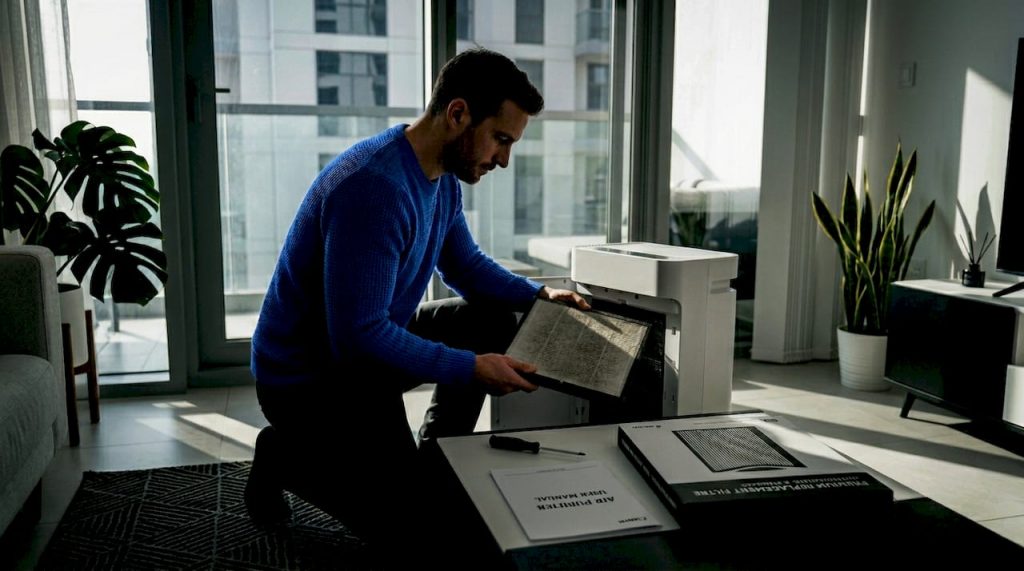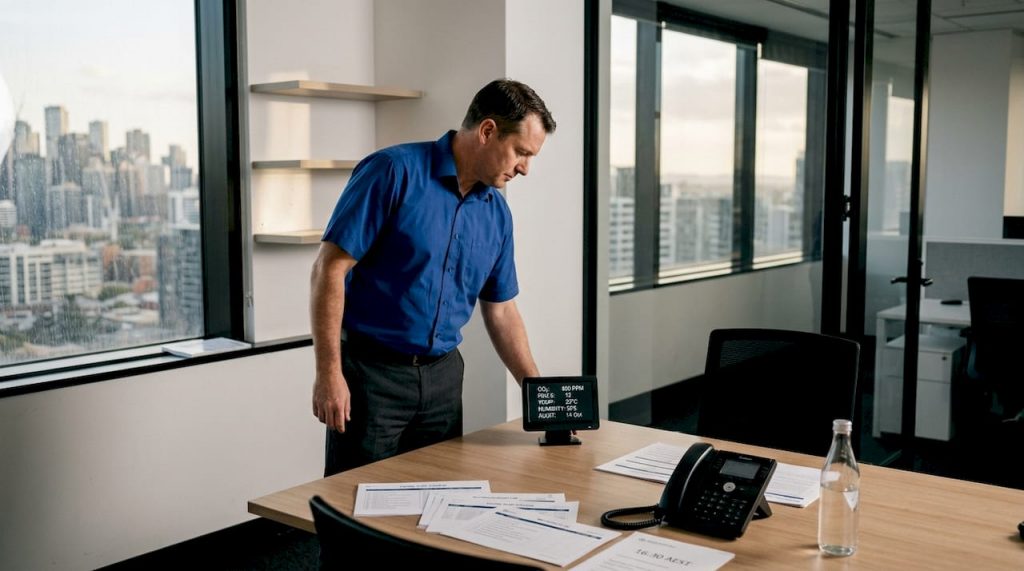
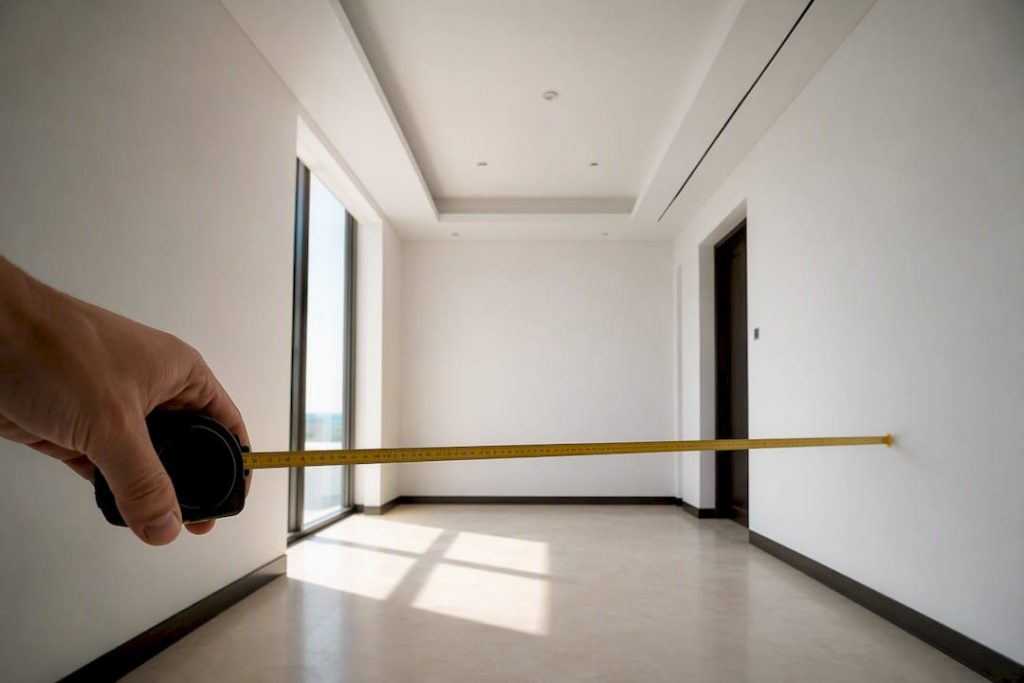
Calculate the CADR you need with this formula: CADR = (room volume × target ACH) ÷ 60. Aim for a moderate number of air changes per hour (ACH) that suits everyday allergy and dust control, increasing it when dealing with smoke, wildfire smoke, or asthma triggers. Skip the manufacturer’s “room size” claim printed on the box. Match the unit’s certified CADR rating instead, ideally one verified by AHAM.
TL;DR:
- Always calculate room volume using length, width, and ceiling height, especially for irregular or vaulted spaces, to determine the correct CADR.
- Target at least 4 to 5 air changes per hour for general allergy relief and increase to 6 ACH or more for higher pollutant loads like wildfire smoke or active asthma.
- Prioritize smoke CADR and verify certifications like AHAM Verifide to ensure independent, accurate performance ratings.
- Place air purifiers centrally, with clearances around them, and consider multiple units for large or open-plan spaces for optimal circulation.
- Avoid relying solely on manufacturer-specified room sizes; use the actual volume and ACH calculations to select a purifier that truly matches your needs.
Table of Contents
- Measuring your room and calculating volume
- What ACH level should you actually target?
- Why ceiling height and floor plan change your numbers
- How to read the spec sheet properly
- Worked examples and a quick sizing chart
- Where to place the unit and whether you need more than one
- Common mistakes when sizing an air purifier
- Understanding different room layouts and their impact on air purifier effectiveness
- Adjusting sizing for high or vaulted ceilings
- How furniture and clutter affect real-world air circulation
- What the sizing debate keeps getting wrong
- ClimatePro’s role in getting the sizing right
- Ready to buy: matching your calculation to a real unit
- Sources
Measuring your room and calculating volume
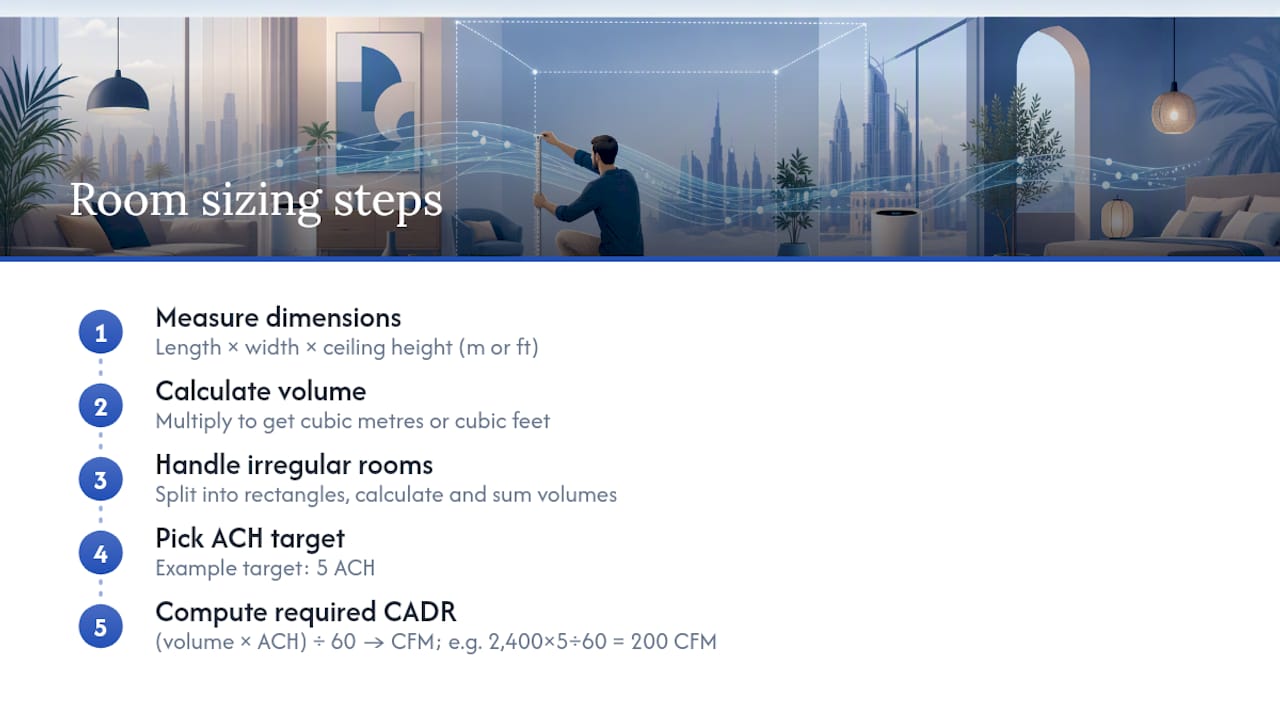
CADR calculations start with volume, not floor area, and that’s where most people go wrong. Multiply length by width by ceiling height, in metres, to get cubic metres, or in feet for cubic feet. A 4m × 5m bedroom with a standard 2.4m ceiling gives you 48 cubic metres. Convert to cubic feet by multiplying by 35.31 if you need CFM ratings, since most CADR figures on air purifier spec sheets are published in cubic feet per minute.
For irregular rooms, split the space into rectangles and add the volumes together. An L-shaped living room might be one 5m × 4m section plus a 2m × 3m nook. Calculate each separately, sum the totals, then run the combined figure through the formula. Closets, alcoves, and small extensions matter more than people assume, particularly if a purifier sits near an open doorway feeding two connected spaces.
Once you have volume, the Harvard Healthy Buildings sizing tool will do the ACH conversion for you, accounting for ceiling height and ventilation automatically. If you’re doing it manually, the formula divides by 60 because ACH is expressed per hour, while CADR is measured per minute. A 2,400 cubic foot room targeting 5 ACH needs (2,400 × 5) ÷ 60 = 200 CFM, a calculation confirmed in HVAC Base’s sizing guide. Get the volume right first. Everything downstream depends on it.
What ACH level should you actually target?
Air changes per hour tells you how many times the purifier processes the entire volume of air in that room, every hour. One ACH means the whole room’s air passes through the filter once an hour, which is barely noticeable against normal dust and allergen buildup. Four to five ACH is where most homes should sit for general allergy relief, pet dander, and everyday dust. That’s frequent enough to keep particle counts down without oversized equipment or excessive noise.
Push to 6 ACH or higher when the pollutant load is heavier: active wildfire smoke, a household member with asthma, or a recent renovation kicking up fine dust. CleanAirWiki’s sizing guidance backs this range, noting that manufacturers often advertise coverage at just 2 ACH, which explains why a “large room” rated purifier can still feel ineffective at home.
Occupancy changes the target too. A bedroom with two adults and a dog generates more particulate than an empty guest room, so bump your target ACH up half a point if the room sees heavy daily use.
Why ceiling height and floor plan change your numbers
Floor area alone is a misleading input, because a room’s air volume is what the purifier actually has to clean. Two bedrooms with identical floor plans but different ceiling heights need different CADR figures. Standard sizing charts assume a 2.4m (8ft) ceiling. Push that to 2.7m (9ft) and you need roughly 12.5% more CADR to hit the same ACH, a relationship detailed in the University of Melbourne’s air cleaner guide. Vaulted or raked ceilings increase overall room volume irregularly, requiring adjustments to CADR calculations based on average ceiling height.
Open-plan layouts require careful consideration whether to size for combined volume or separate zones. For larger connected areas or multiple distinct zones, splitting coverage across multiple units often performs better than one oversized unit.
How to read the spec sheet properly
Smoke CADR is the number to prioritise when comparing units, because smoke particles are the smallest a purifier has to capture, making it the strictest of the three CADR figures manufacturers publish (smoke, dust, pollen). A unit that handles smoke well will comfortably manage dust and pollen too, an approach outlined by Details.io’s CADR calculator.
Look specifically for an AHAM Verifide seal on the box or spec sheet. This means the CADR figures come from independent testing rather than the manufacturer’s own marketing claims. It’s the single best way to sidestep vague “covers up to 500 sq ft” language that ignores ceiling height entirely, as Consumer Reports’ buying guide points out. An Energy Star certified listing is a useful secondary filter, since it narrows the field to units that hit their CADR figures without excessive power draw.
If a spec sheet lists CADR in m³/h and you’ve calculated in CFM, divide by 1.699 to convert m³/h to CFM, or multiply CFM by 1.699 to get m³/h.
Worked examples and a quick sizing chart
Take a typical bedroom: 4m × 4.5m with a 2.4m ceiling, giving 43.2 cubic metres, or roughly 1,525 cubic feet. Targeting 5 ACH: (1,525 × 5) ÷ 60 = 127 CFM minimum.
A living room at 6m × 5m with the same ceiling height comes to 259 cubic metres (9,147 cubic feet). At 4 ACH: (9,147 × 4) ÷ 60 = 610 CFM, or roughly 793 CFM with the buffer applied.
Pick your target ACH from the earlier section, run your own room volume through the formula, then add the buffer. The chart above assumes standard 2.4m ceilings and 4 ACH; adjust upward for higher ceilings or heavier pollutant loads as covered above.
Where to place the unit and whether you need more than one
Placement affects real-world performance as much as the CADR number itself. A purifier tucked behind a curtain or jammed against a wall has its intake and exhaust restricted, cutting effective airflow regardless of what the spec sheet says.
- Keep clearances around the purifier to allow unrestricted air intake and exhaust.
- Position centrally in the room where possible, rather than in a corner.
- Avoid placing units directly beneath air conditioning vents, which can short-circuit airflow patterns.
- In open-plan spaces over 40 square metres, split coverage across two units rather than relying on one oversized purifier; effective CNC dust collection for cleaner, safer workshops depends on such tailored approaches to air filtration Effective CNC dust collection for cleaner, safer workshops.
Two smaller purifiers placed at opposite ends of an open-plan space often outperform a single large unit, because they improve air circulation and eliminate the dead zones a lone unit near one wall tends to leave behind, according to CleanAirWiki’s room calculator research.
That extra headroom lets you run the purifier on a medium fan speed rather than flat out, which means less noise, lower energy use, and the same air changes per hour you were targeting.*
Common mistakes when sizing an air purifier
The most frequent error is trusting the “recommended room size” printed on the box without checking what ACH it assumes. Most of those figures are calculated at just 2 ACH, which is fine for background maintenance but weak against allergens, pet dander, or smoke.
The second mistake is sizing off floor area alone and ignoring ceiling height. A 20 square metre room with a 2.4m ceiling and the same room with a 3.5m vaulted ceiling have very different air volumes, yet a floor-area-only calculation treats them identically.
Buying exactly to the calculated minimum, with no buffer, is another common trap. That leaves the unit running flat out constantly to maintain your target ACH, which means more noise, higher energy draw, and faster filter wear. People also frequently forget occupancy and pollutant load. A room that seemed fine on paper might house two smokers, three pets, and a poorly sealed window letting in traffic pollution, all of which push the real-world target ACH higher than a bare room calculation suggests.
Finally, plenty of buyers ignore dust and pollen CADR figures and focus only on smoke CADR, or vice versa, without checking which pollutant matters most for their household. If pet allergens are the main concern, the pollen and dust figures matter as much as smoke.
Understanding different room layouts and their impact on air purifier effectiveness
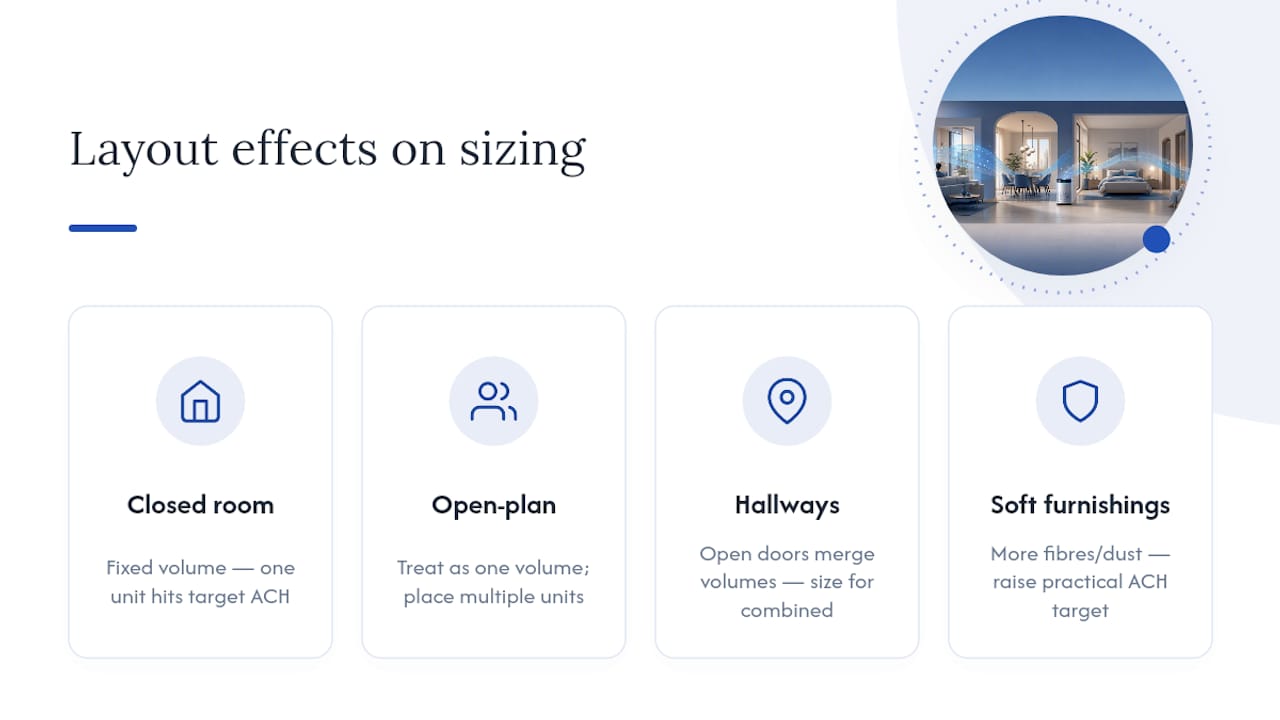
A closed bedroom with a door that stays shut is the easiest layout to size for. Air volume is fixed, air exchange with the rest of the home is minimal, and one correctly sized unit will reliably hit its target ACH.
Open-plan kitchen, living, and dining combinations behave very differently. Air moves freely between zones, cooking particulates drift from the kitchen into the lounge, and a single purifier placed in one corner may never adequately clean air 8 or 10 metres away. Treating the whole connected volume as one calculation, then placing units strategically rather than in a single spot, produces far better results than assuming one unit covers the lot.
Hallways and connecting corridors create a different problem again: rooms with open doors onto a shared hallway effectively merge their air with that hallway and with each other. A bedroom door left open all day isn’t really a closed 43 cubic metre room anymore. It’s part of a much larger shared volume, and sizing for the smaller number alone will underperform.
Rooms with a lot of soft furnishing, like a family room stacked with rugs, curtains, and upholstered furniture, generate more airborne fibre and dust than a sparsely furnished space of the same size, which nudges the practical target ACH upward even though the volume calculation stays the same.
Adjusting sizing for high or vaulted ceilings
Standard sizing charts assume 2.4m ceilings, and that assumption breaks down fast in newer builds or converted spaces with exposed rafters.
Vaulted or raked ceilings are trickier still, because the volume isn’t uniform. A room that’s 2.4m at the walls but peaks at 4m in the centre doesn’t fit a simple height multiplication. The practical approach is to calculate an average ceiling height across the room, roughly halfway between the low and high points for a simple gable shape, and use that average in your volume calculation.
Don’t assume a taller room needs a stronger fan speed setting to compensate. It needs a unit with genuinely higher certified CADR, sized correctly from the start. Running an undersized purifier at maximum speed in a vaulted living room defeats the point of buying for quiet, medium-speed operation in the first place, and it shortens filter life without closing the gap in air changes per hour.
How furniture and clutter affect real-world air circulation
A room’s calculated volume assumes air can move freely through the entire space, and that assumption gets weaker the more furniture and clutter fill the room. Bookshelves, bulky sofas, and floor-to-ceiling storage units create physical barriers that slow air circulation, meaning the purifier has to work harder to pull air from every corner rather than just the open middle of the room.
Soft furnishings work against you in a second way too: carpets, curtains, and upholstered furniture all trap dust and shed fibres, adding to the pollutant load the purifier has to manage. A heavily furnished bedroom will generally need a slightly higher target ACH than an equivalent room with minimal furniture, even though the volume calculation is identical.
Placement interacts with furniture directly. A purifier squeezed between a bed and a bookshelf has restricted intake and exhaust, which cuts its effective CADR well below the rated figure regardless of how correctly you sized it on paper. Keep clear space around the unit and, where possible, position it where air can circulate past furniture rather than being blocked by it. An air purifier count guide is worth a look if you’re dealing with a heavily zoned, heavily furnished floor plan and aren’t sure whether one unit will do the job.
What the sizing debate keeps getting wrong
The air purifier market has trained buyers to shop by floor area because it’s an easy number to print on a box and an easy number to compare at a glance. That’s precisely the problem. Floor area tells you nothing about ceiling height, nothing about how many air changes per hour you’ll actually get, and nothing about whether the unit was tested independently or just marketed generously.
The uncomfortable truth is that most people buying “for a 500 square foot room” are buying for 2 ACH performance and expecting 5 ACH results. It’s not that the manufacturers are lying outright. It’s that the room size claim answers a different question to the one the buyer is actually asking. Once you calculate volume, pick a target ACH, and check the AHAM Verifide CADR figure, the marketing number becomes almost irrelevant. It’s a rough proxy for a calculation you can do more accurately yourself in about two minutes.
The other habit worth breaking is treating an air purifier as a complete fix on its own. It’s one part of an indoor air strategy, and it works best alongside decent ventilation and cutting off pollutant sources at the door, a point the EPA’s indoor air guidance makes clearly. Buy for the right CADR, but don’t expect it to compensate for a home with no fresh air exchange at all.
— Nevel
ClimatePro’s role in getting the sizing right
Once you have a target CADR, checking whether a specific model actually meets it takes the guesswork out of buying. Climatepro lists CADR and AHAM Verifide details on its air purifier product pages, so you can match a calculated figure against a real, independently verified rating rather than a box claim. For households already running a unit, genuine replacement filters are stocked alongside the purifiers themselves, and the buying tips guide walks through what else to check before ordering. Delivery covers Dubai, Abu Dhabi, Sharjah, Ajman, Ras Al Khaimah, Fujairah, and Umm Al Quwain, with aftercare support available if you need help confirming a filter match later.
Ready to buy: matching your calculation to a real unit
You’ve measured the room, picked your target ACH, and worked out the CADR you need.

For a medium bedroom or home office landing around 150 CFM, the Honeywell Air Touch P1 is worth a look. Larger living rooms or open-plan spaces pushing past 250 CFM sit better with something like the Honeywell Air Touch U1, which has the headroom for bigger volumes without running flat out. If you’d rather browse the full range and compare CADR figures side by side, the air purifier catalog covers everything from compact bedroom units to higher-capacity models for open-plan living areas. Genuine replacement filters, including Blueair’s DualProtection range, are available for existing units too, so ongoing maintenance is a straightforward reorder rather than a hunt for a compatible part. If you’re not sure which model matches your calculated CADR, Climatepro’s team can help you confirm the right fit before you order.
Sources
- Harvard Healthy Buildings — Portable Air Cleaner Sizing Tool
- HVAC Base — Air purifier sizing guide
- Consumer Reports — Air purifier buying guide
- EPA — improving your indoor environment