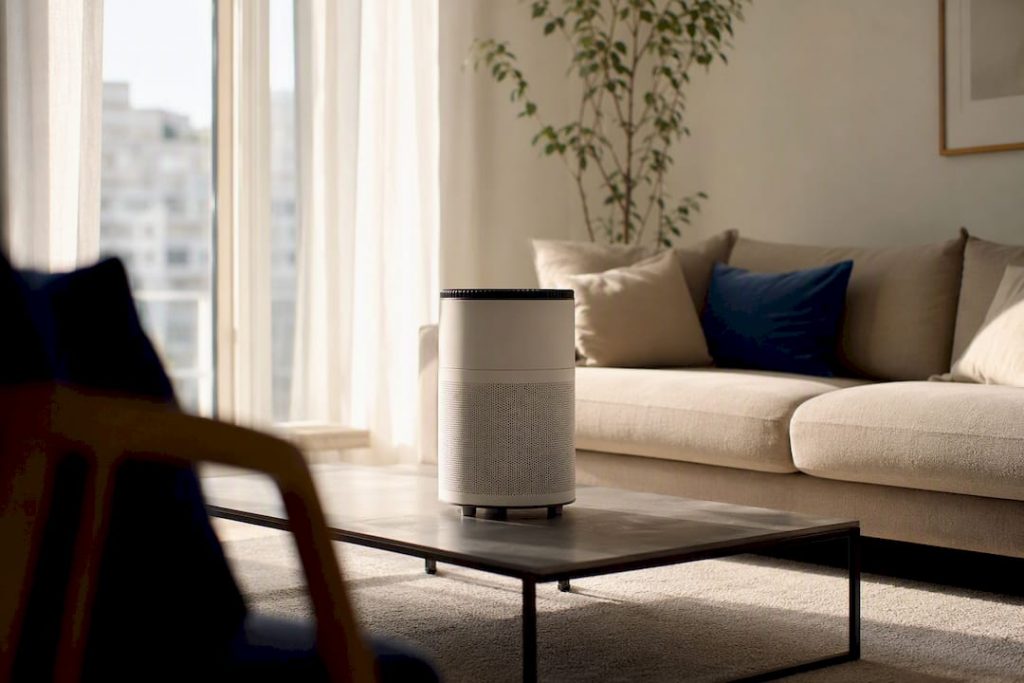
Place your air purifier unobstructed, in the room where you spend the most time. In a bedroom, that means 3 to 6 feet from the pillow, elevated on a stable surface rather than left on the floor. Everything else about placement follows from that one rule: the unit needs clear airflow on all sides and a direct path to the air you’re actually breathing.
A handful of non-negotiables make the difference between a purifier that works and one that’s just running for show.
- Clearance: at least 6 inches from walls and furniture, ideally 12 to 24 inches.
- Elevation: 2 to 5 feet off the ground when the room allows it.
- Avoid dead zones: corners, behind furniture, and next to open windows or vents all choke performance.
- Aim the exhaust: point cleaned air toward where you sit or sleep, not into a wall.
Sizing matters as much as position. A unit rated for a small bedroom will struggle in an open-plan living area no matter how well you’ve placed it, so check the room-size or CADR rating before you decide whether you need one unit or two.
Key Takeaways
Effective air purifier placement depends on clearance, elevation into the breathing zone, and positioning within 3 to 6 feet of where you sleep or spend the most time.
| Point | Details |
|---|---|
| Avoid walls and corners | Poor placement against a wall or in a corner can cut performance by up to 50%. |
| Elevate into the breathing zone | Aim for 2 to 5 feet off the floor to capture suspended PM2.5 and allergens more effectively. |
| Prioritise the bedroom | Place the unit a few feet from the pillow for the largest personal exposure reduction. |
| Match capacity to room size | Check CADR against square footage, and use two smaller units rather than one oversized unit in open-plan spaces. |
| Keep openings closed during normal use | Running near an open window or door forces the unit to process unfiltered outdoor air continuously. |
Table of Contents
- Why air purifier placement changes real-world performance
- Placement rules and a quick checklist you can apply today
- Room-by-room air purifier placement guide
- Common air purifier placement mistakes and how to fix them
- How room size and CADR shape your placement decisions
- Running and maintaining your purifier once it’s positioned
- How ClimatePro helps you get placement and sizing right
- Outlet access and cable management for a cleaner setup
- The placement rule most guides get half right
- Frequently asked questions
- Sources
Why air purifier placement changes real-world performance
Placement isn’t a minor tweak. Independent and consumer testing shows a portable unit pushed against a wall or wedged behind furniture can lose a large portion of its rated effectiveness compared with the same unit sitting in an open spot. That’s not a rounding error. It’s the difference between a purifier that meaningfully cuts indoor pollutants and one that’s mostly cleaning the air a few inches in front of its own casing.
The mechanics are straightforward. Every purifier pulls air in through an intake, strips out particles, and pushes clean air back out through an exhaust. Block either side and you choke the whole cycle. Fabric, timber, and plaster all restrict how much air the fan can actually draw through, so a unit boxed into a corner is working against itself before it’s cleaned a single particle.
Then there’s the breathing zone, the layer of air roughly 2 to 5 feet off the floor where you actually inhale. Fine particles like PM2.5 stay suspended in this zone for hours, while heavier dust and pollen settle faster toward the floor. A purifier sitting on carpet with a bottom intake is mostly processing settled dust, not the fine particulate that does the most respiratory damage. Elevating the unit into that breathing zone is what actually intercepts allergens before you inhale them, rather than after they’ve already settled.
- Poor placement can cut effective performance by up to half.
- The breathing zone (2–5 feet) is where particle capture matters most.
- Fine particles behave differently to heavier dust and hair, and placement needs to account for both.
This is why bedroom placement delivers the biggest personal payoff of any room in the house. You spend more consecutive hours in one fixed spot while sleeping than anywhere else, so getting the placement right there compounds every single night. A purifier doing its job in the lounge room while you sleep down the hall isn’t doing much for you at 2am.
Placement rules and a quick checklist you can apply today
Most placement mistakes come down to ignoring one of four basics: clearance, elevation, orientation, and proximity to openings. Get these right and you’ve solved most of what separates a purifier that performs from one that’s just decorative.
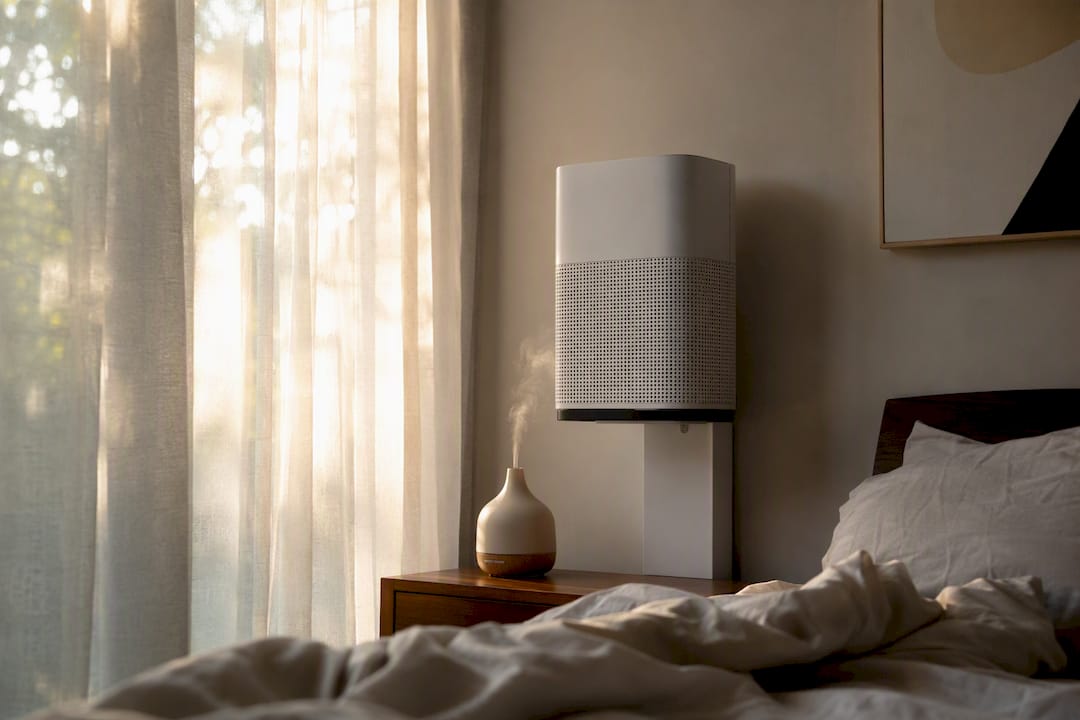
1. Give it clearance. Six inches is the bare minimum from any wall or piece of furniture, but 12 to 24 inches is the sweet spot. Cramped clearance restricts intake airflow and forces the fan motor to work harder for less output, which also shortens its working life.
2. Get it off the floor where you can. Aim for 24 to 36 inches of elevation, roughly waist to chest height for most adults. A stable nightstand, low dresser, or dedicated stand all work. Floor placement isn’t wrong, but it’s a compromise: it puts the unit below the breathing zone and closer to carpet fibres, pet hair, and settled dust that can clog the intake faster than expected.
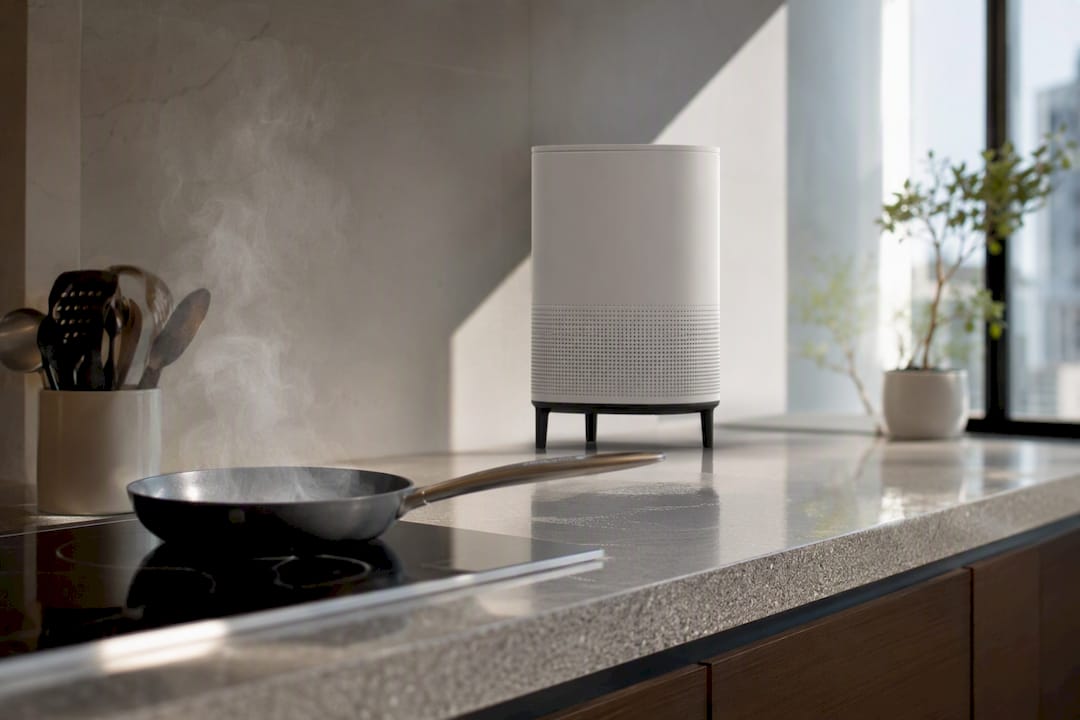
3. Orient intake and exhaust deliberately. If there’s an identifiable pollution source in the room (a cooktop, a litter tray, a pet bed), face the intake toward it so the unit intercepts contaminants before they spread across the room. Point the exhaust toward your seating or sleeping position, never straight into a wall where the cleaned air just bounces back into the intake.
4. Keep distance from HVAC vents. A purifier sitting directly under a supply vent gets its airflow disrupted by the constant draught, while one too close to a return vent ends up competing with the house’s own air handling system rather than complementing it.
5. Skip corners and alcoves entirely. Tight spaces create stagnant air pockets that starve the fan of fresh air to pull from, and the same applies to placing a unit behind a couch or bookshelf where airflow simply can’t reach it properly.
6. Leave windows and doors closed during normal running. Running a purifier next to an open window forces it to process a constant stream of unfiltered outdoor air, which undermines the whole point of running it indoors. The one exception is during a bushfire smoke event, when you might deliberately run a unit near a slightly open window as part of a broader ventilation strategy, but that’s a specific tactic, not everyday practice.
Pro Tip: If you’re not sure whether a spot is too enclosed, hold your hand about a foot from the intake grille. If you can’t feel a noticeable pull of air, the unit is starved for airflow and needs to move.
A quick checklist before you walk away from setup:
- Is there at least 6 inches of clearance on every side?
- Is the unit elevated, or at minimum on a hard floor rather than thick carpet?
- Does the exhaust point toward where you sit or sleep, not into a wall or corner?
- Is it at least a metre or so from any open window, door, or HVAC vent?
Room-by-room air purifier placement guide
General rules get you most of the way there, but every room has its own quirks. Here’s how the same principles apply once you get specific.
Bedroom placement
This is the highest-value placement in the house, and it’s worth getting exactly right. Position the unit a few feet from the pillow, on a nightstand, low dresser, or dedicated stand, so it sits closer to the breathing zone than floor placement allows. Direct the exhaust across the mattress rather than straight at your face; a constant stream of air on your face overnight is more likely to dry out your eyes and throat than help you sleep. If you’re running the unit specifically to manage allergies or a dust problem, close the bedroom door while it runs. A closed door lets the unit clean a smaller, contained volume of air far more thoroughly than it would if servicing the whole floor plan.
Living room placement
Living rooms tend to have a dominant seating zone and a secondary contamination source, whether that’s a front entry that tracks in dust, a pet bed, or a fireplace. Position the purifier between the two where possible, close enough to your usual seating that you get direct benefit, but angled to intercept the source. For open-plan living and dining spaces over roughly 400 square feet, one central unit rarely covers both zones adequately. Two smaller units placed in each occupant zone typically outperform a single larger one trying to cover the whole footprint from the middle.
Kitchen placement
Kitchens generate grease particles, smoke, and odours that clog filters far faster than typical household dust. Keep the unit a few feet from the cooktop, close enough to catch cooking particulate but not so close that grease-laden air coats the filter prematurely. Models with a washable prefilter are worth prioritising here, since the prefilter takes the brunt of grease and large particles before they reach the main HEPA filter.
Home office placement
Desk-height placement within about 4 feet of where you sit gives the most direct personal benefit during working hours. Angle the exhaust away from your monitor and keyboard; a constant airflow across electronics isn’t dangerous, but it does accumulate dust on screens and keys faster than you’d expect.
Nursery placement
Choose a low-noise model and position it at crib-rail height or just above, elevated and completely out of reach of small hands. Cord management is not optional in a nursery: run the cable behind furniture or through a cord cover, and never let it drape anywhere near the cot.
Open-plan and large spaces
The temptation in a big open-plan space is to put one purifier dead centre and assume it covers everything. It won’t. Coverage follows where people actually sit, cook, and sleep, not the geometric middle of the floor plan. Treat each occupant zone as its own placement decision, and you’ll get better real-world results than chasing one unit’s theoretical maximum range.
Common air purifier placement mistakes and how to fix them
Most underperforming purifiers aren’t faulty. They’re just poorly placed. Here are the four mistakes that show up most often, and the fix for each.
- Tucked behind furniture or wedged into a corner. This is the single most common error, and it’s the one behind that 40 to 50% performance loss testing has flagged repeatedly. Fix it by moving the unit to an open wall section or elevated surface with clearance on at least three sides.
- Sitting next to a permanently open window or door. This forces the unit to fight a constant inflow of unfiltered air. Close the opening during normal operation, and reserve near-window placement for deliberate smoke-event ventilation only.
- Bottom-intake unit sitting directly on thick carpet. Carpet fibres restrict airflow into a low intake and accelerate filter clogging. Elevate the unit onto a stand, or shift it to an adjacent hard-floor surface.
- One unit expected to cover multiple rooms or an oversized open area. A quick test: stand at the far edge of the space you’re expecting the purifier to clean, and see whether you can feel any airflow from the unit at all. If you can’t, that zone isn’t being served, and it’s time to size up or add a second unit.
How room size and CADR shape your placement decisions
CADR, or Clean Air Delivery Rate, measures how much filtered air a purifier pushes out per minute for a given particle type. It’s the number that tells you whether a unit is actually strong enough for the room you’re putting it in, and it directly affects where and how many units you need.
A small bedroom (roughly 120 to 150 square feet) usually only needs one appropriately rated unit, placed using the standard bedroom rules above. A medium living room (200 to 300 square feet) still works with one unit, provided it’s rated for that square footage and positioned in the primary seating zone rather than a corner. Once you’re past 400 square feet, especially in open-plan layouts, a single unit is fighting geometry as much as pollution.
- Match CADR to square footage before worrying about exact placement.
- In open-plan spaces, two smaller units in separate occupant zones outperform one large central unit because coverage tracks where people actually are, not the floor plan’s midpoint.
- A unit rated for double the room’s size still benefits from correct placement. Oversizing compensates for some placement compromise, but it doesn’t eliminate the airflow problems caused by corners or blocked clearance.
The rule of thumb worth remembering: sizing gets you enough clean air capacity, but placement decides whether that capacity actually reaches you. A high-CADR unit shoved into a corner still underperforms a modest unit placed well, which is exactly why choosing the right model for your room size needs to go hand in hand with a placement plan, not replace one.
Running and maintaining your purifier once it’s positioned
Good placement only pays off if the unit is actually running properly and the filter isn’t clogged. A handful of operational habits keep the placement gains you’ve just made.
- Run continuously on a moderate setting rather than switching it on and off; in bedrooms, start it 30 to 60 minutes before you go to sleep so the room’s already been through a few clean cycles by the time you’re in bed.
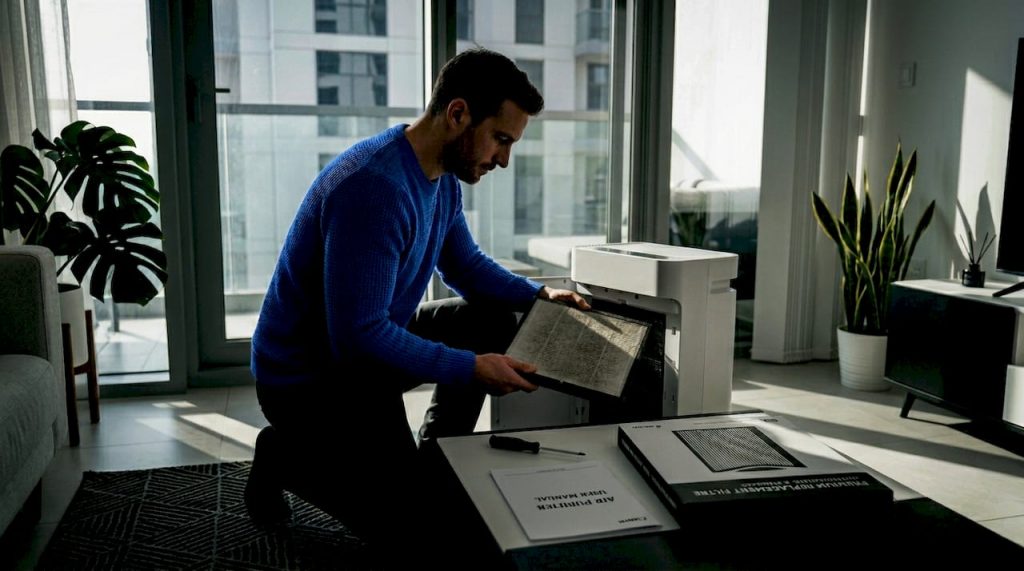
- Replace filters on the manufacturer’s schedule, and check that the protective film has been peeled off a brand-new filter. It’s a surprisingly common reason a “new” unit seems to underperform.
- In kitchens, inspect the prefilter for grease build-up more often than the standard schedule suggests. Grease clogs airflow faster than dust does.
- If the ideal spot is also the noisiest one for your sleep, choose a lower-noise model or shift the unit slightly further from the bed and let elevation compensate. Route the power cord along a wall or under furniture edges, never across a walking path.
- Close the door of the room you’re actively cleaning where practical. A smaller sealed volume means the unit reaches full clean-air turnover faster, and you can generally run a lower fan speed for the same result, which also saves on running costs and noise. For a broader look at balancing appliance run time against household energy use, this guide to energy efficiency in smart buildings is a useful companion read.
Pro Tip: If you’re torn between a slightly noisier spot that’s better positioned and a quieter spot that’s compromised, take the better position and run the unit one fan speed lower overnight. You’ll still get more benefit than a perfectly quiet unit stuck in a corner.
How ClimatePro helps you get placement and sizing right
Placement advice only goes so far when your room has an odd layout, a mix of tile and carpet, or more than one pollution source competing for the same unit. That’s where getting the sizing and filter choice right matters as much as the position itself.
- Climatepro provides sizing guidance matched to your actual room dimensions, not just generic square footage bands.
- Local delivery is available across Dubai, Abu Dhabi, Sharjah, Ajman, Ras Al Khaimah, Fujairah, and Umm Al Quwain, so replacement filters arrive before your current one is fully spent.
- Genuine replacement filters are stocked for the models Climatepro sells, which matters for maintaining the CADR performance you originally paid for.
- If you’re working with a tricky multi-room layout or an open-plan space that might need two units instead of one, Climatepro’s buying guidance and maintenance advice cover both the sizing and upkeep side of the decision.
Outlet access and cable management for a cleaner setup
The best placement spot on paper is useless if there’s no outlet within reach, and running an extension cord across a walkway creates a trip hazard that eventually gets the unit moved somewhere worse. Before you commit to a spot, check outlet position first, then apply the airflow rules within whatever radius that outlet allows.
If the ideal breathing-zone position is a metre or two from the nearest power point, a single well-rated extension cord is a reasonable compromise, provided it’s rated for the unit’s wattage and secured flat against a wall or skirting rather than left loose. In bedrooms and nurseries especially, route the cord behind furniture or through an adhesive cord clip rather than letting it trail across open floor. It’s a small detail, but it’s also the most common reason people end up shifting a purifier back to a “convenient” corner instead of the spot that actually works.
For nurseries and homes with young children or pets, keep any cord entirely out of reach: behind a dresser, along a wall skirting board, or through a cord cover designed for the purpose. A unit placed correctly for airflow but left with a dangling, chewable, or trip-prone cord isn’t a safe setup no matter how good the placement science behind it is.
The placement rule most guides get half right
Most advice on this topic treats placement as a single decision made once, at setup. That undersells it. The room-by-room evidence here points to something more useful: placement is really a set of small, room-specific trade-offs between airflow, proximity to the pollution source, and where you actually sit or sleep.
The conventional advice to “put it in the middle of the room” is the weakest part of most guides. Coverage should follow occupants, not floor geometry, which is exactly why two modest units in a large open-plan space consistently beat one large unit parked in the centre.
If you take one thing from this guide, prioritise the bedroom first. It’s the room where correct placement compounds every single night, and it’s the easiest room to get exactly right with a nightstand, six inches of clearance, and an exhaust that isn’t blowing straight into your face.
Frequently asked questions
Where should I place an air purifier in a bedroom?
Position it 3 to 6 feet from the pillow, elevated on a nightstand or dresser, with the exhaust directed across the mattress rather than at your face.
How much clearance does an air purifier need from walls?
A minimum of 6 inches, though 12 to 24 inches gives noticeably better airflow and performance.
Can I put an air purifier on the floor?
You can, but elevating it 2 to 5 feet off the ground puts it in the breathing zone and improves capture of fine particles compared with floor-level placement.
Should an air purifier be near a window?
No, not during normal operation. An open window or door forces the unit to process a constant stream of outdoor air, which reduces indoor cleaning efficiency.
Do I need more than one air purifier for an open-plan space?
Often yes. In spaces over roughly 400 square feet, two smaller units placed in separate occupant zones typically cover the room better than one large central unit.
Sources
- Air Purifier Placement Guide: Where to Put It for Maximum Effectiveness — Linea
- Where to Place an Air Purifier for Best Results — CleanAirCritic
- You’re probably using your air purifier wrong — WIRED
- This is the best place to put an air purifier, according to experts — Tom’s Guide