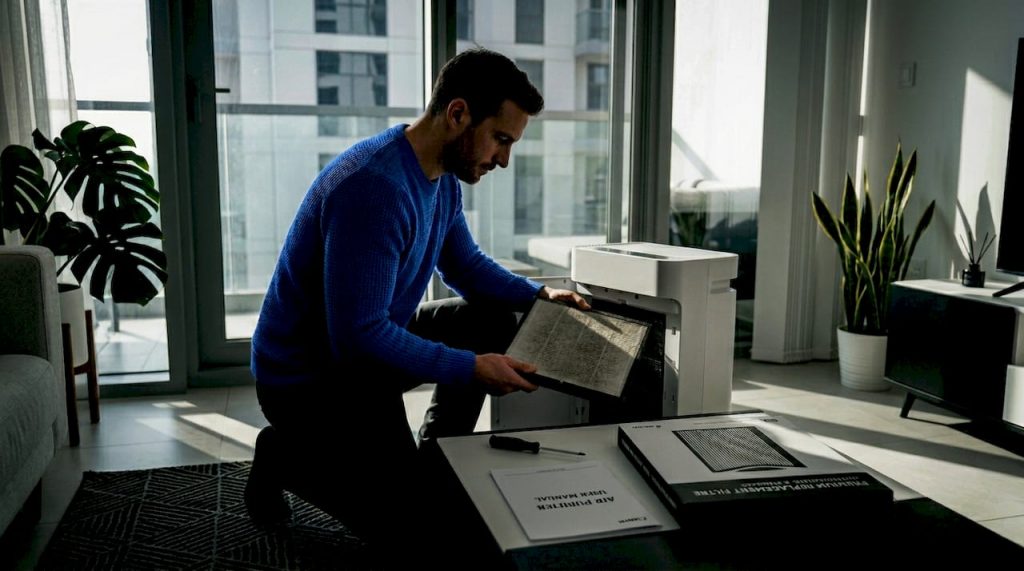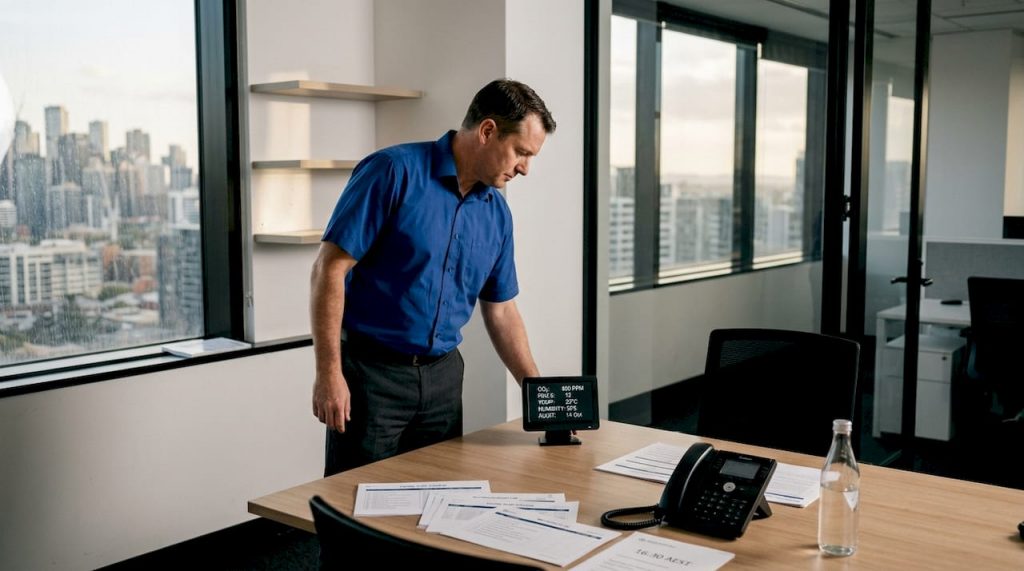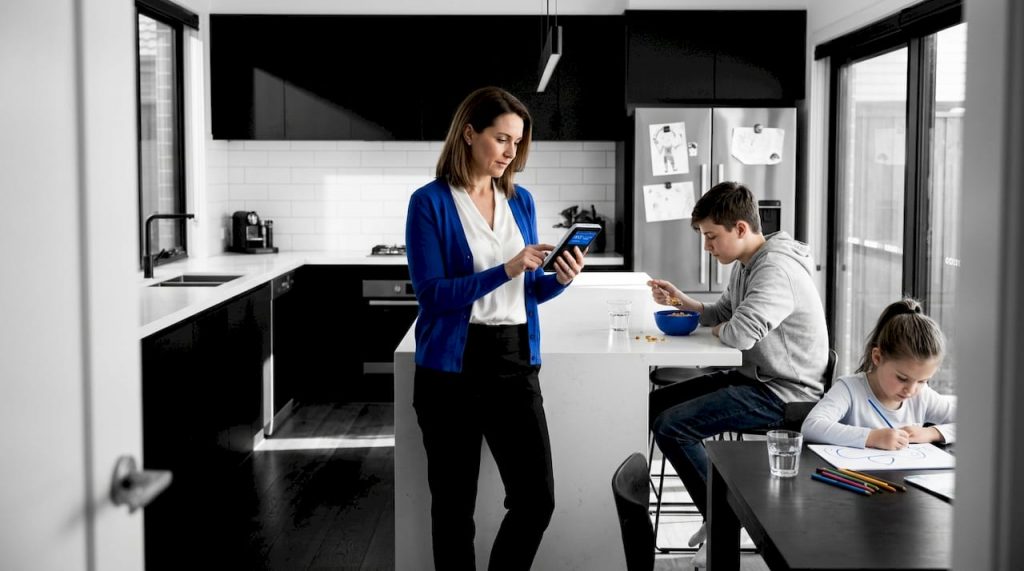
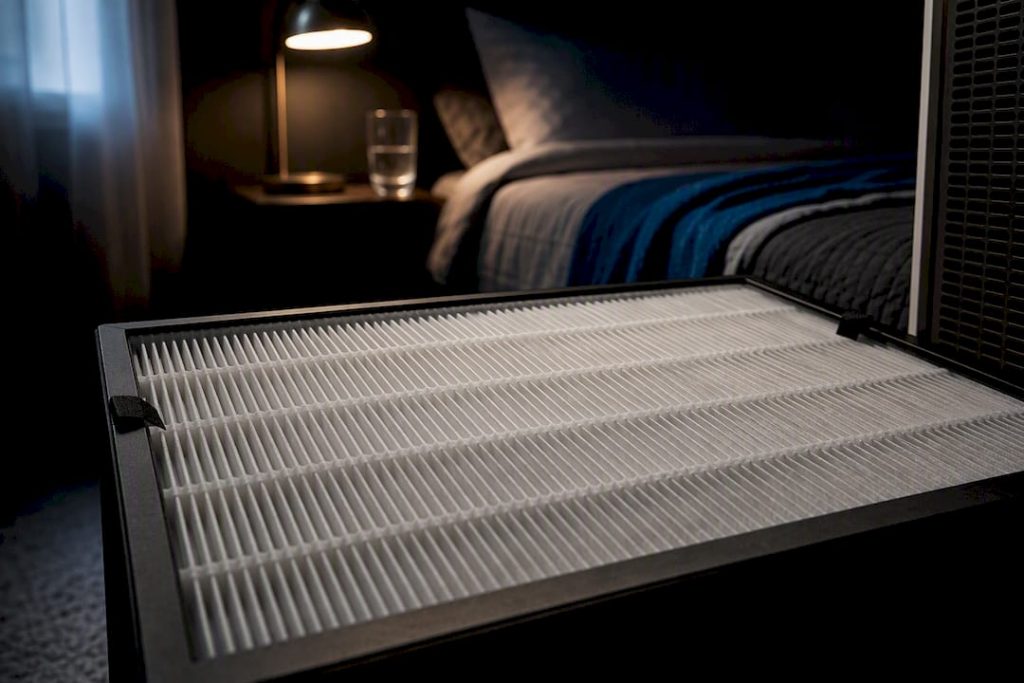
For occupied homes, clinics, nurseries and hotel rooms, the right choice is a mechanical True HEPA (H13) purifier with meaningful activated carbon, never a device that intentionally generates ozone or an ioniser you cannot switch off. This combination captures fine particles without adding a lung irritant to the air you’re trying to clean. Everything else, from sizing to filter replacement, follows from that one decision.
TL;DR:
- True HEPA (H13) filters are essential for effective air purification, capturing 99.97% of 0.3-micron particles through mechanical filtration without ozone byproducts.
- Match your purifier’s CADR to room size by applying the two-thirds rule, ensuring the device provides at least two-thirds of the room’s square footage in airflow for optimal performance.
- Avoid ozone-emitting features like ionizers and electrostatic precipitators; verify the purifier is CARB-listed or explicitly states low ozone emission levels.
- Replace HEPA filters every few months and carbon filters every 3 to 6 months, depending on usage, pollutant load, and visible filter condition.
- Prioritize correct sizing over bells and whistles; an oversized, quiet True HEPA unit outperforms an undersized, noisy one in air cleaning effectiveness.
Table of Contents
- What to check on the spec sheet before buying an air purifier
- Why is ozone in an air purifier a health risk?
- How do you size a purifier to a room using CADR?
- How often should you replace HEPA and carbon filters?
- How Climatepro helps you buy the right ozone-free purifier
- What actually matters when you choose a purifier
- Buy True HEPA air purifiers and filters in the UAE
- Sources
What to check on the spec sheet before buying an air purifier
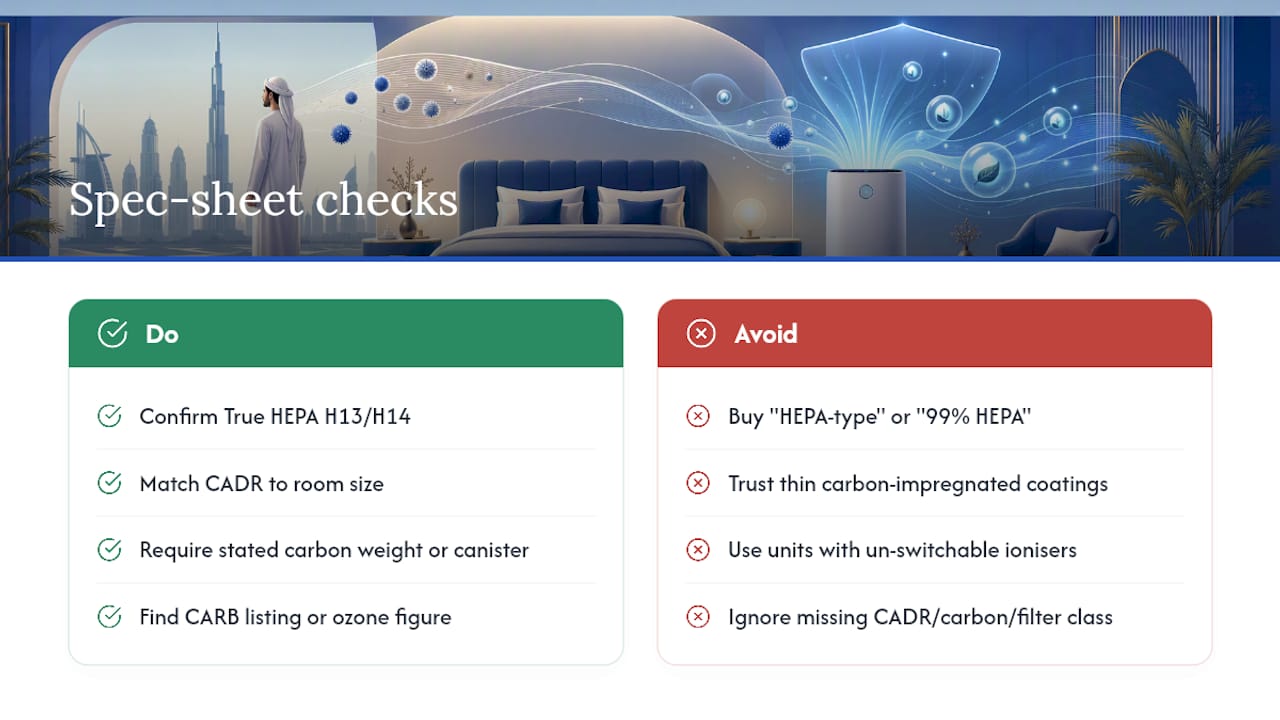
Ozone shows up in air purifier marketing in sneaky ways, so the spec sheet is where good buying decisions actually happen. Before comparing prices or brand names, run through what the unit is actually built to do.
True HEPA, not “HEPA-type.” Genuine True HEPA (H13) media is rated to capture at least 99.97% of particles at 0.3 microns, and it works through mechanical filtration alone, no ozone byproduct involved. “HEPA-type,” “HEPA-like” or “99% HEPA” are marketing terms with no lab standard behind them, and they routinely underperform the real thing.
CADR that matches your room. The Clean Air Delivery Rate tells you how much filtered air a unit actually pushes out per minute, and the EPA recommends matching CADR to room size rather than trusting box art or wattage claims. A purifier sized correctly for the room will always outperform an undersized unit running on its highest, noisiest setting.
Carbon mass, not a carbon coating. A thin carbon-impregnated mesh does very little against cooking odours, pet smells or VOCs. Look for a stated carbon weight or a dedicated carbon canister. Meaningful carbon mass, measured in grams rather than described as a “carbon layer,” is what actually pulls odour molecules out of circulation.
Ionisers, electrostatic precipitators and UV-C. These features are often bundled in as “bonus” technology, but ionisers and some electrostatic precipitators generate ozone as a byproduct, and low-dose UV-C rarely has enough contact time to disinfect moving air. If a unit has an ioniser toggle, check that it can be switched off permanently, or skip that model.
CARB listing or an explicit low-ozone statement. The California Air Resources Board maintains a list of certified air cleaning devices and separates mechanical filtration from ozone-emitting electronic types. A listing there, or a manufacturer’s explicit ozone emission figure, is one of the few objective checks a shopper can actually verify.
Pro Tip: If a spec sheet doesn’t mention carbon weight, filter class (H13/H14) or CADR numbers by pollutant, treat that silence as a red flag rather than an oversight.
Why is ozone in an air purifier a health risk?
Ozone is a lung irritant, not a cleaning agent, no matter how it’s marketed. Consumer Reports links ozone exposure to reduced lung function and worsened respiratory symptoms, and its buying guidance treats ozone generators as unsuitable for occupied spaces, full stop. Anyone with asthma, young children or elderly residents in the home faces the sharpest end of that risk.
The physics work against the marketing, too. The ozone concentrations low enough to be tolerated in a room are far too weak to meaningfully disinfect the air, and pushing concentrations higher to compensate risks exceeding safe exposure limits. There’s no useful middle ground.
Common claims worth treating with scepticism:
- “Ozone neutralises smoke and odours.” It masks some smells temporarily by reacting with them, but the byproducts of that reaction aren’t necessarily safer to breathe.
- “A small amount of ozone is harmless.” Sensitivity varies, and cumulative exposure in an occupied room adds up over hours, not seconds.
- “Ionisers are just a gentler version of the same technology.” Some ioniser designs produce measurable ozone even at low settings, which is why Consumer Reports specifically warns some electronic air cleaners can exceed safe ozone limits.
How do you size a purifier to a room using CADR?
Matching CADR to floor area is arithmetic, not guesswork, and it’s the single biggest factor in whether a purifier actually clears the air or just hums quietly in the corner.
- Measure the room in square metres or square feet, including ceiling height if it’s unusually tall.
- Apply the AHAM two thirds rule, which the EPA also endorses for matching a unit’s CADR to the space it will serve: the purifier’s smoke CADR should be at least two thirds of the room’s area in square feet. A 300 square foot bedroom needs a smoke CADR of roughly 200 or higher.
- Check the AHAM certification and 2/3 rule in more detail before buying if you’re sizing for an unusual layout, open-plan space, or a room with high ceilings.
- Set your target air changes per hour (ACH). Bedrooms and living areas do well at 2 to 3 ACH. Clinics, nurseries or smoky environments benefit from 4 to 6 ACH, which usually means sizing up a full tier rather than buying the “just enough” unit.
- Place the unit centrally, away from walls and furniture that block airflow, and avoid tucking it directly under a supply vent where conditioned air will short-circuit its intake.
Pro Tip: When a room sits between two CADR tiers, buy the larger unit and run it on a lower fan speed. It’ll be quieter and still outperform an undersized purifier working flat out.
Portable purifiers work alongside ventilation, not instead of it. Health Canada notes that source control and fresh-air exchange remain the primary tools for indoor air quality, with purifiers filling the gap those measures can’t close.
How often should you replace HEPA and carbon filters?
Filter life depends on usage hours, pollutant load and the specific model, but a few patterns hold across most True HEPA units.
- HEPA filters generally last several months in typical residential use, with shorter life in dusty, pet-heavy or smoke-exposed spaces.
- Carbon filters saturate faster than HEPA media, often needing replacement every 3 to 6 months if odour or VOC load is high.
- Visual and airflow checks matter more than the calendar: a greying filter, a musty smell on start-up, or a noticeable drop in airflow all signal it’s due early.
- Running cost scales with room size and filter class. Larger H13 filters and carbon canisters generally have higher upfront cost but may last longer than cheaper combo filters that require frequent replacement.
- To cut running costs without losing performance, pair the purifier with basic source control, closing doors during high-pollution periods and vacuuming regularly, so the filter isn’t doing all the work alone.
Sticking to a consistent maintenance routine protects both air quality and the unit’s CADR rating, which drops as filters clog regardless of how good the original spec was.
How Climatepro helps you buy the right ozone-free purifier
This store specialises in air purifiers, humidifiers, dehumidifiers and genuine replacement filters for homes, offices, clinics, nurseries and hotels. The range includes True HEPA models built to exactly the criteria covered above, including the Honeywell Air Touch P2, Air Touch P1 and Air Touch U1 for room and whole-space filtration, plus the Honeywell Move Pure 5 for vehicles.
Every listing states filter class and CADR so buyers can size correctly before checkout, and replacement filters remain available for reorder rather than leaving customers hunting for compatible parts months later. Delivery covers multiple locations across the UAE, which matters for clinics and hotels managing multiple units across a property.
What actually matters when you choose a purifier
Most buying guides spend too much time on secondary features, app connectivity, night-light modes, filter-change indicators, and not nearly enough on the two things that decide whether a purifier works: filter class and carbon mass. That’s backwards. A True HEPA unit with a proper carbon canister and no gimmicks will consistently outperform a feature-loaded model running on a thin carbon coating and an ioniser nobody thought to disable.
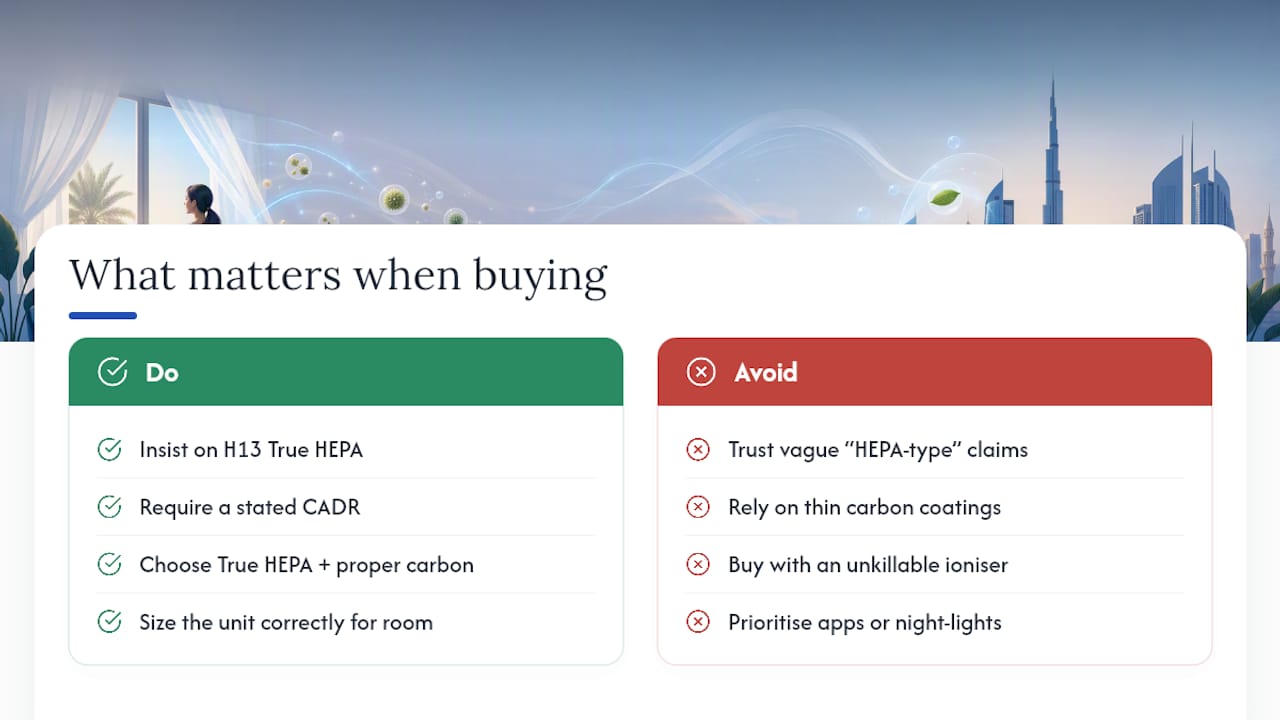
The conventional advice to “just check for HEPA” also falls short, because “HEPA-type” has quietly become a way to imply performance without the lab claim behind it. Insist on the H13 designation and a stated CADR, especially for clinics and nurseries where the air quality bar should be higher, not lower.
If there’s one place to focus energy as a buyer, it’s sizing. An oversized True HEPA unit run quietly beats an undersized one screaming on high, every time. Get that right first, then worry about noise levels and smart features.
— Nevel
Buy True HEPA air purifiers and filters in the UAE
This store stocks mechanical True HEPA purifiers with real carbon media, no ozone generators, no unremovable ionisers. If you’ve matched CADR to your room and settled on H13 filtration, the next step is straightforward.

For a mid-size bedroom or office, the Honeywell Air Touch P2 offers True HEPA filtration at a practical CADR for everyday rooms, while the Honeywell Air Touch U1 suits larger living areas or clinic waiting rooms needing higher air changes per hour. Browse the full air purifier catalogue to compare models by CADR and room size, and reorder genuine Blueair replacement filters when your current filter’s airflow starts to drop. Delivery runs across Dubai, Abu Dhabi, Sharjah, Ajman, Ras Al Khaimah, Fujairah and Umm Al Quwain, with filter reorders kept simple for clinics and hotels managing several units at once.
Sources
- Guide to air purifiers — UMass Environmental Health & Safety
- Air purifier buying guide — Consumer Reports
- List of CARB-certified air cleaning devices — California Air Resources Board